Republic Of Macedonia Carbonated Soft Drink Market
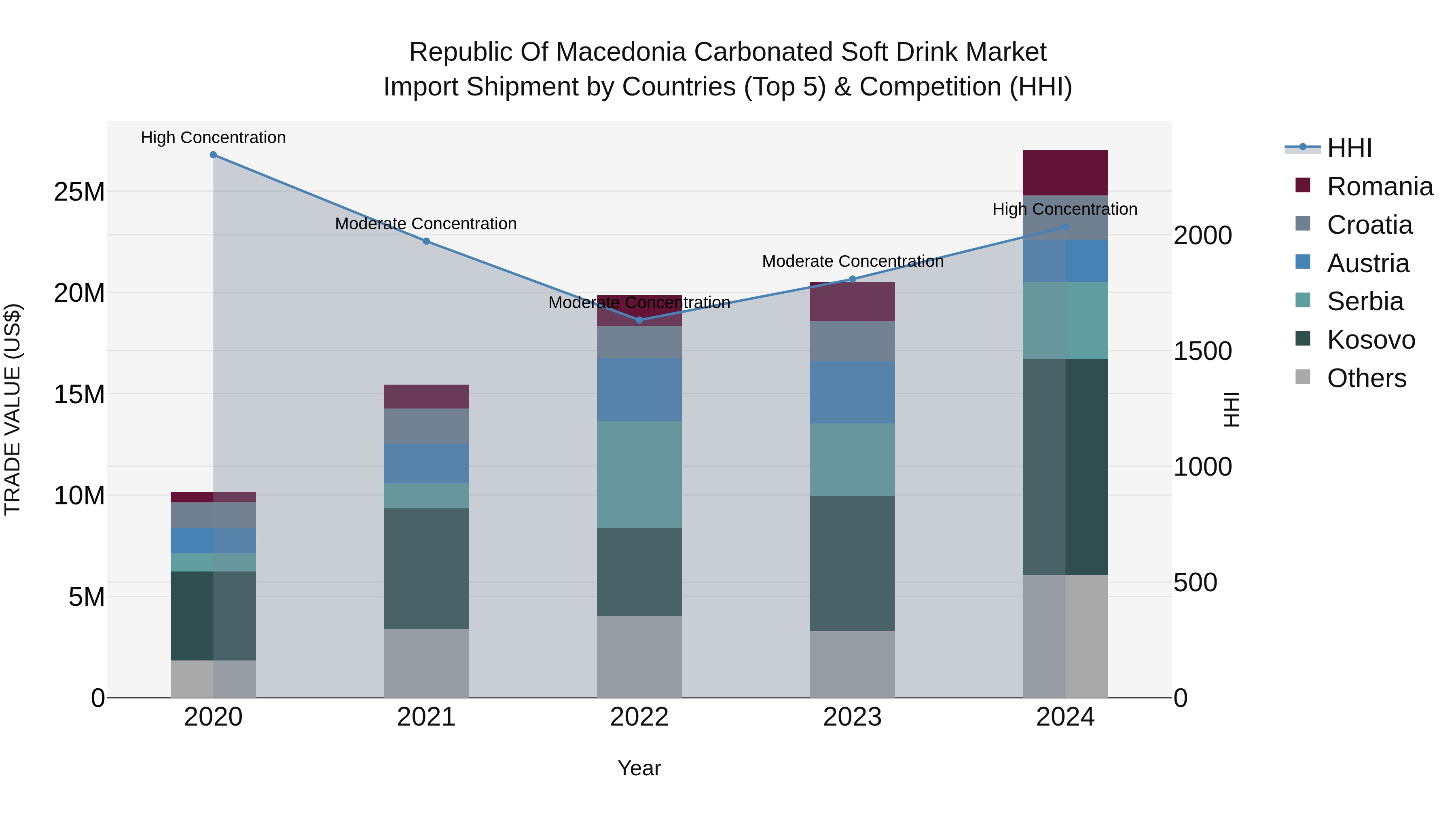
The Republic of North Macedonia`s carbonated soft drink import market saw significant growth in 2024, with Kosovo, Serbia, Romania, Croatia, and Austria emerging as the top exporting countries. The market concentration, as measured by the HHI index, shifted from moderate to high levels in just a year, indicating increased dominance by key players. The impressive compound annual growth rate (CAGR) of 27.69% from 2020 to 2024, coupled with a remarkable growth rate of 31.84% in 2023-24, underscores the rising demand for carbonated soft drinks in North Macedonia.
Key Highlights of the Report:
- Republic of Macedonia Carbonated Soft Drink Market Outlook
- Market Size of Republic of Macedonia Carbonated Soft Drink Market, 2024
- Forecast of Republic of Macedonia Carbonated Soft Drink Market, 2031
- Historical Data and Forecast of Republic of Macedonia Carbonated Soft Drink Revenues & Volume for the Period 2021- 2031
- Republic of Macedonia Carbonated Soft Drink Market Trend Evolution
- Republic of Macedonia Carbonated Soft Drink Market Drivers and Challenges
- Republic of Macedonia Carbonated Soft Drink Price Trends
- Republic of Macedonia Carbonated Soft Drink Porter's Five Forces
- Republic of Macedonia Carbonated Soft Drink Industry Life Cycle
- Historical Data and Forecast of Republic of Macedonia Carbonated Soft Drink Market Revenues & Volume By Flavor for the Period 2021- 2031
- Historical Data and Forecast of Republic of Macedonia Carbonated Soft Drink Market Revenues & Volume By Cola for the Period 2021- 2031
- Historical Data and Forecast of Republic of Macedonia Carbonated Soft Drink Market Revenues & Volume By Citrus for the Period 2021- 2031
- Historical Data and Forecast of Republic of Macedonia Carbonated Soft Drink Market Revenues & Volume By Others for the Period 2021- 2031
- Historical Data and Forecast of Republic of Macedonia Carbonated Soft Drink Market Revenues & Volume By Distribution Channel for the Period 2021- 2031
- Historical Data and Forecast of Republic of Macedonia Carbonated Soft Drink Market Revenues & Volume By Hypermarkets, Supermarkets & Mass Merchandisers for the Period 2021- 2031
- Historical Data and Forecast of Republic of Macedonia Carbonated Soft Drink Market Revenues & Volume By Convenience Stores & Gas Stations for the Period 2021- 2031
- Historical Data and Forecast of Republic of Macedonia Carbonated Soft Drink Market Revenues & Volume By Food Service Outlets for the Period 2021- 2031
- Historical Data and Forecast of Republic of Macedonia Carbonated Soft Drink Market Revenues & Volume By Online Stores & D2C for the Period 2021- 2031
- Historical Data and Forecast of Republic of Macedonia Carbonated Soft Drink Market Revenues & Volume By Others for the Period 2021- 2031
- Republic of Macedonia Carbonated Soft Drink Import Export Trade Statistics
- Market Opportunity Assessment By Flavor
- Market Opportunity Assessment By Distribution Channel
- Republic of Macedonia Carbonated Soft Drink Top Companies Market Share
- Republic of Macedonia Carbonated Soft Drink Competitive Benchmarking By Technical and Operational Parameters
- Republic of Macedonia Carbonated Soft Drink Company Profiles
- Republic of Macedonia Carbonated Soft Drink Key Strategic Recommendations






































