Republic Of Macedonia Cooking Oil Market
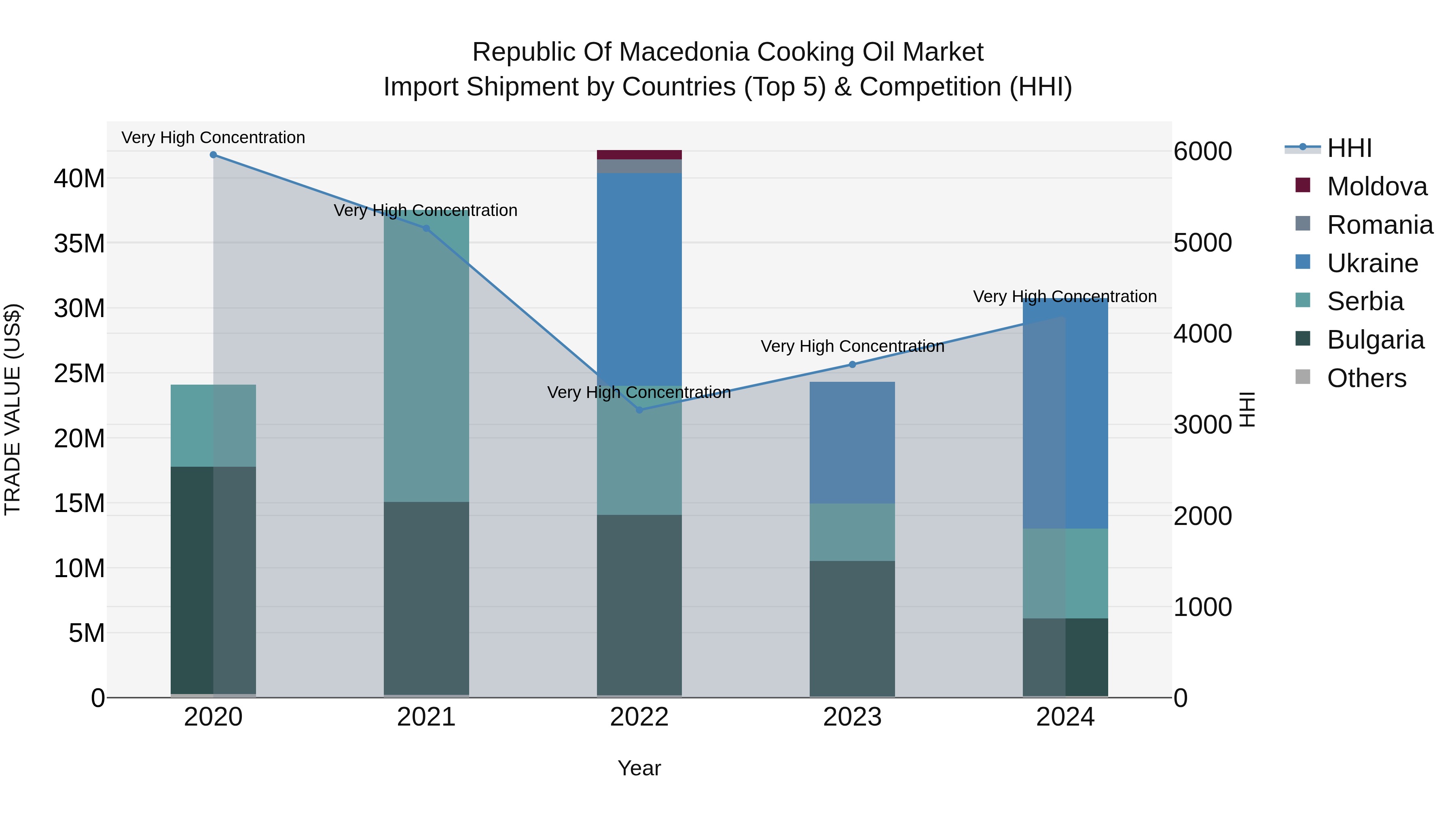
The Republic of Macedonia`s cooking oil import market continued to show strong growth in 2024, with top exporters including Ukraine, Serbia, Bulgaria, Albania, and Finland. The high Herfindahl-Hirschman Index (HHI) indicates a concentrated market, while the impressive Compound Annual Growth Rate (CAGR) of 6.27% from 2020-2024 demonstrates sustained expansion. Notably, the growth rate spiked to 26.54% from 2023-2024, signaling increasing demand and opportunities for market players. The competitive landscape and rising demand in North Macedonia make the cooking oil import sector an area to watch for further developments and investment.
Key Highlights of the Report:
- Republic of Macedonia Cooking Oil Market Outlook
- Market Size of Republic of Macedonia Cooking Oil Market, 2024
- Forecast of Republic of Macedonia Cooking Oil Market, 2031
- Historical Data and Forecast of Republic of Macedonia Cooking Oil Revenues & Volume for the Period 2021- 2031
- Republic of Macedonia Cooking Oil Market Trend Evolution
- Republic of Macedonia Cooking Oil Market Drivers and Challenges
- Republic of Macedonia Cooking Oil Price Trends
- Republic of Macedonia Cooking Oil Porter's Five Forces
- Republic of Macedonia Cooking Oil Industry Life Cycle
- Historical Data and Forecast of Republic of Macedonia Cooking Oil Market Revenues & Volume By Product Type for the Period 2021- 2031
- Historical Data and Forecast of Republic of Macedonia Cooking Oil Market Revenues & Volume By Sunflower Oil for the Period 2021- 2031
- Historical Data and Forecast of Republic of Macedonia Cooking Oil Market Revenues & Volume By Corn Oil for the Period 2021- 2031
- Historical Data and Forecast of Republic of Macedonia Cooking Oil Market Revenues & Volume By Palm Oil for the Period 2021- 2031
- Historical Data and Forecast of Republic of Macedonia Cooking Oil Market Revenues & Volume By Others for the Period 2021- 2031
- Historical Data and Forecast of Republic of Macedonia Cooking Oil Market Revenues & Volume By Package Type for the Period 2021- 2031
- Historical Data and Forecast of Republic of Macedonia Cooking Oil Market Revenues & Volume By Retail for the Period 2021- 2031
- Historical Data and Forecast of Republic of Macedonia Cooking Oil Market Revenues & Volume By Bulk for the Period 2021- 2031
- Republic of Macedonia Cooking Oil Import Export Trade Statistics
- Market Opportunity Assessment By Product Type
- Market Opportunity Assessment By Package Type
- Republic of Macedonia Cooking Oil Top Companies Market Share
- Republic of Macedonia Cooking Oil Competitive Benchmarking By Technical and Operational Parameters
- Republic of Macedonia Cooking Oil Company Profiles
- Republic of Macedonia Cooking Oil Key Strategic Recommendations






































