Republic Of Macedonia Footwear Market
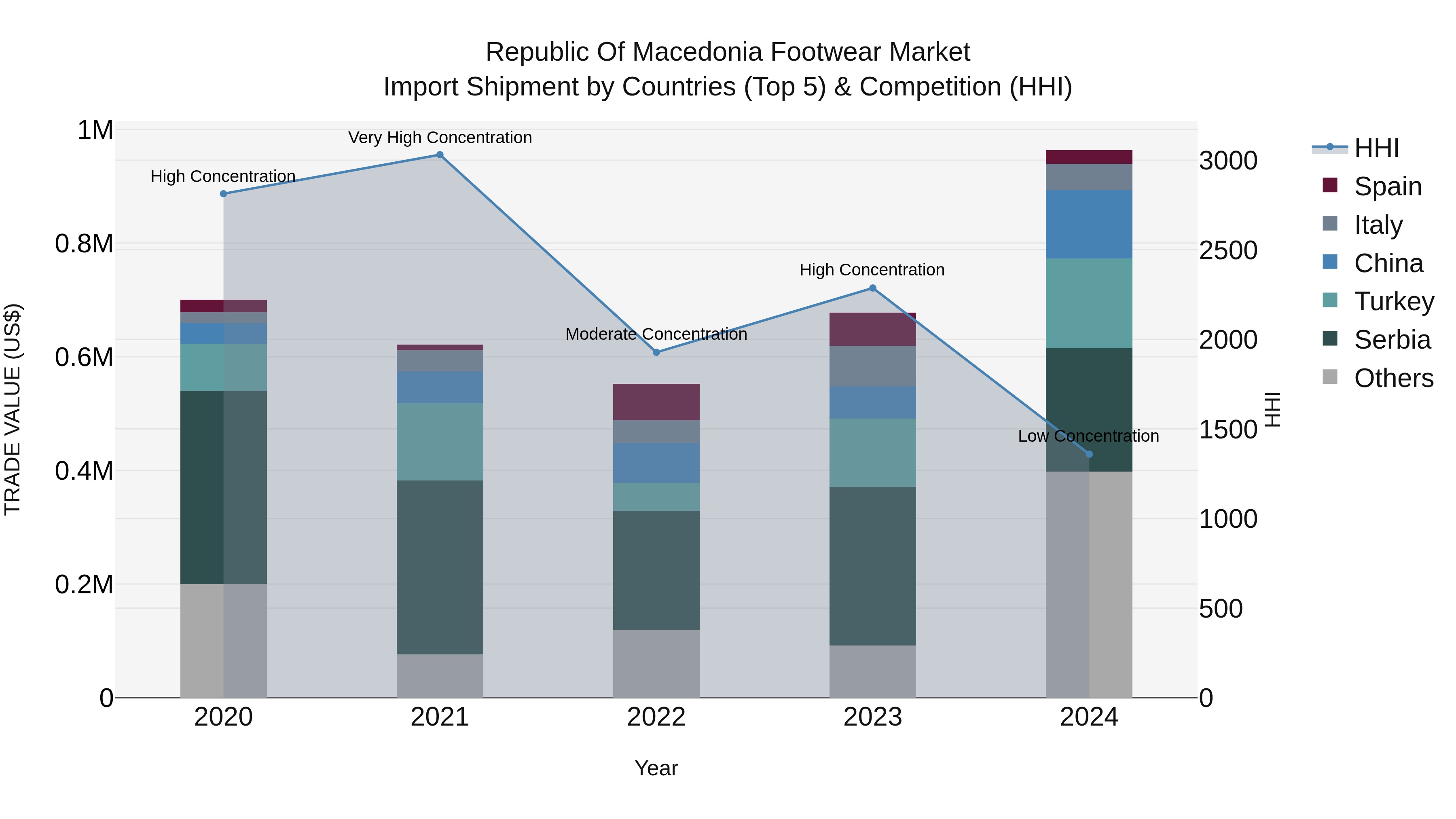
The Republic of Macedonia`s footwear import market experienced a notable shift in 2024, with a decrease in market concentration compared to the previous year. The top exporting countries to North Macedonia, including Serbia, Turkey, Belgium, China, and Bosnia Herzegovina, indicate a diverse range of sources for footwear imports. The impressive Compound Annual Growth Rate (CAGR) of 8.3% from 2020 to 2024 reflects a steady expansion in the market. Furthermore, the substantial growth rate of 42.14% from 2023 to 2024 suggests a rapid acceleration in footwear import shipments, potentially driven by changing consumer preferences or market dynamics.
Footwear Market: North Macedonia vs Top 5 Major Economies in 2027 (Europe)
By 2027, North Macedonia's Footwear market is forecasted to achieve a growing growth rate of 8.24%, with Germany leading the Europe region, followed by United Kingdom, France, Italy and Russia.

Key Highlights of the Report:
- Republic of Macedonia Footwear Market Outlook
- Market Size of Republic of Macedonia Footwear Market, 2024
- Forecast of Republic of Macedonia Footwear Market, 2031
- Historical Data and Forecast of Republic of Macedonia Footwear Revenues & Volume for the Period 2021-2031
- Republic of Macedonia Footwear Market Trend Evolution
- Republic of Macedonia Footwear Market Drivers and Challenges
- Republic of Macedonia Footwear Price Trends
- Republic of Macedonia Footwear Porter`s Five Forces
- Republic of Macedonia Footwear Industry Life Cycle
- Historical Data and Forecast of Republic of Macedonia Footwear Market Revenues & Volume By Type for the Period 2021-2031
- Historical Data and Forecast of Republic of Macedonia Footwear Market Revenues & Volume By Athletic for the Period 2021-2031
- Historical Data and Forecast of Republic of Macedonia Footwear Market Revenues & Volume By Non-Athletic for the Period 2021-2031
- Historical Data and Forecast of Republic of Macedonia Footwear Market Revenues & Volume By Material for the Period 2021-2031
- Historical Data and Forecast of Republic of Macedonia Footwear Market Revenues & Volume By Lather for the Period 2021-2031
- Historical Data and Forecast of Republic of Macedonia Footwear Market Revenues & Volume By Rubber for the Period 2021-2031
- Historical Data and Forecast of Republic of Macedonia Footwear Market Revenues & Volume By Plastic for the Period 2021-2031
- Historical Data and Forecast of Republic of Macedonia Footwear Market Revenues & Volume By End-users for the Period 2021-2031
- Historical Data and Forecast of Republic of Macedonia Footwear Market Revenues & Volume By Male for the Period 2021-2031
- Historical Data and Forecast of Republic of Macedonia Footwear Market Revenues & Volume By Female for the Period 2021-2031
- Historical Data and Forecast of Republic of Macedonia Footwear Market Revenues & Volume By Kids for the Period 2021-2031
- Historical Data and Forecast of Republic of Macedonia Footwear Market Revenues & Volume By Distribution Channel for the Period 2021-2031
- Historical Data and Forecast of Republic of Macedonia Footwear Market Revenues & Volume By Online Stores for the Period 2021-2031
- Historical Data and Forecast of Republic of Macedonia Footwear Market Revenues & Volume By Supermarkets and Hypermarkets for the Period 2021-2031
- Historical Data and Forecast of Republic of Macedonia Footwear Market Revenues & Volume By Independent Retail Stores for the Period 2021-2031
- Historical Data and Forecast of Republic of Macedonia Footwear Market Revenues & Volume By Others for the Period 2021-2031
- Republic of Macedonia Footwear Import Export Trade Statistics
- Market Opportunity Assessment By Type
- Market Opportunity Assessment By Material
- Market Opportunity Assessment By End-users
- Market Opportunity Assessment By Distribution Channel
- Republic of Macedonia Footwear Top Companies Market Share
- Republic of Macedonia Footwear Competitive Benchmarking By Technical and Operational Parameters
- Republic of Macedonia Footwear Company Profiles
- Republic of Macedonia Footwear Key Strategic Recommendations






































