Republic Of Macedonia Household Furniture Market
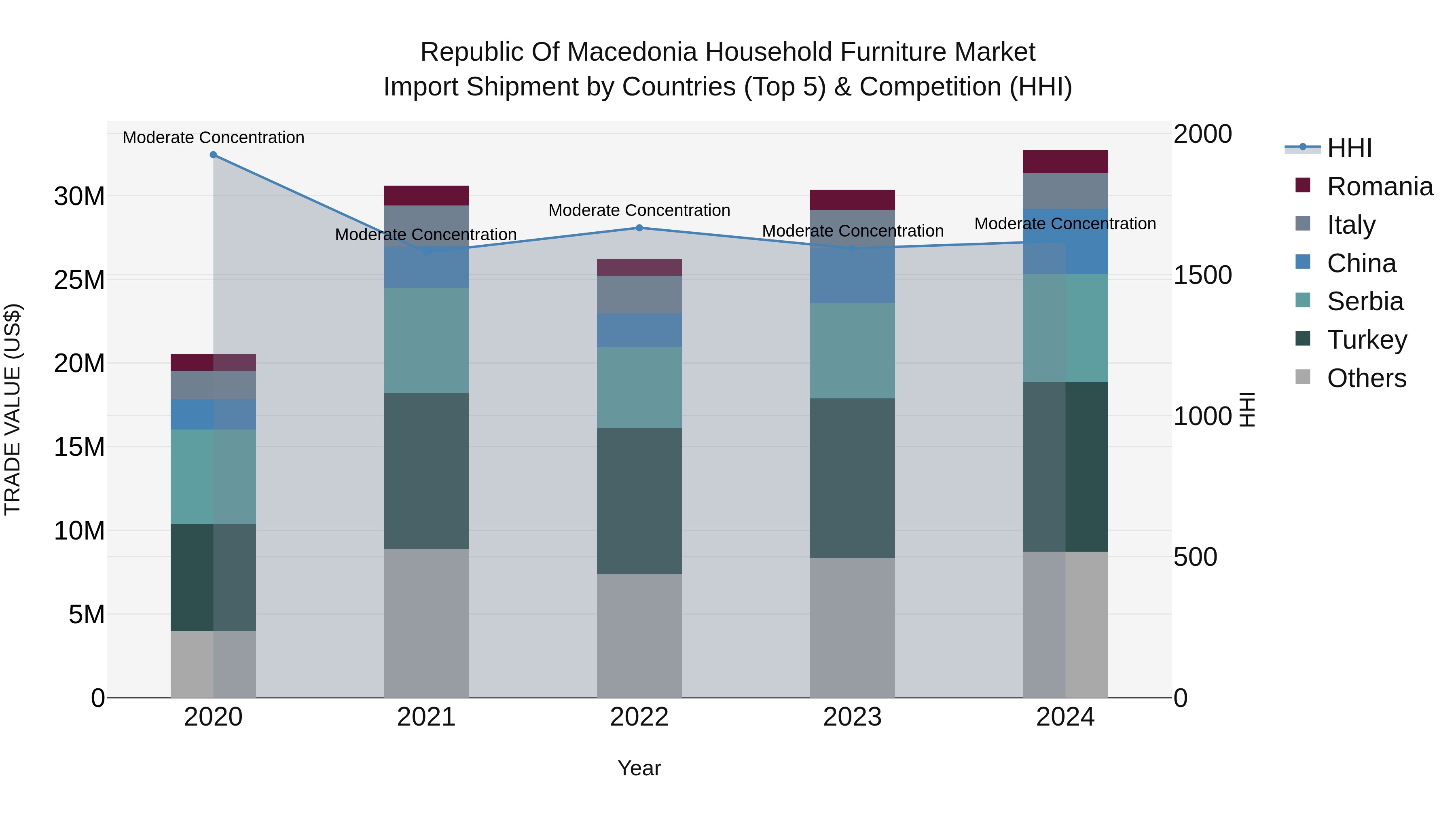
In 2024, North Macedonia continued to see a steady increase in household furniture imports, with top suppliers being Turkey, Serbia, China, Italy, and Bulgaria. The market remained moderately concentrated with a CAGR of 12.33% from 2020 to 2024, indicating sustained growth. The growth rate in 2024 was 7.76%, showing continued momentum in the sector. North Macedonia`s reliance on these key exporting countries highlights the importance of international trade partnerships in meeting the demand for household furniture in the region.
Key Highlights of the Report:
- Republic of Macedonia Household furniture Market Outlook
- Market Size of Republic of Macedonia Household furniture Market, 2024
- Forecast of Republic of Macedonia Household furniture Market, 2031
- Historical Data and Forecast of Republic of Macedonia Household furniture Revenues & Volume for the Period 2021-2031
- Republic of Macedonia Household furniture Market Trend Evolution
- Republic of Macedonia Household furniture Market Drivers and Challenges
- Republic of Macedonia Household furniture Price Trends
- Republic of Macedonia Household furniture Porter`s Five Forces
- Republic of Macedonia Household furniture Industry Life Cycle
- Historical Data and Forecast of Republic of Macedonia Household furniture Market Revenues & Volume By Types for the Period 2021-2031
- Historical Data and Forecast of Republic of Macedonia Household furniture Market Revenues & Volume By Wood Furniture for the Period 2021-2031
- Historical Data and Forecast of Republic of Macedonia Household furniture Market Revenues & Volume By Metal Furniture for the Period 2021-2031
- Historical Data and Forecast of Republic of Macedonia Household furniture Market Revenues & Volume By Plastic Furniture for the Period 2021-2031
- Historical Data and Forecast of Republic of Macedonia Household furniture Market Revenues & Volume By Others for the Period 2021-2031
- Historical Data and Forecast of Republic of Macedonia Household furniture Market Revenues & Volume By Area of Use for the Period 2021-2031
- Historical Data and Forecast of Republic of Macedonia Household furniture Market Revenues & Volume By Bedroom Furniture for the Period 2021-2031
- Historical Data and Forecast of Republic of Macedonia Household furniture Market Revenues & Volume By Living Room Furniture for the Period 2021-2031
- Historical Data and Forecast of Republic of Macedonia Household furniture Market Revenues & Volume By Dining Room Furniture for the Period 2021-2031
- Historical Data and Forecast of Republic of Macedonia Household furniture Market Revenues & Volume By Household Furniture for the Period 2021-2031
- Historical Data and Forecast of Republic of Macedonia Household furniture Market Revenues & Volume By Others for the Period 2021-2031
- Republic of Macedonia Household furniture Import Export Trade Statistics
- Market Opportunity Assessment By Types
- Market Opportunity Assessment By Area of Use
- Republic of Macedonia Household furniture Top Companies Market Share
- Republic of Macedonia Household furniture Competitive Benchmarking By Technical and Operational Parameters
- Republic of Macedonia Household furniture Company Profiles
- Republic of Macedonia Household furniture Key Strategic Recommendations






































