Republic Of Macedonia Mango Market
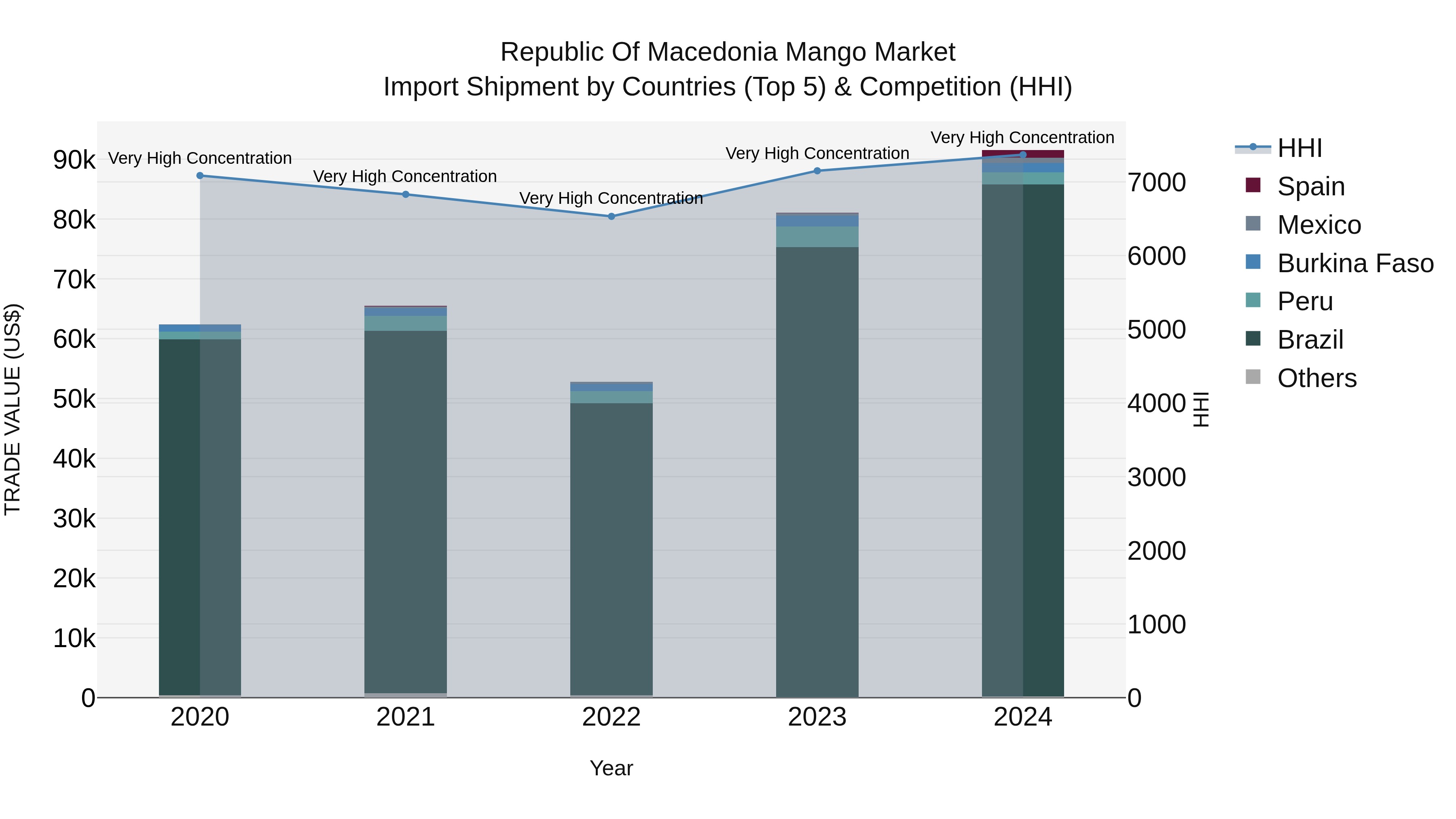
The Republic of Macedonia continues to see strong growth in mango import shipments, with top exporters including Brazil, Peru, Burkina Faso, Spain, and Mexico. The high Herfindahl-Hirschman Index (HHI) indicates a concentrated market, while the impressive Compound Annual Growth Rate (CAGR) of 10.04% from 2020 to 2024 and a growth rate of 12.93% in 2024 highlight the increasing demand for mangoes in North Macedonia. These trends suggest a promising outlook for the mango import market in the country.
Key Highlights of the Report:
- Republic of Macedonia Mango Market Outlook
- Market Size of Republic of Macedonia Mango Market, 2024
- Forecast of Republic of Macedonia Mango Market, 2031
- Historical Data and Forecast of Republic of Macedonia Mango Revenues & Volume for the Period 2021- 2031
- Republic of Macedonia Mango Market Trend Evolution
- Republic of Macedonia Mango Market Drivers and Challenges
- Republic of Macedonia Mango Price Trends
- Republic of Macedonia Mango Porter's Five Forces
- Republic of Macedonia Mango Industry Life Cycle
- Historical Data and Forecast of Republic of Macedonia Mango Market Revenues & Volume By Variety for the Period 2021- 2031
- Historical Data and Forecast of Republic of Macedonia Mango Market Revenues & Volume By Alphonso for the Period 2021- 2031
- Historical Data and Forecast of Republic of Macedonia Mango Market Revenues & Volume By Kesar for the Period 2021- 2031
- Historical Data and Forecast of Republic of Macedonia Mango Market Revenues & Volume By Dashehari for the Period 2021- 2031
- Historical Data and Forecast of Republic of Macedonia Mango Market Revenues & Volume By Chausa for the Period 2021- 2031
- Historical Data and Forecast of Republic of Macedonia Mango Market Revenues & Volume By Langra for the Period 2021- 2031
- Historical Data and Forecast of Republic of Macedonia Mango Market Revenues & Volume By Banganapali (badami) for the Period 2021- 2031
- Historical Data and Forecast of Republic of Macedonia Mango Market Revenues & Volume By Neelum for the Period 2021- 2031
- Historical Data and Forecast of Republic of Macedonia Mango Market Revenues & Volume By Packaging Size for the Period 2021- 2031
- Historical Data and Forecast of Republic of Macedonia Mango Market Revenues & Volume By Less than 4 kg for the Period 2021- 2031
- Historical Data and Forecast of Republic of Macedonia Mango Market Revenues & Volume By 4kg to 8 kg for the Period 2021- 2031
- Historical Data and Forecast of Republic of Macedonia Mango Market Revenues & Volume By More than 8kg for the Period 2021- 2031
- Historical Data and Forecast of Republic of Macedonia Mango Market Revenues & Volume By Application for the Period 2021- 2031
- Historical Data and Forecast of Republic of Macedonia Mango Market Revenues & Volume By B2B for the Period 2021- 2031
- Historical Data and Forecast of Republic of Macedonia Mango Market Revenues & Volume By B2C for the Period 2021- 2031
- Historical Data and Forecast of Republic of Macedonia Mango Market Revenues & Volume By Distribution Channel for the Period 2021- 2031
- Historical Data and Forecast of Republic of Macedonia Mango Market Revenues & Volume By Online for the Period 2021- 2031
- Historical Data and Forecast of Republic of Macedonia Mango Market Revenues & Volume By Offline for the Period 2021- 2031
- Republic of Macedonia Mango Import Export Trade Statistics
- Market Opportunity Assessment By Variety
- Market Opportunity Assessment By Packaging Size
- Market Opportunity Assessment By Application
- Market Opportunity Assessment By Distribution Channel
- Republic of Macedonia Mango Top Companies Market Share
- Republic of Macedonia Mango Competitive Benchmarking By Technical and Operational Parameters
- Republic of Macedonia Mango Company Profiles
- Republic of Macedonia Mango Key Strategic Recommendations






































