Republic Of Macedonia Massage Equipment Market
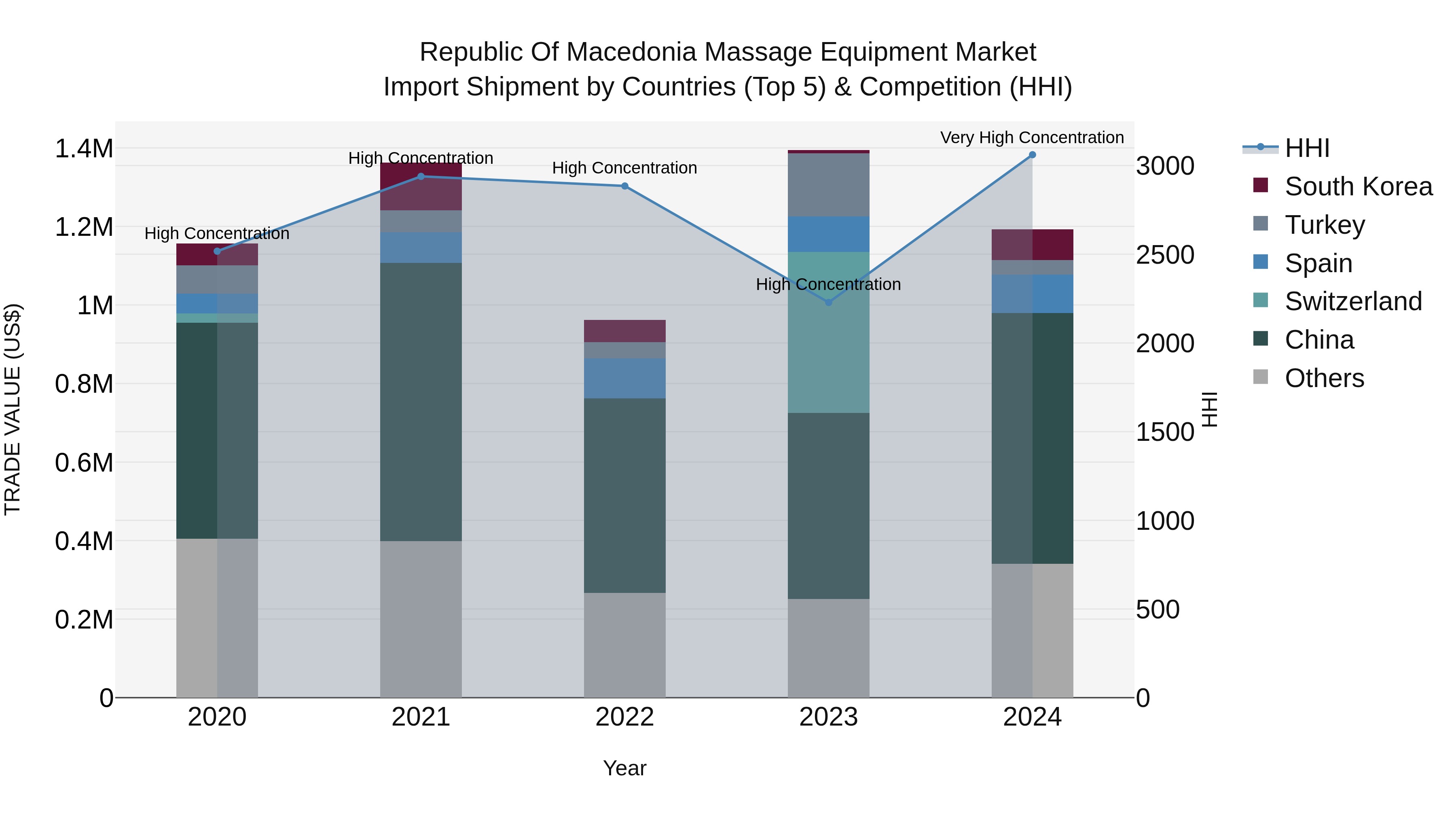
The massage equipment import market in North Macedonia experienced a significant increase in concentration levels in 2024, with top exporting countries being China, Spain, South Korea, Slovenia, and Poland. Despite a slight growth in the CAGR from 2020 to 2024, the market saw a decline in growth rate from 2023 to 2024. This indicates a challenging year for the industry, possibly impacted by various factors such as economic conditions or changing consumer preferences. Monitoring market trends and adapting strategies may be crucial for businesses in this sector to navigate future challenges successfully.
Massage Equipment Market: North Macedonia vs Top 5 Major Economies in 2027 (Europe)
By 2027, North Macedonia's Massage Equipment market is forecasted to achieve a stable growth rate of 3.60%, with Germany leading the Europe region, followed by United Kingdom, France, Italy and Russia.

Key Highlights of the Report:
- Republic of Macedonia Massage Equipment Market Outlook
- Market Size of Republic of Macedonia Massage Equipment Market, 2024
- Forecast of Republic of Macedonia Massage Equipment Market, 2031
- Historical Data and Forecast of Republic of Macedonia Massage Equipment Revenues & Volume for the Period 2021-2031
- Republic of Macedonia Massage Equipment Market Trend Evolution
- Republic of Macedonia Massage Equipment Market Drivers and Challenges
- Republic of Macedonia Massage Equipment Price Trends
- Republic of Macedonia Massage Equipment Porter`s Five Forces
- Republic of Macedonia Massage Equipment Industry Life Cycle
- Historical Data and Forecast of Republic of Macedonia Massage Equipment Market Revenues & Volume By Product for the Period 2021-2031
- Historical Data and Forecast of Republic of Macedonia Massage Equipment Market Revenues & Volume By Chairs & Sofas for the Period 2021-2031
- Historical Data and Forecast of Republic of Macedonia Massage Equipment Market Revenues & Volume By Back Massagers for the Period 2021-2031
- Historical Data and Forecast of Republic of Macedonia Massage Equipment Market Revenues & Volume By Handheld for the Period 2021-2031
- Historical Data and Forecast of Republic of Macedonia Massage Equipment Market Revenues & Volume By Neck & Shoulder for the Period 2021-2031
- Historical Data and Forecast of Republic of Macedonia Massage Equipment Market Revenues & Volume By Others for the Period 2021-2031
- Historical Data and Forecast of Republic of Macedonia Massage Equipment Market Revenues & Volume By Application for the Period 2021-2031
- Historical Data and Forecast of Republic of Macedonia Massage Equipment Market Revenues & Volume By Commercial for the Period 2021-2031
- Historical Data and Forecast of Republic of Macedonia Massage Equipment Market Revenues & Volume By Home for the Period 2021-2031
- Republic of Macedonia Massage Equipment Import Export Trade Statistics
- Market Opportunity Assessment By Product
- Market Opportunity Assessment By Application
- Republic of Macedonia Massage Equipment Top Companies Market Share
- Republic of Macedonia Massage Equipment Competitive Benchmarking By Technical and Operational Parameters
- Republic of Macedonia Massage Equipment Company Profiles
- Republic of Macedonia Massage Equipment Key Strategic Recommendations






































