Republic Of Macedonia Semiconductors And Related Devices Market
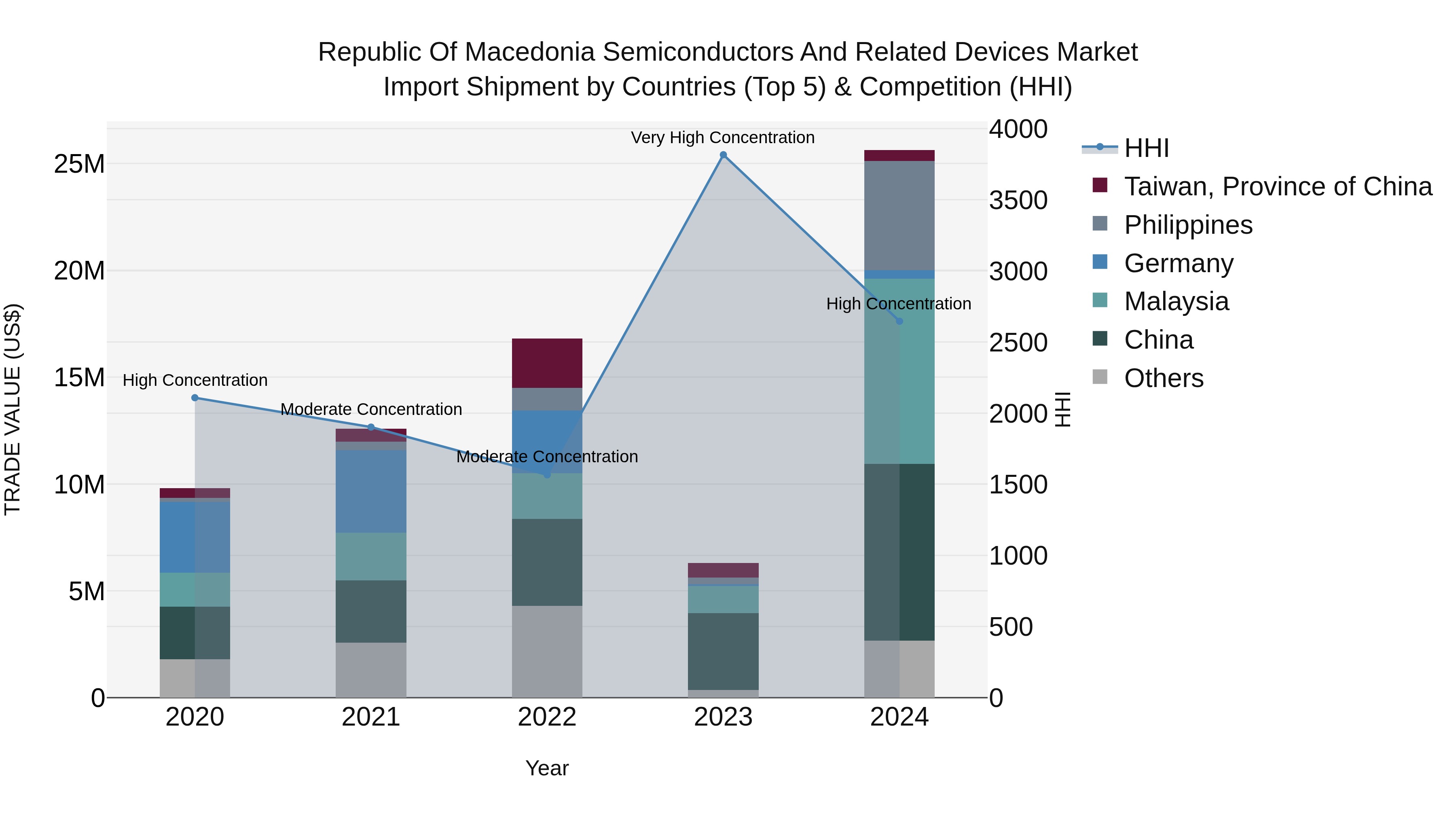
The Republic of Macedonia continues to experience a surge in semiconductor imports, with key suppliers including Malaysia, China, Philippines, South Korea, and Taiwan. The market concentration remains high, indicating a competitive landscape dominated by a few major players. The impressive compound annual growth rate of 27.12% from 2020 to 2024 underscores the robust demand for semiconductors in North Macedonia. The staggering growth rate of 306.92% in 2024 further highlights the rapid acceleration of this sector, signaling significant opportunities for industry players and potential challenges in managing supply chain dynamics.
Key Highlights of the Report:
- Republic of Macedonia Semiconductors and Related Devices Market Outlook
- Market Size of Republic of Macedonia Semiconductors and Related Devices Market, 2024
- Forecast of Republic of Macedonia Semiconductors and Related Devices Market, 2031
- Historical Data and Forecast of Republic of Macedonia Semiconductors and Related Devices Revenues & Volume for the Period 2021-2031
- Republic of Macedonia Semiconductors and Related Devices Market Trend Evolution
- Republic of Macedonia Semiconductors and Related Devices Market Drivers and Challenges
- Republic of Macedonia Semiconductors and Related Devices Price Trends
- Republic of Macedonia Semiconductors and Related Devices Porter`s Five Forces
- Republic of Macedonia Semiconductors and Related Devices Industry Life Cycle
- Historical Data and Forecast of Republic of Macedonia Semiconductors and Related Devices Market Revenues & Volume By Types for the Period 2021-2031
- Historical Data and Forecast of Republic of Macedonia Semiconductors and Related Devices Market Revenues & Volume By Integrated Circuits for the Period 2021-2031
- Historical Data and Forecast of Republic of Macedonia Semiconductors and Related Devices Market Revenues & Volume By Memory Chips for the Period 2021-2031
- Historical Data and Forecast of Republic of Macedonia Semiconductors and Related Devices Market Revenues & Volume By Microprocessors for the Period 2021-2031
- Historical Data and Forecast of Republic of Macedonia Semiconductors and Related Devices Market Revenues & Volume By Others for the Period 2021-2031
- Historical Data and Forecast of Republic of Macedonia Semiconductors and Related Devices Market Revenues & Volume By End-users for the Period 2021-2031
- Historical Data and Forecast of Republic of Macedonia Semiconductors and Related Devices Market Revenues & Volume By Information Technology for the Period 2021-2031
- Historical Data and Forecast of Republic of Macedonia Semiconductors and Related Devices Market Revenues & Volume By Aerospace & Defense for the Period 2021-2031
- Historical Data and Forecast of Republic of Macedonia Semiconductors and Related Devices Market Revenues & Volume By Consumer Electronics for the Period 2021-2031
- Historical Data and Forecast of Republic of Macedonia Semiconductors and Related Devices Market Revenues & Volume By Automotive for the Period 2021-2031
- Historical Data and Forecast of Republic of Macedonia Semiconductors and Related Devices Market Revenues & Volume By Healthcare for the Period 2021-2031
- Historical Data and Forecast of Republic of Macedonia Semiconductors and Related Devices Market Revenues & Volume By Others for the Period 2021-2031
- Republic of Macedonia Semiconductors and Related Devices Import Export Trade Statistics
- Market Opportunity Assessment By Types
- Market Opportunity Assessment By End-users
- Republic of Macedonia Semiconductors and Related Devices Top Companies Market Share
- Republic of Macedonia Semiconductors and Related Devices Competitive Benchmarking By Technical and Operational Parameters
- Republic of Macedonia Semiconductors and Related Devices Company Profiles
- Republic of Macedonia Semiconductors and Related Devices Key Strategic Recommendations






































