Republic Of Macedonia Thyristor Market
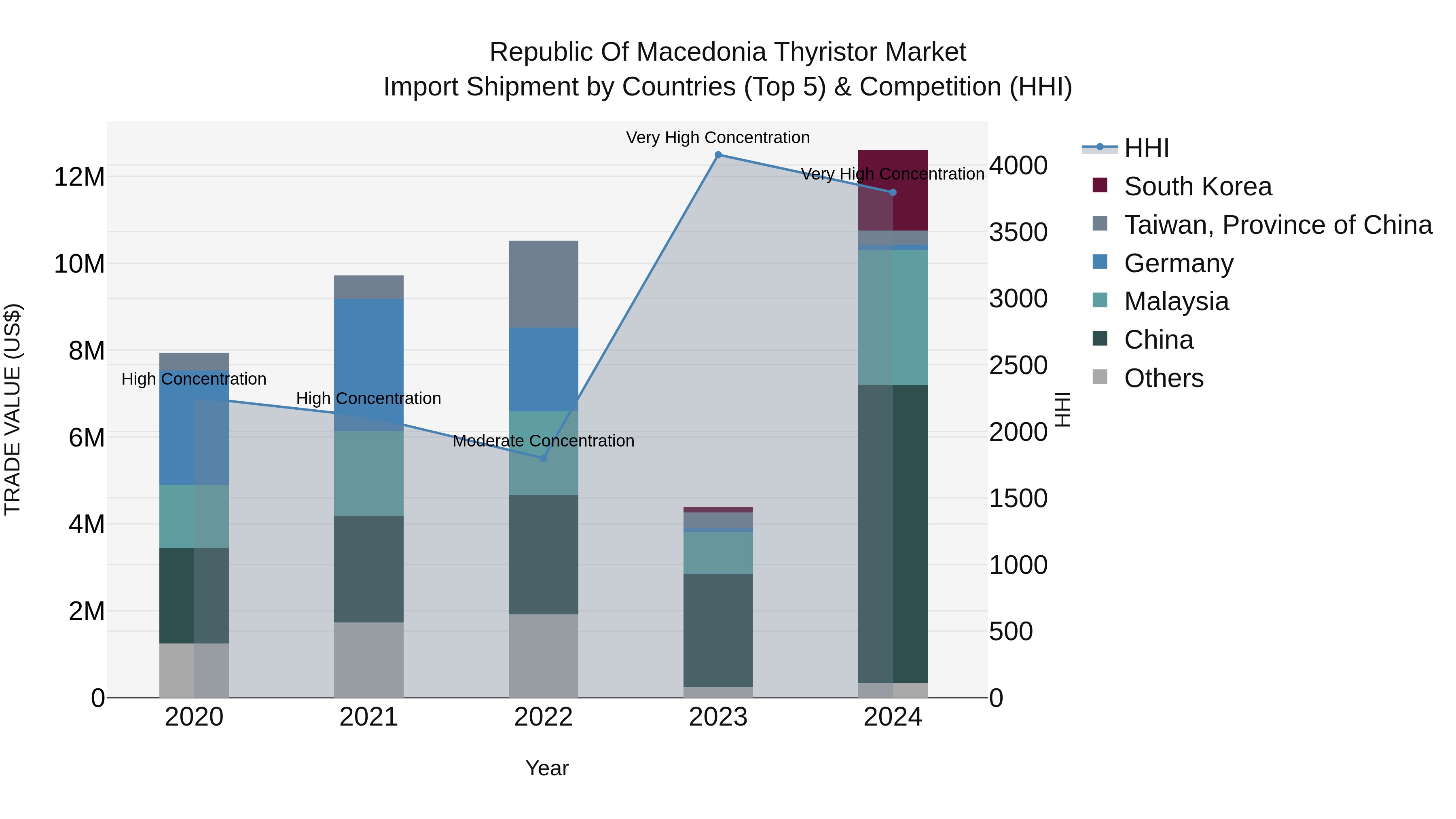
The Republic of North Macedonia saw a significant increase in thyristor import shipments in 2024, with top exporting countries being China, Malaysia, South Korea, Taiwan, Province of China, and Japan. The High Herfindahl-Hirschman Index (HHI) indicates a highly concentrated market. The compound annual growth rate (CAGR) from 2020 to 2024 stood at an impressive 12.23%, with a remarkable growth rate of 186.99% from 2023 to 2024. This data suggests a thriving market for thyristors in North Macedonia, driven by strong partnerships with key exporting nations.
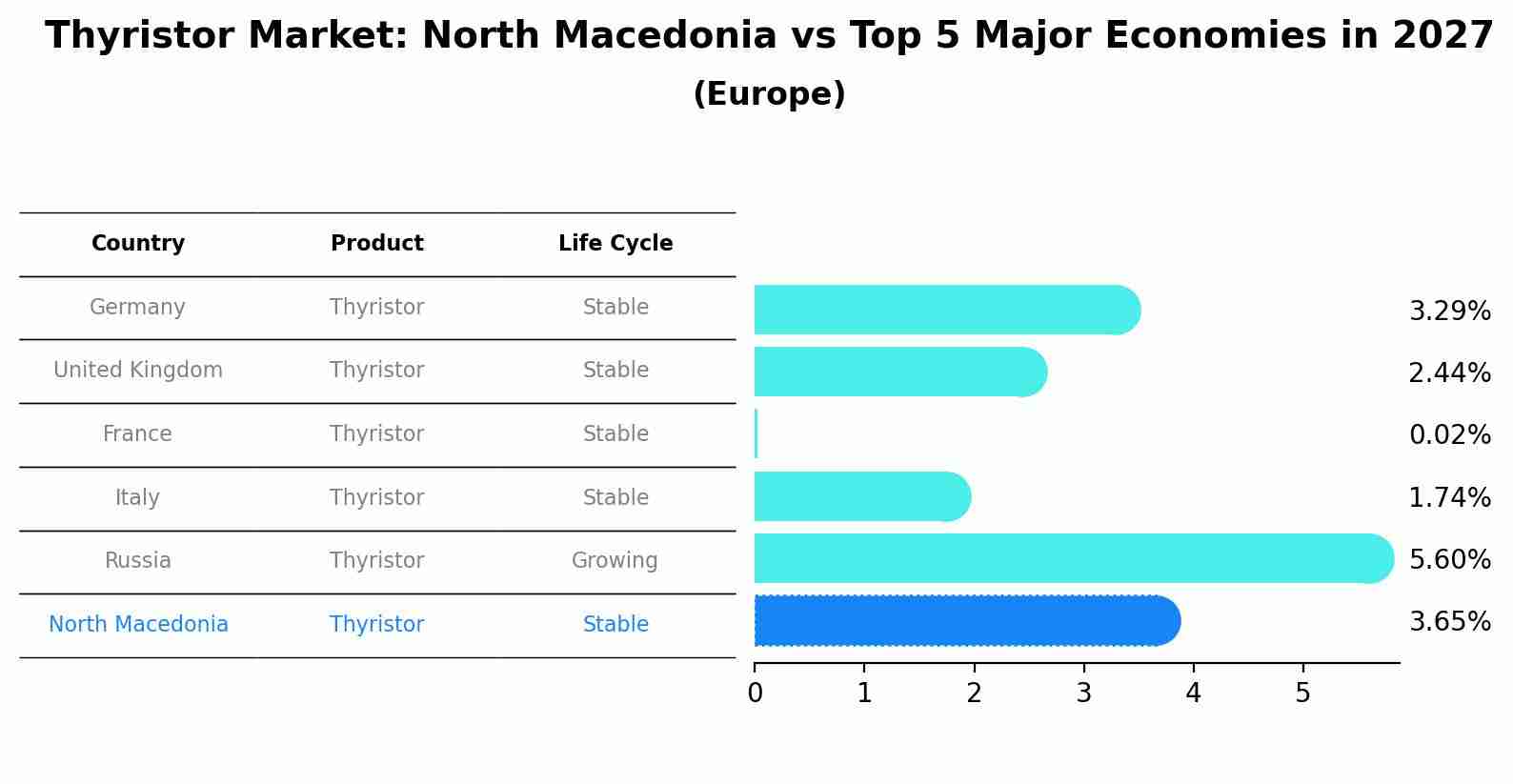
Thyristor Market: North Macedonia vs Top 5 Major Economies in 2027 (Europe)
By 2027, North Macedonia's Thyristor market is forecasted to achieve a stable growth rate of 3.65%, with Germany leading the Europe region, followed by United Kingdom, France, Italy and Russia.
Key Highlights of the Report:
- Republic of Macedonia Thyristor Market Outlook
- Market Size of Republic of Macedonia Thyristor Market, 2024
- Forecast of Republic of Macedonia Thyristor Market, 2031
- Historical Data and Forecast of Republic of Macedonia Thyristor Revenues & Volume for the Period 2021-2031
- Republic of Macedonia Thyristor Market Trend Evolution
- Republic of Macedonia Thyristor Market Drivers and Challenges
- Republic of Macedonia Thyristor Price Trends
- Republic of Macedonia Thyristor Porter`s Five Forces
- Republic of Macedonia Thyristor Industry Life Cycle
- Historical Data and Forecast of Republic of Macedonia Thyristor Market Revenues & Volume By Power Rating for the Period 2021-2031
- Historical Data and Forecast of Republic of Macedonia Thyristor Market Revenues & Volume By Below 5OO MW for the Period 2021-2031
- Historical Data and Forecast of Republic of Macedonia Thyristor Market Revenues & Volume By 500 MW-999 MW for the Period 2021-2031
- Historical Data and Forecast of Republic of Macedonia Thyristor Market Revenues & Volume By 1000 MW and above for the Period 2021-2031
- Historical Data and Forecast of Republic of Macedonia Thyristor Market Revenues & Volume By Industry Vertical for the Period 2021-2031
- Historical Data and Forecast of Republic of Macedonia Thyristor Market Revenues & Volume By Consumer Electronics for the Period 2021-2031
- Historical Data and Forecast of Republic of Macedonia Thyristor Market Revenues & Volume By Industrial for the Period 2021-2031
- Historical Data and Forecast of Republic of Macedonia Thyristor Market Revenues & Volume By Telecommunication & Networking for the Period 2021-2031
- Historical Data and Forecast of Republic of Macedonia Thyristor Market Revenues & Volume By Automotive for the Period 2021-2031
- Historical Data and Forecast of Republic of Macedonia Thyristor Market Revenues & Volume By Aerospace & Defense for the Period 2021-2031
- Historical Data and Forecast of Republic of Macedonia Thyristor Market Revenues & Volume By Healthcare for the Period 2021-2031
- Republic of Macedonia Thyristor Import Export Trade Statistics
- Market Opportunity Assessment By Power Rating
- Market Opportunity Assessment By Industry Vertical
- Republic of Macedonia Thyristor Top Companies Market Share
- Republic of Macedonia Thyristor Competitive Benchmarking By Technical and Operational Parameters
- Republic of Macedonia Thyristor Company Profiles
- Republic of Macedonia Thyristor Key Strategic Recommendations






































