Romania 3D PA (Polyamide) Market (2026-2032) | Revenue, Outlook, Analysis, Industry, Companies, Size, Forecast, Trends, Share, Value & Growth
Market Forecast By Application (Healthcare, Aerospace & Defense, Automotive, Electronics, Others), By Type (PA11, PA12) And Competitive Landscape
| Product Code: ETC4512679 | Publication Date: Jul 2023 | Updated Date: Jun 2026 | Product Type: Report | |
| Publisher: 6Wresearch | Author: Ravi Bhandari | No. of Pages: 70 | No. of Figures: 35 | No. of Tables: 5 |
Romania 3d Pa (Polyamide) Market: Import Trend Analysis
In the Romania 3D PA (Polyamide) market, the import trend experienced a decline from 2023 to 2024, with a notable growth rate of -15.81%. However, the compound annual growth rate (CAGR) for the period 2020-2024 stood at 5.53%. This negative momentum in 2024 could be attributed to shifting demand patterns or potential market disruptions impacting import volumes.
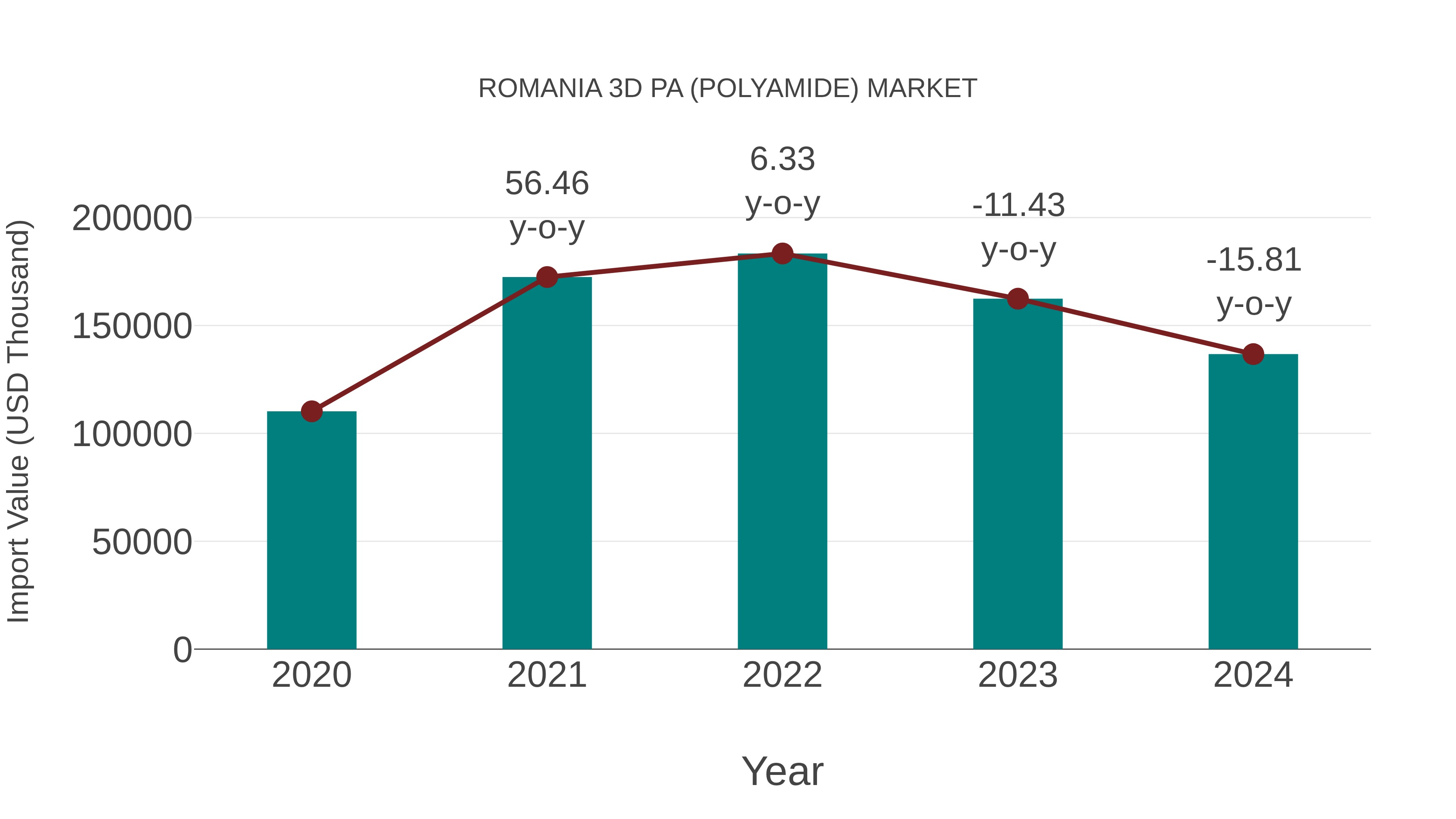
Romania 3D PA (Polyamide) Market Growth Rate
According to 6Wresearch internal database and industry insights, the Romania 3D PA (Polyamide) Market is projected to grow at a compound annual growth rate (CAGR) of 9.4% during the forecast period (2026-2032).
Topics Covered in the Romania 3D PA (Polyamide) Market Report
The Romania 3D PA (Polyamide) Market report thoroughly covers the market by application and type. The market report provides an unbiased and detailed analysis of ongoing market trends, opportunities/high growth areas, and market drivers, which help stakeholders devise and align their market strategies according to the current and future market dynamics.
Romania 3D PA (Polyamide) Market Highlights
| Report Name | Romania 3D PA (Polyamide) Market |
| Forecast period | 2026-2032 |
| CAGR | 9.4% |
| Growing Sector | Healthcare & Medical Device |
Romania 3D PA (Polyamide) Market Synopsis
Romania 3D PA (Polyamide) Market is anticipated to record notable growth due to the increase in industrial automation, the growing application of additive manufacturing techniques, and increased spending on precision engineering applications. Polyamides such as PA11 and PA12 have been popularized by 3D printers due to the lightweight nature of these polyamides, their strength, resistance to chemicals, and their ability to handle complex manufacturing operations. Moreover, the increasing need for customized manufacturing solutions in the automotive, aerospace, electronics, and healthcare industries is driving the adoption of advanced polyamide materials in 3D printing technology in Romania.
Evaluation of Growth Drivers in the Romania 3D PA (Polyamide) Market (2026-2032)
Below mentioned are some prominent drivers and their influence on the market dynamics:
| Drivers | Primary Segments Affected | Why it Matters (Evidence) |
| Growth in Adoption of 3D-Printing in Industries | PA12; Automotive & Aerospace | More manufacturers are using 3D-printed components to enable light weighting and fast manufacturing. |
| Increase in Personalization of Medical Devices | PA11; Medical | Polyamides allow precise custom implants and prototypes in the healthcare industry. |
| Growth in Aerospace Production | PA12; Aerospace & Defense | Polyamides are preferred by aerospace manufacturers due to their durability and heat resistance. |
| Increase in Automotive Prototyping | PA11 & PA12; Automotive | Automotive manufacturers are increasing efforts in prototyping and light weighting components. |
| Technological Advancements in Additive Manufacturing | All Types; Electronics & Others | Improved printer compatibility and material quality enhance production efficiency and accuracy. |
Romania 3D PA (Polyamide) Market is expected to grow at the CAGR of 9.4% during the forecast period of 2026-2032. The growth is attributed to increasing adoption of additive manufacturing processes, particularly within industries such as automotive, aerospace, and healthcare. There is an increasing trend towards lighter and more durable materials for industrial uses which increases adoption of PA11 and PA12 plastics. Favorable policies and measures undertaken by the government to promote the industrial digitization process and smart manufacturing are likely to boost market growth. Investment in production capacity from European companies along with the growing demand for cost-effective prototype options is anticipated to favor future growth for Romania's 3D polyamide industry.
Evaluation of Restraints in the Romania 3D PA (Polyamide) Market
Below mentioned are some major restraints and their influence on the market dynamics:
| Restraints | Primary Segments Affected | What This Means (Evidence) |
| High Initial Cost of 3D Printing Equipment | All Types; SMEs | Smaller manufacturers face difficulties adopting expensive industrial-grade printers. |
| Limited Skilled Workforce | Healthcare & Aerospace | Shortage of trained additive manufacturing professionals slows technology adoption. |
| Raw Material Cost Volatility | PA11 & PA12; Automotive | Fluctuating polymer prices affect production planning and profitability. |
| Slow Standardization of 3D Printing Regulations | Aerospace & Defense | Lack of uniform quality standards limits broader industrial implementation. |
| Dependence on Imported Advanced Materials | PA12; Electronics & Others | Reliance on imported polyamide powders increases supply chain vulnerability. |
Romania 3D PA (Polyamide) Industry Challenges
Irrespective of substantial technological advancements, the Romania 3D PA (Polyamide) Industry continues to face several operational and structural challenges. The issues that affect the industry include the prohibitive cost of acquiring industrial additive manufacturing machines due to their high investment requirement, limiting the number of users to mainly big firms. Another issue is the unreliable supply of premium polyamide powder and sourcing of the materials from foreign countries, creating uncertainty in pricing for the manufacturers. There are also insufficient highly qualified personnel who can efficiently manage the entire process of 3D printing. Moreover, there are no standard regulations guiding industrial additive manufacturing applications.
Romania 3D PA (Polyamide) Market Trends
Key trends in the Romania 3D PA (Polyamide) Market Growth are:
- Increasing Utilization of PA12 in Aerospace Parts: The use of PA12 is increasing among aerospace companies due to its better mechanical strength and lightweight nature.
- Increased Application of Medical 3D Printing Technology: Medical companies are using polyamide material for customized implants, prostheses, and surgical guides.
- Utilization of AI in Additive Manufacturing: Smart manufacturing processes and AI-based production systems are helping improve printing accuracy and efficiency.
- Increasing Need for Sustainable Manufacturing Materials: The companies are focusing on bio-polyamides to ensure sustainable manufacturing processes.
Investment Opportunities in the Romania 3D PA (Polyamide) Market
Some prominent investment opportunities in the Romania 3D PA (Polyamide) Market include:
- Advanced Additive Manufacturing Infrastructure – Investment in high-throughput additive manufacturing facilities could help meet regional manufacturing needs.
- Healthcare Devices – Increased utilization of personalized medical devices presents an opportunity to manufacture polyamide-based medical devices.
- Aerospace Parts Manufacturing – Setting up manufacturing units specifically for aerospace products made of lightweight polyamides can ensure long-term market viability.
- Sustainability – Development of environmentally friendly polyamides through recycling and use of renewable raw material sources.
Top 5 Leading Players in the Romania 3D PA (Polyamide) Market
Some leading players operating in the Romania 3D PA (Polyamide) Market include:
1. EOS GmbH
| Company Name | EOS GmbH |
|---|---|
| Established Year | 1989 |
| Headquarters | Krailling, Germany |
| Website | Click Here |
EOS GmbH specializes in industrial additive manufacturing solutions and advanced polyamide materials used in aerospace, healthcare, and automotive applications. The company offers high-performance PA11 and PA12 printing systems that support rapid prototyping, lightweight manufacturing, and precision engineering processes across European industrial markets.
2. HP Inc.
| Company Name | HP Inc. |
|---|---|
| Established Year | 1939 |
| Headquarters | California, USA |
| Website | Click Here |
HP Inc. provides industrial Multi Jet Fusion 3D printing systems utilizing advanced polyamide powders for large-scale production. The company focuses on improving production speed, material efficiency, and component quality for automotive, healthcare, and consumer electronics manufacturers operating across Romania and Europe.
3. Arkema S.A.
| Company Name | Arkema S.A. |
|---|---|
| Established Year | 2004 |
| Headquarters | Colombes, France |
| Website | Click Here |
Arkema develops specialty polyamide materials, including bio-based PA11 solutions widely used in industrial 3D printing applications. The company supports sustainable manufacturing initiatives and supplies advanced engineering materials for aerospace, medical, and automotive industries requiring high-performance additive manufacturing capabilities.
4. BASF SE
| Company Name | BASF SE |
|---|---|
| Established Year | 1865 |
| Headquarters | Ludwigshafen, Germany |
| Website | Click Here |
BASF offers innovative engineering polymers and additive manufacturing solutions designed for industrial-grade production environments. Its advanced polyamide materials provide durability, flexibility, and thermal resistance, making them suitable for automotive prototyping, aerospace structures, and electronics component manufacturing applications.
5. Stratasys Ltd.
| Company Name | Stratasys Ltd. |
|---|---|
| Established Year | 1989 |
| Headquarters | Minnesota, USA |
| Website | Click Here |
Stratasys develops advanced 3D printing technologies and engineering-grade materials used for industrial additive manufacturing. The company supports rapid prototyping, tooling, and customized production applications using durable polyamide materials across sectors including aerospace, healthcare, and electronics manufacturing.
Government Regulations Introduced in the Romania 3D PA (Polyamide) Market
According to Romania’s government data, Various efforts have been made in order to hasten the implementation of innovative manufacturing technologies like additive manufacturing and engineering polymers. To give an example, Romania’s Digital Innovation Hub projects and Industry 4.0 financial programs are motivating Romanian companies to embrace and incorporate 3D-printing technology into their manufacturing processes. Moreover, various EU-funded Horizon Europe projects emphasize sustainability research in advanced additive manufacturing technology. Besides, policies that promote industrial digitalization, skill development of the work force, and environmentally sustainable manufacturing practices are assisting Romanian companies to increase their competitiveness as well as the implementation of innovative polyamide manufacturing technologies.
Source: https://www.clustercollaboration.eu/content/north-east-romania-dih-digital-innovation-zone
Future Insights of the Romania 3D PA (Polyamide) Market
Romania 3D PA (Polyamide) Market Share is expected to witness strong future growth due to rising industrial digitalization, increasing adoption of additive manufacturing technologies, and expanding demand for lightweight engineering materials across key industries. Integration of AI-enabled manufacturing systems, sustainability-focused polyamide material and manufacturing processes, and accurate production will contribute positively towards market potential during the forecast period. Moreover, investments in manufacturing industries in sectors such as aerospace, healthcare, and automobiles are expected to provide ample opportunities to the applications of industrial 3D printing. Innovative programs by the European Union, along with advancements in material science and indigenous manufacturing abilities, will help increase the use of materials such as PA11 and PA12.
Market Segmentation Analysis
The report offers a comprehensive study of the subsequent market segments and their leading categories.
By Application - Healthcare Dominates the Market
According to Mohit, Senior Research Analyst, 6Wresearch, Healthcare dominated with 31.8% share of the Romania 3D PA (Polyamide) Market in 2025, driven by increasing demand for customized medical devices, prosthetics, and surgical planning models using advanced additive manufacturing technologies. Meanwhile, Aerospace & Defense is projected to expand at a 10.6% CAGR during 2026–2032 due to rising investments in lightweight and precision-engineered aerospace components.
By Type - PA12 Dominates the Market
By type, PA12 accounted for 63.4% share of the market in 2025 owing to its superior chemical resistance, dimensional stability, and suitability for industrial-grade additive manufacturing applications. Meanwhile, PA11 is anticipated to witness a CAGR of 9.9% during 2026–2032, supported by growing interest in bio-based and sustainable engineering materials.
By End-Use Industry - Automotive Emerges as a Key Segment
By end-use industry, Automotive held a significant market share in 2025 due to increasing use of polyamide-based 3D printing for rapid prototyping and lightweight component manufacturing. The Electronics segment is projected to grow at a CAGR of 10.2% during 2026–2032, fueled by rising demand for precision electronic housing and customized production solutions.
Note: Market size and growth projections are calculated using 6Wresearch’s advanced research and forecasting methodology.
Key Attractiveness of the Report
- 10 Years of Market Numbers.
- Historical Data Starting from 2022 to 2025.
- Base Year: 2025.
- Forecast Data until 2032.
- Key Performance Indicators Impacting the Market.
- Major Upcoming Developments and Projects.
Key Highlights of the Report:
- Romania 3D PA (Polyamide) Market Outlook
- Market Size of Romania 3D PA (Polyamide) Market, 2025
- Forecast of Romania 3D PA (Polyamide) Market, 2032
- Historical Data and Forecast of Romania 3D PA (Polyamide) Revenues & Volume for the Period 2022-2032F
- Romania 3D PA (Polyamide) Market Trend Evolution
- Romania 3D PA (Polyamide) Market Drivers and Challenges
- Romania 3D PA (Polyamide) Price Trends
- Romania 3D PA (Polyamide) Porter's Five Forces
- Romania 3D PA (Polyamide) Industry Life Cycle
- Historical Data and Forecast of Romania 3D PA (Polyamide) Market Revenues & Volume By Application for the Period 2022-2032F
- Historical Data and Forecast of Romania 3D PA (Polyamide) Market Revenues & Volume By Healthcare for the Period 2022-2032F
- Historical Data and Forecast of Romania 3D PA (Polyamide) Market Revenues & Volume By Aerospace & Defense for the Period 2022-2032F
- Historical Data and Forecast of Romania 3D PA (Polyamide) Market Revenues & Volume By Automotive for the Period 2022-2032F
- Historical Data and Forecast of Romania 3D PA (Polyamide) Market Revenues & Volume By Electronics for the Period 2022-2032F
- Historical Data and Forecast of Romania 3D PA (Polyamide) Market Revenues & Volume By Others for the Period 2022-2032F
- Historical Data and Forecast of Romania 3D PA (Polyamide) Market Revenues & Volume By Type for the Period 2022-2032F
- Historical Data and Forecast of Romania 3D PA (Polyamide) Market Revenues & Volume By PA11 for the Period 2022-2032F
- Historical Data and Forecast of Romania 3D PA (Polyamide) Market Revenues & Volume By PA12 for the Period 2022-2032F
- Romania 3D PA (Polyamide) Import Export Trade Statistics
- Market Opportunity Assessment By Application
- Market Opportunity Assessment By Type
- Romania 3D PA (Polyamide) Top Companies Market Share
- Romania 3D PA (Polyamide) Competitive Benchmarking By Technical and Operational Parameters
- Romania 3D PA (Polyamide) Company Profiles
- Romania 3D PA (Polyamide) Key Strategic Recommendations
Market Covered
The report offers a comprehensive study of the subsequent market segments:
By Application
- Healthcare
- Aerospace & Defense
- Automotive
- Electronics
- Others
By Type
- PA11
- PA12
Romania 3D PA (Polyamide) Market (2026-2032): FAQs
The Romania 3D PA (Polyamide) Market is projected to grow at a CAGR of 9.4% during the forecast period 2026-2032.
The market is driven by increasing adoption of additive manufacturing technologies and expanding healthcare and aerospace applications.
Some of the major problems include expensive machines, lack of trained additive manufacturing experts, and reliance on imported advanced polyamide materials.
Regulatory issues such as support from the government for Industry 4.0 and sustainability are promoting the use of advanced additive manufacturing technology.
6Wresearch actively monitors the Romania 3D PA (Polyamide) Market and publishes its comprehensive annual report, highlighting emerging trends, growth drivers, revenue analysis, and forecast outlook. Our insights help businesses to make data-backed strategic decisions with ongoing market dynamics. Our analysts track relevent industries related to the Romania 3D PA (Polyamide) Market, allowing our clients with actionable intelligence and reliable forecasts tailored to emerging regional needs.
Yes, we provide customisation as per your requirements. To learn more, feel free to contact us on sales@6wresearch.com
| 1 Executive Summary |
| 2 Introduction |
| 2.1 Key Highlights of the Report |
| 2.2 Report Description |
| 2.3 Market Scope & Segmentation |
| 2.4 Research Methodology |
| 2.5 Assumptions |
| 3 Romania 3D PA (Polyamide) Market Overview |
| 3.1 Romania Country Macro Economic Indicators |
| 3.2 Romania 3D PA (Polyamide) Market Revenues & Volume, 2022 & 2032F |
| 3.3 Romania 3D PA (Polyamide) Market - Industry Life Cycle |
| 3.4 Romania 3D PA (Polyamide) Market - Porter's Five Forces |
| 3.5 Romania 3D PA (Polyamide) Market Revenues & Volume Share, By Application, 2022 & 2032F |
| 3.6 Romania 3D PA (Polyamide) Market Revenues & Volume Share, By Type, 2022 & 2032F |
| 4 Romania 3D PA (Polyamide) Market Dynamics |
| 4.1 Impact Analysis |
| 4.2 Market Drivers |
| 4.2.1 Increasing adoption of 3D printing technology in various industries in Romania |
| 4.2.2 Growing demand for lightweight and durable materials like polyamide in manufacturing processes |
| 4.2.3 Technological advancements in 3D printing techniques and materials |
| 4.3 Market Restraints |
| 4.3.1 High initial setup costs for 3D printing equipment and materials |
| 4.3.2 Limited awareness and expertise in utilizing 3D printing technology among businesses in Romania |
| 4.3.3 Challenges in achieving high precision and quality in 3D printed polyamide products |
| 5 Romania 3D PA (Polyamide) Market Trends |
| 6 Romania 3D PA (Polyamide) Market, By Types |
| 6.1 Romania 3D PA (Polyamide) Market, By Application |
| 6.1.1 Overview and Analysis |
| 6.1.2 Romania 3D PA (Polyamide) Market Revenues & Volume, By Application, 2022 - 2032F |
| 6.1.3 Romania 3D PA (Polyamide) Market Revenues & Volume, By Healthcare, 2022 - 2032F |
| 6.1.4 Romania 3D PA (Polyamide) Market Revenues & Volume, By Aerospace & Defense, 2022 - 2032F |
| 6.1.5 Romania 3D PA (Polyamide) Market Revenues & Volume, By Automotive, 2022 - 2032F |
| 6.1.6 Romania 3D PA (Polyamide) Market Revenues & Volume, By Electronics, 2022 - 2032F |
| 6.1.7 Romania 3D PA (Polyamide) Market Revenues & Volume, By Others, 2022 - 2032F |
| 6.2 Romania 3D PA (Polyamide) Market, By Type |
| 6.2.1 Overview and Analysis |
| 6.2.2 Romania 3D PA (Polyamide) Market Revenues & Volume, By PA11, 2022 - 2032F |
| 6.2.3 Romania 3D PA (Polyamide) Market Revenues & Volume, By PA12, 2022 - 2032F |
| 7 Romania 3D PA (Polyamide) Market Import-Export Trade Statistics |
| 7.1 Romania 3D PA (Polyamide) Market Export to Major Countries |
| 7.2 Romania 3D PA (Polyamide) Market Imports from Major Countries |
| 8 Romania 3D PA (Polyamide) Market Key Performance Indicators |
| 8.1 Rate of adoption of 3D printing technology in key industries in Romania |
| 8.2 Number of new applications and use cases for polyamide in 3D printing |
| 8.3 Research and development investments in enhancing polyamide materials for 3D printing |
| 9 Romania 3D PA (Polyamide) Market - Opportunity Assessment |
| 9.1 Romania 3D PA (Polyamide) Market Opportunity Assessment, By Application, 2022 & 2032F |
| 9.2 Romania 3D PA (Polyamide) Market Opportunity Assessment, By Type, 2022 & 2032F |
| 10 Romania 3D PA (Polyamide) Market - Competitive Landscape |
| 10.1 Romania 3D PA (Polyamide) Market Revenue Share, By Companies, 2025 |
| 10.2 Romania 3D PA (Polyamide) Market Competitive Benchmarking, By Operating and Technical Parameters |
| 11 Company Profiles |
| 12 Recommendations |
| 13 Disclaimer |
Global Go To Market Strategy - 2030
Export potential enables firms to identify high-growth global markets with greater confidence by combining advanced trade intelligence with a structured quantitative methodology. The framework analyzes emerging demand trends and country-level import patterns while integrating macroeconomic and trade datasets such as GDP and population forecasts, bilateral import–export flows, tariff structures, elasticity differentials between developed and developing economies, geographic distance, and import demand projections. Using weighted trade values from 2020–2024 as the base period to project country-to-country export potential for 2030, these inputs are operationalized through calculated drivers such as gravity model parameters, tariff impact factors, and projected GDP per-capita growth. Through an analysis of hidden potentials, demand hotspots, and market conditions that are most favorable to success, this method enables firms to focus on target countries, maximize returns, and global expansion with data, backed by accuracy.
By factoring in the projected importer demand gap that is currently unmet and could be potential opportunity, it identifies the potential for the Exporter (Country) among 190 countries, against the general trade analysis, which identifies the biggest importer or exporter.
To discover high-growth global markets and optimize your business strategy:
Click Here
Pricing
- Single User License$ 1,995
- Department License$ 2,400
- Site License$ 3,120
- Global License$ 3,795

Leadership Perspectives from Industry Events
Search
Thought Leadership and Analyst Meet





Our Clients








6WResearch In News
- Doha a strategic location for EV manufacturing hub: IPA Qatar
- Demand for luxury TVs surging in the GCC, says Samsung
- Empowering Growth: The Thriving Journey of Bangladesh’s Cable Industry
- Demand for luxury TVs surging in the GCC, says Samsung
- Video call with a traditional healer? Once unthinkable, it’s now common in South Africa
- Intelligent Buildings To Smooth GCC’s Path To Net Zero
Latest Reports
- Taiwan Airport Wireless Infrastructure Market (2026-2032)
- Vietnam Airport Wireless Infrastructure Market (2026-2032)
- Thailand Airport Wireless Infrastructure Market (2026-2032)
- South Korea Airport Wireless Infrastructure Market (2026-2032)
- Romania Airport Wireless Infrastructure Market (2026-2032)
- Qatar Airport Wireless Infrastructure Market (2026-2032)
- Philippines Airport Wireless Infrastructure Market (2026-2032)
- Japan Airport Wireless Infrastructure Market (2026-2032)
- Taiwan Airport Winter Services Market (2026-2032)
- Vietnam Airport Winter Services Market (2026-2032)
Industry Events and Analyst Meet

HIMTEX 2026

India Refining Summit 2026

India EV Show 2026

EV tech India Expo 2026

Auto Tech Asia 2026
Whitepaper
- Middle East & Africa Commercial Security Market Click here to view more.
- Middle East & Africa Fire Safety Systems & Equipment Market Click here to view more.
- GCC Drone Market Click here to view more.
- Middle East Lighting Fixture Market Click here to view more.
- GCC Physical & Perimeter Security Market Click here to view more.


