Romania Abrasives Market Growth Rate
According to 6Wresearch internal database and industry insights, the Romania Abrasives Market is projected to grow at a compound annual growth rate (CAGR) of 5.8% during the forecast period (2026-2032).
Romania Abrasives Market Year-wise Growth Rate and Key Drivers
This graph illustrates the annual growth rates of the Romania Abrasives Market from 2021 to 2032, highlighting a steady upward trajectory and projected market expansion over the forecast period.
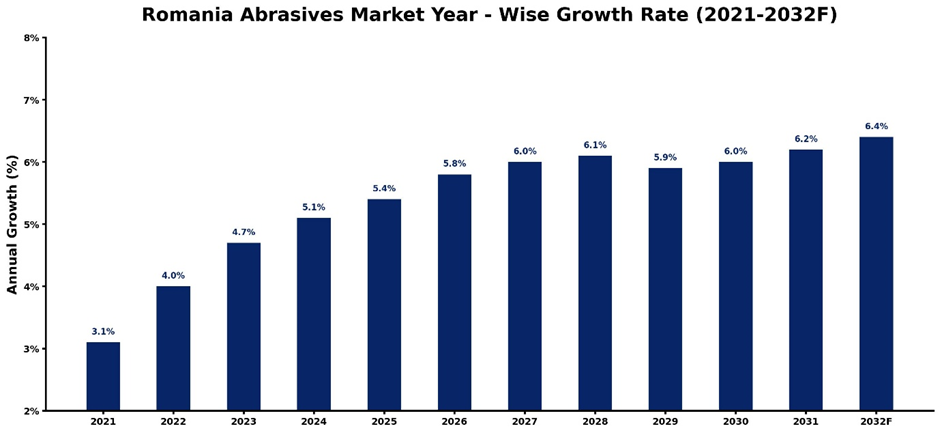
The following table summarizes the historical and forecasted growth rates of the Romania Abrasives Market, along with the rationale behind each year’s performance.
| Year | Estimated Growth (%) | Market Rationale |
| 2021 | 3.1% | Recovery in manufacturing and metal fabrication operations resulted in an increase in grinding and finishing products. |
| 2022 | 4% | Construction projects and industrial maintenance operations have contributed to abrasive products consumption. |
| 2023 | 4.7% | Automobile parts manufacturing and machinery manufacturing increased the demand for coated and bonded abrasives. |
| 2024 | 5.1% | Development of infrastructure and upgrade of manufacturing units led to the growth of the market. |
| 2025 | 5.4% | Growth in demand for abrasives products due to rise in machining operations and industrial output. |
| 2026 | 5.8% | Advancement in manufacturing technologies and automation of industries. |
| 2027 | 6% | Increasing demand from metalworking, aerospace, and automotive industries would boost abrasive products consumption. |
| 2028 | 6.1% | Infrastructure development and renovation projects have fueled demand for the product. |
| 2029 | 5.9% | Engineering applications and surface finishing operations have driven market growth positively. |
| 2030 | 6% | Adoption of super abrasives and grinding operations would enhance market potential. |
| 2031 | 6.2% | Increasing export of manufactured products and industrial production would drive market growth. |
| 2032 | 6.4% | Demand from construction, automotive, and heavy engineering industries would ensure market growth. |
Topics Covered in the Romania Abrasives Market Report
The Romania Abrasives Market report thoroughly covers the market by raw material, type, product, form, application, and end-use. The market report provides an unbiased and detailed analysis of ongoing market trends, opportunities/high growth areas, and market drivers, which help stakeholders devise and align their market strategies according to the current and future market dynamics.
Romania Abrasives Market Highlights
| Report Name | Romania Abrasives Market |
| Forecast period | 2026-2032 |
| CAGR | 5.8% |
| Growing Sector | Grinding Application |
Romania Abrasives Market Synopsis
Romania Abrasives Market is anticipated to witness steady growth due to increased industrial production, infrastructure development, and demand from the automotive and metal fabrication industry segments. Abrasives are the substances that are used for grinding, polishing, cutting, drilling, and surface finishing purposes in several industrial sectors. These abrasives can be of both natural and synthetic types and are important in enhancing the precision of manufacturing operations and efficiency of processes. Increased automation in the industrial sector, increased construction activities, and investments in machining technologies are adding to the growth of the market. There is also an increase in demand for better abrasive products.
Evaluation of Growth Drivers in the Romania Abrasives Market (2026-2032)
Below mentioned are some prominent drivers and their influence on the market dynamics:
| Drivers | Primary Segments Affected | Why it Matters (Evidence) |
| Expansion of Manufacturing Sector | Bonded Abrasive; Grinding | Growing industrial production increases demand for precision grinding and finishing materials. |
| Rising Construction Activities | Coated Abrasive; Cutting & Finishing | Infrastructure development and renovation projects require abrasive products for surface preparation and material processing. |
| Growth in Automotive Production | Super Abrasive; Polishing | Automotive manufacturers utilize abrasives for precision machining, polishing, and component finishing. |
| Industrial Automation Adoption | Synthetic Raw Material; Grinding | Automated machining systems require high-performance abrasives to improve operational efficiency. |
| Increasing Metal Fabrication Demand | Bonded & Coated Abrasive; Cutting | Expanding metalworking activities support consistent demand for abrasive discs, wheels, and sheets. |
Romania Abrasives Market is expected to grow at the CAGR of 5.8% during the forecast period of 2026-2032. The growth can be attributed to the development of manufacturing plants, more infrastructural development, and demand from the automotive and engineering sectors. Abrasive products continue to be crucial for applications like cutting, grinding, polishing, and finishing within the industrial segments. The market is also gaining momentum from the technological innovations in artificial abrasives that provide increased durability and precision. Moreover, increasing automation, metal fabrication operations, and renovation projects in residential as well as commercial sectors are projected to drive demand for abrasive products during the forecast period.
Evaluation of Restraints in the Romania Abrasives Market
Below mentioned are some major restraints and their influence on the market dynamics:
| Restraints | Primary Segments Affected | What This Means (Evidence) |
| Volatility in Raw Material Prices | Natural & Synthetic Abrasives | Fluctuating costs impact production expenses and profit margins for manufacturers. |
| High Energy Costs | Manufacturing Operations | Energy-intensive abrasive production processes increase operational costs. |
| Availability of Low-Cost Imports | Coated Abrasive; Product Manufacturers | Competitive pricing pressure affects domestic manufacturers and market profitability. |
| Environmental Compliance Requirements | Bonded Abrasive Production | Restrictive compliances lead to greater investments for green manufacturing methods. |
| Skilled Labor Shortages | Advanced Abrasive Manufacturing | Lack of technical knowledge leads to delay in implementing new abrasives technology. |
Romania Abrasives Industry Challenges
Irrespective of significant growth opportunities, the Romania Abrasives Market Growth continues to face several challenges that could influence its development trajectory. Another issue is that of the variability of raw material prices, which has a direct bearing on manufacturing costs as well as pricing. Moreover, there are increased costs of energy that affect producers who have manufacturing facilities requiring high amounts of energy. The industry is also facing competition due to imported abrasives that are available at relatively cheaper rates. Industrial emission standards and waste disposal are other issues that keep manufacturers constantly investing in order to ensure compliance. Shortages of qualified technical personnel are also among the issues being faced by manufacturers.
Romania Abrasives Market Trends
Major emerging trends in the Romania Abrasives Industry include:
- Usage of Super Abrasives: Industrial sectors are preferring to use abrasives based on diamond and cubic boron nitride owing to their high durability, accuracy, and effectiveness in machining operations.
- Shift towards Sustainable Manufacturing Process: Companies manufacturing abrasives are focusing on sustainable production process and use of eco-friendly materials.
- Demand for Surface Finishing: Manufacturers of automotive parts, aircraft, and industrial machinery are choosing advanced abrasives to provide precision surface finishing.
- Increase in Automation in Machining Processes: The use of robots in machining processes is boosting the demand for high-end abrasives that are suitable for machining processes.
- Adoption of Synthetic Abrasives: Companies use synthetic abrasives due to their reliability, longevity, and applicability in industrial operations.
Investment Opportunities in the Romania Abrasives Market
Emerging investment opportunities in the Romania Abrasives Market are as follows:
- Modern Abrasive Manufacturing Plants: New investments in state-of-the-art manufacturing plants may facilitate the increased demand for abrasives with superior performance characteristics in various industries.
- Development of Super Abrasives: The rising demand for precision machining provides an opportunity to develop abrasive materials made of diamonds or cubic boron nitride.
- Distribution Channels for the Construction and Infrastructure Sectors: The expansion of distribution networks will be useful for massive infrastructure projects in Romania.
- Industrial Automation: Businesses that provide automation-compatible abrasives stand a chance to gain from the growing popularity of Industry 4.0 technology.
- Research and Development Projects: Development of new abrasive materials and technologies can contribute to the competitiveness of businesses in the market environment.
Top 5 Leading Players in the Romania Abrasives Market
Some leading players operating in the Romania Abrasives Market include:
1. Saint-Gobain Abrasives
| Company Name | Saint-Gobain Abrasives |
|---|---|
| Established Year | 1665 |
| Headquarters | Courbevoie, France |
| Official Website | Click Here |
Saint-Gobain Abrasives provides bonded, coated, and super abrasive products that enhance productivity and surface finishing across metalworking, construction, automotive, and industrial applications.
2. 3M Company
| Company Name | 3M Company |
|---|---|
| Established Year | 1902 |
| Headquarters | Minnesota, United States |
| Official Website | Click Here |
3M manufactures abrasive discs, sheets, belts, and precision grinding solutions that support high-quality finishing and process efficiency across diverse industrial applications.
3. Tyrolit Group
| Company Name | Tyrolit Group |
|---|---|
| Established Year | 1919 |
| Headquarters | Schwaz, Austria |
| Official Website | Click Here |
Tyrolit develops high-performance grinding, cutting, drilling, and dressing tools designed for precision manufacturing, engineering, and construction applications worldwide.
4. Klingspor AG
| Company Name | Klingspor AG |
|---|---|
| Established Year | 1893 |
| Headquarters | Haiger, Germany |
| Official Website | Click Here |
Klingspor offers coated abrasives, grinding discs, and cutting solutions, emphasizing reliability, advanced engineering, and continuous innovation for industrial users.
5. Robert Bosch GmbH
| Company Name | Robert Bosch GmbH |
|---|---|
| Established Year | 1886 |
| Headquarters | Gerlingen, Germany |
| Official Website | Click Here |
Bosch supplies abrasive accessories for power tools, including grinding and cutting products that support construction, metalworking, and maintenance applications globally.
Government Regulations Introduced in the Romania Abrasives Market
According to Romania’s Government Data, several initiatives contribute to the development and modernization of the abrasives industry. The Romanian government has sought to increase the competitiveness of its industries by implementing financial initiatives that would facilitate the modernization of manufacturing machinery and energy-efficient manufacturing technologies. Furthermore, the objectives of the EU Green Deal and Circular Economy Action Plan have increased the incentive for manufacturing firms to engage in sustainable manufacturing practices and minimize industrial waste. Financial initiatives facilitated by the National Recovery and Resilience Plan (PNRR) are also available for digitalization and industrial modernization initiatives.
Future Insights of the Romania Abrasives Market
The future of the Romania Abrasives Market remains promising as industrial modernization, infrastructure expansion, and technological advancements continue to strengthen demand across key end-user sectors. The market is anticipated to be driven by increasing usage of automated manufacturing processes, precision machining, and advanced surface-finishing applications. The need for synthetic and super abrasives is expected to rise owing to efforts towards increasing productivity, durability, and efficiency. In addition, the increasing investment in transport infrastructure and residential renovations as well as industrial development would further contribute to market growth prospects for players in the market. Sustainable manufacturing and environmentally friendly production would also drive innovation within the industry during the forecast period.
Market Segmentation Analysis
The report offers a comprehensive study of the following market segments and their leading categories:
By Raw Material – Synthetic Abrasives Dominate Market, Natural Abrasives Maintain Niche Demand
According to Bhawna Singh, Assistant Manager, 6Wresearch, Synthetic abrasives accounted for the largest revenue contribution of 68.4% in the Romania Abrasives Market Share in 2025 owing to their superior durability, uniform particle structure, and extensive usage across automotive, metalworking, and construction industries. Their excellent performance in precision grinding and finishing applications continues to support market dominance. Meanwhile, Natural abrasives are projected to witness steady growth, registering a CAGR of 5.1% during 2026-2032, driven by their cost-effectiveness and continued utilization in specialized industrial applications.
By Type – Bonded Abrasives Lead Market, Super Abrasives Witness Fastest Growth
Bonded abrasives held the dominant market share of 39.7% in 2025 due to their extensive use in grinding wheels, cutting wheels, and industrial machining operations. Their versatility and suitability for heavy-duty manufacturing applications continue to drive demand across industrial facilities. However, Super abrasives are anticipated to record the highest growth, expanding at a CAGR of 7.2% through 2032, supported by increasing adoption of high-precision machining technologies and rising demand for exceptional hardness and extended operational life.
By Product – Disc Segment Dominates, Sheet & Non-Woven Fabric Expand Rapidly
By product, Disc abrasives accounted for the largest market share of 34.8% in 2025 owing to their widespread application in cutting, grinding, and polishing operations across construction and industrial sectors. Their compatibility with power tools and industrial equipment further strengthens segment demand. Conversely, Sheet & Non-Woven Fabric abrasives are expected to witness the fastest expansion, registering a CAGR of 6.9% during the forecast period, driven by increasing demand for surface finishing, automotive refinishing, and precision polishing applications.
By End-Use – New Non-Residential Construction Dominates, Civil Engineering Renovation Expands Rapidly
New Non-Residential Construction accounted for the largest revenue share of 31.4% in 2025 owing to ongoing investments in commercial buildings, industrial facilities, logistics centers, and public infrastructure projects. Abrasive products are extensively utilized during construction, installation, and finishing activities. Conversely, Civil Engineering Renovation is expected to witness the fastest growth, registering a CAGR of 6.8% during the forecast period, driven by increasing investments in transportation networks, bridges, and aging infrastructure modernization projects.
Note: Market size estimations and growth projections presented in this report are based on 6Wresearch’s advanced forecasting approach, validated with industry datasets as of June 2026.
Key Attractiveness of the Report
- 10 Years of Market Numbers.
- Historical Data Starting from 2022 to 2025.
- Base Year: 2025.
- Forecast Data until 2032.
- Key Performance Indicators Impacting the Market.
- Major Upcoming Developments and Projects.
Key Highlights of the Report:
- Romania Abrasives Market Outlook
- Market Size of Romania Abrasives Market, 2025
- Forecast of Romania Abrasives Market, 2032
- Historical Data and Forecast of Romania Abrasives Revenues & Volume for the Period 2022-2032
- Romania Abrasives Market Trend Evolution
- Romania Abrasives Market Drivers and Challenges
- Romania Abrasives Price Trends
- Romania Abrasives Porter's Five Forces
- Romania Abrasives Industry Life Cycle
- Historical Data and Forecast of Romania Abrasives Market Revenues & Volume By Raw Material for the Period 2022-2032
- Historical Data and Forecast of Romania Abrasives Market Revenues & Volume By Natural for the Period 2022-2032
- Historical Data and Forecast of Romania Abrasives Market Revenues & Volume By Synthetic for the Period 2022-2032
- Historical Data and Forecast of Romania Abrasives Market Revenues & Volume By Type for the Period 2022-2032
- Historical Data and Forecast of Romania Abrasives Market Revenues & Volume By Coated Abrasive for the Period 2022-2032
- Historical Data and Forecast of Romania Abrasives Market Revenues & Volume By Bonded Abrasive for the Period 2022-2032
- Historical Data and Forecast of Romania Abrasives Market Revenues & Volume By Super Abrasive for the Period 2022-2032
- Historical Data and Forecast of Romania Abrasives Market Revenues & Volume By Others for the Period 2022-2032
- Historical Data and Forecast of Romania Abrasives Market Revenues & Volume By Product for the Period 2022-2032
- Historical Data and Forecast of Romania Abrasives Market Revenues & Volume By Disc for the Period 2022-2032
- Historical Data and Forecast of Romania Abrasives Market Revenues & Volume By Cups for the Period 2022-2032
- Historical Data and Forecast of Romania Abrasives Market Revenues & Volume By Cylinder for the Period 2022-2032
- Historical Data and Forecast of Romania Abrasives Market Revenues & Volume By Sheet & Non- Woven Fabric for the Period 2022- 2032
- Historical Data and Forecast of Romania Abrasives Market Revenues & Volume By Others for the Period 2022-2032
- Historical Data and Forecast of Romania Abrasives Market Revenues & Volume By Form for the Period 2022-2032
- Historical Data and Forecast of Romania Abrasives Market Revenues & Volume By Block for the Period 2022-2032
- Historical Data and Forecast of Romania Abrasives Market Revenues & Volume By Powdered for the Period 2022-2032
- Historical Data and Forecast of Romania Abrasives Market Revenues & Volume By Application for the Period 2022-2032
- Historical Data and Forecast of Romania Abrasives Market Revenues & Volume By Grinding for the Period 2022-2032
- Historical Data and Forecast of Romania Abrasives Market Revenues & Volume By Cutting for the Period 2022-2032
- Historical Data and Forecast of Romania Abrasives Market Revenues & Volume By Polishing for the Period 2022-2032
- Historical Data and Forecast of Romania Abrasives Market Revenues & Volume By Drilling for the Period 2022-2032
- Historical Data and Forecast of Romania Abrasives Market Revenues & Volume By Finishing for the Period 2022-2032
- Historical Data and Forecast of Romania Abrasives Market Revenues & Volume By Others for the Period 2022-2032
- Historical Data and Forecast of Romania Abrasives Market Revenues & Volume By End-Use for the Period 2022-2032
- Historical Data and Forecast of Romania Abrasives Market Revenues & Volume By New Residential Construction for the Period 2022-2032
- Historical Data and Forecast of Romania Abrasives Market Revenues & Volume By Residential Renovation for the Period 2022-2032
- Historical Data and Forecast of Romania Abrasives Market Revenues & Volume By New Non-Residential Construction for the Period 2022- 2032
- Historical Data and Forecast of Romania Abrasives Market Revenues & Volume By Non-Residential Renovation for the Period 2022-2032
- Historical Data and Forecast of Romania Abrasives Market Revenues & Volume By New Civil Engineering for the Period 2022-2032
- Historical Data and Forecast of Romania Abrasives Market Revenues & Volume By Civil Engineering Renovation for the Period 2022-2032
- Romania Abrasives Import Export Trade Statistics
- Market Opportunity Assessment By Raw Material
- Market Opportunity Assessment By Type
- Market Opportunity Assessment By Product
- Market Opportunity Assessment By Form
- Market Opportunity Assessment By Application
- Market Opportunity Assessment By End-Use
- Romania Abrasives Top Companies Market Share
- Romania Abrasives Competitive Benchmarking By Technical and Operational Parameters
- Romania Abrasives Company Profiles
- Romania Abrasives Key Strategic Recommendations
Market Covered
The report offers a comprehensive study of the subsequent market segments:
By Raw Material
- Natural
- Synthetic
By Type
- Coated Abrasive
- Bonded Abrasive
- Super Abrasive
- Others
By Product
- Disc
- Cups
- Cylinder
- Sheet & Non-Woven Fabric
- Others
By Form
- Block
- Powdered
By Application
- Grinding
- Cutting
- Polishing
- Drilling
- Finishing
- Others
By End-Use
- New Residential Construction
- Residential Renovation
- New Non-Residential Construction
- Non-Residential Renovation
- New Civil Engineering
- Civil Engineering Renovation






































