Romania Accumulator Market Growth Rate
According to 6Wresearch internal database and industry insights, the Romania Accumulator Market is projected to grow at a compound annual growth rate (CAGR) of 6.7% during the forecast period (2026-2032).
Romania Accumulator Market Year-wise Growth Rate and Key Drivers (2022-2032)
This graph illustrates the annual growth rates of the Romania Accumulator Market from 2022 to 2032, highlighting a steady upward trajectory and projected market expansion over the forecast period.
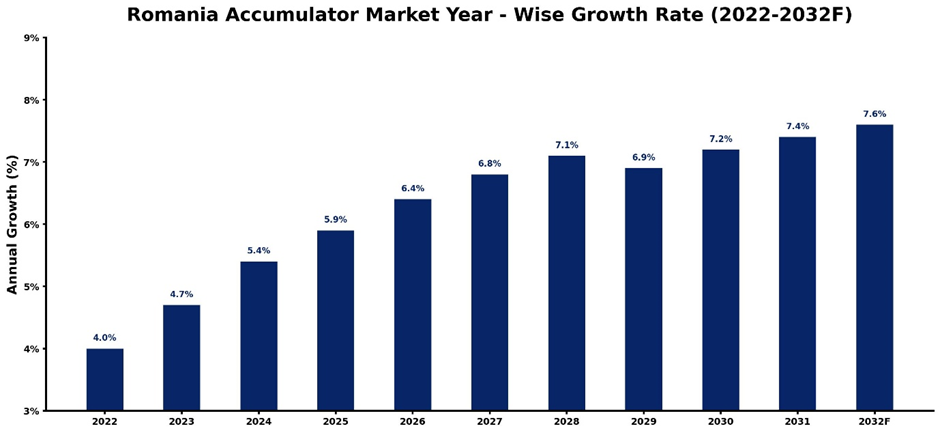
The following table summarizes the historical and forecasted growth rates of the Romania Accumulator Market, along with the rationale behind each year's performance.
| Year | Estimated Growth (%) | Market Rationale |
| 2022 | 4% | Recovery in industrial production and rising investments in hydraulic equipment supported accumulator demand across manufacturing facilities. |
| 2023 | 4.7% | Growth in automotive manufacturing and construction machinery increased the adoption of hydraulic accumulator systems. |
| 2024 | 5.4% | Expansion of industrial automation and infrastructure development strengthened demand for efficient hydraulic energy storage solutions. |
| 2025 | 5.9% | Higher investments in heavy machinery, mining equipment, and industrial maintenance accelerated market expansion. |
| 2026 | 6.4% | Increasing deployment of advanced hydraulic systems and modernization of industrial facilities support market growth. |
| 2027 | 6.8% | Growing adoption of energy-efficient hydraulic equipment and rising OEM production continue to boost demand. |
| 2028 | 7.1% | Expansion of smart manufacturing and predictive maintenance technologies increases accumulator installations. |
| 2029 | 6.9% | Stable replacement demand from industrial equipment and construction machinery maintains positive market performance. |
| 2030 | 7.2% | Renewable energy projects and modernization of hydraulic machinery generate fresh opportunities for accumulator manufacturers. |
| 2031 | 7.4% | Continued industrial digitalization and increasing investments in automation strengthen demand for high-performance accumulators. |
| 2032 | 7.6% | Sustained industrial expansion, growing exports of machinery, and adoption of advanced hydraulic technologies support long-term market growth. |
Topics Covered in the Romania Accumulator Market Report
The Romania Accumulator Market report thoroughly covers the market by type, application, and sales channel. The market report provides an unbiased and detailed analysis of ongoing market trends, opportunities/high growth areas, and market drivers, which help stakeholders devise and align their market strategies according to the current and future market dynamics.
Romania Accumulator Market Highlights
| Report Name | Romania Accumulator Market |
| Forecast period | 2026-2032 |
| CAGR | 6.7% |
| Growing Sector | Construction and Agricultural Machinery |
Romania Accumulator Market Synopsis
Romania Accumulator Market is anticipated to witness considerable growth due to an increase in industrial automation, higher investments in construction machinery, and more production activities taking place across the nation. Accumulators, which are hydraulic devices designed to store pressurized fluid and regulate system pressure, play a critical role in improving equipment efficiency, minimizing energy consumption, and ensuring operational safety in hydraulic systems. Growing demand from industries such as construction, agriculture, mining, oil & gas, automotive manufacturing, and renewable energy is further supporting market expansion.
Evaluation of Growth Drivers in the Romania Accumulator Market (2026-2032)
Below mentioned are some prominent drivers and their influence on the market dynamics:
| Drivers | Primary Segments Affected | Why it Matters (Evidence) |
| Expansion of Industrial Automation | Bladder Accumulator; Automobile Industry & Machinery | Automated hydraulic systems require efficient energy storage and pressure stabilization, increasing accumulator demand across manufacturing facilities. |
| Growth in Construction and Agricultural Equipment | Piston Accumulator; Construction and Agricultural Machinery | Rising investments in infrastructure and mechanized farming increase the deployment of hydraulic machinery equipped with accumulators. |
| Increasing Automotive Manufacturing | Bladder & Diaphragm Accumulator; Automobile Industry | Expanding vehicle production and hydraulic testing systems support higher demand for reliable accumulator solutions. |
| Rising Investments in Oil & Gas Infrastructure | Piston Accumulator; Oil and Gas Industry | Hydraulic systems used in drilling, pipeline operations, and industrial equipment require durable accumulators for pressure management. |
| Adoption of Energy-Efficient Hydraulic Systems | All Types; Direct & Indirect Channel | Industries are replacing conventional hydraulic components with energy-efficient solutions to improve productivity and reduce operational costs. |
Romania Accumulator Market is expected to grow at a CAGR of 6.7% during the forecast period of 2026-2032. The growth is mainly driven by industrial automation, upgrades in manufacturing plants, and increased demand for hydraulic devices in sectors including automotive, construction, agriculture, plastics, marine, and oil & gas. The increasing need for energy-efficient hydraulic equipment and the concept of predictive maintenance encourages the industries to adopt advanced accumulator technology. In addition, infrastructure development projects, increasing industrial production, investment support through Romania's digital transformation, and increasing demand from OEMs will be some factors contributing to market growth in the coming years.
Evaluation of Restraints in the Romania Accumulator Market
Below mentioned are some major restraints and their influence on the market dynamics:
| Restraints | Primary Segments Affected | What This Means (Evidence) |
| High Initial Investment Cost | Piston Accumulator; Direct Channel | Advanced hydraulic accumulators require significant upfront investment, limiting adoption among small industrial operators. |
| Volatility in Raw Material Prices | All Types; Direct & Indirect Channel | Fluctuating prices of steel, aluminum, and specialty alloys increase manufacturing costs and affect profit margins. |
| Shortage of Skilled Hydraulic Professionals | All Types; Machinery & Oil and Gas Industry | Limited technical expertise slows installation, servicing, and optimization of advanced hydraulic accumulator systems. |
| Dependence on Imported Hydraulic Components | Bladder & Diaphragm Accumulator; Direct Channel | Import dependency exposes manufacturers and distributors to supply chain delays and fluctuating procurement costs. |
| Long Product Replacement Cycle | All Types; Automobile Industry & Machinery | Hydraulic accumulators have extended operational lifespans, reduced replacement frequency and limiting recurring product demand. |
Romania Accumulator Industry Challenges
Despite favorable dynamics, the Romania accumulator market growth continues to face several practical challenges that may affect long-term expansion. Several industries continue to use aged hydraulic machinery, thus making it difficult and expensive to implement recent developments in accumulator technology. The reliance on foreign hydraulic systems makes businesses prone to problems associated with procurement and cost issues. Moreover, a lack of skilled engineers in the field poses several challenges in the process of implementation. Limited budgets among small and medium companies often result in postponement of upgrading processes, while growing competition from imported products adds further difficulties for local suppliers.
Romania Accumulator Market Trends
Romania accumulator industry is evolving with several notable trends which are as follows:
- Use of Bladder Accumulators: The demand for bladder accumulators is growing among industries due to their better performance, higher efficiency, and reduced maintenance requirements.
- Use of Advanced Systems to Monitor Hydraulic Conditions: Companies are incorporating new systems with digital sensors that will help monitor the conditions of hydraulics and perform predictive maintenance.
- Increasing Applications in Renewable Energy Equipment: The use of hydraulic accumulators is becoming common in renewable energy systems to stabilize the performance of such devices.
Investment Opportunities in the Romania Accumulator Market
Several major investment opportunities in the market are:
- Production of Hydraulic Accumulators Locally: Setting up production facilities locally will reduce dependence on importing as well as increase the chain of hydraulic systems in Romania.
- Development of Smart Hydraulic Systems: Development of networked systems for accumulators is an investment in preventive maintenance and greater productivity.
- Industrial Aftermarket Services Network: Development of networks for maintenance, repair, and replacement services offers opportunities for additional revenue and improved client relations.
- Construction Equipment and Agricultural Equipment: Collaboration with original equipment manufacturers of construction and agricultural equipment can help use more accumulators in these industries.
Top Players in Romania Accumulator Market
Some leading players operating in the Romania Accumulator Market include:
1. Bosch Rexroth AG
| Company Name | Bosch Rexroth AG |
|---|---|
| Established Year | 1795 |
| Headquarters | Lohr am Main, Germany |
| Official Website | Click Here |
Bosch Rexroth manufactures high-performance hydraulic accumulators and fluid power solutions that improve pressure stability, energy efficiency, and operational reliability across industrial, mobile, and construction equipment applications.
2. HYDAC International GmbH
| Company Name | HYDAC International GmbH |
|---|---|
| Established Year | 1963 |
| Headquarters | Sulzbach/Saar, Germany |
| Official Website | Click Here |
HYDAC develops bladder, piston, and diaphragm accumulators alongside hydraulic accessories, delivering efficient pressure storage solutions that enhance machine performance, safety, and system durability worldwide.
3. Parker Hannifin Corporation
| Company Name | Parker Hannifin Corporation |
|---|---|
| Established Year | 1917 |
| Headquarters | Cleveland, Ohio, USA |
| Official Website | Click Here |
Parker Hannifin supplies advanced hydraulic accumulators and motion-control technologies designed to optimize energy storage, reduce pressure fluctuations, and improve productivity across industrial and mobile equipment.
4. Eaton Corporation plc
| Company Name | Eaton Corporation plc |
|---|---|
| Established Year | 1911 |
| Headquarters | Dublin, Ireland |
| Official Website | Click Here |
Eaton offers reliable hydraulic accumulator solutions engineered for demanding industrial applications, helping customers improve equipment efficiency, reduce maintenance requirements, and enhance overall hydraulic system performance.
5. Freudenberg Sealing Technologies GmbH & Co. KG
| Company Name | Freudenberg Sealing Technologies GmbH & Co. KG |
|---|---|
| Established Year | 1849 |
| Headquarters | Weinheim, Germany |
| Official Website | Click Here |
Freudenberg manufactures sealing technologies and hydraulic components supporting accumulator systems, enabling improved operational safety, leak prevention, and long-term performance across multiple industrial sectors.
Government Regulations Introduced in the Romania Accumulator Market
According to Romania's Government data, several regulatory measures are still in place for the modernization of industries and the use of hydraulic equipment throughout the country. In terms of Romania’s National Recovery and Resilience Plan (PNRR), funding will be made available for the modernization of the industry, digitization of industry, and efficient energy production systems, making it possible for businesses to invest in better hydraulic equipment. Moreover, adherence to the European Union Pressure Equipment Directive (PED 2014/68/EU) and the Machinery Regulation (EU) 2023/1230 makes it necessary for hydraulic accumulators to comply with stringent safety and performance specifications.
Future Insights of the Romania Accumulator Market
Romania Accumulator Market is expected to witness sustained expansion over the forecast period, supported by increasing investments in industrial automation, infrastructure development, and advanced manufacturing technologies. The increasing need for hydraulic systems with high energy efficiency in the automobile, construction, agriculture, marine, plastic, and oil and gas industries will further drive the growth of accumulators. Moreover, the future of the industry will be positively affected by the growing use of predictive maintenance systems and digital hydraulic systems as well as smart factories where pressure accumulators are required.
Market Segmentation Analysis
This report presents a detailed analysis of the market segments along with their leading categories.
By Type- Bladder Accumulators Dominate the Market, Piston Accumulators Register the Fastest Growth
The Bladder Accumulators occupied a major 49.80% market share in the Romania Accumulator Market in 2025 due to their quick reaction speed, small size, high energy storage capacity, and usage in various industrial machinery, construction machinery, automobile manufacturing, and hydraulic systems. The ease of maintenance and low cost are the other factors contributing to their widespread acceptance amongst end-users. At the same time, the Piston Accumulators segment is expected to register a robust CAGR of 8.46% in the period from 2026-2032, driven by the rising demand for high-pressure hydraulic applications, heavy industrial machinery, renewable energy machinery, and large-scale projects.
By Application- Automobile Industry Holds the Largest Share, Oil and Gas Industry Shows the Highest Growth
According to Ravi Bhandari, Research Head, 6Wresearch, the Automobile Industry secured the leading market share of 31.90% in 2025, driven by increasing vehicle production, expansion of automotive component manufacturing, and growing deployment of hydraulic equipment in assembly lines, testing systems, and production facilities. Conversely, the Oil and Gas Industry is expected to expand at a notable CAGR of 8.18% through 2032, fueled by modernization of hydraulic equipment, pipeline infrastructure upgrades, increased maintenance activities, and growing investments in energy security projects requiring reliable pressure storage solutions.
By Sales Channel- Direct Channel Leads the Market, Indirect Channel Records Rapid Expansion
The Direct Channel commanded a substantial market share of 63.40% in the Romania Accumulator Market in 2025 owing to rising preference for direct procurement from the manufacturers by industrial customers, OEMs, and infrastructure companies. The Indirect Channel, on the other hand, is expected to experience a CAGR of 7.94% during the forecast period of 2026-2032, driven by the rising number of industrial distributors, hydraulic equipment dealers, local service centers, and the availability of replacement products for SMEs in Romania.
Note: Market size estimations and growth projections presented in this report are based on 6Wresearch's proprietary forecasting methodology, utilizing the latest available industry data, government publications, and primary research inputs.
Key Attractiveness of the Report
- 10 Years of Market Numbers.
- Historical Data Starting from 2022 to 2025.
- Base Year: 2025.
- Forecast Data until 2032.
- Key Performance Indicators Impacting the Market.
- Major Upcoming Developments and Projects.
Key Highlights of the Report:
- Romania Accumulator Market Outlook
- Market Size of Romania Accumulator Market, 2025
- Forecast of Romania Accumulator Market, 2032
- Historical Data and Forecast of Romania Accumulator Revenues & Volume for the Period 2022-2032F
- Romania Accumulator Market Trend Evolution
- Romania Accumulator Market Drivers and Challenges
- Romania Accumulator Price Trends
- Romania Accumulator Porter's Five Forces
- Romania Accumulator Industry Life Cycle
- Historical Data and Forecast of Romania Accumulator Market Revenues & Volume By Type for the Period 2022-2032F
- Historical Data and Forecast of Romania Accumulator Market Revenues & Volume By Bladder Accumulator for the Period 2022-2032F
- Historical Data and Forecast of Romania Accumulator Market Revenues & Volume By Piston Accumulator for the Period 2022-2032F
- Historical Data and Forecast of Romania Accumulator Market Revenues & Volume By Diaphragm Accumulator for the Period 2022-2032F
- Historical Data and Forecast of Romania Accumulator Market Revenues & Volume By Application for the Period 2022-2032F
- Historical Data and Forecast of Romania Accumulator Market Revenues & Volume By Automobile Industry for the Period 2022-2032F
- Historical Data and Forecast of Romania Accumulator Market Revenues & Volume By Construction and Agricultural for the Period 2022-2032F
- Historical Data and Forecast of Romania Accumulator Market Revenues & Volume By Machinery for the Period 2022-2032F
- Historical Data and Forecast of Romania Accumulator Market Revenues & Volume By Plastics Industry for the Period 2022-2032F
- Historical Data and Forecast of Romania Accumulator Market Revenues & Volume By Marine Industry for the Period 2022-2032F
- Historical Data and Forecast of Romania Accumulator Market Revenues & Volume By Oil and Gas Industry for the Period 2022-2032F
- Historical Data and Forecast of Romania Accumulator Market Revenues & Volume By Sales Channel for the Period 2022-2032F
- Historical Data and Forecast of Romania Accumulator Market Revenues & Volume By Direct Channel for the Period 2022-2032F
- Historical Data and Forecast of Romania Accumulator Market Revenues & Volume By Indirect Channel for the Period 2022-2032F
- Romania Accumulator Import Export Trade Statistics
- Market Opportunity Assessment By Type
- Market Opportunity Assessment By Application
- Market Opportunity Assessment By Sales Channel
- Romania Accumulator Top Companies Market Share
- Romania Accumulator Competitive Benchmarking By Technical and Operational Parameters
- Romania Accumulator Company Profiles
- Romania Accumulator Key Strategic Recommendations
Market Covered
The report offers a comprehensive study of the subsequent market segments:
By Type
- Bladder Accumulator
- Piston Accumulator
- Diaphragm Accumulator
By Application
- Automobile Industry
- Construction and Agricultural Machinery
- Plastics Industry
- Marine Industry
- Oil and Gas Industry
By Sales Channel
- Direct Channel
- Indirect Channel






































