Romania Acoustic Guitar Market Growth Rate
According to 6Wresearch internal database and industry insights, the Romania Acoustic Guitar Market is projected to grow at a compound annual growth rate (CAGR) of 5.9% during the forecast period (2026-2032).
Romania Acoustic Guitar Market Year-wise Growth Rate and Key Drivers (2022-2032)
This graph illustrates the annual growth rates of the Romania Acoustic Guitar Market from 2022 to 2032, highlighting a steady upward trajectory and projected market expansion over the forecast period.
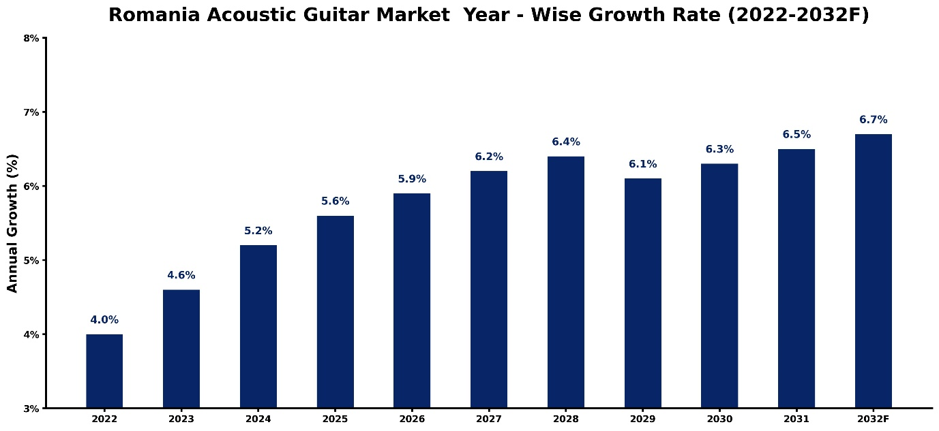
The following table summarizes the historical and forecasted growth rates of the Romania Acoustic Guitar Market, along with the rationale behind each year's performance.
| Year | Estimated Growth (%) | Market Rationale |
| 2022 | 4% | Rising enrollment in music education and growing online instrument sales supported market expansion. |
| 2023 | 4.6% | Increasing popularity of live performances and independent musicians encouraged acoustic guitar purchases. |
| 2024 | 5.2% | Expanding music schools and improving consumer spending boosted demand for beginner and intermediate guitars. |
| 2025 | 5.6% | Premium product launches and wider retail availability strengthened overall market performance. |
| 2026 | 5.9% | Growing adoption of acoustic guitars among hobbyists and professional performers supports market growth. |
| 2027 | 6.2% | Expansion of music education programs and cultural events increases instrument demand. |
| 2028 | 6.4% | Rising e-commerce penetration and premium handcrafted guitar sales continue market expansion. |
| 2029 | 6.1% | Market growth moderates slightly due to replacement purchases becoming more prominent. |
| 2030 | 6.3% | Greater demand for high-quality acoustic instruments and performance equipment strengthens sales. |
| 2031 | 6.5% | Growth in music tourism and creative arts education supports sustained market expansion. |
| 2032 | 6.7% | Continued investments in music education and increasing consumer preference for premium instruments drive long-term growth. |
Topics Covered in the Romania Acoustic Guitar Market Report
The Romania Acoustic Guitar Market Report provides a comprehensive analysis based on Product and Application. It offers detailed insights into key industry trends, growth drivers, emerging opportunities, competitive developments, and high-growth segments. The report presents an objective assessment of current dynamics and future prospects, enabling stakeholders to make informed business decisions and develop effective strategies aligned with the evolving industry landscape.
Romania Acoustic Guitar Market Highlights
| Report Name | Romania Acoustic Guitar Market |
| Forecast period | 2026–2032 |
| CAGR | 5.9% |
| Growing Sector | Teaching |
Romania Acoustic Guitar Market Synopsis
Romania Acoustic Guitar Market is anticipated to record notable growth owing to increasing interest in music education, expanding live entertainment activities, and rising consumer spending on recreational hobbies. Acoustic guitars are stringed musical instruments that generate sound naturally through a hollow wooden body without requiring electronic amplification. These have become common tools for music learning, performance, song writing, and self-entertainment. Moreover, growing trend of online music lessons, cultural events, and independent artists, coupled with greater accessibility via digital marketplaces, is likely to provide favorable growth prospects for the producers and suppliers in Romania.
Evaluation of Growth Drivers in the Romania Acoustic Guitar Market (2026-2032)
Below mentioned are some prominent drivers and their influence on the market dynamics:
| Drivers | Primary Segments Affected | Why it Matters (Evidence) |
| Expansion of Music Education | Nylon/Gut Stringed Guitars; Teaching | Rising student enrollment in music schools increases entry-level guitar demand. |
| Growth of Live Entertainment | Steel Stringed Guitars; Perform | More concerts and cultural festivals encourage professional instrument purchases. |
| Rising Online Retail Sales | All Products; Other | E-commerce platforms improve accessibility to domestic and international guitar brands. |
| Growing Youth Interest in Music | Steel Stringed & Nylon/Gut Stringed Guitars; Teaching | Social media and digital learning encourage more young consumers to learn guitar. |
| Increasing Disposable Income | Premium Products; Perform | Higher consumer spending supports purchases of quality acoustic instruments. |
Romania Acoustic Guitar Market is expected to grow at the CAGR of 5.9% during the forecast period of 2026-2032. The development profile of this market is supported by increasing household spending on leisure activities, expanding cultural participation, and rising investments in music education. The urbanization level in Romania has crossed 54%, and the level of internet penetration is higher than 90%, which is promoting the growth of the online music education platform. Household final consumption expenditure is rising continuously, and the creative industries in Romania are making important contributions towards providing jobs to the youth in the country. Greater involvement of consumers in the community music program will boost the demand for acoustic guitars in the future.
Evaluation of Restraints in the Romania Acoustic Guitar Market
Below mentioned are some major restraints and their influence on the market dynamics:
| Restraints | Primary Segments Affected | What This Means (Evidence) |
| High Cost of Premium Instruments | Steel Stringed Guitars; Perform | Imported premium guitars remain relatively expensive for many consumers. |
| Competition from Digital Music Production | Other; Other | Some young musicians prefer digital production tools over traditional instruments. |
| Dependence on Imported Products | All Products; Perform | Import dependency exposes retailers to currency fluctuations and logistics costs. |
| Limited Music Education in Rural Areas | Nylon/Gut Stringed Guitars; Teaching | Fewer music schools reduce instrument demand outside urban centers. |
| Counterfeit Musical Instruments | All Products; Other | Low-quality imitation products affect consumer confidence and brand reputation. |
Romania Acoustic Guitar Industry Challenges
Despite the Romania Acoustic Guitar Market Growth, manufacturers, distributors, and retailers continue to encounter several operational challenges that influence market expansion. One of the primary concerns is the growing dependence on imported musical instruments, which exposes the market to exchange rate fluctuations, higher transportation costs, and longer delivery timelines.
Romania's annual inflation has remained above 5% in recent years, increasing retail prices for musical instruments and accessories. Although internet penetration exceeds 90%, many independent music retailers continue to face intense competition from international e-commerce platforms offering aggressive pricing. Furthermore, shortages of skilled guitar repair technicians, rising raw material costs for premium tonewoods, and counterfeit branded instruments remain persistent challenges affecting product quality, consumer confidence, and long-term market development.
Romania Acoustic Guitar Market Trends
Notable trends influencing the Romania Acoustic Guitar Industry include:
- Growing Popularity of Online Music Learning: Digital learning platforms and virtual guitar lessons are encouraging more beginners to purchase acoustic guitars for home-based practice.
- Demand for High-Quality Handmade Guitars: The rise in the number of professional musicians preferring high-quality handmade guitars with better sound and custom designs is notable.
- Rise in Music Festivals and Live Performances: The continuous rise in cultural events and an independent music industry in Romania keeps stimulating the demand for performing acoustic guitars.
- Use of Environmentally Friendly Materials: The manufacturers are now using sustainable materials and production methods to attract environmentally conscious customers.
Investment Opportunities in the Romania Acoustic Guitar Market
Growth-oriented investment opportunities in the Romania Acoustic Guitar Market are:
- Local Guitar Production: Building local manufacturing units will help minimize dependence on imports and also assist in customizing guitars.
- Music Education Centers: Investments in guitar schools and other musical training centers can help stimulate demand for products in the long run.
- High-end Musical Instruments Retail Stores: Exclusive retail stores specializing in premium guitars, musical accessories, and after sales services can help in capturing new markets.
- Musical Instruments Online Platforms: E-commerce websites concentrating on musical instruments, accessories, and educational programs continue drawing more customer attraction.
Top Players in Romania Acoustic Guitar Market
Some leading players operating in the Romania Acoustic Guitar Market include:
1. Yamaha Corporation
| Company Name | Yamaha Corporation |
|---|---|
| Established Year | 1887 |
| Headquarters | Hamamatsu, Japan |
| Official Website | Click Here |
Yamaha manufactures a comprehensive portfolio of acoustic guitars recognized for reliable craftsmanship, balanced sound quality, beginner-friendly designs, and professional performance across global music markets.
2. C.F. Martin & Co., Inc.
| Company Name | C.F. Martin & Co., Inc. |
|---|---|
| Established Year | 1833 |
| Headquarters | Pennsylvania, United States |
| Official Website | Click Here |
Martin designs premium handcrafted acoustic guitars widely preferred by professional musicians for exceptional tonal performance, innovative construction techniques, and long-standing manufacturing excellence.
3. Gibson Brands, Inc.
| Company Name | Gibson Brands, Inc. |
|---|---|
| Established Year | 1902 |
| Headquarters | Tennessee, United States |
| Official Website | Click Here |
Gibson produces world-renowned acoustic guitars featuring premium materials, superior craftsmanship, and iconic designs that serve professional performers, recording artists, and music enthusiasts worldwide.
4. Fender Musical Instruments Corporation
| Company Name | Fender Musical Instruments Corporation |
|---|---|
| Established Year | 1946 |
| Headquarters | Arizona, United States |
| Official Website | Click Here |
Fender develops versatile acoustic guitars combining modern manufacturing technologies, comfortable playability, durable construction, and appealing designs suitable for musicians across all experience levels.
5. Cort Guitars
| Company Name | Cort Guitars |
|---|---|
| Established Year | 1973 |
| Headquarters | Seoul, South Korea |
| Official Website | Click Here |
Cort manufactures affordable and premium acoustic guitars offering reliable sound performance, innovative engineering, and broad product choices for educational institutions and professional performers alike.
Government Regulations Introduced in the Romania Acoustic Guitar Market
According to Romania's government data, several initiatives continue supporting the musical instrument industry and wider cultural sector. Romania follows EU Timber Regulation (EUTR) requirements that encourage legal sourcing of wood materials used in musical instrument manufacturing, helping promote sustainable forestry practices.
Additionally, the Ministry of Culture supports music education, cultural festivals, and artistic development through various national cultural funding programs and grants benefiting educational institutions and performing arts organizations. Romania also implements European consumer product safety regulations and imports quality standards that ensure musical instruments entering the domestic market comply with safety, labeling, and environmental requirements. These initiatives collectively strengthen consumer confidence while encouraging sustainable growth across the acoustic guitar market.
Future Insights of the Romania Acoustic Guitar Market
The Romania Acoustic Guitar Market is likely to experience stable long-term growth due to the development of music education and live entertainment activities in the country. By 2032, increasing engagement of people in creative art education and independent music-making will considerably contribute to demand for beginner, intermediate, and professional acoustic guitars.
Youth remain an important target audience for musical instruments, while the high penetration rate of the Internet in Romania exceeds 90%. Growing investments in cultural programs, expanding music festivals, and increasing consumer preference for premium handcrafted instruments are expected to further enhance market opportunities, encouraging manufacturers to introduce innovative, sustainable, and technologically enhanced acoustic guitar product portfolios.
Market Segmentation Analysis
This report presents a detailed analysis of the market segments along with their leading categories.
By Product- Steel Stringed Guitars Dominate the Market, Nylon/Gut Stringed Guitars Witness Steady Growth
According to Ravi Bhandari, Research Head, 6Wresearch, Steel Stringed Guitars accounted for a dominant 58.70% share of the market in 2025 owing to their widespread popularity among professional performers, independent musicians, and contemporary music enthusiasts. Meanwhile, Nylon/Gut Stringed Guitars are projected to grow at a CAGR of 6.2% during 2026-2032, driven by expanding music education programs, increasing beginner enrollments, and greater adoption across classical music training institutions throughout Romania.
By Application- Teaching Leads the Market, Perform Segment Records the Fastest Growth
Teaching application segment accounted for 54.30% of the Romania Acoustic Guitar Market Share in 2025 owing to increasing enrollments at music schools, coaching institutes, universities, and other learning institutions. The growing interest of children and young adults in playing musical instruments has played a pivotal role in boosting the demand for beginner and intermediate acoustic guitars.
On the other hand, the perform segment is expected to witness a CAGR of 6.5% until 2032 backed by growing live entertainment events, independent artists, cultural festivals, tourism, and investments in performing arts in Romania.
Note: Market size estimations and growth projections presented in this report are based on 6Wresearch's proprietary forecasting methodology, utilizing the latest available industry data, government publications, and primary research inputs.
Key Attractiveness of the Report
- 10 Years of Market Numbers
- Historical Data Starting from 2022 to 2025
- Base Year: 2025
- Forecast Data until 2032
- Key Performance Indicators Impacting the Market
- Major Upcoming Developments and Projects
Key Highlights of the Report:
- Romania Acoustic Guitar Market Outlook
- Market Size of Romania Acoustic Guitar Market, 2025
- Forecast of Romania Acoustic Guitar Market, 2032
- Historical Data and Forecast of Romania Acoustic Guitar Revenues & Volume for the Period 2022-2032
- Romania Acoustic Guitar Market Trend Evolution
- Romania Acoustic Guitar Market Drivers and Challenges
- Romania Acoustic Guitar Price Trends
- Romania Acoustic Guitar Porter's Five Forces
- Romania Acoustic Guitar Industry Life Cycle
- Historical Data and Forecast of Romania Acoustic Guitar Market Revenues & Volume By Product for the Period 2022-2032
- Historical Data and Forecast of Romania Acoustic Guitar Market Revenues & Volume By Nylon/gut Stringed Guitars for the Period 2022-2032
- Historical Data and Forecast of Romania Acoustic Guitar Market Revenues & Volume By Steel Stringed Guitars for the Period 2022-2032
- Historical Data and Forecast of Romania Acoustic Guitar Market Revenues & Volume By Other for the Period 2022-2032
- Historical Data and Forecast of Romania Acoustic Guitar Market Revenues & Volume By Application for the Period 2022-2032
- Historical Data and Forecast of Romania Acoustic Guitar Market Revenues & Volume By Perform for the Period 2022-2032
- Historical Data and Forecast of Romania Acoustic Guitar Market Revenues & Volume By Teaching for the Period 2022-2032
- Historical Data and Forecast of Romania Acoustic Guitar Market Revenues & Volume By Other for the Period 2022-2032
- Romania Acoustic Guitar Import Export Trade Statistics
- Market Opportunity Assessment By Product
- Market Opportunity Assessment By Application
- Romania Acoustic Guitar Top Companies Market Share
- Romania Acoustic Guitar Competitive Benchmarking By Technical and Operational Parameters
- Romania Acoustic Guitar Company Profiles
- Romania Acoustic Guitar Key Strategic Recommendations
Market Covered
The report offers a comprehensive study of the subsequent market segments:
By Product
- Nylon/Gut Stringed Guitars
- Steel Stringed Guitars
- Other
By Application
- Perform
- Teaching
- Other






































