Romania Acrylic Sheet Market Size (2020-2030)
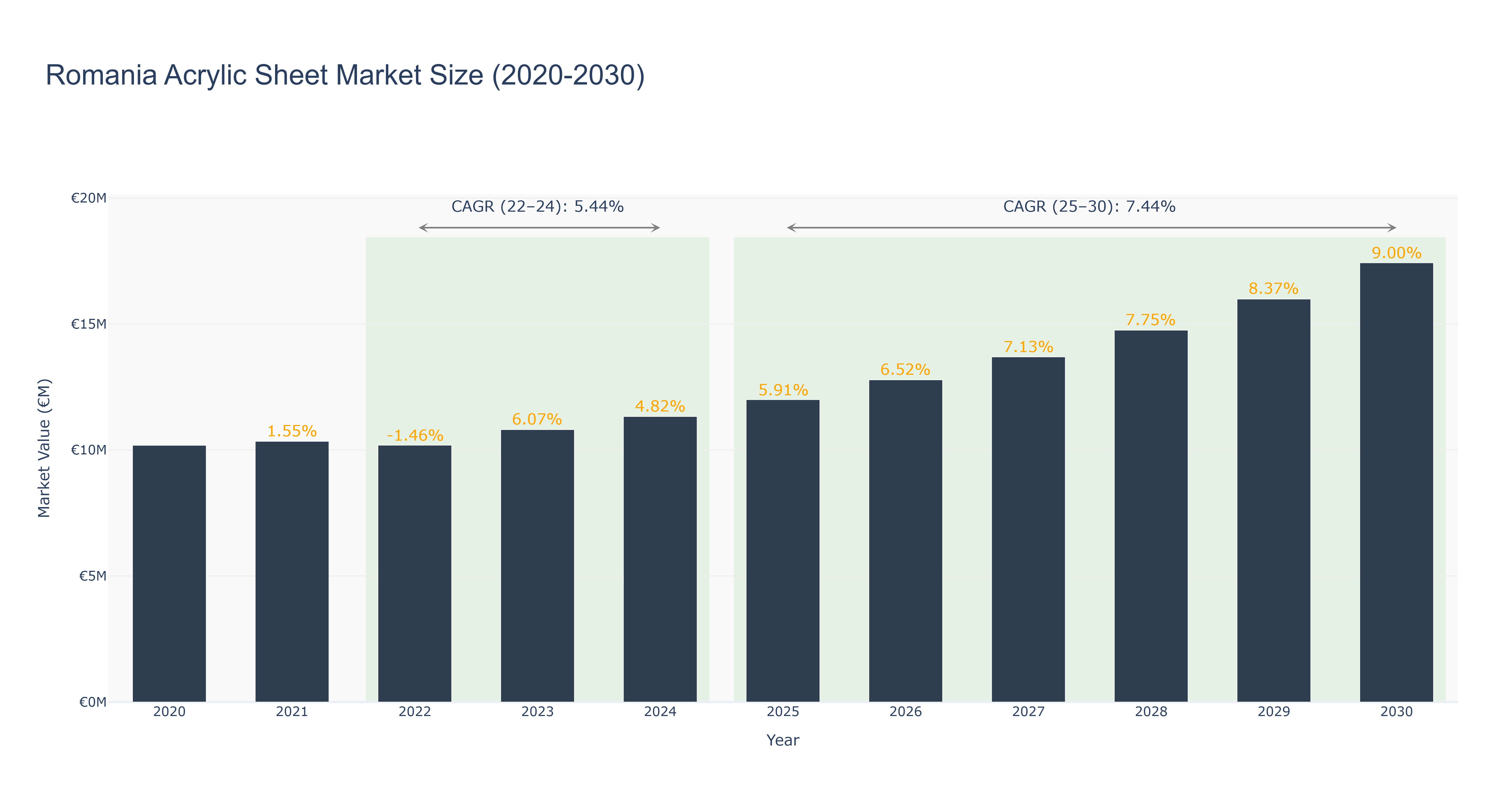
Romania Acrylic Sheet Market has shown a promising growth trajectory over the years. The market peaked at €17.43 million in 2030, with a steady increase from €10.18 million in 2020. The actual market size saw incremental growth from 2020 to 2024, and a robust forecasted growth is expected from 2025 to 2030. The CAGR values reflect a notable increase, with a CAGR of 5.44% from 2022 to 2024 and a higher CAGR of 7.44% from 2025 to 2030. The market's growth can be attributed to increasing demand in construction and automotive industries, as acrylic sheets are favored for their durability and versatility. Looking ahead, Romania is set to witness new infrastructure projects integrating acrylic sheets for sustainable building solutions, driving further market expansion.
Romania Acrylic Sheet Market: Production & Trade Performance (2019-2025)
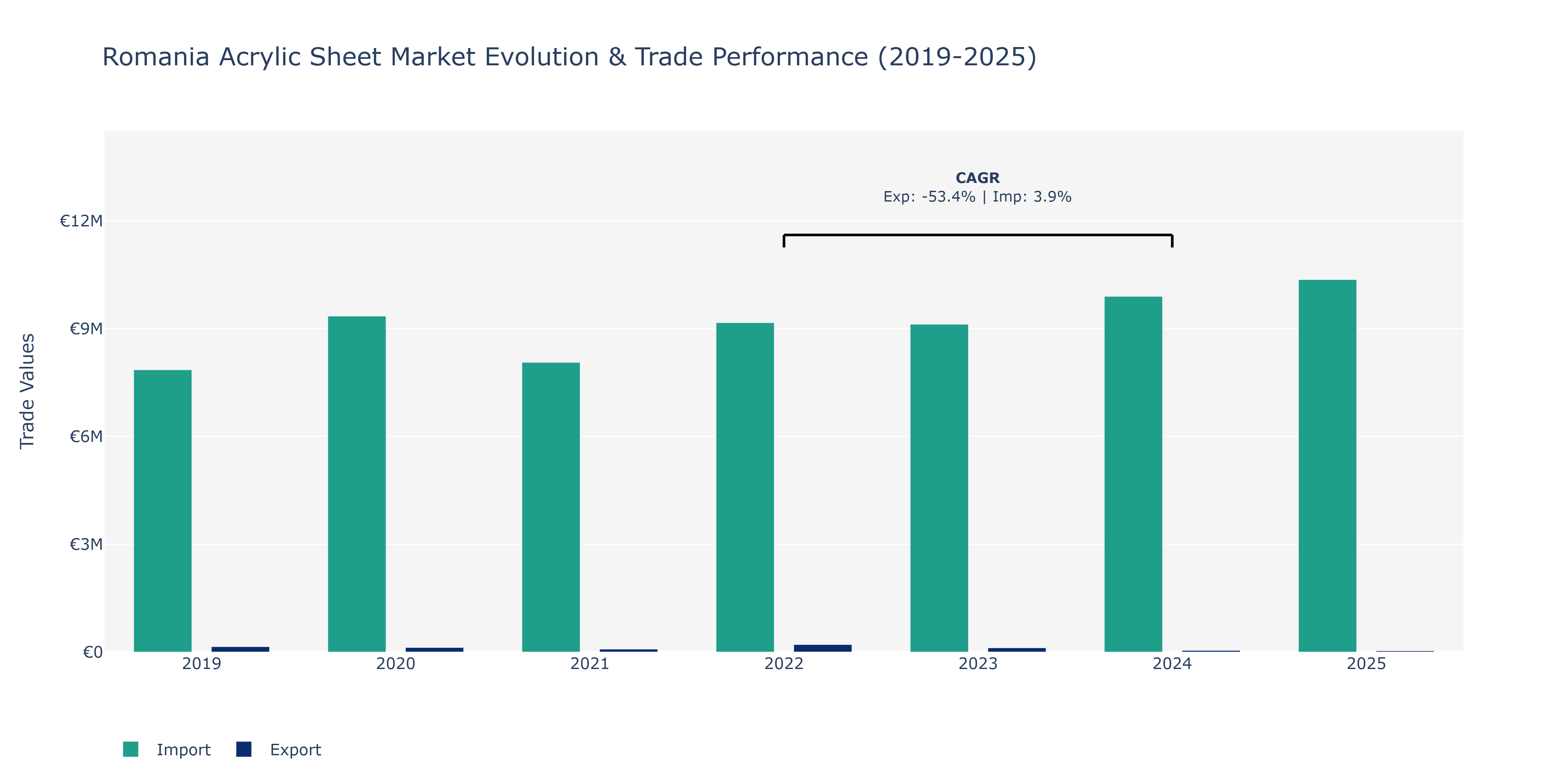
Between 2019 and 2025, Romania's Acrylic Sheet Market witnessed varied trends in exports and imports. Exports notably declined from €149.24 thousand in 2019 to €34.03 thousand in 2025, marking a significant drop in outbound trade. Conversely, imports followed a fluctuating trajectory, increasing from €7.85 million in 2019 to €10.36 million in 2025. Peak import values were recorded in 2025, indicating a growing demand for acrylic sheets in Romania. The decline in exports can be attributed to changing market dynamics, possibly influenced by shifts in global demand, production capacities, or competitive pricing strategies. On the contrary, the consistent growth in imports reflects the country's reliance on foreign suppliers to meet domestic demand for acrylic sheets. These trends suggest a need for local exporters to reassess their strategies and competitiveness in the market to regain momentum.
Romania Acrylic Sheet Market Growth Rate
According to 6Wresearch internal database and industry insights, the Romania Acrylic Sheet Market is projected to grow at a compound annual growth rate (CAGR) of 8.1% during the forecast period (2026-2032).
Topics Covered in the Romania Acrylic Sheet Market Report
The Romania Acrylic Sheet Market Report provides a comprehensive analysis based on Technology and Application. It offers detailed insights into key industry trends, growth drivers, emerging opportunities, competitive developments, and high-growth segments. The report presents an objective assessment of current market dynamics and future prospects, enabling stakeholders to make informed business decisions and develop effective strategies aligned with the evolving acrylic sheet industry landscape.
Romania Acrylic Sheet Market Highlights
| Report Name | Romania Acrylic Sheet Market |
| Forecast period | 2026-2032 |
| CAGR | 8.1% |
| Growing Sector | Architecture & Construction |
Romania Acrylic Sheet Market Synopsis
Romania Acrylic Sheet Market is anticipated to witness considerable growth due to growth in construction activities, increased investment in commercial infrastructure, and growing need for lightweight, tough, and clear materials in various sectors. Acrylic sheets are performance plastic materials that offer superior optical properties, resistance to weathering, impact strength, and formability, making them appropriate for use in glazing, signs, automotive parts, furniture, and medical applications. Moreover, increasing use of green building materials, modernization of manufacturing plants, and growing industrial production are anticipated to drive market demand during the forecast period.
Evaluation of Growth Drivers in the Romania Acrylic Sheet Market (2026-2032)
Below mentioned are some prominent drivers and their influence on the market dynamics:
| Drivers | Primary Segments Affected | Why it Matters (Evidence) |
| Rising Construction and Infrastructure Projects | Architecture & Construction; Cell Cast | Commercial and residential developments increase demand for durable glazing, partitions, and protective acrylic panels. |
| Growth in Retail and Advertising Industry | Visual Communication & Retail; Extruded | Expansion of digital signage and premium display solutions boosts acrylic sheet consumption across retail applications. |
| Increasing Automotive Lightweighting | Automotive & Transportation; Continuous Cast | Vehicle manufacturers increasingly utilize lightweight acrylic components to improve fuel efficiency and design flexibility. |
| Expansion of Healthcare Infrastructure | Medical; Cell Cast | Rising healthcare investments encourage greater use of acrylic sheets in medical equipment, protective barriers, and laboratory applications. |
| Technological Advancements in Manufacturing | All Technologies; All Applications | Improved production efficiency and enhanced product quality support wider industrial adoption and long-term market competitiveness. |
Romania Acrylic Sheet Market is projected to expand at a CAGR of 8.1% during the forecast period of 2026-2032. The market growth is supported by macroeconomic indicators, including Romania's manufacturing sector contributing nearly 19% to national GDP, while annual industrial production continues to recover alongside increasing capital investments. Construction output has shown consistent improvement, with infrastructure spending accounting for more than 5% of GDP in recent years. Additionally, urbanization has exceeded 55%, creating sustained demand for commercial buildings, healthcare facilities, transportation infrastructure, and modern retail spaces where acrylic sheet applications continue to expand across multiple end-user industries.
Evaluation of Restraints in the Romania Acrylic Sheet Market
Below mentioned are some major restraints and their influence on the market dynamics:
| Restraints | Primary Segments Affected | What This Means (Evidence) |
| Volatility in Raw Material Prices | All Technologies; All Applications | Fluctuating prices of methyl methacrylate (MMA) increase production costs and reduce manufacturers' profit margins. |
| High Energy Consumption in Manufacturing | Cell Cast; Continuous Cast | The increase in cost of electricity and natural gas increases production cost which in turn influences price competitiveness. |
| Competition from Alternative Materials | Architecture & Construction; Furniture & Design | The use of polycarbonate, tempered glass, and composite materials hinders the use of acrylic sheets in some areas of application. |
| Environmental Concerns Regarding Plastic Waste | All Technologies; All Applications | The rise of environmental laws encourages manufacturers to develop recyclable materials. |
| Dependence on Imported Raw Materials | Extruded; Continuous Cast | Trade barriers may disrupt the schedule of production and distribution of the products. |
Romania Acrylic Sheet Industry Challenges
Although the Romania Acrylic Sheet Market Growth is expected to maintain steady development throughout the forecast period, manufacturers face various problems which may affect their development in the long run. The problem here is the instability of the price for the petrochemical materials used in the manufacture of acrylic resins and the product itself. In fact, the fluctuation of the industrial producer price in Romania has been more than 5% in some quarters recently, whereas the cost of energy is putting additional strain on margins in the manufacturing industry.
Moreover, keeping high quality of products, meeting European ecological standards, and using recyclable technologies in the manufacture of acrylic sheets are all associated with significant investments in capital. The lack of skilled personnel and tough competition with the foreign producers of cheap acrylic sheets add to the difficulties on the Romanian market.
Romania Acrylic Sheet Market Trends
Emerging trends in the Romania Acrylic Sheet Industry include:
- Growing Preference for Sustainable Acrylic Products: Manufacturers increasingly offer recyclable and eco-friendly acrylic sheets due to the changing requirements of European legislation.
- Increasing Adoption in Modern Architecture: There is a growing use of acrylic sheets in architectural designs for skylights, façades, partitions, and interiors on account of their lightweight, strength, and high transparency.
- Expansion of Digital Signage Applications: Growing spending on commercial advertising, retail upgrades, and smart city projects are expected to drive demand for premium acrylic solutions for display and signage.
- Technological Advancements in Manufacturing: Automation, precision extrusion technologies, and improved casting processes are enabling manufacturers to deliver higher-quality acrylic sheets with reduced production waste.
Investment Opportunities in the Romania Acrylic Sheet Market
Some major investment opportunities in the Romania Acrylic Sheet Market are as follows:
- Expansion of Domestic Acrylic Sheet Manufacturing: Investments in modern plants can help overcome dependence on imports and increase supply to both domestic and international markets.
- Development of Recyclable Acrylic Materials: Companies which invest in circular economy and eco-friendly acrylic technology can take advantage of the increasing government restrictions and customer preference for green products.
- Advanced Fabrication and Customization Services: Setting up fabrication plants for services such as laser cutting, CNC machining, and thermoforming can present several investment opportunities in construction, automotive, and retail sectors.
Top Players in Romania Acrylic Sheet Market
Some leading players operating in the Romania Acrylic Sheet Market include:
1. Röhm GmbH
| Company Name | Röhm GmbH |
|---|---|
| Established Year | 2019 |
| Headquarters | Darmstadt, Germany |
| Official Website | Click Here |
Röhm manufactures PLEXIGLAS® acrylic sheets for architecture, automotive, medical, and industrial applications.
2. Trinseo PLC
| Company Name | Trinseo PLC |
|---|---|
| Established Year | 2010 |
| Headquarters | Wayne, Pennsylvania, United States |
| Official Website | Click Here |
Trinseo supplies acrylic sheet materials for construction, transportation, healthcare, and display applications.
3. Plaskolite LLC
| Company Name | Plaskolite LLC |
|---|---|
| Established Year | 1950 |
| Headquarters | Columbus, Ohio, United States |
| Official Website | Click Here |
Plaskolite manufactures acrylic sheet products for glazing, displays, lighting, and industrial applications.
4. Mitsubishi Chemical Group Corporation
| Company Name | Mitsubishi Chemical Group Corporation |
|---|---|
| Established Year | 1933 |
| Headquarters | Tokyo, Japan |
| Official Website | Click Here |
Mitsubishi Chemical produces acrylic sheet solutions for medical, automotive, electronics, and construction industries.
5. 3A Composites GmbH
| Company Name | 3A Composites GmbH |
|---|---|
| Established Year | 1969 |
| Headquarters | Sins, Switzerland |
| Official Website | Click Here |
3A Composites manufactures acrylic sheet products for architectural, transportation, and visual communication applications.
Government Regulations Introduced in the Romania Acrylic Sheet Market
According to Romania's Government Data, there are several initiatives that are currently helping to foster sustainable development in the acrylic sheet industry. Romania is implementing the National Recovery and Resilience Plan (PNRR) to promote energy-saving construction materials and environmentally friendly production processes. Moreover, producers abide by the EU REACH regulation on safe chemical usage and the Waste Framework Directive to recycle and embrace circular economy of plastic materials. Romania has also implemented energy efficiency initiatives within the context of the European Green Deal, whereas the development of infrastructure has been giving more preference to eco-friendly building materials. This creates favorable conditions for innovation and investment in the industry value chain.
Future Insights of the Romania Acrylic Sheet Market
Romanian Acrylic Sheet Market is set to grow at a steady pace in the coming years, driven by the rising construction activities, increasing modernization of industries, and rising demand for lightweight and robust materials across diverse end-use applications. By 2032, Romania will be making increased investments towards sustainable infrastructure and rising numbers of green building projects and energy-efficient buildings will result in further use of acrylic sheets. The manufacturing industry in Romania generates about 19% of the GDP, and exports contribute more than 40% towards the economy's overall contribution, which provides a favourable outlook towards industrial material demand.
Market Segmentation Analysis
This report presents a detailed analysis of the market segments along with their leading categories.
By Technology – Cell Cast Technology Dominates Market, Continuous Cast Records Fastest Growth
Cell Cast technology accounted for an estimated 46.80% share of the Romania Acrylic Sheet Market in 2025 owing to its superior optical clarity, excellent surface finish, and extensive use in premium architectural, medical, and industrial applications. Manufacturers continue to prefer Cell Cast sheets where higher durability and customization are required. On the other hand, the Continuous Cast technology is estimated to witness the highest CAGR of 7.5% from 2026-2032 due to rising preference towards cost-effective manufacturing process, consistency in quality, and growing applications in construction, automotive, and commercial fabrication industries.
By Application – Architecture & Construction Leads Market, Medical Segment Witnesses Highest Growth
The architecture & construction application accounted for the maximum market share of about 38.60% in 2025 owing to the growing use of acrylic sheets in commercial building constructions, residential construction, façades, skylights, partitions, and interior design. Lightweight and weatherproof nature of the material further propels its usage in modern infrastructural construction. On the other hand, the medical application is projected to grow at the highest CAGR of 7.8% up to 2032 owing to growing application of acrylic sheets in hospitals, laboratories, and healthcare equipment industries.
By End-use Industry – Commercial Infrastructure Dominates Market, Automotive & Transportation Shows Strong Growth
According to Sumit Sagar, Senior Research Analyst, 6Wresearch, Commercial infrastructure continued its dominance within end-use industry and accounted for almost 34.90% of the Romania Acrylic Sheet Market Share in 2025, owing to increasing investments in shopping centers, office buildings, hospitality developments, and retail spaces that needed high-end glazing and display solutions. Increased remodeling operations aided in the market growth throughout cities. At the same time, the Automotive & Transportation sector is expected to witness CAGR of 7.3% from 2026-2032, attributed to growing requirements for lightweight parts, enhanced aesthetics of vehicles, fuel efficiency considerations, and increased production activities within the automotive sector in Central and Eastern Europe.
Note: Market size estimations and growth projections presented in this report are based on 6Wresearch's proprietary forecasting methodology, utilizing the latest available industry data, government publications, and primary research inputs.
Key Attractiveness of the Report
- 10 Years of Market Numbers.
- Historical Data Starting from 2022 to 2025.
- Base Year: 2025.
- Forecast Data until 2032.
- Key Performance Indicators Impacting the Market.
- Major Upcoming Developments and Projects.
Key Highlights of the Report:
- Romania Acrylic Sheet Market Outlook
- Market Size of Romania Acrylic Sheet Market, 2025
- Forecast of Romania Acrylic Sheet Market, 2032
- Historical Data and Forecast of Romania Acrylic Sheet Revenues & Volume for the Period 2022-2032F
- Romania Acrylic Sheet Market Trend Evolution
- Romania Acrylic Sheet Market Drivers and Challenges
- Romania Acrylic Sheet Price Trends
- Romania Acrylic Sheet Porter's Five Forces
- Romania Acrylic Sheet Industry Life Cycle
- Historical Data and Forecast of Romania Acrylic Sheet Market Revenues & Volume By Technology for the Period 2022-2032F
- Historical Data and Forecast of Romania Acrylic Sheet Market Revenues & Volume By Cell Cast for the Period 2022-2032F
- Historical Data and Forecast of Romania Acrylic Sheet Market Revenues & Volume By Extruded for the Period 2022-2032F
- Historical Data and Forecast of Romania Acrylic Sheet Market Revenues & Volume By Continuous Cast for the Period 2022-2032F
- Historical Data and Forecast of Romania Acrylic Sheet Market Revenues & Volume By Application for the Period 2022-2032F
- Historical Data and Forecast of Romania Acrylic Sheet Market Revenues & Volume By Architecture & Construction for the Period 2022-2032F
- Historical Data and Forecast of Romania Acrylic Sheet Market Revenues & Volume By Furniture & Design for the Period 2022-2032F
- Historical Data and Forecast of Romania Acrylic Sheet Market Revenues & Volume By Automotive & Transportation for the Period 2022-2032F
- Historical Data and Forecast of Romania Acrylic Sheet Market Revenues & Volume By Visual Comm. & Retail for the Period 2022-2032F
- Historical Data and Forecast of Romania Acrylic Sheet Market Revenues & Volume By Electronics & Energy for the Period 2022-2032F
- Historical Data and Forecast of Romania Acrylic Sheet Market Revenues & Volume By Medical for the Period 2022-2032F
- Historical Data and Forecast of Romania Acrylic Sheet Market Revenues & Volume By Sanitary for the Period 2022-2032F
- Romania Acrylic Sheet Import Export Trade Statistics
- Market Opportunity Assessment By Technology
- Market Opportunity Assessment By Application
- Romania Acrylic Sheet Top Companies Market Share
- Romania Acrylic Sheet Competitive Benchmarking By Technical and Operational Parameters
- Romania Acrylic Sheet Company Profiles
- Romania Acrylic Sheet Key Strategic Recommendations
Market Covered
The report offers a comprehensive study of the subsequent market segments:
By Technology
- Cell Cast
- Extruded
- Continuous Cast
By Application
- Architecture & Construction
- Furniture & Design
- Automotive & Transportation
- Visual Communication & Retail
- Electronics & Energy
- Medical
- Sanitary






































