Romania Active Wheelchair Market Growth Rate
According to 6Wresearch internal database and industry insights, the Romania Active Wheelchair Market is projected to grow at a compound annual growth rate (CAGR) of 6.7% during the forecast period (2026-2032).
Romania Active Wheelchair Market Year-wise Growth Rate and Key Drivers (2022-2032)
This graph illustrates the annual growth rates of the Romania Active Wheelchair Market from 2022 to 2032, highlighting a steady upward trajectory and projected market expansion over the forecast period.
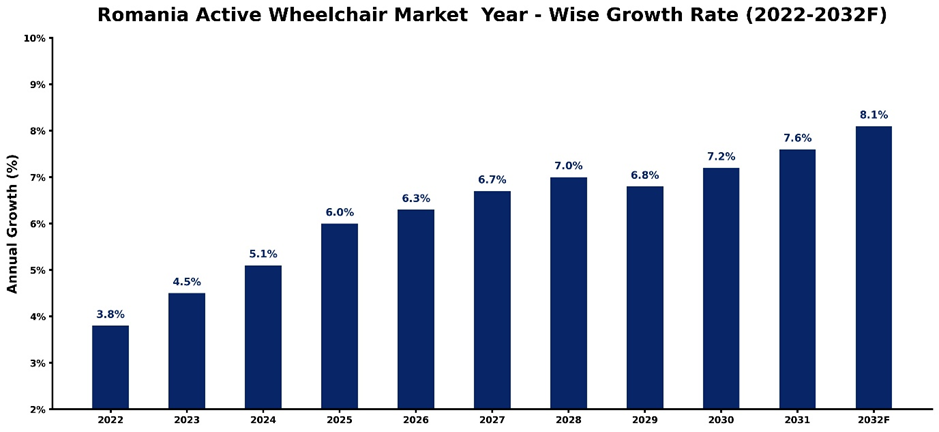 The following table summarizes the historical and forecasted growth rates of the Romania Active Wheelchair Market, along with the rationale behind each year’s performance.
| Year | Estimated Growth (%) | Market Rationale |
| 2022 | 3.8% | Growing rehabilitation requirements and gradual improvement in access to mobility aids supported demand for active wheelchairs. |
| 2023 | 4.5% | Higher awareness of independent mobility and increasing referrals for rehabilitation services supported market expansion. |
| 2024 | 5.1% | Expansion of assistive-device availability and stronger demand from people with neurological and mobility-related conditions encouraged adoption. |
| 2025 | 6% | Increasing disability-related care needs, ageing demographics, and wider availability of advanced manual and power wheelchairs supported market growth. |
| 2026 | 6.3% | Greater focus on rehabilitation, assistive-device provision, and accessibility improvements is expected to strengthen demand for active mobility solutions. |
| 2027 | 6.7% | Rising adoption of lightweight manual wheelchairs and technologically advanced power wheelchairs is projected to expand the addressable user base. |
| 2028 | 7% | Increasing demand for customized seating, improved maneuverability, and mobility solutions for spinal cord injuries and cerebral palsy is expected to accelerate adoption. |
| 2029 | 6.8% | Growth remains positive as replacement demand increases, although affordability constraints and reimbursement limitations may moderate the pace of expansion. |
| 2030 | 7.2% | Greater integration of smart controls, power-assist technologies, and rehabilitation-focused mobility solutions is projected to stimulate market development. |
| 2031 | 7.6% | Expansion of specialized rehabilitation centers and increasing emphasis on independent living are expected to improve access to advanced wheelchair solutions. |
| 2032 | 8.1% | Stronger accessibility policies, ageing-related mobility needs, and continued product innovation are expected to sustain robust demand through the forecast period. |
Topics Covered in the Romania Active Wheelchair Market Report
The Romania Active Wheelchair Market Report provides a comprehensive analysis based on Product Type and Application. It offers detailed insights into key industry trends, growth drivers, emerging opportunities, competitive developments, and high-growth segments. The report presents an objective assessment of current dynamics and future prospects, enabling stakeholders to make informed business decisions and develop effective strategies aligned with the evolving mobility and rehabilitation landscape.
Vietnam Adeno Associated Virus CDMO Market Highlights
| Report Name | Romania Active Wheelchair Market |
| Forecast period | 2026-2032 |
| CAGR | 6.7% |
| Growing Sector | Healthcare |
Romania Active Wheelchair Market Synopsis
Romania Active Wheelchair Market is anticipated to record notable growth due to growing demand for independent mobility, rehabilitation services, and sophisticated assistive devices. Active wheelchairs are specially made mobility devices meant to offer more freedom of movement, comfort, and independence to the user. Manual wheelchairs concentrate on being light and nimble while power wheelchairs offer the user motorized mobility. The factors that are creating demand for active wheelchairs are the aging population, mobility difficulties associated with disabilities, and the growing focus on accessibility in Romania. It is expected that rehabilitation services, procurement of assistive technology, and healthcare infrastructure will encourage their use.
Evaluation of Growth Drivers in the Romania Active Wheelchair Market (2026- 2032)
Below mentioned are some prominent drivers and their influence on the market dynamics:
| Drivers | Primary Segments Affected | Why it Matters (Evidence) |
| Rising Demand for Independent Mobility | Manual Wheelchairs; Power Wheelchairs | Higher demand for independent living leads to higher demands for lighter, mobile, and customized mobility aids. |
| Growth in Rehabilitation Services | Power Wheelchairs; Spinal Cord Injury | Expanding rehabilitation requirements create additional demand for customized mobility equipment supporting recovery and long-term independence. |
| Ageing Population | Power Wheelchairs; Other Application | Romania’s population is ageing, strengthening long-term mobility requirements |
| Increasing Accessibility Initiatives | Manual Wheelchairs; Power Wheelchairs | The accessibility monitoring framework covers built environments, transport, ICT, and public policies, supporting improvements in mobility access. |
| Expansion of Assistive Device Provision | Manual Wheelchairs; Power Wheelchairs | Health insurance framework includes medical devices intended for the recovery of organic or functional deficiencies, supporting access to assistive mobility equipment. |
Romania Active Wheelchair Market is expected to expand at a CAGR of 6.7% during the forecast period of 2026-2032, supported by demographic ageing, increasing rehabilitation needs, and a broader policy focus on accessibility and independent living. Romania’s population is ageing rapidly, while disability and poverty-related challenges continue to influence access to mobility and assistive solutions. These demographic and socioeconomic conditions highlight the importance of affordable assistive equipment, reimbursement mechanisms, and accessible procurement channels. In addition, growing awareness of assistive technologies and rehabilitation services is encouraging demand for mobility solutions that enhance comfort and participation in daily activities.
Evaluation of Restraints in the Romania Active Wheelchair Market
Below mentioned are some major restraints and their influence on the market dynamics:
| Restraints | Primary Segments Affected | What This Means (Evidence) |
| High Cost of Advanced Wheelchairs | Power Wheelchairs; Spinal Cord Injury | Advanced motors, batteries, seating systems, and electronic controls increase purchase costs and may restrict affordability. |
| Limited Reimbursement Coverage | Manual Wheelchairs; Power Wheelchairs | Reimbursement limitations can delay purchases or encourage users to select basic products rather than highly customized solutions. |
| Shortage of Specialized Assessment Services | Power Wheelchairs; Cerebral Palsy | Limited access to trained rehabilitation professionals can make accurate wheelchair configuration and fitting more difficult. |
| Accessibility Barriers | Manual Wheelchairs; Other Application | Uneven accessibility in buildings, public transport, and public spaces can reduce the practical benefits of mobility equipment. |
| Maintenance and Replacement Challenges | Power Wheelchairs; Manual Wheelchairs | Specialized components, batteries, repairs, and replacement parts can increase ownership costs and create service delays. |
Romania Active Wheelchair Industry Challenges
While the Romania Active Wheelchair Market Growth shows promising prospects, the operation in the local market is associated with unique difficulties. These difficulties mostly concern the cost, access, special fittings, maintenance, and various mobility needs of the customers. In 2024, Romania had 27.9% of its citizens at risk of poverty or social exclusion, which makes the cost of innovative assistive devices a significant factor for those who have to use mobility products on a long-term basis. At the same time, Romania has 30 indicators in its monitoring system for assessing accessibility of 30 parameters related to buildings, transport, ICT, and policy making. This implies that accessibility is a multidimensional problem, not just a product requirement, thus active wheelchair providers should be ready to offer their products together with competitive prices and fitting services.
Romania Active Wheelchair Market Trends
Major trends influencing the Romania Active Wheelchair Industry include:
- Lightweight Manual Wheelchairs are the New Norm: The manufacturing companies are now focusing on developing lightweight frames as well as more responsive wheelchairs that enhance maneuverability and make it easier for the user.
- Increased Use of Power Wheelchairs: People who face a lot of difficulties in moving around are now preferring the use of power wheelchairs that come with better adjustments.
- Focus on Customized Seating Solutions: More wheelchair manufacturers are now focusing on the development of customized seating solutions.
Investment Opportunities in the Romania Active Wheelchair Market
Emerging investment opportunities in the Romania Active Wheelchair Market include the following:
- Distributing Technologically Advanced Power Wheelchairs: Enhanced distribution channels for technologically advanced power wheelchairs could help increase their availability beyond big urban healthcare facilities.
- Production of Lightweight Manual Wheelchairs: There may be a need for investment in the manufacture of lightweight and customizable manual wheelchairs to satisfy customer needs.
- Development of Rehabilitation Centers: The development of wheelchair testing and customization centers would help to open up avenues for comprehensive wheelchair services.
Top Players in Romania Active Wheelchair Market
Some leading players operating in the Romania Active Wheelchair Market include:
1. Ottobock SE & Co. KGaA
| Company Name | Ottobock SE & Co. KGaA |
|---|---|
| Established Year | 1919 |
| Headquarters | Duderstadt, Germany |
| Official Website | Click Here |
Ottobock provides manual and power wheelchairs, including active-use and customized rehabilitation solutions designed to improve independence, mobility, comfort, and everyday functionality.
2. Sunrise Medical LLC
| Company Name | Sunrise Medical LLC |
|---|---|
| Established Year | 1983 |
| Headquarters | Fresno, USA |
| Official Website | Click Here |
Sunrise Medical develops manual and power wheelchairs, seating systems, and mobility technologies designed for active users, rehabilitation needs, positioning, and independent daily mobility.
3. Permobil AB
| Company Name | Permobil AB |
|---|---|
| Established Year | 1967 |
| Headquarters | Kista, Sweden |
| Official Website | Click Here |
Permobil develops power and manual wheelchairs, seating, positioning, and power-assist technologies with emphasis on personalized mobility, advanced functionality, and user independence.
4. Pride Mobility Products Corporation
| Company Name | Pride Mobility Products Corporation |
|---|---|
| Established Year | 1986 |
| Headquarters | Duryea, USA |
| Official Website | Click Here |
Pride Mobility manufactures power wheelchairs and complex rehabilitation products, incorporating technologically advanced mobility features designed to support independence and everyday quality of life.
Government Regulations Introduced in the Romania Active Wheelchair Market
According to Romania’s Government Data, several policies and healthcare measures support access to rehabilitation services, medical devices, and assistive technologies for people with disabilities. Romania’s Law No. 448/2006 requires public authorities to support social inclusion and establish conditions for assistive technology and specialized rehabilitation services.
The legislation also provides eligible people with disabilities access to medical devices in outpatient care under the national health insurance framework. In addition, the National Health Insurance House (CNAS) provides the framework through which insured individuals receive medical devices and healthcare services. A 2023 government-approved framework also expanded preventive and healthcare access, while assistive-technology subsidy procedures have supported access to technologies and devices through publicly co-financed programs.
Future Insights of the Romania Active Wheelchair Market
Romania Active Wheelchair Market is expected to evolve toward more personalized, technologically advanced, and rehabilitation-oriented mobility solutions through 2032. The country’s ageing demographic profile is likely to remain an important demand factor, with Romania’s median age increasing by 8.6 years between 2005 and 2025, representing the largest increase among EU Member States during this period. Demand is also expected to benefit from policy focus on accessibility and assistive technology, while medical-device reimbursement mechanisms can support eligible users. Power wheelchairs are likely to gain traction as users seek greater independence, adjustable seating, and improved outdoor mobility. At the same time, lightweight manual wheelchairs should remain important among active users seeking maneuverability and easier transportation.
Market Segmentation Analysis
This report presents a detailed analysis of the market segments along with their leading categories.
By Product Type- Manual Wheelchairs Maintain Market Leadership, Power Wheelchairs Set for Rapid Expansion
Manual wheelchairs are estimated to secure a dominant 61.40% share of the Romania Active Wheelchair Market in 2025, supported by comparatively lower acquisition costs, broad clinical applicability, ease of transportation, and established use across rehabilitation and home-care settings. Conversely, power wheelchairs are projected to advance at a CAGR of 8.15% during 2026–2032, driven by rising demand for independent mobility, advanced seating functions, electronic controls, and improved outdoor performance. Increasing ageing-related mobility requirements and rehabilitation needs are expected to encourage healthcare providers and users to consider powered solutions for long-term mobility support.
By Application- Spinal Cord Injury Accounts for Major Demand, Cerebral Palsy Shows Strong Growth
According to Sumit Sagar, Senior Research Analyst, 6Wresearch, Spinal Cord Injury applications are estimated to account for 29.70% of the Romania Active Wheelchair Market share in 2025, reflecting the substantial need for long-term mobility support, rehabilitation, specialized seating, and independent movement among affected users. Meanwhile, Cerebral Palsy applications are anticipated to expand at a CAGR of 7.82% through 2032, supported by increasing emphasis on early rehabilitation, customized seating, posture management, and mobility independence.
Note: Market size estimations and growth projections presented in this report are based on 6Wresearch's proprietary forecasting methodology, utilizing the latest available industry data, government publications, and primary research inputs.
Key Attractiveness of the Report
- 10 Years of Market Numbers.
- Historical Data Starting from 2022 to 2025.
- Base Year: 2025.
- Forecast Data until 2032.
- Key Performance Indicators Impacting the Market.
- Major Upcoming Developments and Projects.
Key Highlights of the Report:
- Romania Active Wheelchair Market Outlook
- Market Size of Romania Active Wheelchair Market, 2025
- Forecast of Romania Active Wheelchair Market, 2032
- Historical Data and Forecast of Romania Active Wheelchair Revenues & Volume for the Period 2022-2032
- Romania Active Wheelchair Market Trend Evolution
- Romania Active Wheelchair Market Drivers and Challenges
- Romania Active Wheelchair Price Trends
- Romania Active Wheelchair Porter's Five Forces
- Romania Active Wheelchair Industry Life Cycle
- Historical Data and Forecast of Romania Active Wheelchair Market Revenues & Volume By Product Type for the Period 2022-2032
- Historical Data and Forecast of Romania Active Wheelchair Market Revenues & Volume By Manual Wheelchairs for the Period 2022-2032
- Historical Data and Forecast of Romania Active Wheelchair Market Revenues & Volume By Power Wheelchairs for the Period 2022-2032
- Historical Data and Forecast of Romania Active Wheelchair Market Revenues & Volume By Application for the Period 2022-2032
- Historical Data and Forecast of Romania Active Wheelchair Market Revenues & Volume By Alzheimer's for the Period 2022-2032
- Historical Data and Forecast of Romania Active Wheelchair Market Revenues & Volume By Diabetes for the Period 2022-2032
- Historical Data and Forecast of Romania Active Wheelchair Market Revenues & Volume By Spinal Cord Injury for the Period 2022-2032
- Historical Data and Forecast of Romania Active Wheelchair Market Revenues & Volume By Cerebral Palsy for the Period 2022-2032
- Historical Data and Forecast of Romania Active Wheelchair Market Revenues & Volume By Other Application for the Period 2022-2032
- Romania Active Wheelchair Import Export Trade Statistics
- Market Opportunity Assessment By Product Type
- Market Opportunity Assessment By Application
- Romania Active Wheelchair Top Companies Market Share
- Romania Active Wheelchair Competitive Benchmarking By Technical and Operational Parameters
- Romania Active Wheelchair Company Profiles
- Romania Active Wheelchair Key Strategic Recommendations
Market Covered
The report offers a comprehensive study of the subsequent market segments:
By Product Type
- Manual Wheelchairs
- Power Wheelchairs
By Application
- Alzheimer's
- Diabetes
- Spinal Cord Injury
- Cerebral Palsy
- Other Application






































