Romania Adaptogen Market Growth Rate
According to 6Wresearch internal database and industry insights, the Romania Adaptogen Market is projected to grow at a compound annual growth rate (CAGR) of 7.1% during the forecast period (2026-2032).
Romania Adaptogen Market Year-wise Growth Rate and Key Drivers (2022-2032)
This graph illustrates the annual growth rates of the Romania Adaptogen Market from 2022 to 2032, highlighting a steady upward trajectory and projected market expansion over the forecast period.
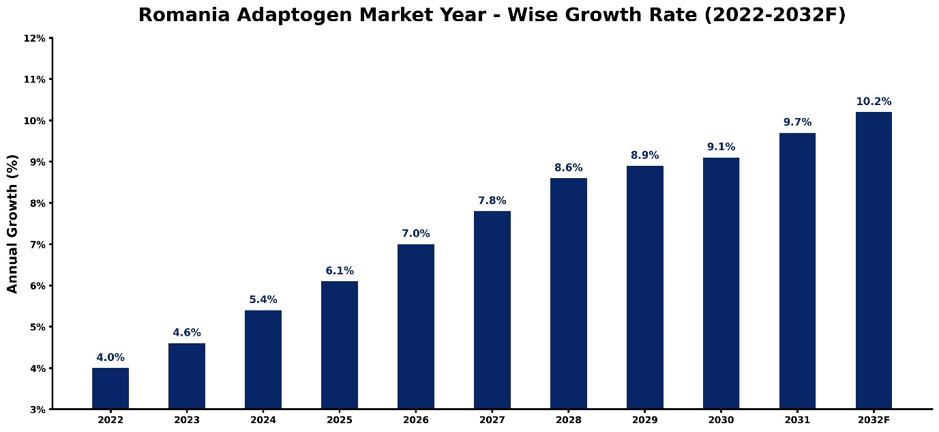
The following table presents the estimated annual growth rates of the market for each year, along with the key factors influencing market performance during the respective period. The values are intended to highlight year-wise drivers rather than provide a direct comparison between individual years.
| Year | Estimated Growth (%) | Market Rationale |
| 2022 | 4% | Growing consumer interest in natural wellness products is supporting market growth. |
| 2023 | 4.6% | Wider availability of herbal supplements is increasing product adoption. |
| 2024 | 5.4% | Rising awareness of adaptogens is driving consumer demand. |
| 2025 | 6.1% | Increasing online availability is improving access to adaptogen products. |
| 2026 | 7% | Growing demand for stress-management products is supporting market expansion. |
| 2027 | 7.8% | Greater use of adaptogens in nutraceuticals is increasing demand. |
| 2028 | 8.6% | Product innovation in sleep, energy, and stress support is driving growth. |
| 2029 | 8.9% | Wider use of adaptogens in functional beverages is creating new opportunities. |
| 2030 | 9.1% | Growing e-commerce adoption is expanding the reach of botanical products. |
| 2031 | 9.7% | Increasing demand for standardized herbal formulations is supporting market growth. |
| 2032 | 10.2% | The integration of adaptogens into everyday wellness products is driving market expansion. |
Topics Covered in the Romania Adaptogen Market Report
The Romania Adaptogen Market Report provides a comprehensive analysis based on Nature, End Use, and Sales Channel. It offers detailed insights into key industry trends, growth drivers, emerging opportunities, competitive developments, and high-growth segments. The report presents an objective assessment of current dynamics and future prospects, enabling stakeholders to make informed business decisions and develop effective strategies aligned with the evolving industry landscape.
Romania Adaptogen Market Highlights
| Report Name | Romania Adaptogen Market |
| Forecast period | 2026-2032 |
| CAGR | 7.1% |
| Growing Sector | Nutraceuticals |
Romania Adaptogen Market Synopsis
Romania Adaptogen Market is anticipated to record notable growth as consumers increasingly seek plant-based solutions for stress management, energy, sleep support, and everyday wellness. Adaptogens are plant-based components that are used in dietary supplements, functional foods and drinks, as well as in the formulation of cosmetic products for stress-induced physical and psychological issues. Some of the popular adaptogenic ingredients are ashwagandha, ginseng, astragalus, cordyceps, turmeric, and holy basil. The use of adaptogenic extracts is increasing in Romania natural health products. Increased availability through online channels, pharmacy products, and interest in natural health products is facilitating this transition to more mainstream product formulations.
Evaluation of Growth Drivers in the Romania Adaptogen Market (2026-2032)
Below mentioned are some prominent drivers and their influence on the market dynamics:
| Drivers | Primary Segments Affected | Why it Matters (Evidence) |
| Increased Consumer Awareness | Nutraceuticals; Health & Wellness Stores | Greater awareness of stress, sleep, and energy support is encouraging consumers to explore adaptogen-based products. |
| Rising Demand for Natural Ingredients | Natural/Organic; Food & Beverages | Consumers' preference for botanical and clean label ingredients contributes to the increased popularity of natural adaptogen formulas. |
| Expansion of Online Retail | Online Retailing; Direct/B2B | E-commerce gives consumers access to a broader selection of specialist adaptogen products and standardized extracts. |
| Product Innovation and Standardization | Nutraceuticals; Pharmaceuticals | Companies are introducing concentrated and standardized formulations around ashwagandha, rhodiola, ginseng, and other botanicals. |
| Growing Functional Food and Beverage Use | Food & Beverages; Nutraceuticals | Adaptogens are increasingly incorporated into convenient products such as teas, drinks, powders, and wellness blends. |
Romania Adaptogen Market is expected to grow at a CAGR of 7.1% during the forecast period of 2026-2032, supported by wider consumer interest in stress-management and preventive wellness products, while established Romanian supplement companies are adding standardized adaptogen formulations to their portfolios. Therefore, changing economic conditions may encourage value-focused purchasing, favoring clearly positioned and affordable wellness products.
Evaluation of Restraints in the Romania Adaptogen Market
Below mentioned are some major restraints and their influence on the market dynamics:
| Restraints | Primary Segments Affected | What This Means (Evidence) |
| Limited Standardization Across Products | Natural/Organic; Nutraceuticals | Differences in extract strength and formulation quality can make products difficult for consumers to compare. |
| Regulatory Restrictions on Health Claims | All Types; Food & Beverages | European and Romanian requirements can limit how brands communicate benefits associated with adaptogens. |
| Premium Pricing of Standardized Extracts | Nutraceuticals; Health & Wellness Stores | Higher-quality standardized ingredients can increase retail prices and reduce affordability for price-sensitive consumers. |
| Limited Consumer Understanding | All Types; Other Retailing Format | Some consumers remain unfamiliar with differences between adaptogens, herbs, vitamins, and conventional supplements. |
| Competition from Conventional Wellness Products | Nutraceuticals; Pharmaceuticals | Vitamins, minerals, sports supplements, and conventional stress-support products compete for the same consumer spending. |
Romania Adaptogen Market Industry Challenges
Despite the Romania Adaptogen Market Growth, the industry continues to face practical challenges related to product consistency, consumer education, regulatory requirements, and pricing. The use of foreign plant-based components in a majority of products makes firms vulnerable to the effects of sourcing issues, changes in currency exchange rates, and disruptions in the supply chain. The inconsistency in the concentrations of extracts used in different products could be another issue of concern since this would make it difficult for consumers to compare them. There is a need for marketers of products to observe proper compliance with EU regulations on supplements since they could relate to stress, sleep, immunity, or brain functionality.
Romania Adaptogen Market Trends
Key developments impacting the Romania Adaptogen Market are highlighted below:
- Rising Ashwagandha Adoption: Ashwagandha is gaining visibility in Romanian supplement portfolios, with local brands offering standardized extracts aimed at stress and everyday wellness.
- Growth of Multi-Adaptogen Formulas: Combination supplements containing ashwagandha, rhodiola and ginseng are increasing to develop distinct stress relief and energy formulas.
- Expansion of Online Wellness Retail: E-commerce is increasing access to specialist adaptogen products, including powders, capsules, blends, and standardized extracts.
- Shift Toward Standardized Extracts: Consumers and retailers are increasingly exposed to products specifying active-compound concentrations, supporting greater transparency and product differentiation.
Investment Opportunities in the Romania Adaptogen Market
Promising investment avenues in the Romania Adaptogen Market are presented below:
- Standardized Botanical Extract Production – Local processing and formulation capabilities can reduce dependence on imported finished products while supporting consistent ingredient quality.
- Adaptogenic Functional Beverages – Investors can develop teas, coffees, smoothies, and ready-to-drink products combining familiar formats with selected adaptogenic ingredients.
- Premium Nutraceutical Formulations – High-grade capsules and powders containing standardized ashwagandha, ginseng, rhodiola, and cordyceps could target individuals that seek something more specific.
- Online Direct-to-Consumer Platforms – Customized e-commerce sites might provide more diverse product lines, learning resources, subscription services, and personalized wellness plans.
Top Players in Romania Adaptogen Market
Some leading players operating in the Romania Adaptogen Market include:
1. Alevia
| Company Name | Alevia |
| Established Year | 1994 |
| Headquarters | Fălticeni, Suceava, Romania |
| Official Website | Click Here |
Alevia develops Romanian-made dietary supplements and natural products, including standardized adaptogen formulations featuring ashwagandha, rhodiola, and Siberian ginseng for stress and vitality support.
2. Zenyth Pharmaceuticals
| Company Name | Zenyth Pharmaceuticals |
| Established Year | 2007 |
| Headquarters | Bistrița, Neamț, Romania |
| Official Website | Click Here |
Zenyth Pharmaceuticals produces premium dietary supplements and offers standardized KSM-66 ashwagandha products positioned around stress resilience, mental balance, and everyday wellness.
3. Fares
| Company Name | Fares |
| Established Year | 1929 |
| Headquarters | Orăștie, Hunedoara, Romania |
| Official Website | Click Here |
Fares combines long-standing Romanian phytotherapy expertise with modern herbal products, including ashwagandha and ginseng formulations aimed at supporting energy, resilience, and wellbeing.
4. Secom
| Company Name | Secom |
| Established Year | 1991 |
| Headquarters | Bucharest, Romania |
| Official Website | Click Here |
Secom distributes and develops natural health products in Romania, with adaptogen offerings such as ashwagandha and rhodiola supporting its broader wellness and supplement portfolio.
5. Herbagetica
| Company Name | Herbagetica |
| Established Year | 2010 |
| Headquarters | Brașov, Romania |
| Official Website | - |
Herbagetica develops plant-based supplements using standardized botanical extracts, with ashwagandha, rhodiola, ginseng, and other adaptogens incorporated into stress and vitality-oriented formulations.
Government Initiatives Introduced in the Romania Adaptogen Market
According to Romania's Government Data, multiple initiatives aim to strengthen prevention, health promotion, and the wider health system. For instance, the National Health Strategy 2023–2030 emphasizes prevention, accessible health services, digital health, research, and infrastructure investment. In 2025, the Government also approved a national cardiovascular strategy for 2025–2030, including measures to improve early-diagnosis capacity and strengthen community care. Separately, the Ministry of Health published an order concerning permitted vitamins, minerals, and their forms for use in food supplements. Together, these measures support a more structured wellness environment, although they do not specifically subsidize adaptogen products.
Future Insights of the Romania Adaptogen Market
Romania Adaptogen Industry is set to become a more organized market as consumers as well as retailers focus more on ingredient authenticity, potency, and claims on products. Ashwagandha will continue being one of the top ingredients in the market, and ginseng, rhodiola, cordyceps, and holy basil are predicted to become popular ingredients through formulation for stress, energy, cognitive functions, and recovery. Online retail will remain important due to it gives consumers access to a wider range of specialist products than traditional stores. By 2032, product differentiation is expected to depend increasingly on standardized extracts, clean-label positioning, scientific communication, and convenient dosage formats.
Market Segmentation Analysis
This report presents a detailed analysis of the market segments along with their leading categories.
By Nature- Natural/Organic Adaptogens Maintain Market Leadership, Synthetic Sources Show Selective Growth
Natural/organic adaptogens are estimated to have secured a dominant 68.40% of the Romania Adaptogen Market Share in 2025, supported by strong consumer preference for botanical ingredients and clean-label wellness products. Meanwhile, synthetic-source formulations are projected to advance at a CAGR of 6.85% during 2026–2032, supported by demand for controlled formulation characteristics and consistent ingredient specifications. Ashwagandha remains one of the most visible natural ingredients in Romanian retail channels, while ginseng, astragalus, cordyceps, turmeric, and holy basil broaden the available product mix.
By End Use- Nutraceuticals Lead Market, Food & Beverage Applications Show Rapid Expansion
According to Sumit Sagar, Senior Research Analyst, 6Wresearch, Nutraceuticals are estimated to have accounted for 46.70% of the market share in 2025, supported by demand for capsules, powders, blends, and other products positioned around stress, energy, sleep, and general wellness. Meanwhile, food and beverage applications are anticipated to expand at a CAGR of 8.15% through 2032, driven by growing interest in convenient functional products.
By Sales Channel- Health & Wellness Stores Retain Strong Presence, Online Retailing Shows Rapid Growth
Health & wellness stores are expected to hold 31.20% of the share of the Romania Adaptogen Market in 2025 owing to the availability of specialized product ranges and consumer preferences in buying botanical supplements from these outlets. On the other hand, e-commerce is expected to exhibit the highest CAGR of 9.20% between 2026 and 2032, as a fast-growing sales channel. This is attributed to the easy availability of adaptogens both imported and domestic on digital platforms with information on ingredients, subscription services, and price comparisons.
Note: Market size estimations and growth projections presented in this report are based on 6Wresearch's proprietary forecasting methodology, utilizing the latest available industry data, government publications, and primary research inputs.
Key Attractiveness of the Report
- 10 Years of Market Numbers.
- Historical Data Starting from 2022 to 2025.
- Base Year: 2025.
- Forecast Data until 2032.
- Key Performance Indicators Impacting the Market.
- Major Upcoming Developments and Projects.
Key Highlights of the Report:
- Romania Adaptogen Market Outlook
- Market Size of Romania Adaptogen Market, 2025
- Forecast of Romania Adaptogen Market, 2032
- Historical Data and Forecast of Romania Adaptogen Revenues & Volume for the Period 2022-2032
- Romania Adaptogen Market Trend Evolution
- Romania Adaptogen Market Drivers and Challenges
- Romania Adaptogen Price Trends
- Romania Adaptogen Porter's Five Forces
- Romania Adaptogen Industry Life Cycle
- Historical Data and Forecast of Romania Adaptogen Market Revenues & Volume By Nature for the Period 2022-2032
- Historical Data and Forecast of Romania Adaptogen Market Revenues & Volume By Natural/Organic for the Period 2022-2032
- Historical Data and Forecast of Romania Adaptogen Market Revenues & Volume By Synthetic, Source for the Period 2022-2032
- Historical Data and Forecast of Romania Adaptogen Market Revenues & Volume By Ashwagandha for the Period 2022-2032
- Historical Data and Forecast of Romania Adaptogen Market Revenues & Volume By Ginseng for the Period 2022-2032
- Historical Data and Forecast of Romania Adaptogen Market Revenues & Volume By Astragalus for the Period 2022-2032
- Historical Data and Forecast of Romania Adaptogen Market Revenues & Volume By Cordyceps for the Period 2022-2032
- Historical Data and Forecast of Romania Adaptogen Market Revenues & Volume By Turmeric for the Period 2022-2032
- Historical Data and Forecast of Romania Natural/Organic Adaptogen Market Revenues & Volume By Holy Basil for the Period 2022-2032
- Historical Data and Forecast of Romania Adaptogen Market Revenues & Volume By End Use for the Period 2022-2032
- Historical Data and Forecast of Romania Adaptogen Market Revenues & Volume By Food & Beverages for the Period 2022-2032
- Historical Data and Forecast of Romania Adaptogen Market Revenues & Volume By Pharmaceuticals for the Period 2022-2032
- Historical Data and Forecast of Romania Adaptogen Market Revenues & Volume By Nutraceuticals for the Period 2022-2032
- Historical Data and Forecast of Romania Adaptogen Market Revenues & Volume By Cosmetics & Personal Care for the Period 2022-2032
- Historical Data and Forecast of Romania Adaptogen Market Revenues & Volume By Animal Feed for the Period 2022-2032
- Historical Data and Forecast of Romania Adaptogen Market Revenues & Volume By Sales Channel for the Period 2022-2032
- Historical Data and Forecast of Romania Adaptogen Market Revenues & Volume By Direct/B2B for the Period 2022-2032
- Historical Data and Forecast of Romania Adaptogen Market Revenues & Volume By Hypermarkets/Supermarkets for the Period 2022-2032
- Historical Data and Forecast of Romania Adaptogen Market Revenues & Volume By Convenience Stores for the Period 2022-2032
- Historical Data and Forecast of Romania Adaptogen Market Revenues & Volume By Specialty Stores for the Period 2022-2032
- Historical Data and Forecast of Romania Adaptogen Market Revenues & Volume By Health & Wellness Stores for the Period 2022-2032
- Historical Data and Forecast of Romania Adaptogen Market Revenues & Volume By Other Retailing Format for the Period 2022-2032
- Historical Data and Forecast of Romania Adaptogen Market Revenues & Volume By Online Retailing for the Period 2022-2032
- Romania Adaptogen Import Export Trade Statistics
- Market Opportunity Assessment By Nature
- Market Opportunity Assessment By End Use
- Market Opportunity Assessment By Sales Channel
- Romania Adaptogen Top Companies Market Share
- Romania Adaptogen Competitive Benchmarking By Technical and Operational Parameters
- Romania Adaptogen Company Profiles
- Romania Adaptogen Key Strategic Recommendations
Market Covered
The report offers a comprehensive study of the subsequent market segments:
By Nature
- Natural/Organic
- Synthetic
- Source
- Ashwagandha
- Ginseng
- Astragalus
- Cordyceps
- Turmeric
- Holy Basil
By End Use
- Food & Beverages
- Pharmaceuticals
- Nutraceuticals
- Cosmetics & Personal Care
- Animal Feed
By Sales Channel
- Direct/B2B
- Hypermarkets/Supermarkets
- Convenience Stores
- Specialty Stores
- Health & Wellness Stores
- Other Retailing Format
- Online Retailing






































