Romania Armored Vehicle Market Size, Share & Growth Rate
The Romania Armored Vehicle Market was estimated at USD 170 Million in 2025 and is projected to reach USD 223 Million by 2032, growing at a CAGR of 4.0% from 2026 to 2032. This growth is significantly fueled by increasing national security concerns and robust modernization initiatives within Romania's defense framework. With a renewed emphasis on advanced military capabilities, the demand for state-of-the-art armored vehicles is witnessing a steady uptick, especially those featuring enhanced protection and mobility.
Romania Armored Vehicle Market Year-wise Growth Rate and Key Drivers
This graph highlights how the Romania Armored Vehicle Market has steadily grown over the years, supported by major growth factors.
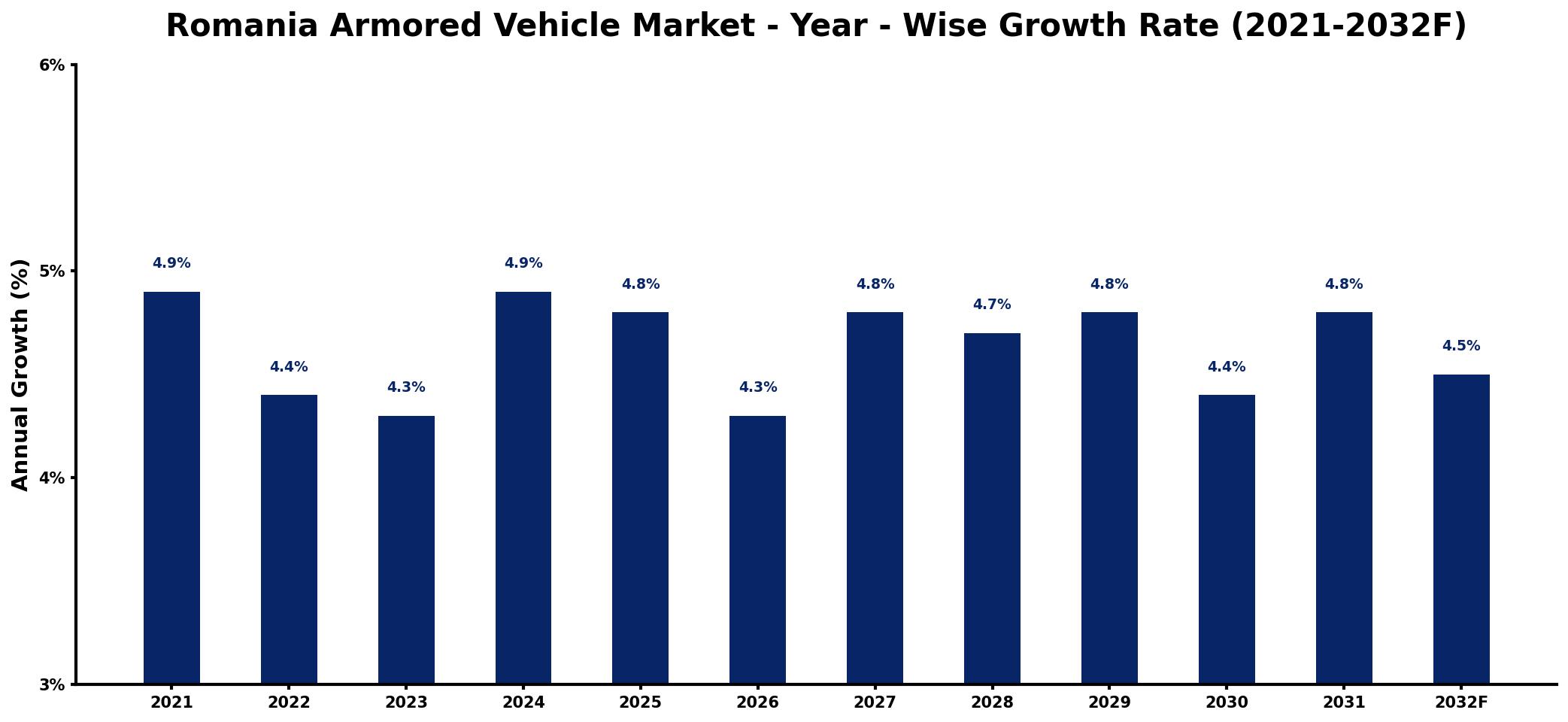
The table below presents the year‑wise growth rates along with the key drivers influencing the market
| Year | Growth Rate | Major Drivers |
| 2021 | 4.9% | increased defense spending initiatives |
| 2022 | 4.4% | growing regional security concerns |
| 2023 | 4.3% | rising geopolitical tensions influencing |
| 2024 | 4.9% | expansion of military modernization programs |
| 2025 | 4.8% | surge in government contracts awarded |
| 2026 | 4.3% | enhanced focus on homeland security |
| 2027 | 4.8% | growing interest in technological innovations |
| 2028 | 4.7% | increased collaboration with NATO partners |
| 2029 | 4.8% | rising demand for tactical solutions |
| 2030 | 4.4% | strategic investments in defense technologies |
| 2031 | 4.8% | growing emphasis on defense readiness |
| 2032 | 4.5% | rising procurement volume requirements |
Note: Market size estimations and growth projections presented in this report are based on 6Wresearch's proprietary forecasting methodology, utilizing the latest available industry data, government publications, and primary research inputs.
Romania Armored Vehicle Market Synopsis
The strongest force shaping the Romania Armored Vehicle Market today is the pressing need for modernization in the defense sector. This imperative is compelling the Romanian government to invest strategically in upgrading and expanding its armored vehicle fleet to tackle evolving security challenges effectively.
As Romania actively participates in NATO missions and engages with regional security dynamics, there is a heightened demand for versatile armored vehicles. These vehicles not only address military needs but are also pivotal for internal security operations, reflecting the broader geopolitical landscape.
Romania Armored Vehicle Market Key Takeaways
- The Romania Armored Vehicle Market is expanding due to rising defense spending and modernization efforts.
- Key opportunities exist in the procurement of advanced armored vehicles and upgrades to existing fleets.
- Collaborations with international manufacturers are shaping the technology landscape of the market.
- Government policies are increasingly favoring local manufacturers to boost domestic production.
- Technological advancements in vehicle systems are critical for maintaining competitive advantage.
Evaluation of Restraints in Romania Armored Vehicle Market
Despite the growth potential, the Romania Armored Vehicle Market faces several restraints that hinder its full development. Limited defense budgets pose significant challenges to procurement opportunities, making it difficult for the military to acquire new vehicles and maintain existing fleets. Furthermore, competition from international suppliers, often offering more advanced technology, can deter local manufacturers. The bureaucratic hurdles associated with defense acquisitions can delay crucial contracts and acquisitions, ultimately impacting market dynamics.
Romania Armored Vehicle Market Trends
Current trends in the Romania Armored Vehicle Market indicate a shift toward lighter, more agile vehicles capable of rapid response to security threats. Advanced features such as enhanced ballistic protection, sophisticated surveillance systems, and communication technologies are increasingly sought after. There is also a noticeable trend towards procurement for peacekeeping missions and internal security operations, as the government aims to bolster law enforcement capabilities.
Romania Armored Vehicle Market Opportunities
Investors looking at the Romania Armored Vehicle Market will find lucrative opportunities driven by increasing military budgets and a focus on modernization. Potential areas for investment include the acquisition of new armored vehicles to replace aging fleets and the development of advanced technologies such as unmanned ground vehicles. Additionally, providing maintenance and support services presents an attractive avenue for generating revenue, catering to the needs of Romania's defense sector.
Government Initiatives in the Romania Armored Vehicle Market
The Romanian government is actively implementing policies that encourage the development of the domestic defense industry. These policies include preferential treatment for local manufacturers during procurement processes, aimed at fostering a robust local market. Furthermore, Romania's compliance with EU regulations on defense procurement ensures transparency and fairness, which benefits both domestic and international suppliers. Strategic investments are prioritized to enhance the capabilities of the armed forces, particularly in alignment with NATO standards.
Future Insights of the Romania Armored Vehicle Market
Looking ahead to 2026-2032, the Romania Armored Vehicle Market is expected to continue its trajectory of steady growth. This growth will be driven by the need for replacing aging vehicles, the imperative of enhancing border security, and addressing new security challenges that arise in the region. Investments in innovative technologies, such as active protection systems and the digitalization of vehicle operations, will be essential in shaping the market's future landscape, ensuring Romania remains agile in a dynamic geopolitical environment.
Romania Armored Vehicle Market Latest Developments (2025 - 2026)
Recent developments within the Romania Armored Vehicle Market highlight an increased focus on partnerships aimed at technology transfer and local production. The government has ramped up efforts to finalize contracts for new armored vehicles while also considering upgrades for existing fleets. Innovations in vehicle design and capabilities are becoming a focal point as Romania positions itself to meet both domestic and NATO operational requirements more effectively.
Romania Armored Vehicle Market - Key Attractiveness of the Report
- 10 Years of Market Numbers
- Historical Data Starting from 2022 to 2025
- Base Year: 2025
- Forecast Data until 2032
- Key Performance Indicators Impacting the Market
- Major Upcoming Developments and Projects
Key Highlights of the Report:
- Romania Armored Vehicle Market Outlook
- Market Size of Romania Armored Vehicle Market, 2025
- Forecast of Romania Armored Vehicle Market, 2032
- Historical Data and Forecast of Romania Armored Vehicle Revenues & Volume for the Period 2022-2032F
- Romania Armored Vehicle Market Trend Evolution
- Romania Armored Vehicle Market Drivers and Challenges
- Romania Armored Vehicle Price Trends
- Romania Armored Vehicle Porter's Five Forces
- Romania Armored Vehicle Industry Life Cycle
- Historical Data and Forecast of Romania Armored Vehicle Market Revenues & Volume By Platform for the Period 2022-2032F
- Historical Data and Forecast of Romania Armored Vehicle Market Revenues & Volume By Combat Vehicles for the Period 2022-2032F
- Historical Data and Forecast of Romania Armored Vehicle Market Revenues & Volume By Combat Support Vehicles for the Period 2022-2032F
- Historical Data and Forecast of Romania Armored Vehicle Market Revenues & Volume By Unmanned Armored Ground Vehicles for the Period 2022-2032F
- Historical Data and Forecast of Romania Armored Vehicle Market Revenues & Volume By Mobility for the Period 2022-2032F
- Historical Data and Forecast of Romania Armored Vehicle Market Revenues & Volume By Wheeled for the Period 2022-2032F
- Historical Data and Forecast of Romania Armored Vehicle Market Revenues & Volume By Tracked for the Period 2022-2032F
- Historical Data and Forecast of Romania Armored Vehicle Market Revenues & Volume By System for the Period 2022-2032F
- Historical Data and Forecast of Romania Armored Vehicle Market Revenues & Volume By Engine for the Period 2022-2032F
- Historical Data and Forecast of Romania Armored Vehicle Market Revenues & Volume By Drive System for the Period 2022-2032F
- Historical Data and Forecast of Romania Armored Vehicle Market Revenues & Volume By Ballistic Armor for the Period 2022-2032F
- Historical Data and Forecast of Romania Armored Vehicle Market Revenues & Volume By Turret Drives for the Period 2022-2032F
- Historical Data and Forecast of Romania Armored Vehicle Market Revenues & Volume By Ammunition Handling System for the Period 2022-2032F
- Historical Data and Forecast of Romania Armored Vehicle Market Revenues & Volume By Fire Control Systems (FCS) for the Period 2022-2032F
- Historical Data and Forecast of Romania Armored Vehicle Market Revenues & Volume By Armaments for the Period 2022-2032F
- Historical Data and Forecast of Romania Armored Vehicle Market Revenues & Volume By Countermeasure System for the Period 2022-2032F
- Romania Armored Vehicle Import Export Trade Statistics
- Market Opportunity Assessment By Platform
- Market Opportunity Assessment By Mobility
- Market Opportunity Assessment By System
- Romania Armored Vehicle Top Companies Market Share
- Romania Armored Vehicle Competitive Benchmarking By Technical and Operational Parameters
- Romania Armored Vehicle Company Profiles
- Romania Armored Vehicle Key Strategic Recommendations






































