Romania Base Oil Market: Import Trend Analysis
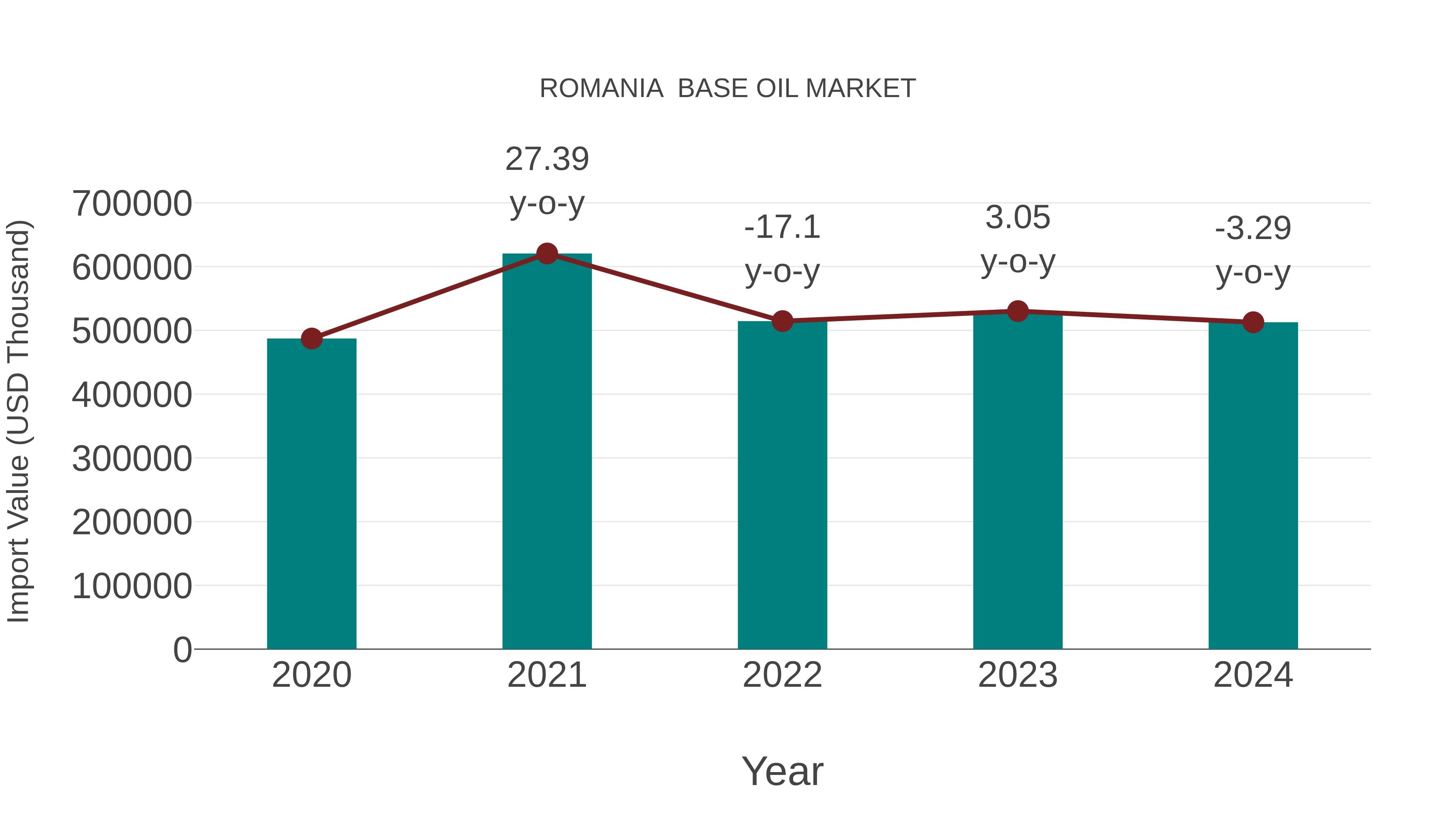
In the Romania base oil market, the import trend experienced a decline from 2023 to 2024, with a growth rate of -3.29%. The compound annual growth rate (CAGR) for imports from 2020 to 2024 stood at 1.29%. This decline could be attributed to shifting demand dynamics or changes in trade policies impacting import volumes.
Romania Base Oil Market Growth Rate
According to 6Wresearch internal database and industry insights, the Romania Base Oil Market is projected to grow at a compound annual growth rate (CAGR) of 5.9% during the forecast period (2026-2032).
Topics Covered in the Romania Base Oil Market Report
The Romania Base Oil Market report thoroughly covers the market by product type and applications. The market report provides an unbiased and detailed analysis of ongoing market trends, opportunities/high growth areas, and market drivers, which help stakeholders devise and align their market strategies according to the current and future market dynamics.
Romania Base Oil Market Highlights
| Report Name | Romania Base Oil Market |
| Forecast period | 2026-2032 |
| CAGR | 5.9% |
| Growing Sector | Automotive |
Romania Base Oil Market Synopsis
Romania Base Oil Market is anticipated to record notable growth owing to the rise in the requirement for lubricants in the automobile and industrial industries. With higher vehicle penetration rates and increased industrialization activities, there has been a steady increase in the usage of premium base oils. This market is also gaining traction due to the use of synthetic and semi-synthetic lubricants, which are being used owing to their efficiency. Moreover, the government's push for industrial growth and energy efficiency has contributed to market growth.
Evaluation of Growth Drivers in the Romania Base Oil Market
Below mentioned are some prominent drivers and their influence on the market dynamics:
| Drivers | Primary Segments Affected | Why it Matters (Evidence) |
| Rising Automotive Demand | Group II & III; Automotive | Growing vehicle fleet increases lubricant consumption. |
| Industrial Expansion | Group I & II; Industrial Application | Manufacturing growth drives demand for industrial lubricants. |
| Shift Towards Synthetic Oils | Group III & IV; Automotive | High-performance lubricants require superior base oils. |
| Growth in Aftermarket Services | All Types; Automotive | Maintenance and servicing boost lubricant usage. |
| Government Industrial Policies | All Types; Industrial Application | Policies support industrial growth and lubricant demand. |
Romania Base Oil Market is expected to grow at the CAGR of 5.9% during the forecast period of 2026-2032. The growth factors include the rising demand for base oils due to its use in automotive and industrial applications, together with the increasing trend towards more advanced grades of base oil like Groups II and III. Increasing numbers of cars and rising industrial activity have contributed to the increased use of lubricants. Furthermore, the preference towards energy-efficient and durable lubricants is promoting the use of improved base oils. Various government policies to enhance industrial infrastructure and increase manufacturing outputs will drive market growth.
Evaluation of Restraints in the Romania Base Oil Market
Below mentioned are some major restraints and their influence on the market dynamics:
| Restraints | Primary Segments Affected | What This Means (Evidence) |
| Volatility in Crude Oil Prices | All Types | Fluctuating raw material costs impact pricing stability. |
| Environmental Regulations | Group I; Industrial Application | Restrictions on emissions limit use of low-quality oils. |
| High Cost of Synthetic Oils | Group III & IV; Automotive | Premium pricing reduces adoption among small users. |
| Import Dependency | All Types | Reliance on imports affects supply consistency. |
| Limited Refining Capacity | Group II & III | Domestic production constraints hinder market growth. |
Romania Base Oil Industry Challenges
Irrespective of massive growth and development, the Romania Base Oil Industry faces several challenges such as fluctuating crude oil prices and dependency on imports for high-quality base oils. There are challenges with the production of high-end base oils at many local refineries, which affect the consistency of the supply chain. In addition, the stringent environmental policies have forced the producers to invest in the upgrading of their processing procedures, raising operating costs. Moreover, the competition from synthetic oils that do not require frequent changeover presents another challenge for the industry. Small industries are reluctant to use high-end base oils owing to their high prices.
Romania Base Oil Market Trends
Emerging trends in the Romania Base Oil Market Growth include:
- Transition to Group II & III Oils: Higher interest in high-grade base oils will result in efficient performance of the lubricants.
- Demand for Automotive Aftermarket Lubricants: Growth in vehicle maintenance services is increasing the demand for lubricants.
- Use of Environmentally Friendly Lubricants: Growing environmental consciousness will help increase use of green base oils.
- Advancement in Refining Technologies: Better refining methods will enhance the production capacity of base oils.
Investment Opportunities in the Romania Base Oil Market
Some best investment Opportunities in the Romania Base Oil Market include:
- Modernization of Refinery – Improvements in the facility to produce superior quality Group II and III base oils may increase competitiveness.
- Production of Synthetic Lubricants – Allocation of funds to produce advanced lubricants may help meet the evolving demands.
- Establishment of Distribution Channels – Building an effective logistics chain may result in better distribution of products.
- Lubricants for Industrial Uses – Development of tailor-made lubricants may lead to niche marketing.
Top 5 Leading Players in the Romania Base Oil Market
Some leading players operating in the Romania Base Oil Market include:
1. OMV Petrom
| Company Name | OMV Petrom |
|---|---|
| Established Year | 2004 |
| Headquarters | Bucharest, Romania |
| Official Website | Click Here |
OMV Petrom is a major player in Romania’s oil and gas sector, producing and supplying base oils and lubricants. The company focuses on refining efficiency and sustainable solutions, supporting domestic demand for high-quality lubrication products across automotive and industrial sectors.
2. Rompetrol
| Company Name | Rompetrol |
|---|---|
| Established Year | 1974 |
| Headquarters | Bucharest, Romania |
| Official Website | - |
Rompetrol operates advanced refineries and supplies base oils and petroleum products. Its strong distribution network and focus on refining innovation help meet the growing demand for high-performance lubricants in Romania and surrounding European markets.
3. ExxonMobil Corporation
| Company Name | ExxonMobil Corporation |
|---|---|
| Established Year | 1999 |
| Headquarters | Texas, USA |
| Official Website | Click Here |
ExxonMobil offers premium base oils and lubricant solutions through its global network. The company’s advanced refining technologies and product innovation support the growing need for high-quality lubricants in automotive and industrial applications in Romania.
4. Royal Dutch Shell plc
| Company Name | Royal Dutch Shell plc |
|---|---|
| Established Year | 1907 |
| Headquarters | London, United Kingdom |
| Official Website | Click Here |
Shell provides a wide range of base oils and lubricants, focusing on performance and sustainability. Its strong presence in Europe and advanced product portfolio make it a key supplier of high-grade base oils for diverse industrial and automotive uses.
5. TotalEnergies SE
| Company Name | TotalEnergies SE |
|---|---|
| Established Year | 1924 |
| Headquarters | Paris, France |
| Official Website | Click Here |
TotalEnergies delivers high-performance base oils and lubricants tailored for modern engines and industrial machinery. The company emphasizes innovation and sustainability, supporting Romania’s growing demand for efficient and environmentally friendly lubrication solutions.
Government Regulations Introduced in the Romania Base Oil Market
According to Romania’s Government Data, Various strategies have been put in place to facilitate sustainable growth in the industry as well as efficient energy usage. The regulatory measures that are in line with those of the EU on the environment promote the production of high-grade base oils. The government facilitates the upgrading of refineries by using incentives and funds for purposes of achieving efficiency and minimizing emissions. Further, the growth policies in relation to the industrial and automotive sectors have positively impacted the growth of demand for lubricants.
Future Insights of the Romania Base Oil Market
Romania Base Oil Market Share is expected to witness steady growth supported by increasing demand from automotive and industrial sectors. The trend toward high-performance and environmentally friendly lubricants will ensure that more advanced types of base oils, like Group II and III, are used. Further developments in refining technologies and improvements in infrastructure are expected to improve the capacity for local base oil production. Moreover, the growth in industrial operations and increase in the number of vehicles will ensure ongoing demand for lubricants. In this regard, the focus on sustainable practices and energy efficiency will ensure further prospects for development within the base oil sector.
Market Segmentation Analysis
The report offers a comprehensive study of the subsequent market segments and their leading categories.
Automotive to Dominate the Market – By Application
According to Mohit, Senior Research Analyst, 6Wresearch, Automotive segment leads the Romania Base Oil Market. The dominance of the market is due to an increase in the number of cars, leading to increased demand for engine oils and lubricants. There is an increase in the growth rate of the automotive aftermarket industry. This will contribute to the continuous consumption of base oil products in the market. Further, there has been an increased demand for high-performing lubricants in the market.
Group II to Dominate the Market – By Type
Group II is one of the segments with high market share owing to enhanced performance properties in relation to Group I oils. They exhibit greater oxidative stability and reduced impurities that make them ideal for use in modern engines. Growing demand for quality lubricants has increased the use of base oils from Group II. The need to decrease the emission of pollutants in the environment has spurred the demand for cleaner base oils.
Key Attractiveness of the Report
- 10 Years of Market Numbers.
- Historical Data Starting from 2022 to 2025.
- Base Year: 2025.
- Forecast Data until 2032.
- Key Performance Indicators Impacting the Market.
- Major Upcoming Developments and Projects.
Key Highlights of the Report:
- Romania Asia-Pacific Base Oil Market Outlook
- Market Size of Romania Asia-Pacific Base Oil Market, 2025
- Forecast of Romania Asia-Pacific Base Oil Market, 2032
- Historical Data and Forecast of Romania Asia-Pacific Base Oil Revenues & Volume for the Period 2022-2032F
- Romania Asia-Pacific Base Oil Market Trend Evolution
- Romania Asia-Pacific Base Oil Market Drivers and Challenges
- Romania Asia-Pacific Base Oil Price Trends
- Romania Asia-Pacific Base Oil Porter's Five Forces
- Romania Asia-Pacific Base Oil Industry Life Cycle
- Historical Data and Forecast of Romania Asia-Pacific Base Oil Market Revenues & Volume By Type for the Period 2022-2032F
- Historical Data and Forecast of Romania Asia-Pacific Base Oil Market Revenues & Volume By Group I for the Period 2022-2032F
- Historical Data and Forecast of Romania Asia-Pacific Base Oil Market Revenues & Volume By Group II for the Period 2022-2032F
- Historical Data and Forecast of Romania Asia-Pacific Base Oil Market Revenues & Volume By Group III for the Period 2022-2032F
- Historical Data and Forecast of Romania Asia-Pacific Base Oil Market Revenues & Volume By Group IV for the Period 2022-2032F
- Historical Data and Forecast of Romania Asia-Pacific Base Oil Market Revenues & Volume By Group V for the Period 2022-2032F
- Historical Data and Forecast of Romania Asia-Pacific Base Oil Market Revenues & Volume By Application for the Period 2022-2032F
- Historical Data and Forecast of Romania Asia-Pacific Base Oil Market Revenues & Volume By Automotive for the Period 2022-2032F
- Historical Data and Forecast of Romania Asia-Pacific Base Oil Market Revenues & Volume By IndustrialApplication for the Period 2022-2032F
- Historical Data and Forecast of Romania Asia-Pacific Base Oil Market Revenues & Volume By Others for the Period 2022-2032F
- Romania Asia-Pacific Base Oil Import Export Trade Statistics
- Market Opportunity Assessment By Type
- Market Opportunity Assessment By Application
- Romania Asia-Pacific Base Oil Top Companies Market Share
- Romania Asia-Pacific Base Oil Competitive Benchmarking By Technical and Operational Parameters
- Romania Asia-Pacific Base Oil Company Profiles
- Romania Asia-Pacific Base Oil Key Strategic Recommendations
Market Covered
The report offers a comprehensive study of the subsequent market segments:
By Type
- Group I
- Group II
- Group III
- Group IV
- Group V
By Application
- Automotive
- IndustrialApplication
- Others






































