Romania Building Energy Management Systems Market | Country-Wise Share and Competition Analysis
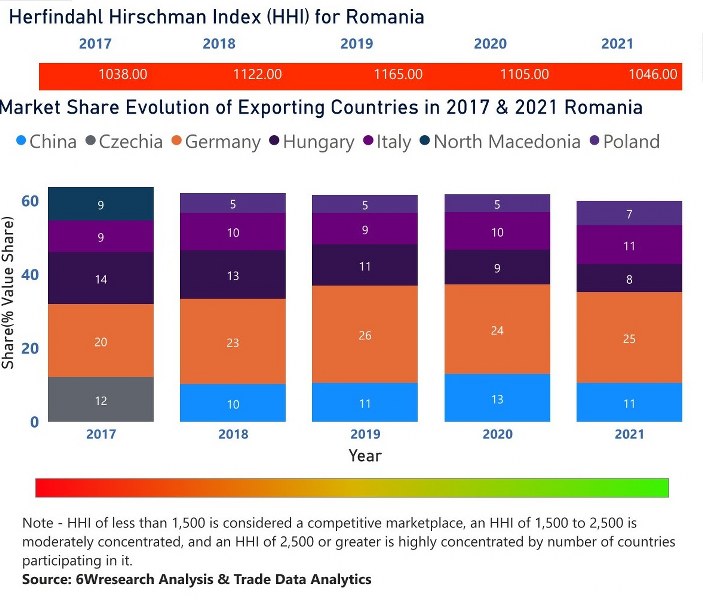
In the year 2021, Germany was the largest exporter in terms of value, followed by China. It has registered a growth of 20.28% over the previous year. While China registered a decline of -2.85% as compare to the previous year. In the year 2017 Germany was the largest exporter followed by Hungary. In term of Herfindahl Index, which measures the competitiveness of countries exporting, Romania has the Herfindahl index of 1038 in 2017 which signifies high competitiveness also in 2021 it registered a Herfindahl index of 1046 which signifies high competitiveness in the market.
Romania Building Energy Management Systems Market - Export Market Opportunities
Romania Building Energy Management System Market Synopsis
Romania Building Energy Management System Market is driven by growing infrastructural development projects and growing urbanization. The growing foreign direct investment, increasing electricity prices and growing awareness regarding energy-efficient products is further boosting the growth of the building energy management system market in Romania. The aspects increasing the demand for the installation of building energy management systems in Romania are reduction in energy consumption, improving comfort for building users, maintaining a healthy balance and improving profitability.
According to 6wresearch, Romania Building Energy Management System Market size is expected to grow during 2025-2031. Romania’s market is expected to register negative growth in the demand for building energy management systems as well as in the economy during the first quarter of 2020 due to the outbreak of COVID-19 which has spread a worse impact on the business worldwide. However, recovery and healthy growth in the economic scenario are expected in the Romania market during the second half of 2020-2026. In terms of technology, the wired segment is dominating the building energy management system market in Romania and in the upcoming years, the wireless segment is anticipated to hold the building energy management system market share in Romania due to improving technology, easy installation and increases the productivity.
Based on end-users, the commercial segment has registered a major installation of building energy management systems over the past few years in Romania on account of growing construction in the commercial sector and increasing demand for connected devices.
The Romania Building Energy Management System Market report thoroughly covers the market by components and services, technology, end-users, and applications. The Romania Building Energy Management System market outlook report provides an unbiased and detailed analysis of the on-going Romania Building Energy Management System Market trends, opportunities/high growth areas and market drivers which would help the stakeholders to devise and align their market strategies according to the current and future market dynamics.
Key Highlights of the Report:
- Romania Building Energy Management System Market Overview
- Romania Building Energy Management System Market Outlook
- Romania Building Energy Management System Market Forecast
- Historical Data of Romania Building Energy Management System Market Revenues for the Period 2021-2031
- Romania Building Energy Management System Market Size and Forecast of Revenues, Until 2031
- Historical Data of Romania Building Energy Management System Market Revenues, by Components and Services, for the Period 2021-2031
- Market Size & Forecast of Romania Building Energy Management System Market Revenues, by Components and Services, until 2031
- Historical Data of Romania Building Energy Management System Market Revenues, by Technology, for the Period 2021-2031
- Market Size & Forecast of Romania Building Energy Management System Market Revenues, by Technology, until 2031
- Historical Data of Romania Building Energy Management System Market Revenues, by End-User, for the Period 2021-2031
- Market Size & Forecast of Romania Building Energy Management System Market Revenues, by End-User, until 2031
- Historical Data of Romania Building Energy Management System Market Revenues, by Application, for the Period 2021-2031
- Market Size & Forecast of Romania Building Energy Management System Market Revenues, by Application, until 2031
- Market Drivers and Restraints
- Romania Building Energy Management System Market Trends
- Market Opportunity Assessment
- Romania Building Energy Management System Market Share, By Players
- Romania Building Energy Management System Market Overview on Competitive Benchmarking
- Company Profiles
- Key Strategic Recommendations
Markets Covered
The Romania Building Energy Management System market report provides a detailed analysis of the following market segments:
- By Components & Services:
- Hardware
- Sensors
- Controllers
- Actuators
- Others
- Software
- Services
- By Technology:
- Wired
- Wireless
- By End Users:
- Residential
- Commercial
- Industrial
- By Applications:
- Space Heating
- Computers & Office Equipment
- Lighting
- Air Conditioners
- Others






































