Romania Carbon Black Market Size (2020-2030)
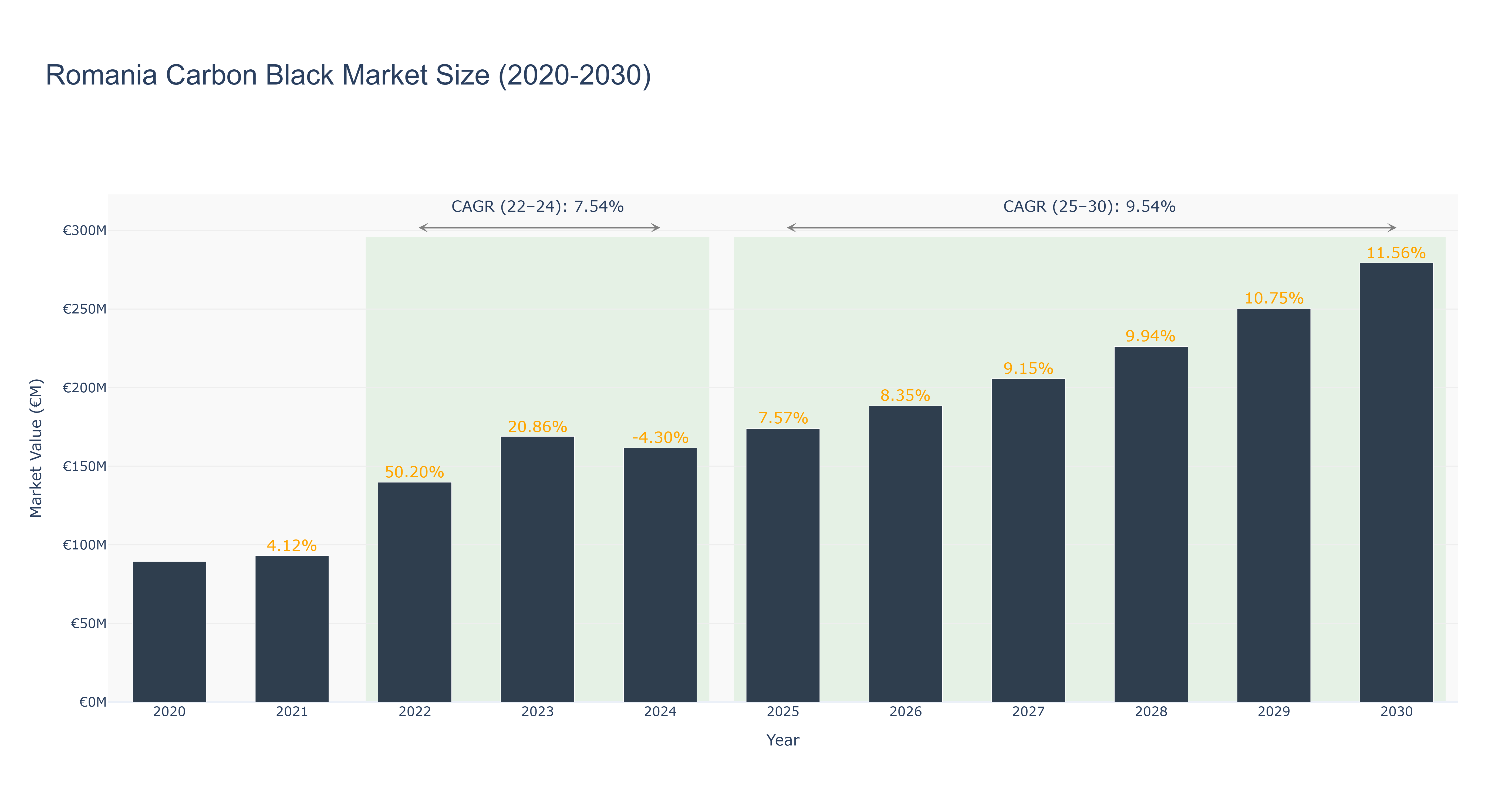
Romania Carbon Black Market has shown a fluctuating trend in recent years. The peak market size of €279.42 million is forecasted for 2030. From 2020 to 2024, the market experienced a slight decrease in size, with the lowest point at €161.70 million in 2024. The growth then rebounded steadily, reaching €188.46 million in 2026. The CAGR for the period 2022-24 was 7.54%, while for 2025-30, it is projected at 9.54%. The market's growth can be attributed to increasing demand from various industries such as automotive, construction, and manufacturing. Looking ahead, Romania is set to invest in sustainable carbon black production technologies, aligning with the global shift towards eco-friendly practices. This strategic move is expected to further boost market growth and solidify Romania's position in the carbon black industry.
Romania Carbon Black Market: Production & Trade Performance (2019-2025)
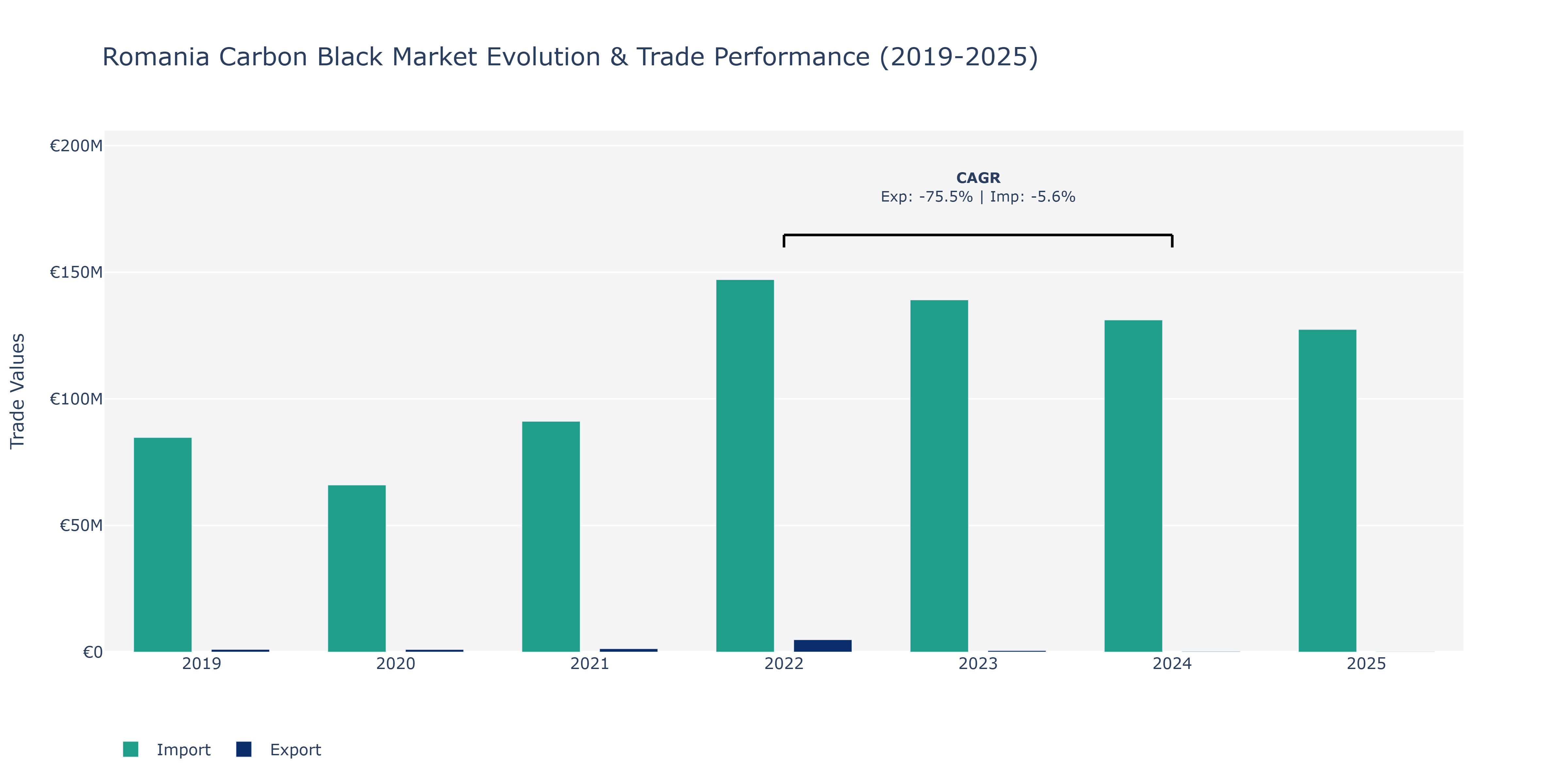
In the Romania Carbon Black Market, both exports and imports exhibited notable fluctuations during the period analyzed. Exports started at €1.04 million in 2019, decreased to €988.03 thousand in 2020, then sharply rose to €1.33 million in 2021, driven by potentially increased demand or new market opportunities. However, a drastic decline was observed in 2022 to €4.86 million, which could be attributed to shifts in global trade dynamics or domestic economic challenges. Imports, on the other hand, began at €84.72 million in 2019, decreased to €65.97 million in 2020, and steadily increased in the following years, reaching €127.39 million in 2025. This upward trend may signify growing domestic consumption or technological advancements that require more imports. The fluctuations in both exports and imports highlight the market's sensitivity to external factors and the need for companies to adapt swiftly to changing conditions to maintain a competitive edge in the industry.
Romania Carbon Black Market Overview
The Romania Carbon Black Market is experiencing steady growth driven by the increasing demand from end-use industries such as automotive, construction, and plastics. The market is primarily dominated by major players like Cabot Corporation and Orion Engineered Carbons. The rising automotive production in the country, coupled with the growing construction sector, is expected to further boost the demand for carbon black. Moreover, the increasing focus on sustainability and environmental regulations is leading to a shift towards the use of specialty carbon black grades. The market also faces challenges such as fluctuating raw material prices and competition from alternative materials. Overall, the Romania Carbon Black Market is poised for growth, driven by industrial expansion and technological advancements in the manufacturing processes.
Romania Carbon Black Market Trends
The Romania Carbon Black Market is witnessing a growth trend driven by various factors such as increasing demand from the automotive and construction industries, as well as the rising focus on sustainable practices. The market is experiencing a shift towards the production of specialty carbon blacks with enhanced properties to cater to specific applications. Additionally, growing investments in research and development activities to improve product quality and performance are further fueling market growth. The increasing emphasis on environmental regulations and the adoption of eco-friendly manufacturing processes are also influencing the market dynamics. Overall, the Romania Carbon Black Market is expected to continue its upward trajectory in the coming years, driven by evolving industry requirements and technological advancements.
Romania Carbon Black Market Challenges
Challenges in the Romania Carbon Black Market include intense competition among domestic and international players, pricing pressures due to fluctuating raw material costs, and regulatory uncertainties related to environmental policies. The market is also vulnerable to economic downturns and geopolitical factors that can impact demand and supply dynamics. Additionally, the need for significant investments in technology and infrastructure to meet stringent quality standards poses a challenge for smaller manufacturers. Adapting to evolving consumer preferences for sustainable and eco-friendly products further complicates the market landscape. Overall, navigating these challenges requires companies in the Romania Carbon Black Market to stay agile, innovative, and well-informed about industry trends and regulations.
Romania Carbon Black Market Investment Opportunities
The Romania Carbon Black Market presents several investment opportunities due to the growing demand for this versatile material in various industries such as automotive, construction, and manufacturing. With the increasing focus on reducing environmental impact and improving product performance, the demand for carbon black as a reinforcing agent in rubber and plastic products is expected to rise. Investing in carbon black production facilities or distribution channels in Romania could prove lucrative as the market expands. Additionally, with the government`s initiatives to promote sustainable practices and reduce emissions, there is potential for investments in eco-friendly carbon black production technologies. Overall, the Romania Carbon Black Market offers promising investment avenues for those looking to capitalize on the growing demand for this essential material.
Romania Carbon Black Market Government Policy
The Romanian government has implemented various policies related to the Carbon Black Market to address environmental concerns and promote sustainable development. This includes regulations on emissions, waste management, and pollution control to reduce the environmental impact of carbon black production. Additionally, the government has introduced incentives and subsidies for companies investing in cleaner technologies and processes, as well as promoting research and development in the carbon black sector. The aim is to ensure compliance with environmental standards, improve air quality, and promote the transition towards a greener economy in Romania. These policies indicate a growing emphasis on environmental sustainability and regulatory compliance within the carbon black industry in Romania.
Romania Carbon Black Market Future Outlook
The future outlook for the Romania Carbon Black Market appears positive, with sustained growth anticipated in the coming years. This can be attributed to the increasing demand for carbon black in various industries such as automotive, construction, and plastics, driven by factors like urbanization, industrialization, and technological advancements. Additionally, the growing emphasis on sustainability and environmental regulations is expected to boost the demand for specialty carbon black grades. However, challenges such as fluctuating raw material prices and competition from alternative products may impact market growth. Overall, with the expanding industrial base and rising investments in key sectors, the Romania Carbon Black Market is poised for steady development and innovation to meet evolving consumer needs and regulatory requirements.
Key Highlights of the Report:
- Romania Carbon Black Market Outlook
- Market Size of Romania Carbon Black Market, 2021
- Forecast of Romania Carbon Black Market, 2027
- Historical Data and Forecast of Romania Carbon Black Revenues & Volume for the Period 2018 - 2027
- Romania Carbon Black Market Trend Evolution
- Romania Carbon Black Market Drivers and Challenges
- Romania Carbon Black Price Trends
- Romania Carbon Black Porter's Five Forces
- Romania Carbon Black Industry Life Cycle
- Historical Data and Forecast of Romania Carbon Black Market Revenues & Volume By Type for the Period 2018 - 2027
- Historical Data and Forecast of Romania Carbon Black Market Revenues & Volume By Furnace Black for the Period 2018 - 2027
- Historical Data and Forecast of Romania Carbon Black Market Revenues & Volume By Channel Black for the Period 2018 - 2027
- Historical Data and Forecast of Romania Carbon Black Market Revenues & Volume By Thermal Black for the Period 2018 - 2027
- Historical Data and Forecast of Romania Carbon Black Market Revenues & Volume By Acetylene Black for the Period 2018 - 2027
- Historical Data and Forecast of Romania Carbon Black Market Revenues & Volume By Others for the Period 2018 - 2027
- Historical Data and Forecast of Romania Carbon Black Market Revenues & Volume By Grade for the Period 2018 - 2027
- Historical Data and Forecast of Romania Carbon Black Market Revenues & Volume By Standard for the Period 2018 - 2027
- Historical Data and Forecast of Romania Carbon Black Market Revenues & Volume By Specialty for the Period 2018 - 2027
- Historical Data and Forecast of Romania Carbon Black Market Revenues & Volume By Application for the Period 2018 - 2027
- Historical Data and Forecast of Romania Carbon Black Market Revenues & Volume By Tires for the Period 2018 - 2027
- Historical Data and Forecast of Romania Carbon Black Market Revenues & Volume By High-performance Coatings for the Period 2018 - 2027
- Historical Data and Forecast of Romania Carbon Black Market Revenues & Volume By Plastics for the Period 2018 - 2027
- Historical Data and Forecast of Romania Carbon Black Market Revenues & Volume By Others for the Period 2018 - 2027
- Romania Carbon Black Import Export Trade Statistics
- Market Opportunity Assessment By Type
- Market Opportunity Assessment By Grade
- Market Opportunity Assessment By Application
- Romania Carbon Black Top Companies Market Share
- Romania Carbon Black Competitive Benchmarking By Technical and Operational Parameters
- Romania Carbon Black Company Profiles
- Romania Carbon Black Key Strategic Recommendations






































