Romania Cloud ERP Market Size & Growth Rate (2026-2032)
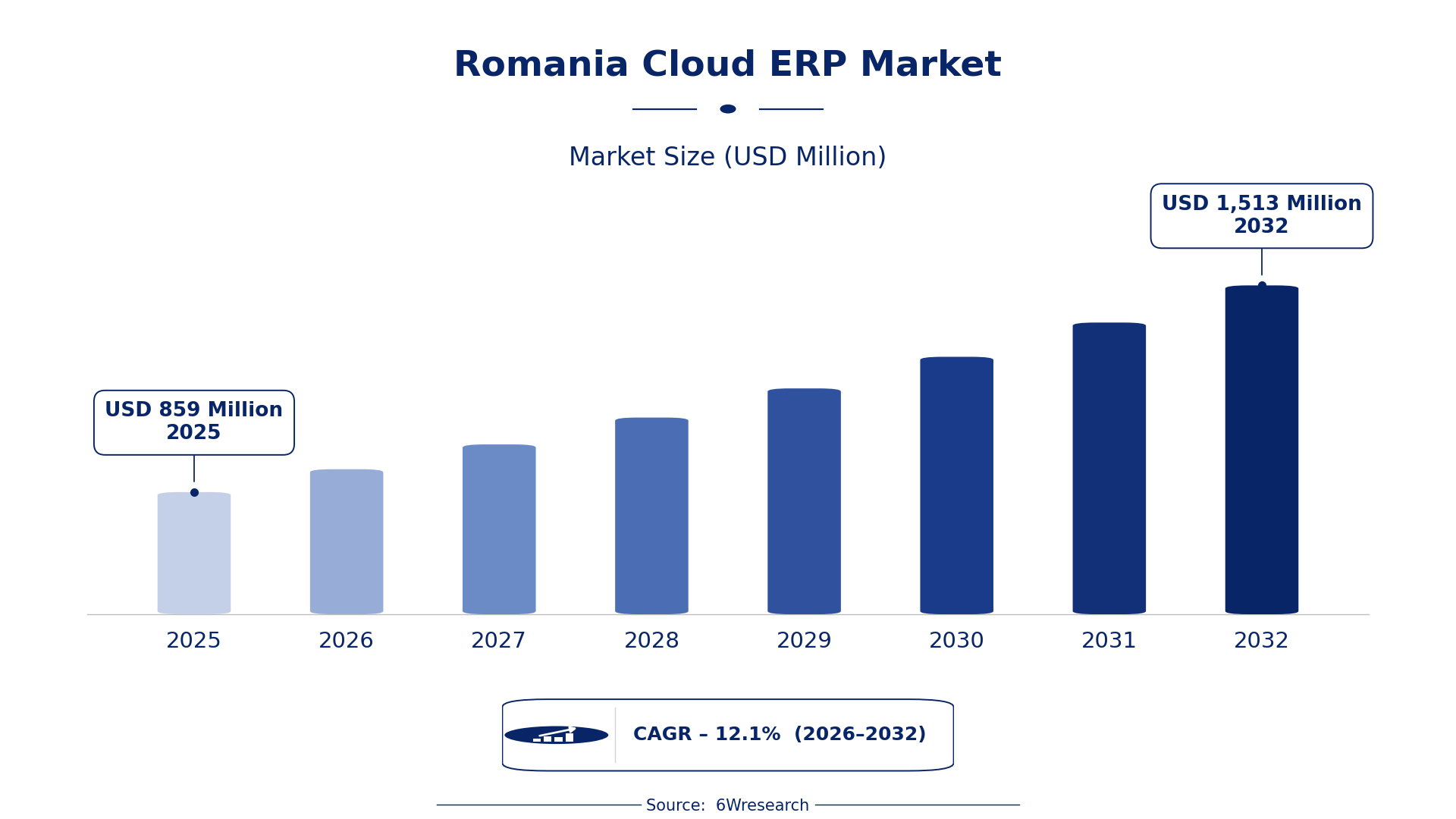
The Romania Cloud ERP Market was estimated at USD 859 Million in 2025 and is projected to reach USD 1513 Million by 2032, growing at a CAGR of 12.1% from 2026 to 2032.
Romania Cloud ERP Market Synopsis
The Romania Cloud ERP market has experienced a significant shift as enterprises increasingly abandon traditional ERP systems in favor of more agile cloud-based solutions. This momentum reflects a growing recognition of the benefits such as scalability, cost reduction, and improved operational efficiency.
Looking ahead, the landscape is becoming even more competitive, with a notable rise in tailored ERP solutions that cater specifically to Romanian businesses. This trend underscores the market's evolution towards integrating advanced technologies like AI and analytics to further enhance decision-making capabilities.
Romania Cloud ERP Market Year-wise Growth Rate and Key Drivers
This graph illustrates the annual growth rates of the Romania Cloud ERP Market from 2021 to 2032, highlighting a steady upward trajectory and projected expansion over the forecast period.
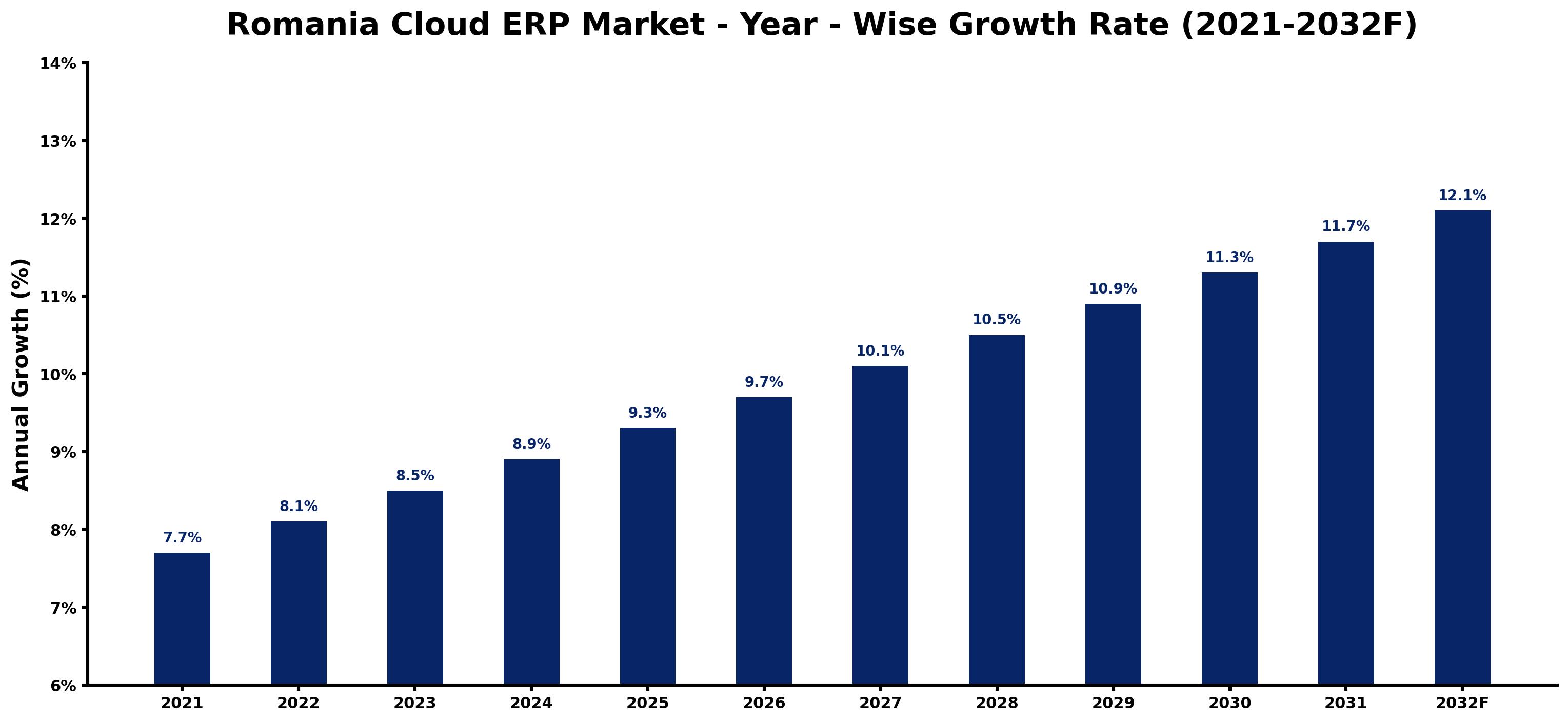
The table below presents the year‑wise growth rates along with the key drivers influencing the market
| Year | Growth Rate | Major Drivers |
| 2021 | 7.7% | Growing SME sector investing in cloud solutions |
| 2022 | 8.1% | Increased regulations on data protection boosting ERP adoption |
| 2023 | 8.5% | Surge in remote work prompting ERP system upgrades |
| 2024 | 8.9% | EU funding programs enhancing local cloud infrastructure |
| 2025 | 9.3% | Local manufacturers digitizing supply chain processes |
| 2026 | 9.7% | Rise in cybersecurity threats bolstering ERP security features |
| 2027 | 10.1% | Technological advancements in AI-driven ERP functionalities |
| 2028 | 10.5% | High mobile internet penetration improving cloud accessibility |
| 2029 | 10.9% | Demand for real-time analytics enhancing decision-making tools |
| 2030 | 11.3% | Shift to subscription-based pricing models attracting users |
| 2031 | 11.7% | Growing importance of sustainability influencing ERP functionalities |
| 2032 | 12.1% | Increased fintech collaborations driving ERP integration |
Note: Market size estimations and growth projections presented in this report are based on 6Wresearch's proprietary forecasting methodology, utilizing the latest available industry data, government publications, and primary research inputs.
Romania Cloud ERP Market Key Takeaways
Below are some of the specific key takeaways from the market, including:
- Enterprises are prioritizing digital transformation initiatives to enhance efficiency.
- Cloud ERP solutions are being favored for their flexibility and cost-effectiveness.
- Industry-specific ERP solutions are increasingly addressing unique business needs.
- Data security and compliance remain critical issues for organizations adopting cloud ERP.
- Government initiatives are boosting cloud ERP adoption in the public sector.
Evaluation of Restraints in Romania Cloud ERP Market
While the Romania Cloud ERP market is on an upward trajectory, several restraints hinder its full potential. Data migration poses a significant challenge, as organizations often struggle with transferring vast amounts of information from legacy systems to cloud platforms. Additionally, cultural resistance within companies can slow down the adoption process, particularly among teams accustomed to traditional systems. Extensive training is needed to bridge this gap, which can divert resources and time. Compliance with local regulations adds another layer of complexity, as organizations must ensure that their cloud solutions align with data protection laws.
Romania Cloud ERP Market Trends
Several trends are shaping the Romania Cloud ERP market. The integration of AI into ERP systems is enhancing data analysis capabilities, allowing businesses to make informed decisions rapidly. There's also a noticeable shift towards industry-specific solutions, as businesses seek tailored functionalities that address their unique requirements. Additionally, remote work and digital collaboration tools are driving demand for cloud ERP solutions, enabling teams to work efficiently across various locations.
Romania Cloud ERP Market Opportunities
As businesses continue to embrace digital transformation, opportunities abound in the Romania Cloud ERP market. The demand for customized solutions presents a ripe environment for vendors to innovate and introduce specialized offerings. on top of that, the government's push for modernization in public services creates an avenue for cloud ERP providers to engage with public sector clients, fostering long-term partnerships. Companies that focus on security and compliance solutions will likely gain a competitive edge, as organizations prioritize data protection in their digital strategies.
Government Initiatives in the Romania Cloud ERP Market
Government initiatives in Romania are playing a crucial role in shaping the Cloud ERP market. With a focus on enhancing public sector efficiency, policies are being introduced to modernize operations through cloud-based solutions. These efforts are pivotal for both public and private entities looking to streamline processes and improve service delivery.
- A national digital infrastructure upgrade programme launched in late 2022 aimed at improving access to cloud services across government agencies.
- Ongoing initiatives focus on training programs for public sector employees to facilitate the transition to cloud-based ERP systems.
- A regulatory framework introduced in 2023 mandates the adoption of cloud technologies in public administration.
- Upcoming initiatives are planned to expand funding for cloud ERP solutions, targeting small and medium enterprises by 2025.
Future Insights of the Romania Cloud ERP Market
The future of the Romania Cloud ERP market looks promising, driven by continuous advancements in technology and increasing corporate investment in digital tools. By 2032, we can expect a more mature market with enhanced interoperability between various systems, facilitating better data flow and collaboration. As businesses become more accustomed to cloud solutions, the focus will likely shift to integrating next-gen technologies like machine learning and IoT into ERP systems, further optimizing operations and enabling real-time insights.
Romania Cloud ERP Market Latest Developments
Recent developments in the Romania Cloud ERP market indicate a vibrant and rapidly evolving environment. Organizations are investing in innovative solutions to meet their operational challenges, while new partnerships are forming to enhance service offerings.
- A leading technology vendor launched a new cloud ERP solution tailored for the manufacturing sector in early 2023, emphasizing real-time analytics and reporting.
- An ongoing collaboration between IT service providers and educational institutions aims to enhance cloud ERP training programs, which began in Q2 2023.
- A rollout of industry-specific cloud ERP functionalities is expected to commence in mid-2024, focusing on healthcare and retail sectors.
- A major technology vendor is currently developing a cloud-based ERP system integrated with AI capabilities, expected to enter the market by late 2024.
Romania Cloud ERP Market - Key Attractiveness of the Report
- 10 Years of Market Numbers
- Historical Data Starting from 2022 to 2025
- Base Year: 2025
- Forecast Data until 2032
- Key Performance Indicators Impacting the Market
- Major Upcoming Developments and Projects
Key Highlights of the Report:
- Romania Cloud ERP Market Outlook
- Market Size of Romania Cloud ERP Market, 2025
- Forecast of Romania Cloud ERP Market, 2032
- Historical Data and Forecast of Romania Cloud ERP Revenues & Volume for the Period 2022-2032F
- Romania Cloud ERP Market Trend Evolution
- Romania Cloud ERP Market Drivers and Challenges
- Romania Cloud ERP Price Trends
- Romania Cloud ERP Porter's Five Forces
- Romania Cloud ERP Industry Life Cycle
- Historical Data and Forecast of Romania Cloud ERP Market Revenues & Volume By Component for the Period 2022-2032F
- Historical Data and Forecast of Romania Cloud ERP Market Revenues & Volume By Solution for the Period 2022-2032F
- Historical Data and Forecast of Romania Cloud ERP Market Revenues & Volume By Services for the Period 2022-2032F
- Historical Data and Forecast of Romania Cloud ERP Market Revenues & Volume By Vertical for the Period 2022-2032F
- Historical Data and Forecast of Romania Cloud ERP Market Revenues & Volume By BFSI for the Period 2022-2032F
- Historical Data and Forecast of Romania Cloud ERP Market Revenues & Volume By Manufacturing for the Period 2022-2032F
- Historical Data and Forecast of Romania Cloud ERP Market Revenues & Volume By IT and Telecom for the Period 2022-2032F
- Historical Data and Forecast of Romania Cloud ERP Market Revenues & Volume By Business Function for the Period 2022-2032F
- Historical Data and Forecast of Romania Cloud ERP Market Revenues & Volume By Accounting and Finance for the Period 2022-2032F
- Historical Data and Forecast of Romania Cloud ERP Market Revenues & Volume By Sales and Marketing for the Period 2022-2032F
- Historical Data and Forecast of Romania Cloud ERP Market Revenues & Volume By Inventory and Order Management for the Period 2022-2032F
- Historical Data and Forecast of Romania Cloud ERP Market Revenues & Volume By Organization Size for the Period 2022-2032F
- Historical Data and Forecast of Romania Cloud ERP Market Revenues & Volume By SMEs for the Period 2022-2032F
- Historical Data and Forecast of Romania Cloud ERP Market Revenues & Volume By Large Enterprises for the Period 2022-2032F
- Romania Cloud ERP Import Export Trade Statistics
- Market Opportunity Assessment By Component
- Market Opportunity Assessment By Vertical
- Market Opportunity Assessment By Business Function
- Market Opportunity Assessment By Organization Size
- Romania Cloud ERP Top Companies Market Share
- Romania Cloud ERP Competitive Benchmarking By Technical and Operational Parameters
- Romania Cloud ERP Company Profiles
- Romania Cloud ERP Key Strategic Recommendations






































