Romania Digital Railway Market Size & Growth Rate (2026-2032)
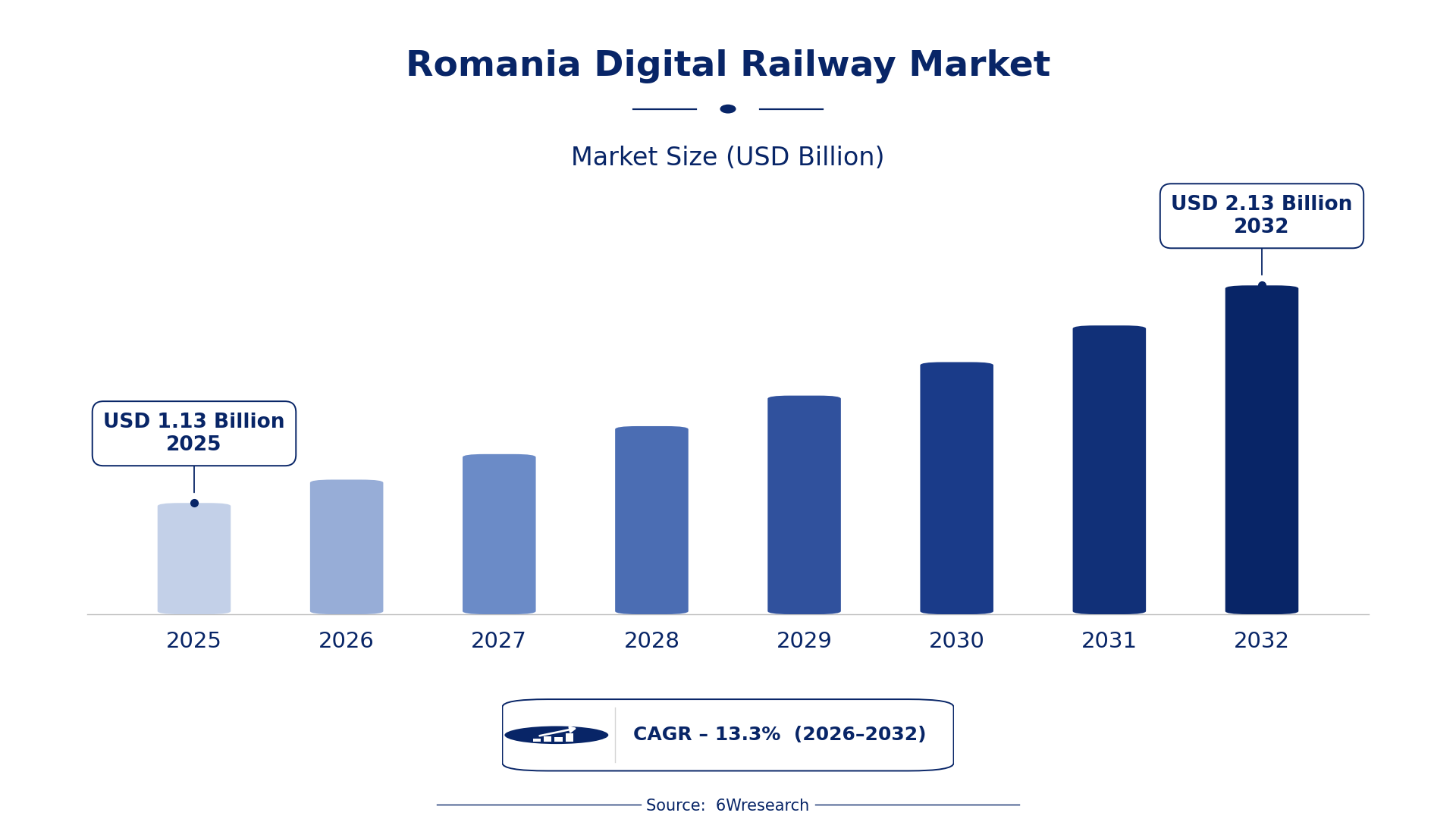
The Romania Digital Railway Market was estimated at USD 1132 Million in 2025 and is projected to reach USD 2128 Million by 2032, growing at a CAGR of 13.3% from 2026 to 2032.
Romania Digital Railway Market Synopsis
The Romanian railway sector is undergoing a significant transformation as it embraces digital technologies to enhance operational efficiency and passenger services. Current modernization initiatives are focusing on the implementation of advanced signaling systems, predictive maintenance, and smart control solutions that promise to revolutionize how rail operations are managed.
As urbanization and infrastructure investments gain momentum, the demand for digital railway solutions is intensifying. This shift is not only about improving safety and efficiency but also about meeting interoperability standards across the European rail networks, positioning Romania as a key player in regional transport connectivity.
Romania Digital Railway Market Year-wise Growth Rate and Key Drivers
This graph illustrates the annual growth rates of the Romania Digital Railway Market from 2021 to 2032, highlighting a steady upward trajectory and projected expansion over the forecast period.
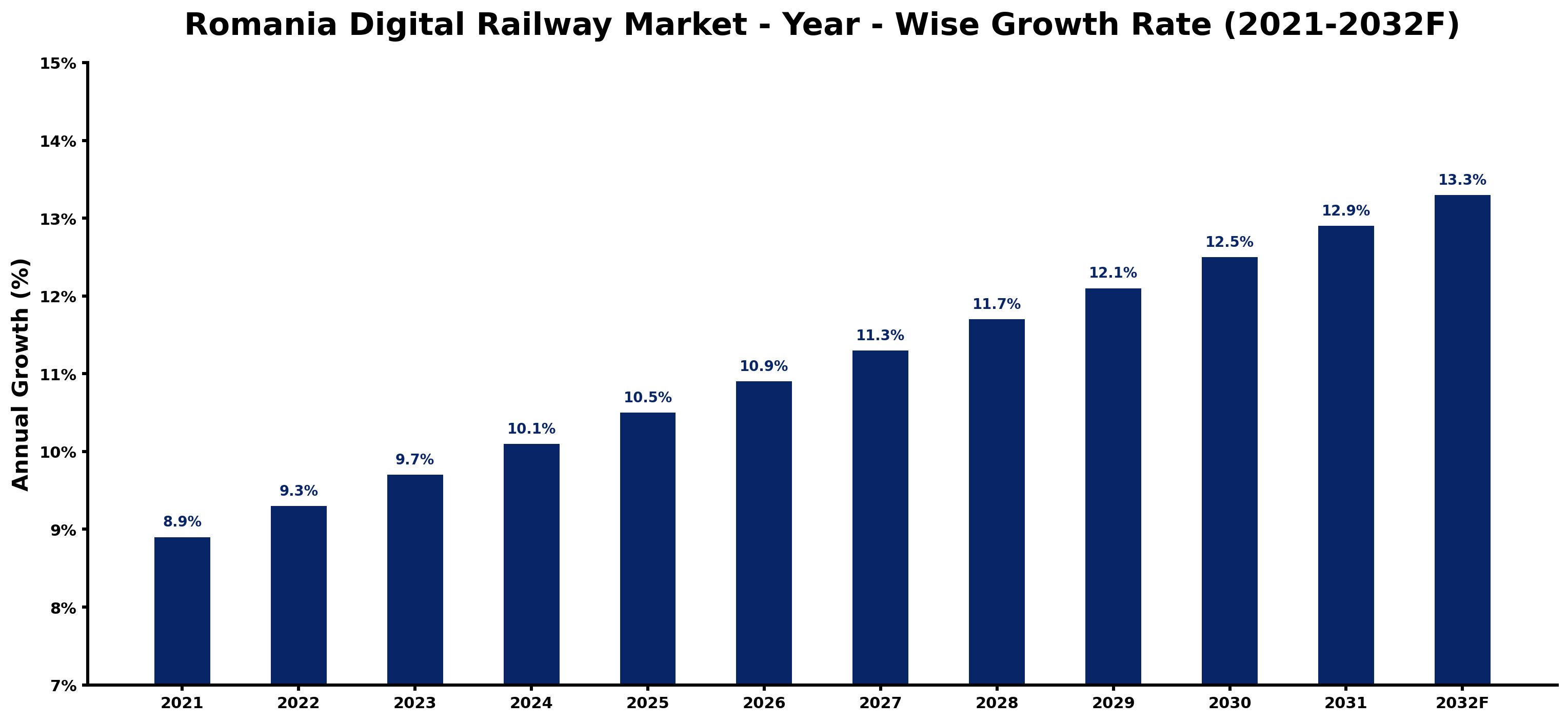
The table below presents the year‑wise growth rates along with the key drivers influencing the market
| Year | Growth Rate | Major Drivers |
| 2021 | 8.9% | EU funding for rail digitalization projects initiated |
| 2022 | 9.3% | Increased investment in IoT for railway operations |
| 2023 | 9.7% | Adoption of EU digital rail policies accelerated |
| 2024 | 10.1% | Rollout of 5G networks enhancing rail communication |
| 2025 | 10.5% | Partnerships with tech firms improving rail safety systems |
| 2026 | 10.9% | Government incentives for digital rail technologies enacted |
| 2027 | 11.3% | Growing urban mobility demands driving automation solutions |
| 2028 | 11.7% | Focus on sustainability boosting smart rail technologies |
| 2029 | 12.1% | Integration of AI for predictive maintenance in rail |
| 2030 | 12.5% | Rise of passenger apps improving customer service experience |
| 2031 | 12.9% | Investment in cybersecurity for railway networks increased |
| 2032 | 13.3% | Collaboration with EU on cross-border digital initiatives |
Note: Market size estimations and growth projections presented in this report are based on 6Wresearch's proprietary forecasting methodology, utilizing the latest available industry data, government publications, and primary research inputs.
Romania Digital Railway Market Key Takeaways
Below are some of the specific key takeaways from the market, including:
- The market is driven by modernization initiatives and the demand for enhanced passenger safety.
- Investment in digital signaling and control systems is a major growth factor.
- Urbanization and infrastructure investment are influencing market dynamics significantly.
- Government policies are supporting the transition to smart railway networks.
- Interoperability requirements are key to optimizing Romania's rail network performance.
Evaluation of Restraints in Romania Digital Railway Market
Despite the promising growth trajectory, the Romania Digital Railway Market faces notable challenges. The legacy infrastructure requires comprehensive upgrades to integrate digital solutions effectively. Significant capital investment is essential for deploying advanced technologies, which can deter stakeholders. Additionally, regulatory compliance and safety assurances remain critical concerns as organizations strive to enhance operational reliability amidst these transitions.
Romania Digital Railway Market Trends
The market is witnessing a surge in the adoption of predictive maintenance technologies, allowing operators to anticipate and mitigate equipment failures before they occur. Digital signaling systems are being prioritized, enhancing communication between trains and control centers. Increased focus on passenger experience is driving the development of real-time information systems that keep travelers informed throughout their journeys.
Romania Digital Railway Market Opportunities
The transition toward smart rail solutions presents substantial growth opportunities. Investments aimed at enhancing infrastructure and integrating IoT technologies are likely to attract considerable funding. Additionally, public-private partnerships can play a crucial role in advancing digital railway initiatives, fostering innovation while sharing the financial burden of modernization. Opportunities also lie in enhancing cross-border connectivity through interoperability enhancements.
Government Initiatives in the Romania Digital Railway Market
Government initiatives are crucial in shaping the Romania Digital Railway Market, reflecting a commitment to modernization, safety, and efficiency. The current regulatory framework emphasizes the integration of digital technologies while addressing safety and environmental concerns. These policies not only support the implementation of advanced systems but also encourage investment in smart infrastructure.
- A national digital infrastructure upgrade programme now in its rollout phase aims to enhance overall network efficiency.
- Ongoing initiatives focus on implementing digital signaling systems across major rail corridors to improve safety and reliability.
- A regulatory framework introduced in 2025 mandates compliance with EU interoperability standards, streamlining cross-border operations.
- Future plans include a public-private partnership to develop smart passenger information systems by 2028.
Future Insights of the Romania Digital Railway Market
Looking ahead to 2026-2032, the Romania Digital Railway Market is set to expand significantly. Continued investments in digital technologies will be paramount in achieving efficiency gains and safety improvements. As the country aligns with European standards, there will be a stronger emphasis on interoperability, enhancing cross-border connectivity and collaboration. The market is likely to attract increased private sector investment, further propelling innovation and operational excellence.
Romania Digital Railway Market Latest Developments
Recent months have seen a flurry of activity within the Romania Digital Railway Market, underscoring a strong commitment to digital transformation. Stakeholders are increasingly recognizing the potential of digital technologies to optimize operations and improve passenger experiences. This momentum is evident in the ongoing implementation of various initiatives aimed at modernizing the railway infrastructure.
- A major technology vendor launched a new predictive maintenance platform in early 2025, enhancing operational reliability for regional rail operators.
- An initiative that began in mid-2025 focuses on upgrading existing signaling systems, currently underway and expected to complete by late 2026.
- Plans for a comprehensive digital passenger information system are set to commence in Q3 2026, enhancing real-time communication across networks.
- By mid-2026, a leading regional operator is expected to finalize the integration of IoT solutions to monitor train performance proactively.
Romania Digital Railway Market - Key Attractiveness of the Report
- 10 Years of Market Numbers
- Historical Data Starting from 2022 to 2025
- Base Year: 2025
- Forecast Data until 2032
- Key Performance Indicators Impacting the Market
- Major Upcoming Developments and Projects
Key Highlights of the Report:
- Romania Digital Railway Market Outlook
- Market Size of Romania Digital Railway Market, 2025
- Forecast of Romania Digital Railway Market, 2032
- Historical Data and Forecast of Romania Digital Railway Revenues & Volume for the Period 2022-2032F
- Romania Digital Railway Market Trend Evolution
- Romania Digital Railway Market Drivers and Challenges
- Romania Digital Railway Price Trends
- Romania Digital Railway Porter's Five Forces
- Romania Digital Railway Industry Life Cycle
- Historical Data and Forecast of Romania Digital Railway Market Revenues & Volume By Application for the Period 2022-2032F
- Historical Data and Forecast of Romania Digital Railway Market Revenues & Volume By Rail operations management for the Period 2022-2032F
- Historical Data and Forecast of Romania Digital Railway Market Revenues & Volume By Passenger Information System for the Period 2022-2032F
- Historical Data and Forecast of Romania Digital Railway Market Revenues & Volume By Asset Management for the Period 2022-2032F
- Historical Data and Forecast of Romania Digital Railway Market Revenues & Volume By Other Applications (other aplications includes connectivity and communication) for the Period 2022-2032F
- Historical Data and Forecast of Romania Digital Railway Market Revenues & Volume By Services for the Period 2022-2032F
- Historical Data and Forecast of Romania Digital Railway Market Revenues & Volume By Managed Services for the Period 2022-2032F
- Historical Data and Forecast of Romania Digital Railway Market Revenues & Volume By Professional Service for the Period 2022-2032F
- Historical Data and Forecast of Romania Digital Railway Market Revenues & Volume By Solutions for the Period 2022-2032F
- Historical Data and Forecast of Romania Digital Railway Market Revenues & Volume By Remote Monitoring for the Period 2022-2032F
- Historical Data and Forecast of Romania Digital Railway Market Revenues & Volume By Route Optimization And Scheduling for the Period 2022-2032F
- Historical Data and Forecast of Romania Digital Railway Market Revenues & Volume By Analytics for the Period 2022-2032F
- Historical Data and Forecast of Romania Digital Railway Market Revenues & Volume By Network management for the Period 2022-2032F
- Historical Data and Forecast of Romania Digital Railway Market Revenues & Volume By Predictive maintenance for the Period 2022-2032F
- Historical Data and Forecast of Romania Digital Railway Market Revenues & Volume By Security for the Period 2022-2032F
- Historical Data and Forecast of Romania Digital Railway Market Revenues & Volume By Other Solutions for the Period 2022-2032F
- Romania Digital Railway Import Export Trade Statistics
- Market Opportunity Assessment By Application
- Market Opportunity Assessment By Services
- Market Opportunity Assessment By Solutions
- Romania Digital Railway Top Companies Market Share
- Romania Digital Railway Competitive Benchmarking By Technical and Operational Parameters
- Romania Digital Railway Company Profiles
- Romania Digital Railway Key Strategic Recommendations






































