Romania Electric 3-Wheeler Market Growth Rate
According to 6Wresearch internal database and industry insights, the Romania Electric 3-Wheeler Market is projected to grow at a compound annual growth rate (CAGR) of 8.7% during the forecast period (2026-2032).
Romania Electric 3-Wheeler Market Year-wise Growth Rate and Key Drivers
This graph highlights how the Romania Electric 3-Wheeler Market has steadily grown over the past five years, supported by major growth factors.
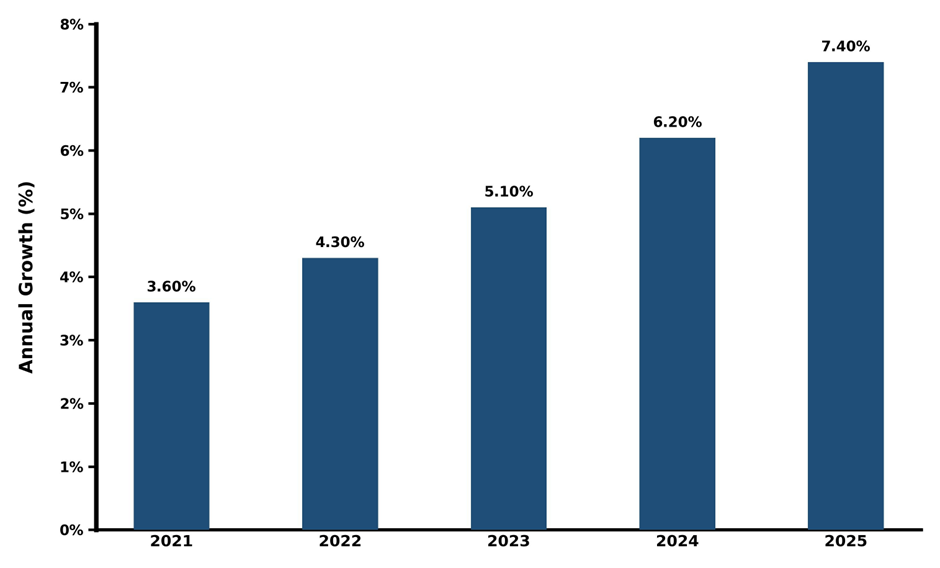
The table below presents the year‑wise growth rates along with the key drivers influencing the market
| Year | Est. Annual Growth (%) | Growth Drivers |
| 2021 | 3.6% | Rising interest in sustainable urban transportation solutions |
| 2022 | 4.3% | Expansion of e-mobility pilot projects and charging facilities |
| 2023 | 5.1% | Increasing fuel prices encouraging electric vehicle adoption |
| 2024 | 6.2% | Government incentives for low-emission commercial transport |
| 2025 | 7.4% | Growing demand for last-mile delivery and passenger mobility solutions |
Topics Covered in the Romania Electric 3-Wheeler Market Report
The Romania Electric 3-Wheeler Market report thoroughly covers the market by end-use, motor power, battery capacity, range, battery type, and payload capacity. The market report provides an unbiased and detailed analysis of ongoing market trends, opportunities/high growth areas, and market drivers, which help stakeholders devise and align their market strategies according to the current and future market dynamics.
Romania Electric 3-Wheeler Market Highlights
| Report Name |
Romania Electric 3-Wheeler Market |
| Forecast period | 2026-2032 |
| CAGR | 8.7% |
| Market Size |
Load Carrier |
Romania Electric 3-Wheeler Market Synopsis
Romania Electric 3-Wheeler Market is anticipated to witness considerable growth due to the growing importance of sustainable mobility, increasing urban logistics activities, and initiatives by the government towards electric mobility. The increasing use of electric three-wheelers for carrying goods and transporting passengers over short distances is driving the growth of the market within urban areas. Moreover, high fuel prices and strict emission reduction requirements are pushing companies towards adopting electric vehicles. Additionally, advancements in battery technology, charging facility developments, and growing involvement of foreign electric vehicle companies are other key factors that will help drive the growth of the market in Romania during the forecast period.
Evaluation of Growth Drivers in the Romania Electric 3-Wheeler Market (2026-2032)
Below mentioned are some prominent drivers and their influence on the market dynamics:
| Drivers | Primary Segments Affected | Why it Matters (Evidence) |
| Increasing Demand for Sustainable Urban Mobility | Passenger Carrier; Lithium-ion Battery | Urban transport operators are shifting toward low-emission electric mobility solutions. |
| Growth in Last-Mile Delivery Services | Load Carrier; Above 1,500 W | E-commerce and food delivery expansion is increasing demand for electric cargo vehicles. |
| Government Incentives for Electric Vehicles | All Segments; Lithium-ion Battery | Subsidies and tax benefits encourage businesses to adopt electric three-wheelers. |
| Advancements in Battery Technology | Above 6 kWh; Above 50 Miles | Improved battery efficiency enhances vehicle range and operational performance. |
| Expansion of Charging Infrastructure | Passenger Carrier & Load Carrier; All Battery Types | Growing charging station networks improve convenience for fleet operators and drivers. |
Romania Electric 3-Wheeler Market is expected to grow at the CAGR of 8.7% during the forecast period of 2026-2032. Growth will be propelled by increased investment in sustainable transport infrastructure, the increasing trend towards urbanization, and the increasing requirement for cost-effective means of commercial transportation. Growing demand from the logistics and ecommerce industries will help boost the adoption of electric freight vehicles in Romanian cities. Favorable government policies towards the adoption of clean transportation and the reduction in carbon emissions will also boost fleet electrification. Advancements in the production of lithium-ion batteries and growing investment in charging infrastructure along with the entry of global EV makers into Romania will bolster industry growth.
Evaluation of Restraints in the Romania Electric 3-Wheeler Market
Below mentioned are some major restraints and their influence on the market dynamics:
| Restraints | Primary Segments Affected | What This Means (Evidence) |
| Limited Charging Infrastructure in Rural Areas | Passenger Carrier; Above 50 Miles | Inadequate charging access restricts adoption outside urban centers. |
| High Initial Purchase Costs | Lithium-ion Battery; Load Carrier | Higher upfront vehicle prices discourage small businesses from adoption. |
| Battery Replacement Expenses | Above 6 kWh; Lithium-ion Battery | Battery maintenance and replacement costs increase long-term ownership expenses. |
| Limited Consumer Awareness | Passenger Carrier; Lead-acid Battery | Lack of awareness regarding EV benefits slows market penetration. |
| Dependence on Imported Components | All Segments; Above 1,500 W | Supply chain disruptions impact pricing and product availability. |
Romania Electric 3-Wheeler Industry Challenges
Despite the promising growth outlook, the Romania Electric 3-Wheeler Industry continues to face several operational and structural challenges. However, issues concerning inadequate charging station facilities in smaller towns and rural areas are still a considerable problem in the case of both fleets and individual drivers. Moreover, the issue of relatively high initial purchasing prices in comparison with other traditional fuel-driven three-wheelers represents another important factor affecting the affordability of small transportation enterprises. On top of that, the dependence of the industry on importing batteries and other vehicle elements poses risks in terms of potential supply chain issues and varying prices. Finally, a lack of knowledge among consumers about electric vehicles constitutes a major drawback.
Romania Electric 3-Wheeler Market Trends
Key trends in the Romania Electric 3-Wheeler Market Growth include:
- Lithium-ion Batteries Being Used: The use of lithium-ion batteries is on the rise due to their better efficiency, faster charging times, and higher durability.
- Increased Requirement of Electric Load Carriers: The rising number of online shopping transactions is pushing companies towards acquiring electric load carriers to conduct effective last-mile deliveries.
- Smart Connectivity Options: The use of smart connectivity technology like GPS trackers and telematics systems is on the rise.
- Requirement for High Range Three Wheelers: Companies are now looking for three wheelers that can cover more distance per charge and serve their business purposes.
Investment Opportunities in the Romania Electric 3-Wheeler Market
Some prominent investment opportunities in the Romania Electric 3-Wheeler Market include:
- Charging Network Development within Cities – Increasing the number of charging stations within urban areas can help foster more EV adoption.
- Assembly and Production Units in Romania – Having assembly plants within the region can help lower import dependency and cost competitiveness.
- Electric Fleet Management – Corporations can look into purchasing electric fleets for logistics, courier, and passenger transport firms.
- Investments in Battery Systems – Investing in higher capacity batteries that are capable of fast charging can improve overall vehicle performance and increase demand.
Top 5 Leading Players in the Romania Electric 3-Wheeler Market
Some leading players operating in the Romania Electric 3-Wheeler Market include:
1. Karsan
| Company Name | Karsan |
|---|---|
| Established Year | 1966 |
| Headquarters | Bursa, Turkey |
| Official Website | Click Here |
Karsan manufactures electric public transportation vehicles including the e-JEST and e-ATAK models used across Romania’s urban transit systems. The company focuses on smart mobility solutions, zero-emission transportation technologies, and expanding electric vehicle deployments in European municipalities through strategic partnerships and sustainable transit initiatives.
2. Piaggio Group
| Company Name | Piaggio Group |
|---|---|
| Established Year | 1884 |
| Headquarters | Pontedera, Italy |
| Official Website | - |
Piaggio Group manufactures electric three-wheelers and compact urban mobility vehicles including the electric Ape range for cargo transportation and last-mile logistics. The company emphasizes sustainable transportation innovation, energy-efficient mobility systems, and expanding environmentally friendly vehicle solutions across European transportation markets including Romania.
3. Clean Motion AB
| Company Name | Clean Motion AB |
|---|---|
| Established Year | 2010 |
| Headquarters | Gothenburg, Sweden |
| Official Website | Click Here |
Clean Motion develops lightweight electric utility vehicles designed for urban logistics and sustainable last-mile transportation applications. The company focuses on energy-efficient vehicle engineering, low operating costs, and environmentally friendly transportation technologies while strengthening its presence in European smart mobility markets.
4. Bajaj Auto Limited
| Company Name | Bajaj Auto Limited |
|---|---|
| Established Year | 1945 |
| Headquarters | Pune, India |
| Official Website | Click Here |
Bajaj Auto manufactures electric and conventional three-wheelers for passenger and cargo transportation applications. The company prioritizes affordable urban mobility, durable vehicle performance, and expansion of electric transportation solutions while increasing its international footprint across emerging and European electric vehicle markets.
5. Anadolu Automobil Rom
| Company Name | Anadolu Automobil Rom |
|---|---|
| Established Year | 1995 |
| Headquarters | Bucharest, Romania |
| Official Website | - |
Anadolu Automobil Rom operates as an automotive distribution company supporting the deployment of electric public transportation vehicles across Romania. The company collaborates with international electric vehicle manufacturers to strengthen sustainable urban mobility infrastructure and improve access to advanced electric transit solutions in Romanian cities.
Government Regulations Introduced in the Romania Electric 3-Wheeler Market
According to Romania’s Government Data, several measures have been proposed to promote the use of electric mobility systems within the country. First, the "Rabla Plus" campaign in Romania has provided financial bonuses for buying electric cars, which includes electric mobility systems in commercial sectors. Secondly, in collaboration with European Union initiatives on sustainability, the Romanian government is also working to increase the number of electric car-charging stations in order to curb pollution levels in cities such as Bucharest and Cluj-Napoca. Thirdly, there have been some laws passed that seek to improve air quality through the adoption of green transportation. Finally, under the National Recovery and Resilience plan, Romania has committed to investing in electric mobility infrastructure development.
Future Insights of the Romania Electric 3-Wheeler Market
The Romania Electric 3-Wheeler Market Share is expected to witness strong growth in the coming years due to increasing urban transportation needs, expanding logistics operations, and supportive government policies promoting clean mobility. Increased investment in charging facilities and advances in battery technology will help improve the performance and cost-efficiency of electric three-wheelers in the nation. Moreover, increased consumer and business consciousness about the environment will result in quicker movement toward adopting sustainable modes of transport. With the increasing adoption of electric three-wheelers for carrying loads for e-commerce companies, coupled with the growth of intelligent mobility platforms, there will be significant opportunities for players in the Romanian electric mobility market.
Market Segmentation Analysis
The report offers a comprehensive study of the subsequent market segments and their leading categories.
Load Carrier to Dominate the Market – By End-Use
According to Mohit, Senior Research Analyst, 6Wresearch, the Load Carrier category dominates the Romania Electric 3-Wheeler Market owing to the rapid growth of e-commerce, urban delivery services, and logistics operations. Electric load carriers have become more common among companies to decrease operating fuel expenses and ensure sustainability. The growing requirement for last-mile delivery services in Romanian cities will drive the segment's growth in the coming years. Moreover, government policies favoring eco-friendly commercial vehicles and advancements in battery technology are prompting logistics players to switch to electric fleets. The segment will remain dominant due to its growing use in business applications and the high demand for environmentally sustainable transport options.
Above 1,500 W Segment to Lead the Market – By Motor Power
The Above 1,500 W segment holds a major share in the Romania Electric Three-Wheeler Market owing to its superior performance capabilities, ability to carry a larger load, and overall efficiency. Commercial establishments involved in the transport of goods tend to favor powerful three-wheelers due to their longer life span and greater reliability.
Key Attractiveness of the Report
- 10 Years of Market Numbers.
- Historical Data Starting from 2022 to 2025.
- Base Year: 2025.
- Forecast Data until 2032.
- Key Performance Indicators Impacting the Market.
- Major Upcoming Developments and Projects.
Key Highlights of the Report:
- Romania Electric 3-Wheeler Market Outlook
- Market Size of Romania Electric 3-Wheeler Market, 2025
- Forecast of Romania Electric 3-Wheeler Market, 2032
- Historical Data and Forecast of Romania Electric 3-Wheeler Revenues & Volume for the Period 2022 - 2032
- Romania Electric 3-Wheeler Market Trend Evolution
- Romania Electric 3-Wheeler Market Drivers and Challenges
- Romania Electric 3-Wheeler Price Trends
- Romania Electric 3-Wheeler Porter's Five Forces
- Romania Electric 3-Wheeler Industry Life Cycle
- Historical Data and Forecast of Romania Electric 3-Wheeler Market Revenues & Volume By End-Use for the Period 2022 - 2032
- Historical Data and Forecast of Romania Electric 3-Wheeler Market Revenues & Volume By Passenger Carrier for the Period 2022 - 2032
- Historical Data and Forecast of Romania Electric 3-Wheeler Market Revenues & Volume By Load Carrier for the Period 2022 - 2032
- Historical Data and Forecast of Romania Electric 3-Wheeler Market Revenues & Volume By Motor Power for the Period 2022 - 2032
- Historical Data and Forecast of Romania Electric 3-Wheeler Market Revenues & Volume By Below 1,000 W for the Period 2022 - 2032
- Historical Data and Forecast of Romania Electric 3-Wheeler Market Revenues & Volume By 1,000-1,500 W for the Period 2022 - 2032
- Historical Data and Forecast of Romania Electric 3-Wheeler Market Revenues & Volume By Above 1,500 W for the Period 2022 - 2032
- Historical Data and Forecast of Romania Electric 3-Wheeler Market Revenues & Volume By Battery Capacity for the Period 2022 - 2032
- Historical Data and Forecast of Romania Electric 3-Wheeler Market Revenues & Volume By Below 3 kWh for the Period 2022 - 2032
- Historical Data and Forecast of Romania Electric 3-Wheeler Market Revenues & Volume By 3-6 kWh for the Period 2022 - 2032
- Historical Data and Forecast of Romania Electric 3-Wheeler Market Revenues & Volume By Above 6 kWh for the Period 2022 - 2032
- Historical Data and Forecast of Romania Electric 3-Wheeler Market Revenues & Volume By Range for the Period 2022 - 2032
- Historical Data and Forecast of Romania Electric 3-Wheeler Market Revenues & Volume By Up to 50 Miles for the Period 2022 - 2032
- Historical Data and Forecast of Romania Electric 3-Wheeler Market Revenues & Volume By Above 50 Miles for the Period 2022 - 2032
- Historical Data and Forecast of Romania Electric 3-Wheeler Market Revenues & Volume By Battery Type for the Period 2022 - 2032
- Historical Data and Forecast of Romania Electric 3-Wheeler Market Revenues & Volume By Lead-acid Battery for the Period 2022 - 2032
- Historical Data and Forecast of Romania Electric 3-Wheeler Market Revenues & Volume By Lithium-ion Battery for the Period 2022 - 2032
- Historical Data and Forecast of Romania Electric 3-Wheeler Market Revenues & Volume By Other for the Period 2022 - 2032
- Historical Data and Forecast of Romania Electric 3-Wheeler Market Revenues & Volume By Payload Capacity for the Period 2022 - 2032
- Historical Data and Forecast of Romania Electric 3-Wheeler Market Revenues & Volume By Up to 300 kg for the Period 2022 - 2032
- Historical Data and Forecast of Romania Electric 3-Wheeler Market Revenues & Volume By 300-500 kg for the Period 2022 - 2032
- Historical Data and Forecast of Romania Electric 3-Wheeler Market Revenues & Volume By Above 500 kg for the Period 2022 - 2032
- Romania Electric 3-Wheeler Import Export Trade Statistics
- Market Opportunity Assessment By End-Use
- Market Opportunity Assessment By Motor Power
- Market Opportunity Assessment By Battery Capacity
- Market Opportunity Assessment By Range
- Market Opportunity Assessment By Battery Type
- Market Opportunity Assessment By Payload Capacity
- Romania Electric 3-Wheeler Top Companies Market Share
- Romania Electric 3-Wheeler Competitive Benchmarking By Technical and Operational Parameters
- Romania Electric 3-Wheeler Company Profiles
- Romania Electric 3-Wheeler Key Strategic Recommendations
Market Covered
The report offers a comprehensive study of the subsequent market segments:
By End-Use
- Passenger Carrier
- Load Carrier
By Motor Power
- Below 1,000 W
- 1,000-1,500 W
- Above 1,500 W
By Battery Capacity
- Below 3 kWh
- 3-6 kWh
- Above 6 kWh
By Range
- Up to 50 Miles
- Above 50 Miles
By Battery Type
- Lead-acid Battery
- Lithium-ion Battery
- Other
By Payload Capacity
- Up to 300 kg
- 300-500 kg
- Above 500 kg






































