Romania Engines Market (2026-2032) | Trends, Growth, Revenue, Companies, Share, Size, Industry, Value, Forecast & Analysis
Market Forecast By Type (Power Generation (Emergency & Standby, Prime Power, Peak Shaving), Marine (Recreational and Commercial)), By Power Rating (0-60 HP, 61-100 HP, 101-300 HP, 301-500 HP, 501-700 HP, above 700 HP) And Competitive Landscape
| Product Code: ETC4531579 | Publication Date: Jul 2023 | Updated Date: May 2026 | Product Type: Report | |
| Publisher: 6Wresearch | Author: Ravi Bhandari | No. of Pages: 85 | No. of Figures: 45 | No. of Tables: 25 |
Romania Engines Market: Import Trend Analysis
In the Romania engines market, the import trend experienced a decline with a growth rate of -18.21% from 2023 to 2024. However, the compound annual growth rate (CAGR) for 2020-2024 stood at 5.89%. This decrease in import momentum could be attributed to shifting demand patterns or changes in trade policies impacting market stability.
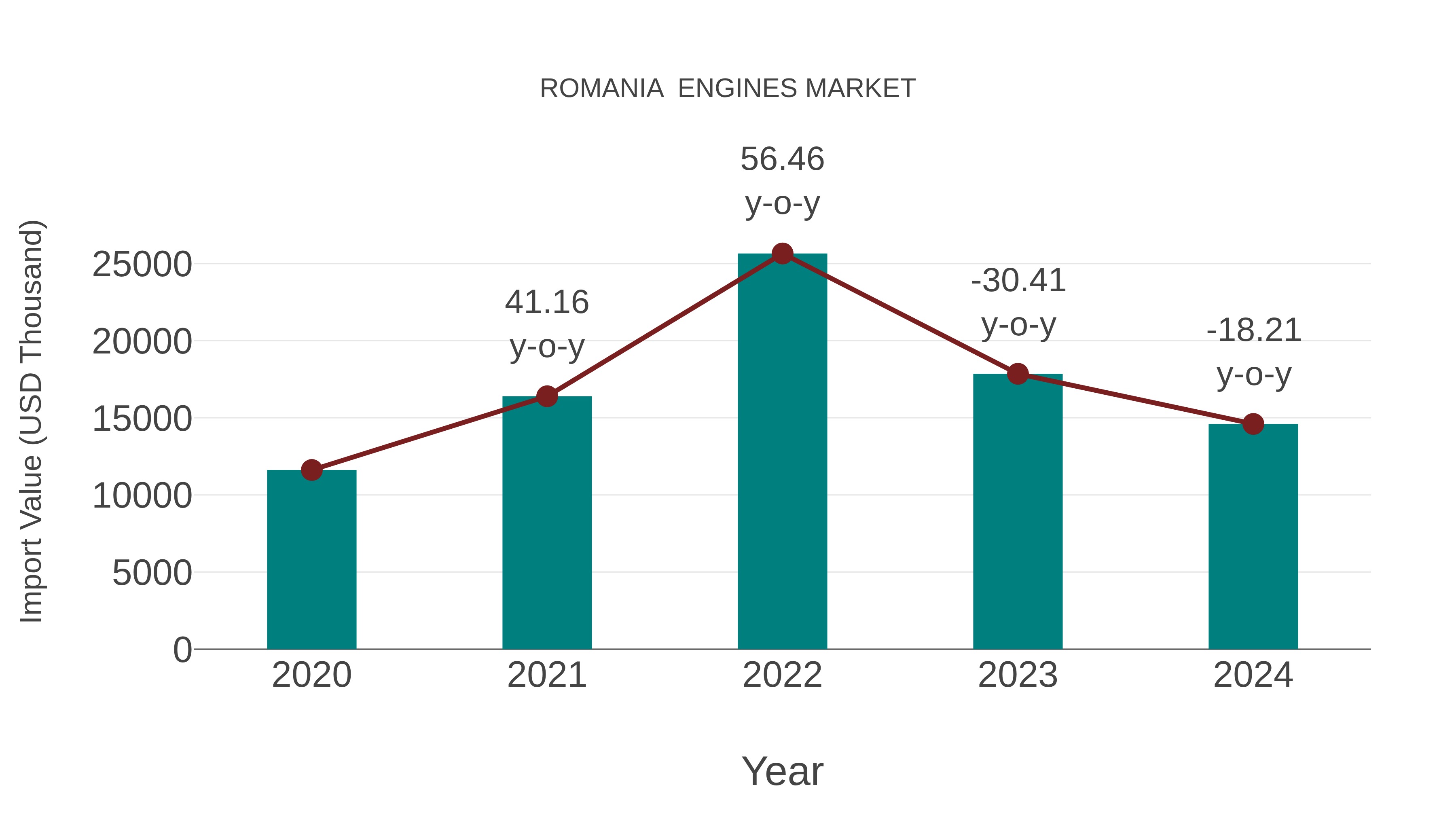
Romania Engines Market Growth Rate
According to 6Wresearch internal database and industry insights, the Romania Engines Market is projected to grow at a compound annual growth rate (CAGR) of 5.9% during the forecast period (2026-2032).
Topics Covered in the Romania Engines Market Report
The Romania Engines Market report thoroughly covers the market by type and power rating. The market report provides an unbiased and detailed analysis of ongoing market trends, opportunities/high growth areas, and market drivers, which help stakeholders devise and align their market strategies according to the current and future market dynamics.
Romania Engines Market Highlights
| Report Name |
Romania Engines Market |
| Forecast period | 2026-2032 |
| CAGR | 5.9% |
| Market Size |
Power Generation (Prime Power) |
Romania Engines Market Synopsis
Romania Engines Market is anticipated to witness considerable growth due to the increase in industrialization, investments in infrastructure development, and high demands for a stable power supply in the commercial and industrial sectors. Increasing adoption of engines for backup and main power solutions is a major reason behind the growth in the engine market in Romania. Additionally, increased marine transport activities and boating are helping drive the market for marine engines in the country. Growing concerns for energy security and modernization of industries have also added more opportunities for market growth in the coming years.
Evaluation of Growth Drivers in the Romania Engines Market
Below mentioned are some prominent drivers and their influence on the market dynamics:
| Drivers | Primary Segments Affected | Why it Matters (Evidence) |
| Rising Demand for Backup Power Solutions | Power Generation; 301-500 HP | Industries and commercial facilities require uninterrupted power during grid failures. |
| Expansion of Industrial Infrastructure | Prime Power; Above 700 HP | Manufacturing and heavy industries are increasing demand for high-capacity engines. |
| Growth in Marine Tourism and Logistics | Marine; 101-300 HP | Increasing marine transport and recreational boating activities support engine demand. |
| Government Investments in Energy Projects | Emergency & Standby; 501-700 HP | National infrastructure upgrades require efficient power generation equipment. |
| Technological Advancements in Engine Efficiency | All Types; Above 300 HP | Modern fuel-efficient engines reduce operational costs and improve performance. |
Romania Engines Market is expected to grow at the CAGR of 5.9% during the forecast period of 2026-2032. The market growth can be attributed to increased industrial growth, increased construction activities in the commercial sector, and investments in the modernization of energy infrastructure. The need for backup power systems due to increased demands in hospitals, industrial plants, and data centers is further boosting the industry. Moreover, an increase in activities related to marine transport and tourism is positively affecting the demand for more efficient marine engines. Advances in technology that improve the efficiency, performance, and durability of engines have also been contributing factors in boosting the growth of the industry.
Evaluation of Restraints in the Romania Engines Market
Below mentioned are some major restraints and their influence on the market dynamics:
| Restraints | Primary Segments Affected | What This Means (Evidence) |
| High Initial Equipment Costs | Above 700 HP; Prime Power | Expensive engine systems limit adoption among smaller businesses. |
| Stringent Emission Regulations | Marine; 301-500 HP | Environmental compliance increases manufacturing and maintenance expenses. |
| Volatile Fuel Prices | Power Generation; All HP Segments | Fluctuating fuel costs impact operational affordability for end users. |
| Dependence on Imported Components | Emergency & Standby; Above 500 HP | Supply chain disruptions affect production timelines and pricing. |
| Skilled Workforce Shortages | Marine & Power Generation; All Types | Limited technical expertise affects engine maintenance and servicing quality. |
Romania Engines Industry Challenges
Although strong growth potential, the Romania Engines Industry continues to face several operational and market-related challenges. The key challenge facing the company relates to the escalating prices of engines and other imported parts. This is due to the increased prices increase the total ownership costs for both industries and marine companies that purchase their engines. Moreover, there are stringent environmental laws that make the company spend more money in research and development on cleaner technologies. Fuel price variations also pose significant challenges in terms of high costs of running the machines due to fluctuating prices of fuel. Another challenge associated with this engine technology is the shortage of qualified personnel for repairs.
Romania Engines Market Trends
Key trends evaluating the landscape of the Romania Engines Market Growth are:
- Inclusion of Efficient Engine Technologies: There is an increase in the development of more efficient engines.
- Increasing Demand for Engines for Prime Power: There is increasing demand from factories for engines to supply uninterrupted power.
- Incorporation of Digital Monitoring: The incorporation of digital monitoring and preventive maintenance technologies by engine manufacturers.
- Increase in Marine Recreational Activities: Growth in recreational activities on water bodies and logistics through ships has led to rising demands for marine engines.
Investment Opportunities in the Romania Engines Market
Some best investment opportunities in the Romania Engines Market Share include:
- Development of Industrial Power Infrastructures – Investment in backup and primary power generation can benefit Romania’s developing industry.
- Marine Engine Manufacturing Growth – An increase in marine tourism and logistics provides opportunities for manufacturing efficient marine engines.
- IoT-Based Engine Diagnostics Services – Businesses can make investments in monitoring systems that analyze engine performance through the Internet of Things (IoT).
- Efficient Engine Development – Research and development of engines with low emissions are lucrative business ventures.
Top 5 Leading Players in the Romania Engines Market
Some leading players operating in the Romania Engines Market include:
1. Caterpillar Inc
| Company Name | Caterpillar Inc. |
|---|---|
| Established Year | 1925 |
| Headquarters | Texas, USA |
| Official Website | Click Here |
Caterpillar Inc. manufactures industrial engines and power generation systems widely used across construction, mining, marine, and industrial applications. The company focuses on fuel-efficient engine technologies, reliable standby power solutions, and advanced performance systems to support industrial and commercial operations globally, including Romania.
2. Cummins Inc
| Company Name | Cummins Inc. |
|---|---|
| Established Year | 1919 |
| Headquarters | Indiana, USA |
| Official Website | Click Here |
Cummins develops diesel and natural gas engines for power generation, marine, and industrial applications. The company emphasizes innovation in low-emission technologies, digital engine monitoring, and efficient power systems while strengthening its market presence across European industrial and energy infrastructure sectors.
3. Rolls-Royce Holdings plc
| Company Name | Rolls-Royce Holdings plc |
|---|---|
| Established Year | 1906 |
| Headquarters | London, United Kingdom |
| Official Website | Click Here |
Rolls-Royce manufactures advanced engines and power systems for marine, industrial, and energy applications. The company focuses on high-performance engine technologies, operational efficiency, and sustainable energy solutions while supporting infrastructure modernization and marine transportation development across international markets.
4. MAN Energy Solutions
| Company Name | MAN Energy Solutions |
|---|---|
| Established Year | 1758 |
| Headquarters | Augsburg, Germany |
| Official Website | Click Here |
MAN Energy Solutions provides large-scale engines and energy systems for marine and industrial applications. The company specializes in fuel-efficient propulsion technologies, sustainable energy systems, and advanced power generation solutions designed to improve industrial productivity and operational reliability.
5. Volvo Penta
| Company Name | Volvo Penta |
|---|---|
| Established Year | 1907 |
| Headquarters | Gothenburg, Sweden |
| Official Website | Click Here |
Volvo Penta manufactures marine and industrial engines focused on performance, fuel efficiency, and operational durability. The company supports commercial marine transport, recreational boating, and industrial power applications while investing in environmentally sustainable engine technologies and smart connectivity solutions.
Government Regulations Introduced in the Romania Engines Market
According to Romania’s Government Data, several measures have been put in place to upgrade the country’s infrastructure to enhance energy availability. First, the country’s National Recovery and Resilience Plan offers financial assistance aimed at industrial modernization, energy efficiency, and development of emergency power system infrastructure. Second, the country’s government has set stricter environmental guidelines that conform to EU emission standards, thus driving the use of environmentally friendly and efficient engines. The Romanian government has also made investments in upgrading port infrastructures and marine transport infrastructures, which will increase the demand for marine engines. Third, measures geared toward encouraging the incorporation of renewable energy and industrial efficiency have offered new opportunities for advanced engines in commercial and industrial use in the country.
Future Insights of the Romania Engines Market
The outlook for the Romania Engines Market is positive due to increasing investments in industrial infrastructure, growing demand for uninterrupted power generation systems, and expanding marine transportation activities across the country. Technological developments aimed at maximizing fuel efficiency, emission reduction, and monitoring are likely to enhance the performance of the latest engines. Furthermore, the growth of factories, logistics networks, and energy plants will further contribute to the demand for engines with high capacity. Increased governmental encouragement of industrial upgrading and sustainable energy development is likely to create positive business prospects for engine producers and suppliers in Romania during the forecast period.
Market Segmentation Analysis
The report offers a comprehensive study of the subsequent market segments and their leading categories.
Power Generation (Prime Power) to Dominate the Market – By Type
According to Rahul, Senior Research Analyst, 6Wresearch, the Power Generation segment dominates the Romania Engines Market owing to increasing industrial activities and the growing need for reliable continuous power supply solutions. Prime power engines are becoming crucial for ensuring constant productivity in many industries like manufacturing, healthcare, construction, and commercial infrastructure. An increase in fluctuating energy demands and infrastructure development activities is contributing towards the growth of the market segment in Romania.
Marine (Commercial) Segment to Witness Growth – By Type
The Marine (Commercial) sector is experiencing a lot of growth within the Romania Engines market owing to the increase in marine logistics operations, upgrading of ports, and increased inland water transportation services. There has been an improvement in the efficiency of marine transportation systems through the installation of efficient engines.
Key Attractiveness of the Report
- 10 Years of Market Numbers.
- Historical Data Starting from 2022 to 2025.
- Base Year: 2025.
- Forecast Data until 2032.
- Key Performance Indicators Impacting the Market.
- Major Upcoming Developments and Projects.
Key Highlights of the Report:
- Romania Engines Market Outlook
- Market Size of Romania Engines Market, 2025
- Forecast of Romania Engines Market, 2032
- Historical Data and Forecast of Romania Engines Revenues & Volume for the Period 2022-2032F
- Romania Engines Market Trend Evolution
- Romania Engines Market Drivers and Challenges
- Romania Engines Price Trends
- Romania Engines Porter's Five Forces
- Romania Engines Industry Life Cycle
- Historical Data and Forecast of Romania Engines Market Revenues & Volume By Type for the Period 2022-2032F
- Historical Data and Forecast of Romania Engines Market Revenues & Volume By Power Generation (Emergency & Standby, Prime Power, Peak Shaving) for the Period 2022-2032F
- Historical Data and Forecast of Romania Engines Market Revenues & Volume By Marine (Recreational and Commercial) for the Period 2022-2032F
- Historical Data and Forecast of Romania Engines Market Revenues & Volume By Power Rating for the Period 2022-2032F
- Historical Data and Forecast of Romania Engines Market Revenues & Volume By 0-60 HP for the Period 2022-2032F
- Historical Data and Forecast of Romania Engines Market Revenues & Volume By 61-100 HP for the Period 2022-2032F
- Historical Data and Forecast of Romania Engines Market Revenues & Volume By 101-300 HP for the Period 2022-2032F
- Historical Data and Forecast of Romania Engines Market Revenues & Volume By 301-500 HP for the Period 2022-2032F
- Historical Data and Forecast of Romania Engines Market Revenues & Volume By 501-700 HP for the Period 2022-2032F
- Historical Data and Forecast of Romania Engines Market Revenues & Volume By above 700 HP for the Period 2022-2032F
- Romania Engines Import Export Trade Statistics
- Market Opportunity Assessment By Type
- Market Opportunity Assessment By Power Rating
- Romania Engines Top Companies Market Share
- Romania Engines Competitive Benchmarking By Technical and Operational Parameters
- Romania Engines Company Profiles
- Romania Engines Key Strategic Recommendations
Market Covered
The report offers a comprehensive study of the subsequent market segments:
By Type
- Power Generation (Emergency & Standby, Prime Power, Peak Shaving)
- Marine (Recreational and Commercial)
By Power Rating
- 0-60 HP
- 61-100 HP
- 101-300 HP
- 301-500 HP
- 501-700 HP
- Above 700 HP
Romania Engines Market (2026-2032): FAQs
The Romania Engines Market is projected to grow at a CAGR of 5.9% during the forecast
Some major challenges include increasing cost of machinery, stringent environment emission norms and changing oil prices.
Some emerging trends include intelligent engine management systems, emission control engines and after sales services for maintenance of engines.
End users mainly consist of manufacturing units, commercial establishments, shipping companies, logistic firms and energy companies.
6Wresearch actively monitors the Romania Engines Market and publishes its comprehensive annual report, highlighting emerging trends, growth drivers, revenue analysis, and forecast outlook. Our insights help businesses to make data-backed strategic decisions with ongoing market dynamics. Our analysts track relevent industries related to the Romania Engines Market, allowing our clients with actionable intelligence and reliable forecasts tailored to emerging regional needs.
Yes, we provide customisation as per your requirements. To learn more, feel free to contact us on sales@6wresearch.com
| 1 Executive Summary |
| 2 Introduction |
| 2.1 Key Highlights of the Report |
| 2.2 Report Description |
| 2.3 Market Scope & Segmentation |
| 2.4 Research Methodology |
| 2.5 Assumptions |
| 3 Romania Engines Market Overview |
| 3.1 Romania Country Macro Economic Indicators |
| 3.2 Romania Engines Market Revenues & Volume, 2022 & 2032F |
| 3.3 Romania Engines Market - Industry Life Cycle |
| 3.4 Romania Engines Market - Porter's Five Forces |
| 3.5 Romania Engines Market Revenues & Volume Share, By Type, 2022 & 2032F |
| 3.6 Romania Engines Market Revenues & Volume Share, By Power Rating, 2022 & 2032F |
| 4 Romania Engines Market Dynamics |
| 4.1 Impact Analysis |
| 4.2 Market Drivers |
| 4.2.1 Increasing demand for energy-efficient engines in Romania |
| 4.2.2 Growth in industrial and construction sectors driving demand for engines |
| 4.2.3 Government initiatives promoting the use of clean and sustainable energy sources |
| 4.3 Market Restraints |
| 4.3.1 Fluctuating raw material prices impacting engine manufacturing costs |
| 4.3.2 Intense competition from global engine manufacturers |
| 4.3.3 Environmental regulations increasing manufacturing costs and limiting market expansion |
| 5 Romania Engines Market Trends |
| 6 Romania Engines Market, By Types |
| 6.1 Romania Engines Market, By Type |
| 6.1.1 Overview and Analysis |
| 6.1.2 Romania Engines Market Revenues & Volume, By Type, 2022 - 2032F |
| 6.1.3 Romania Engines Market Revenues & Volume, By Power Generation (Emergency & Standby, Prime Power, Peak Shaving), 2022 - 2032F |
| 6.1.4 Romania Engines Market Revenues & Volume, By Marine (Recreational and Commercial), 2022 - 2032F |
| 6.2 Romania Engines Market, By Power Rating |
| 6.2.1 Overview and Analysis |
| 6.2.2 Romania Engines Market Revenues & Volume, By 0-60 HP, 2022 - 2032F |
| 6.2.3 Romania Engines Market Revenues & Volume, By 61-100 HP, 2022 - 2032F |
| 6.2.4 Romania Engines Market Revenues & Volume, By 101-300 HP, 2022 - 2032F |
| 6.2.5 Romania Engines Market Revenues & Volume, By 301-500 HP, 2022 - 2032F |
| 6.2.6 Romania Engines Market Revenues & Volume, By 501-700 HP, 2022 - 2032F |
| 6.2.7 Romania Engines Market Revenues & Volume, By above 700 HP, 2022 - 2032F |
| 7 Romania Engines Market Import-Export Trade Statistics |
| 7.1 Romania Engines Market Export to Major Countries |
| 7.2 Romania Engines Market Imports from Major Countries |
| 8 Romania Engines Market Key Performance Indicators |
| 8.1 Adoption rate of energy-efficient engines in Romania |
| 8.2 Investment in research and development for engine technology |
| 8.3 Number of government projects promoting clean energy solutions in Romania |
| 8.4 Percentage of engine manufacturers implementing sustainable practices |
| 8.5 Growth rate of the industrial and construction sectors in Romania |
| 9 Romania Engines Market - Opportunity Assessment |
| 9.1 Romania Engines Market Opportunity Assessment, By Type, 2022 & 2032F |
| 9.2 Romania Engines Market Opportunity Assessment, By Power Rating, 2022 & 2032F |
| 10 Romania Engines Market - Competitive Landscape |
| 10.1 Romania Engines Market Revenue Share, By Companies, 2025 |
| 10.2 Romania Engines Market Competitive Benchmarking, By Operating and Technical Parameters |
| 11 Company Profiles |
| 12 Recommendations |
| 13 Disclaimer |
Global Go To Market Strategy - 2030
Export potential enables firms to identify high-growth global markets with greater confidence by combining advanced trade intelligence with a structured quantitative methodology. The framework analyzes emerging demand trends and country-level import patterns while integrating macroeconomic and trade datasets such as GDP and population forecasts, bilateral import–export flows, tariff structures, elasticity differentials between developed and developing economies, geographic distance, and import demand projections. Using weighted trade values from 2020–2024 as the base period to project country-to-country export potential for 2030, these inputs are operationalized through calculated drivers such as gravity model parameters, tariff impact factors, and projected GDP per-capita growth. Through an analysis of hidden potentials, demand hotspots, and market conditions that are most favorable to success, this method enables firms to focus on target countries, maximize returns, and global expansion with data, backed by accuracy.
By factoring in the projected importer demand gap that is currently unmet and could be potential opportunity, it identifies the potential for the Exporter (Country) among 190 countries, against the general trade analysis, which identifies the biggest importer or exporter.
To discover high-growth global markets and optimize your business strategy:
Click Here
Pricing
- Single User License$ 1,995
- Department License$ 2,400
- Site License$ 3,120
- Global License$ 3,795

Leadership Perspectives from Industry Events
Search
Thought Leadership and Analyst Meet





Our Clients








6WResearch In News
- Doha a strategic location for EV manufacturing hub: IPA Qatar
- Demand for luxury TVs surging in the GCC, says Samsung
- Empowering Growth: The Thriving Journey of Bangladesh’s Cable Industry
- Demand for luxury TVs surging in the GCC, says Samsung
- Video call with a traditional healer? Once unthinkable, it’s now common in South Africa
- Intelligent Buildings To Smooth GCC’s Path To Net Zero
Latest Reports
- Taiwan Airport Wireless Infrastructure Market (2026-2032)
- Vietnam Airport Wireless Infrastructure Market (2026-2032)
- Thailand Airport Wireless Infrastructure Market (2026-2032)
- South Korea Airport Wireless Infrastructure Market (2026-2032)
- Romania Airport Wireless Infrastructure Market (2026-2032)
- Qatar Airport Wireless Infrastructure Market (2026-2032)
- Philippines Airport Wireless Infrastructure Market (2026-2032)
- Japan Airport Wireless Infrastructure Market (2026-2032)
- Taiwan Airport Winter Services Market (2026-2032)
- Vietnam Airport Winter Services Market (2026-2032)
Industry Events and Analyst Meet

HIMTEX 2026

India Refining Summit 2026

India EV Show 2026

EV tech India Expo 2026

Auto Tech Asia 2026
Whitepaper
- Middle East & Africa Commercial Security Market Click here to view more.
- Middle East & Africa Fire Safety Systems & Equipment Market Click here to view more.
- GCC Drone Market Click here to view more.
- Middle East Lighting Fixture Market Click here to view more.
- GCC Physical & Perimeter Security Market Click here to view more.


