Romania Ethyl Alcohol Market Size (2020-2030)
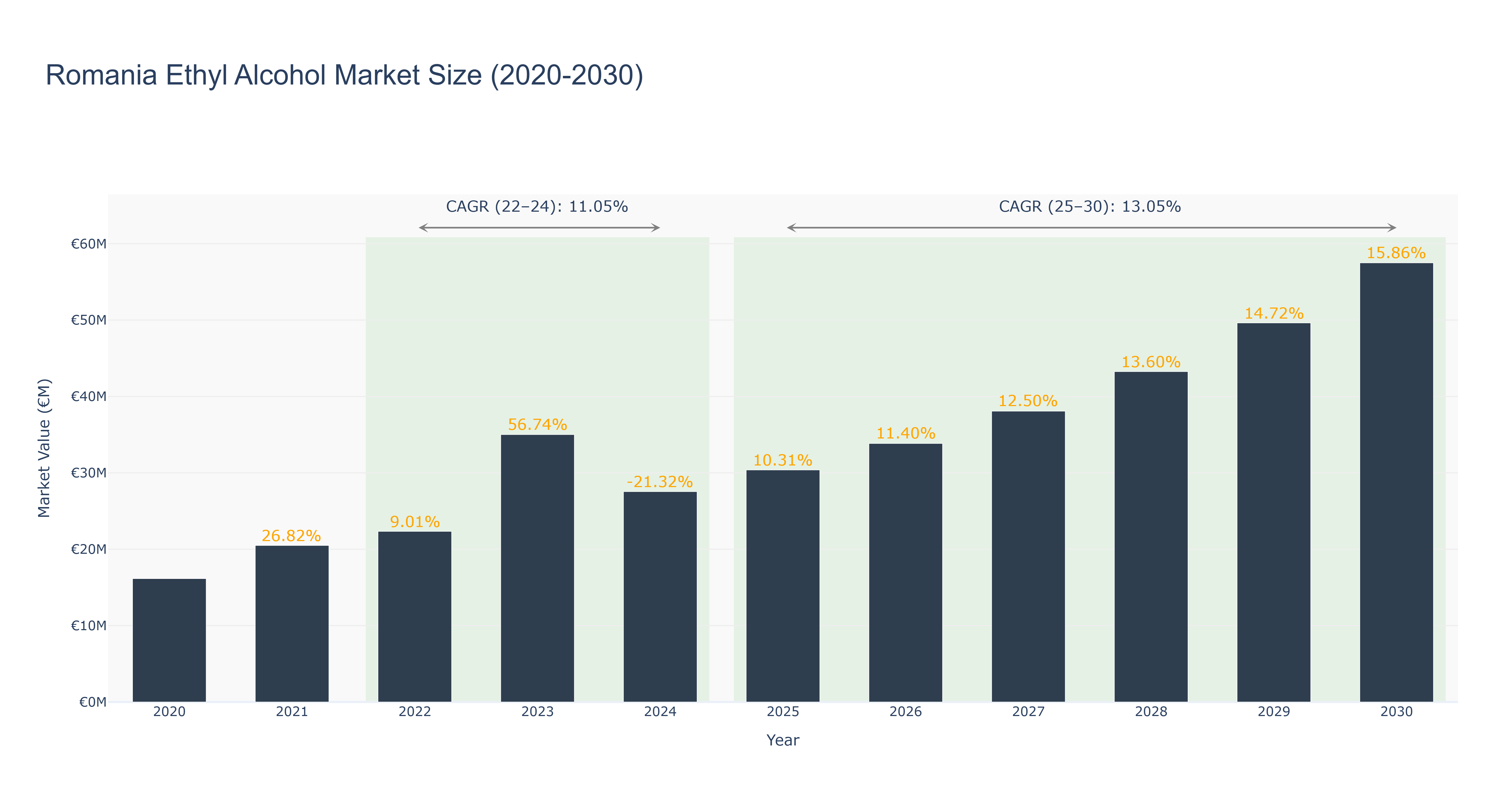
Romania Ethyl Alcohol Market has shown a promising growth trend over the years. The market size peaked at €57.50 million in 2030, with a steady increase since 2020 when it was €16.16 million. The market faced a decline in 2024 to €27.55 million, attributed to external factors impacting production and demand. However, a strong recovery followed, with forecasted growth to reach €57.50 million by 2030. The CAGR for the period 2022-24 was 11.05%, while for 2025-30, it is projected at 13.05%. Industry drivers such as increasing demand for ethyl alcohol in various sectors and favorable government regulations have contributed to this growth. Looking ahead, Romania is set to invest in sustainable production practices to meet growing market demands and enhance competitiveness in the global market.
Romania Ethyl Alcohol Market: Production & Trade Performance (2019-2025)
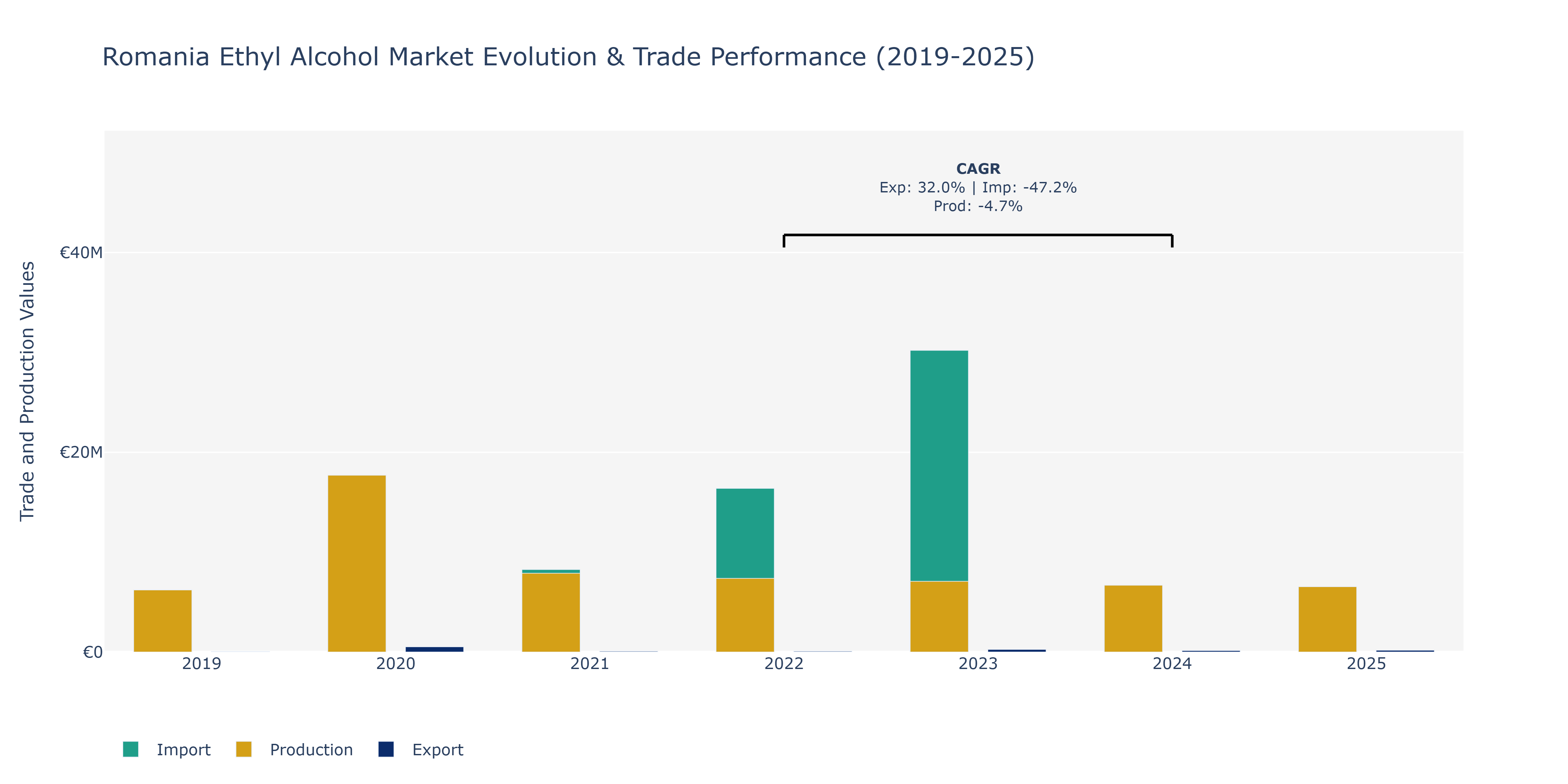
In the Romania Ethyl Alcohol Market, exports witnessed fluctuations over the analyzed period. Starting at €48.51 thousand in 2019, the value increased notably in 2020 to €521.33 thousand, showcasing a peak point. However, there was a slight decline in 2021 before a resurgence in 2022 and 2023, reaching €259.46 thousand. Imports, on the other hand, showed steady growth from €2.41 million in 2019 to €3.43 million in 2025, with a peak in 2023. Production levels fluctuated, with a peak in 2020 at €17.71 billion before declining to €6.69 billion in 2024. These trends could be attributed to various factors such as changes in global demand for ethyl alcohol, local production capacity, and international trade policies affecting import and export volumes. The surge in imports could be driven by rising domestic consumption or limited local production capacity, while fluctuations in production might stem from market dynamics impacting supply chains or regulatory changes influencing production levels.
Romania Ethyl Alcohol Market Overview
The Romania Ethyl Alcohol Market is experiencing steady growth driven by demand from various industries such as pharmaceuticals, cosmetics, food and beverages, and automotive. The market is witnessing an increasing trend towards the use of ethyl alcohol in sanitizers and disinfectants due to the ongoing COVID-19 pandemic. The government`s focus on promoting the use of biofuels is also contributing to the growth of the market. Key players in the Romania Ethyl Alcohol Market include Biofuel Factory, Cristim, Ethanol Distribution Company, and others. The market is characterized by intense competition, with companies focusing on product innovation, strategic partnerships, and expanding their distribution networks to gain a competitive edge. However, challenges such as fluctuating raw material prices and stringent regulations regarding the production and consumption of ethyl alcohol may impact market growth in the near future.
Romania Ethyl Alcohol Market Trends
The Romania Ethyl Alcohol Market is experiencing several key trends. One prominent trend is the increasing demand for ethyl alcohol in various industries, including pharmaceuticals, cosmetics, and alcoholic beverages. This demand is driven by the growth of these industries in Romania and the need for high-quality ethyl alcohol as a key ingredient. Additionally, there is a rising interest in using ethyl alcohol as a cleaner and disinfectant, especially in light of the COVID-19 pandemic. Another trend is the focus on sustainability and environmentally friendly production methods, as consumers and businesses alike are becoming more conscious of the environmental impact of their choices. Overall, these trends are shaping the Romania Ethyl Alcohol Market and driving innovation in product development and production processes.
Romania Ethyl Alcohol Market Challenges
The Romania Ethyl Alcohol Market faces several challenges, including strict government regulations on alcohol production and distribution, increasing competition from imported ethyl alcohol products, fluctuating raw material prices, and changing consumer preferences towards healthier alternatives. Additionally, economic instability and currency fluctuations can impact the pricing and demand for ethyl alcohol in the market. Furthermore, the presence of counterfeit products poses a threat to the reputation and trust of legitimate ethyl alcohol producers. To navigate these challenges, companies operating in the Romania Ethyl Alcohol Market need to stay updated on regulatory changes, invest in quality control measures, diversify their product offerings, and focus on building strong relationships with distributors and retailers to maintain a competitive edge in the market.
Romania Ethyl Alcohol Market Investment Opportunities
Investment opportunities in the Romania Ethyl Alcohol Market include the production and distribution of ethyl alcohol for various industries such as pharmaceuticals, cosmetics, and beverages. With the increasing demand for hand sanitizers and disinfectants due to the ongoing global health crisis, there is a growing need for ethyl alcohol as a key ingredient. Investing in ethanol production facilities or partnering with existing manufacturers to expand capacity can be lucrative. Additionally, exploring opportunities for exporting ethyl alcohol to neighboring countries can further enhance profitability. As the market continues to evolve and adapt to changing consumer needs, investing in the Romania Ethyl Alcohol Market presents a promising opportunity for growth and diversification.
Romania Ethyl Alcohol Market Government Policy
The Romanian government has implemented various policies to regulate the ethyl alcohol market, aiming to ensure consumer safety and fair competition. These policies include setting minimum quality standards for ethyl alcohol production, regulating the licensing and operation of distilleries, and imposing strict labeling requirements for products containing ethyl alcohol. Additionally, the government has implemented taxation policies to control the production and distribution of ethyl alcohol, with measures in place to combat illicit production and smuggling. Overall, the government`s policies in the Romania ethyl alcohol market focus on promoting transparency, quality, and safety within the industry while also safeguarding public health and preventing illegal activities.
Romania Ethyl Alcohol Market Future Outlook
The future outlook for the Romania Ethyl Alcohol Market appears positive, driven by the increasing demand for alcohol in various industries such as pharmaceuticals, food and beverage, and personal care products. The market is expected to witness steady growth attributed to the rising disposable income of consumers, changing lifestyle preferences, and the growing popularity of alcoholic beverages. Additionally, the government`s supportive policies and initiatives to promote the production and consumption of ethyl alcohol are likely to further boost market growth. However, factors such as fluctuating raw material prices and stringent regulations related to alcohol production and distribution may pose challenges to market expansion. Overall, the Romania Ethyl Alcohol Market is anticipated to experience moderate yet sustained growth in the coming years.
Key Highlights of the Report:
- Romania Ethyl Alcohol Market Outlook
- Market Size of Romania Ethyl Alcohol Market, 2021
- Forecast of Romania Ethyl Alcohol Market, 2031
- Historical Data and Forecast of Romania Ethyl Alcohol Revenues & Volume for the Period 2018 - 2031
- Romania Ethyl Alcohol Market Trend Evolution
- Romania Ethyl Alcohol Market Drivers and Challenges
- Romania Ethyl Alcohol Price Trends
- Romania Ethyl Alcohol Porter's Five Forces
- Romania Ethyl Alcohol Industry Life Cycle
- Historical Data and Forecast of Romania Ethyl Alcohol Market Revenues & Volume By Grade for the Period 2018 - 2031
- Historical Data and Forecast of Romania Ethyl Alcohol Market Revenues & Volume By Food Grade for the Period 2018 - 2031
- Historical Data and Forecast of Romania Ethyl Alcohol Market Revenues & Volume By Industrial Grade for the Period 2018 - 2031
- Historical Data and Forecast of Romania Ethyl Alcohol Market Revenues & Volume By Pharmaceutical Grade for the Period 2018 - 2031
- Historical Data and Forecast of Romania Ethyl Alcohol Market Revenues & Volume By Lab Grade for the Period 2018 - 2031
- Historical Data and Forecast of Romania Ethyl Alcohol Market Revenues & Volume By End-user Industry for the Period 2018 - 2031
- Historical Data and Forecast of Romania Ethyl Alcohol Market Revenues & Volume By Automotive and Transportation for the Period 2018 - 2031
- Historical Data and Forecast of Romania Ethyl Alcohol Market Revenues & Volume By Food and Beverage for the Period 2018 - 2031
- Historical Data and Forecast of Romania Ethyl Alcohol Market Revenues & Volume By Pharmaceutical for the Period 2018 - 2031
- Historical Data and Forecast of Romania Ethyl Alcohol Market Revenues & Volume By Cosmetics and Personal Care (Includes hand-Sanitizer) for the Period 2018 - 2031
- Historical Data and Forecast of Romania Ethyl Alcohol Market Revenues & Volume By Other End-user Industries for the Period 2018 - 2031
- Romania Ethyl Alcohol Import Export Trade Statistics
- Market Opportunity Assessment By Grade
- Market Opportunity Assessment By End-user Industry
- Romania Ethyl Alcohol Top Companies Market Share
- Romania Ethyl Alcohol Competitive Benchmarking By Technical and Operational Parameters
- Romania Ethyl Alcohol Company Profiles
- Romania Ethyl Alcohol Key Strategic Recommendations






































