Romania Ethylene Glycol Market Size (2020-2030)
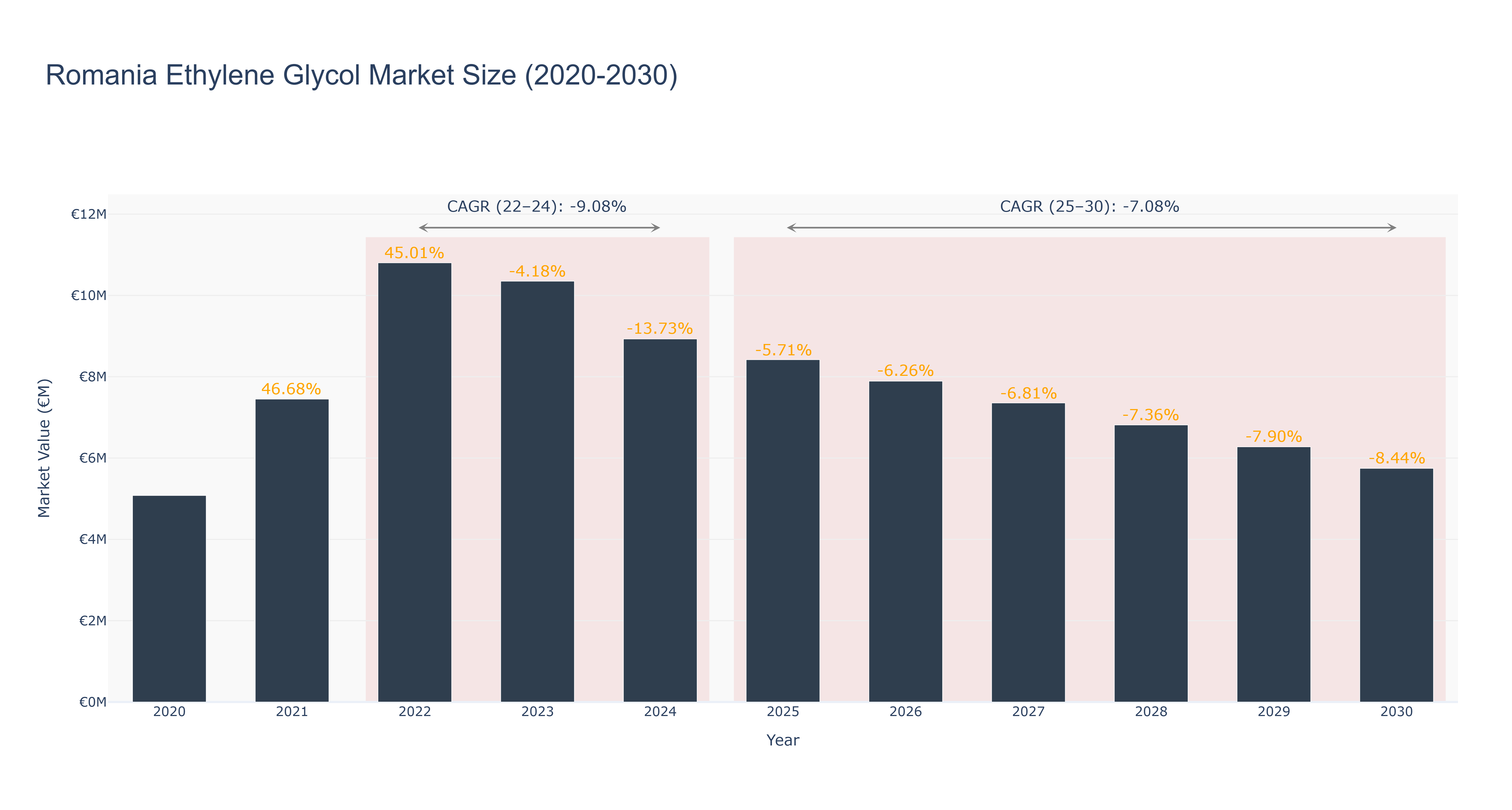
Romania Ethylene Glycol Market has seen fluctuations in market size over the years. The peak market size of €10.80 million was recorded in 2022, followed by a decline to €5.75 million in 2030. Actual market size decreased from €10.35 million in 2023 to €5.75 million in 2030. The CAGR for the period 2022-24 was -9.08%, while for 2025-30 it stands at -7.08%. The market experienced a downturn due to global economic slowdown impacting demand, while the forecasted stability could be attributed to increased awareness towards sustainable practices in chemical industries. Looking ahead, Romania is set to launch a new government-backed initiative to promote eco-friendly production methods in the chemical sector, aiming to boost the market's growth and competitiveness in the coming years. Industry drivers for the Romania Ethylene Glycol Market include environmental regulations pushing for greener alternatives, growing demand from end-user industries like textiles and automotive, and increasing focus on reducing carbon footprint in manufacturing processes.
Romania Ethylene Glycol Market: Production & Trade Performance (2019-2025)
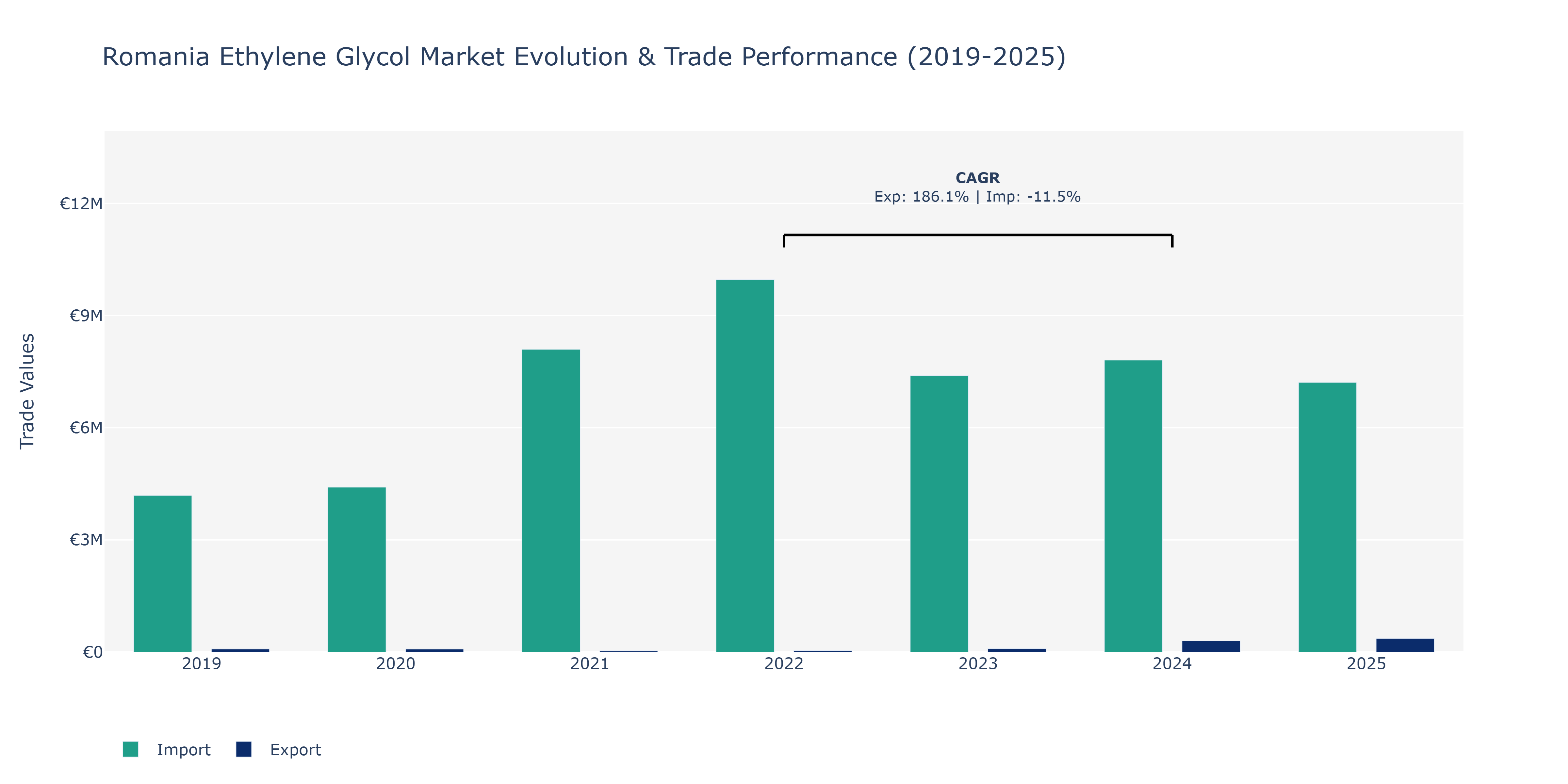
In the Romania Ethylene Glycol Market, a notable fluctuation in both Exports and Imports was observed over the years. Exports showed a downward trend from 2019 to 2021, experiencing a sharp decline to €31.1 thousand in 2021. However, a substantial rebound occurred in 2023, reaching €97.12 thousand, and peaked at €297.44 thousand in 2024. Similarly, Imports fluctuated, with a peak in 2022 at €9.96 million, followed by a decrease to €7.21 million in 2025. The surge in Exports in 2024 can be attributed to increased demand from international markets due to Romania's improved production capabilities and competitive pricing strategies. Conversely, the decline in Imports post-2022 may be linked to enhanced domestic production capacities, reducing the reliance on foreign suppliers. This aligns with the global trend of countries striving for self-sufficiency in key industries to mitigate supply chain risks.
Romania Ethylene Glycol Market Synopsis
The Romania Ethylene Glycol market is experiencing steady growth due to increasing demand from various end-use industries such as automotive, textiles, and packaging. The growth is driven by the expanding automotive sector and the rising consumption of polyester fibers in the textile industry. Additionally, the country`s strategic location in Europe makes it an attractive hub for ethylene glycol trade. Market players are focusing on expanding their production capacities to meet the growing demand and gain a competitive edge in the market. However, fluctuations in raw material prices and environmental concerns regarding ethylene glycol production are some of the challenges faced by the market. Overall, the Romania Ethylene Glycol market is poised for continued growth with opportunities for innovation and strategic partnerships.
Romania Ethylene Glycol Market Trends
The Romania Ethylene Glycol market is experiencing steady growth driven by increasing demand from various industries such as automotive, textiles, and packaging. The automotive sector, in particular, is a major contributor to the market growth due to the rising production of vehicles in the region. Additionally, the growing popularity of polyester fibers in the textile industry is fueling the demand for ethylene glycol as a raw material. Companies in the market are focusing on expanding their production capacities and developing innovative products to cater to the increasing demand. Sustainability and environmental concerns are also influencing the market, with a shift towards bio-based ethylene glycol production. Overall, the Romania Ethylene Glycol market is expected to continue on a positive growth trajectory in the coming years.
Romania Ethylene Glycol Market Challenges
In the Romania Ethylene Glycol Market, some of the key challenges include fluctuating raw material prices, increasing competition from other glycol-based products, and environmental concerns regarding the disposal and recycling of ethylene glycol. The market is also impacted by regulatory changes related to environmental standards and safety requirements, which can add complexity and cost to production processes. Additionally, economic uncertainties and currency fluctuations can affect the overall demand and pricing dynamics in the market. Companies operating in the Romania Ethylene Glycol Market need to navigate these challenges effectively by implementing strategies to mitigate risks, enhance operational efficiency, and adapt to changing market conditions to maintain a competitive edge.
Romania Ethylene Glycol Market Investment Opportunities
The Romania Ethylene Glycol market presents several investment opportunities due to the country`s growing automotive, textile, and packaging industries which are key consumers of ethylene glycol. With an increasing demand for antifreeze and coolant products in the automotive sector as well as polyester fibers in the textile industry, there is a strong potential for growth in the ethylene glycol market. Investing in ethylene glycol production facilities or partnering with local manufacturers can be lucrative. Additionally, the push towards sustainable practices and the development of bio-based ethylene glycol production methods offer innovative investment prospects in the market. Conducting a thorough market analysis, understanding regulatory frameworks, and assessing competition will be crucial for successful investments in the Romania Ethylene Glycol market.
Jordan Agar Market Government Policies
The Romanian government has implemented various policies to regulate the ethylene glycol market in the country. These policies include setting quality standards for ethylene glycol products to ensure consumer safety and environmental protection. Additionally, there are regulations in place to promote competition in the market and prevent monopolistic practices. The government also imposes taxes and tariffs on ethylene glycol imports to protect domestic producers and support the local industry. Furthermore, environmental sustainability is a key focus, with policies encouraging the use of eco-friendly production methods and promoting recycling initiatives to reduce waste and minimize the environmental impact of ethylene glycol production and usage in Romania.
Romania Ethylene Glycol Market Future Outlook
The future outlook for the Romania Ethylene Glycol market appears positive, driven by increasing demand from various end-use industries such as automotive, textiles, and packaging. The growing adoption of ethylene glycol as a key raw material in the production of polyester fibers and antifreeze products is expected to drive market growth. Additionally, the rising focus on sustainable and bio-based alternatives is likely to create new opportunities for market players. However, challenges such as fluctuating raw material prices and environmental concerns may impact market growth. Overall, with the expanding industrial sector and increasing applications of ethylene glycol in various sectors, the Romania Ethylene Glycol market is poised for steady growth in the coming years.
Key Highlights of the Report:
- Romania Ethylene Glycol Market Outlook
- Market Size of Romania Ethylene Glycol Market, 2021
- Forecast of Romania Ethylene Glycol Market, 2031
- Historical Data and Forecast of Romania Ethylene Glycol Revenues & Volume for the Period 2018 - 2031
- Romania Ethylene Glycol Market Trend Evolution
- Romania Ethylene Glycol Market Drivers and Challenges
- Romania Ethylene Glycol Price Trends
- Romania Ethylene Glycol Porter's Five Forces
- Romania Ethylene Glycol Industry Life Cycle
- Historical Data and Forecast of Romania Ethylene Glycol Market Revenues & Volume By Product for the Period 2018 - 2031
- Historical Data and Forecast of Romania Ethylene Glycol Market Revenues & Volume By MEG for the Period 2018 - 2031
- Historical Data and Forecast of Romania Ethylene Glycol Market Revenues & Volume By DEG for the Period 2018 - 2031
- Historical Data and Forecast of Romania Ethylene Glycol Market Revenues & Volume By TEG for the Period 2018 - 2031
- Historical Data and Forecast of Romania Ethylene Glycol Market Revenues & Volume By Application for the Period 2018 - 2031
- Historical Data and Forecast of Romania Ethylene Glycol Market Revenues & Volume By PET for the Period 2018 - 2031
- Historical Data and Forecast of Romania Ethylene Glycol Market Revenues & Volume By Polyester Fiber for the Period 2018 - 2031
- Historical Data and Forecast of Romania Ethylene Glycol Market Revenues & Volume By Antifreeze for the Period 2018 - 2031
- Historical Data and Forecast of Romania Ethylene Glycol Market Revenues & Volume By Films for the Period 2018 - 2031
- Romania Ethylene Glycol Import Export Trade Statistics
- Market Opportunity Assessment By Product
- Market Opportunity Assessment By Application
- Romania Ethylene Glycol Top Companies Market Share
- Romania Ethylene Glycol Competitive Benchmarking By Technical and Operational Parameters
- Romania Ethylene Glycol Company Profiles
- Romania Ethylene Glycol Key Strategic Recommendations






































