Romania Facility Management Market Size & Growth Rate (2026-2032)
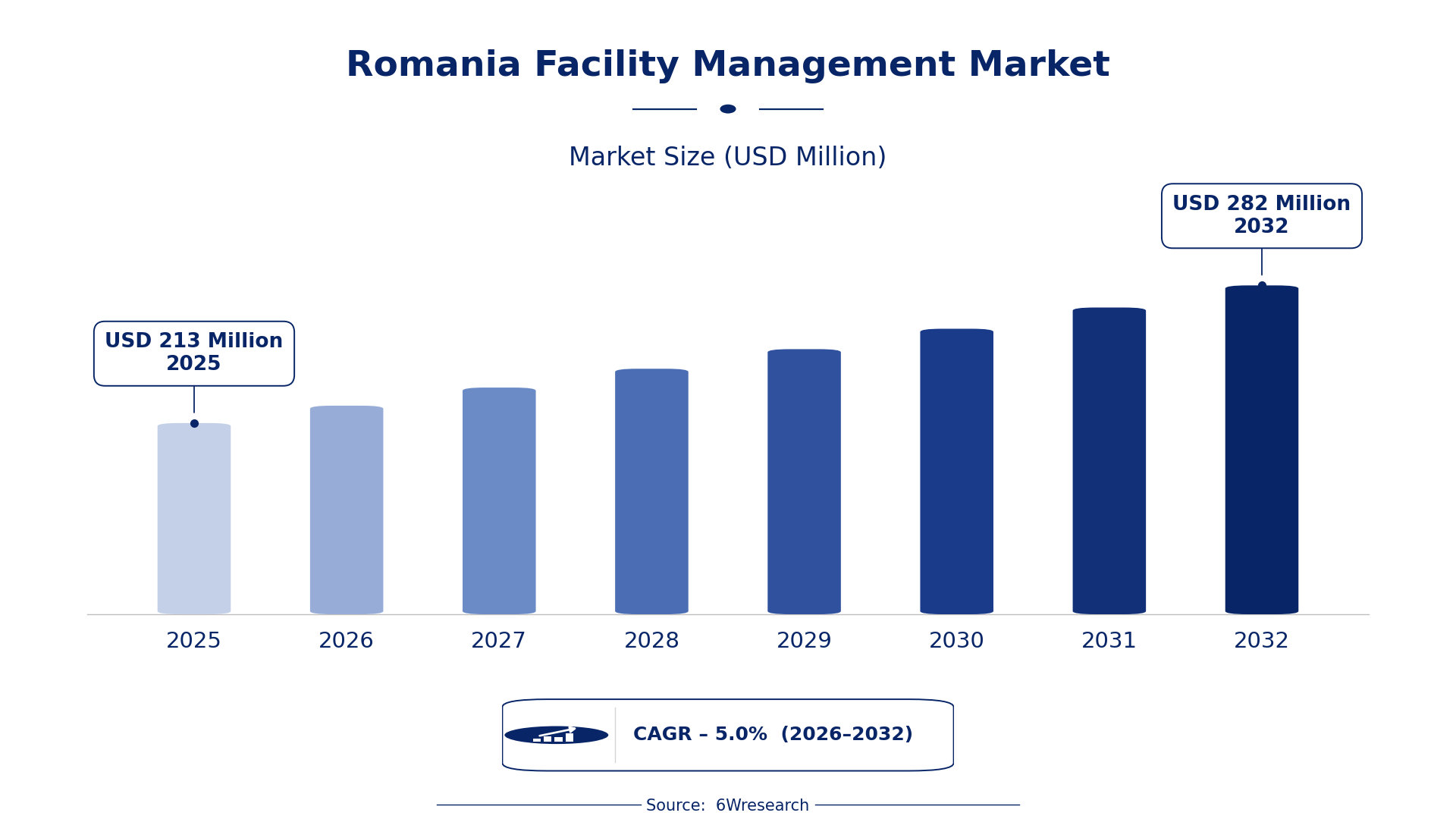
The Romania Facility Management Market was estimated at USD 213 Million in 2025 and is projected to reach USD 282 Million by 2032, growing at a CAGR of 5.0% from 2026 to 2032.
Romania Facility Management Market Synopsis
The Romania Facility Management Market is currently on an upward trajectory, fueled by the increasing demand for outsourced services across both commercial and residential sectors. As businesses prioritize core operations and seek cost efficiencies, the reliance on specialized facility management services has become more pronounced.
This market is characterized by a competitive mix of local and international providers, each striving to offer comprehensive solutions ranging from maintenance to energy management. With a growing emphasis on sustainability and technological integration, the landscape is evolving rapidly, presenting both challenges and opportunities.
Romania Facility Management Market Year-wise Growth Rate and Key Drivers
This graph illustrates the annual growth rates of the Romania Facility Management Market from 2021 to 2032, highlighting a steady upward trajectory and projected expansion over the forecast period.
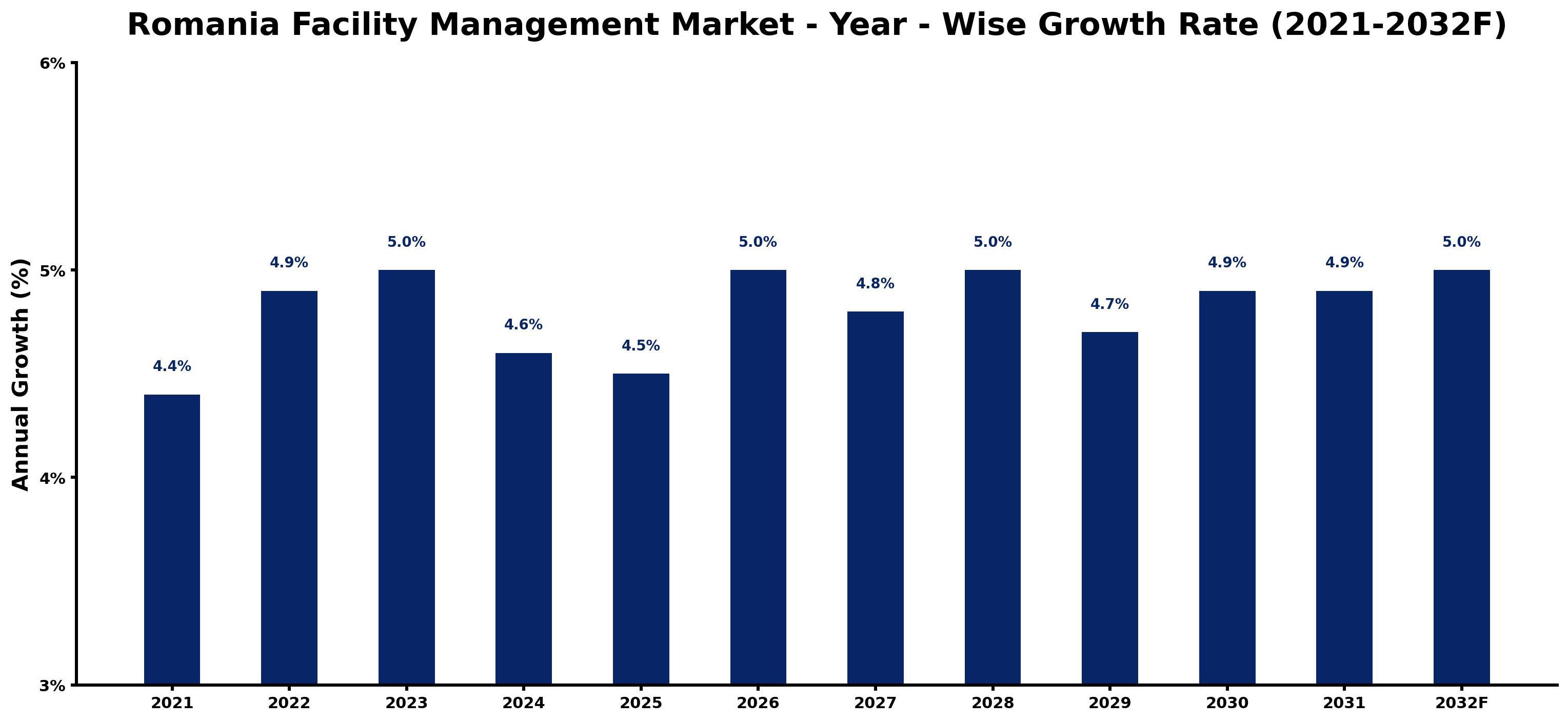
The table below presents the year‑wise growth rates along with the key drivers influencing the market
| Year | Growth Rate | Major Drivers |
| 2021 | 4.4% | Increase in outsourcing facility services by local firms. |
| 2022 | 4.9% | Government energy efficiency regulations drive facility upgrades. |
| 2023 | 5.0% | Rise in skilled workforce for facility management roles. |
| 2024 | 4.6% | Growing interest in sustainability certifications among businesses. |
| 2025 | 4.5% | Increased foreign investments in Romanian commercial real estate. |
| 2026 | 5.0% | Adoption of IoT solutions for local facility management. |
| 2027 | 4.8% | Enhanced demand for hygiene services post-pandemic. |
| 2028 | 5.0% | Government incentives for green facility management practices. |
| 2029 | 4.7% | Urbanization leading to higher facility management needs. |
| 2030 | 4.9% | Emergence of facility management tech startups in Cluj. |
| 2031 | 4.9% | Support from local chambers for service innovation. |
| 2032 | 5.0% | Growing corporate focus on operational cost reduction. |
Note: Market size estimations and growth projections presented in this report are based on 6Wresearch's proprietary forecasting methodology, utilizing the latest available industry data, government publications, and primary research inputs.
Romania Facility Management Market Key Takeaways
Below are some of the specific key takeaways from the market, including:
- The market is projected to grow at a CAGR of 4.8% from 2026 to 2032.
- Outsourced facility management services are increasingly favored for cost optimization.
- Technological advancements, particularly in IoT and smart building solutions, are reshaping service delivery.
- Sustainability initiatives are becoming a critical differentiator among service providers.
- Opportunities are emerging in sectors such as healthcare and education.
Evaluation of Restraints in Romania Facility Management Market
Despite its growth, the Romania Facility Management Market faces notable restraints. Intense competition has led to price pressures, making it challenging for service providers to maintain quality while remaining profitable. Additionally, the industry struggles with a shortage of skilled labor, which hampers the delivery of high-quality services.
on top of that, the rapid pace of technological change demands continuous investment in training and development, adding to operational costs. Providers must also stay ahead of evolving regulations, which require constant monitoring and compliance, creating additional complexities in the market.
Romania Facility Management Market Trends
Several trends are currently shaping the Romania Facility Management Market. One prominent trend is the increasing adoption of technology solutions, particularly IoT and cloud-based systems. These advancements are enabling improved efficiency, enhanced service delivery, and greater sustainability.
Another trend is the growing integration of smart building technologies, which enhance user experience while optimizing resource consumption. This shift is not merely about operational improvement; it's also about meeting the rising consumer expectation for green and efficient buildings.
Romania Facility Management Market Opportunities
The market presents numerous opportunities for growth and investment. Expanding service offerings into new sectors such as healthcare and education is a significant avenue for providers looking to diversify and capture new revenue streams. Additionally, the development of integrated facility management solutions is gaining traction, allowing companies to offer a more comprehensive approach to building management.
With sustainability becoming a priority, providers who can offer environmentally friendly solutions stand to differentiate themselves and attract a broader clientele. This focus on green practices aligns with regulatory requirements and societal expectations, positioning companies for long-term success.
Government Initiatives in the Romania Facility Management Market
Government policy plays a crucial role in shaping the Romania Facility Management Market. Regulations aimed at promoting sustainability and improving service quality are increasingly influencing industry dynamics. As the government emphasizes environmental standards and energy efficiency, compliance has become a key consideration for service providers.
- A recently completed initiative focused on establishing energy efficiency benchmarks for commercial buildings to reduce environmental impact.
- Currently ongoing efforts include the development of a regulatory framework mandating greater transparency in facility management billing practices.
- A planned public-private partnership aims to enhance the integration of technology in facility management services by 2027.
- The government has introduced incentives for companies adopting sustainable practices within facility management operations.
- Ongoing training programs are being implemented to address the skills gap in the facility management workforce.
Future Insights of the Romania Facility Management Market
Looking ahead to 2026-2032, the Romania Facility Management Market is set for considerable expansion. The increasing demand for outsourced services is expected to continue driving growth, alongside a heightened focus on energy efficiency and sustainability.
Technological advancements such as AI integration and smart building solutions will further enhance operational capabilities. As companies adapt to post-pandemic realities, the importance of maintaining safe and healthy environments will likely elevate the demand for professional facility management services.
Romania Facility Management Market Latest Developments
In the past year, the Romania Facility Management Market has witnessed a flurry of activity, reflecting an industry eager to adapt to new challenges and opportunities. Providers are increasingly focusing on integrating advanced technologies to enhance service offerings, while sustainability remains a central theme in new initiatives.
- A major technology vendor launched an advanced facility management software platform in Q2 2025, designed to improve operational efficiencies.
- A leading regional operator initiated a sustainability program focused on reducing carbon footprints for managed properties, which began in early 2025 and remains ongoing.
- A partnership between two service providers to develop comprehensive integrated management solutions was announced in late 2025.
- By mid-2026, a service expansion into the healthcare sector is planned, aimed at addressing specific needs within that industry.
- New training programs aimed at upskilling the workforce in technology use and sustainability practices are currently being rolled out.
Romania Facility Management Market - Key Attractiveness of the Report
- 10 Years of Market Numbers
- Historical Data Starting from 2022 to 2025
- Base Year: 2025
- Forecast Data until 2032
- Key Performance Indicators Impacting the Market
- Major Upcoming Developments and Projects
Key Highlights of the Report:
- Romania Facility Management Market Outlook
- Market Size of Romania Facility Management Market, 2025
- Forecast of Romania Facility Management Market, 2032
- Historical Data and Forecast of Romania Facility Management Revenues & Volume for the Period 2022-2032F
- Romania Facility Management Market Trend Evolution
- Romania Facility Management Market Drivers and Challenges
- Romania Facility Management Price Trends
- Romania Facility Management Porter's Five Forces
- Romania Facility Management Industry Life Cycle
- Historical Data and Forecast of Romania Facility Management Market Revenues & Volume By Component for the Period 2022-2032F
- Historical Data and Forecast of Romania Facility Management Market Revenues & Volume By Solutions for the Period 2022-2032F
- Historical Data and Forecast of Romania Facility Management Market Revenues & Volume By Services for the Period 2022-2032F
- Historical Data and Forecast of Romania Facility Management Market Revenues & Volume By Deployment Mode for the Period 2022-2032F
- Historical Data and Forecast of Romania Facility Management Market Revenues & Volume By Cloud for the Period 2022-2032F
- Historical Data and Forecast of Romania Facility Management Market Revenues & Volume By On-premises for the Period 2022-2032F
- Historical Data and Forecast of Romania Facility Management Market Revenues & Volume By Organization Size for the Period 2022-2032F
- Historical Data and Forecast of Romania Facility Management Market Revenues & Volume By Large enterprises for the Period 2022-2032F
- Historical Data and Forecast of Romania Facility Management Market Revenues & Volume By Small and medium-sized enterprises (SMEs) for the Period 2022-2032F
- Historical Data and Forecast of Romania Facility Management Market Revenues & Volume By Vertical for the Period 2022-2032F
- Historical Data and Forecast of Romania Facility Management Market Revenues & Volume By BFSI for the Period 2022-2032F
- Historical Data and Forecast of Romania Facility Management Market Revenues & Volume By IT and Telecom for the Period 2022-2032F
- Historical Data and Forecast of Romania Facility Management Market Revenues & Volume By Government and Public Administration for the Period 2022-2032F
- Historical Data and Forecast of Romania Facility Management Market Revenues & Volume By Healthcare for the Period 2022-2032F
- Historical Data and Forecast of Romania Facility Management Market Revenues & Volume By Education for the Period 2022-2032F
- Historical Data and Forecast of Romania Facility Management Market Revenues & Volume By Retail for the Period 2022-2032F
- Historical Data and Forecast of Romania Facility Management Market Revenues & Volume By Energy and Utilities for the Period 2022-2032F
- Historical Data and Forecast of Romania Facility Management Market Revenues & Volume By Manufacturing for the Period 2022-2032F
- Romania Facility Management Import Export Trade Statistics
- Market Opportunity Assessment By Component
- Market Opportunity Assessment By Deployment Mode
- Market Opportunity Assessment By Organization Size
- Market Opportunity Assessment By Vertical
- Romania Facility Management Top Companies Market Share
- Romania Facility Management Competitive Benchmarking By Technical and Operational Parameters
- Romania Facility Management Company Profiles
- Romania Facility Management Key Strategic Recommendations






































