Romania Flexible Foam Market: Import Trend Analysis
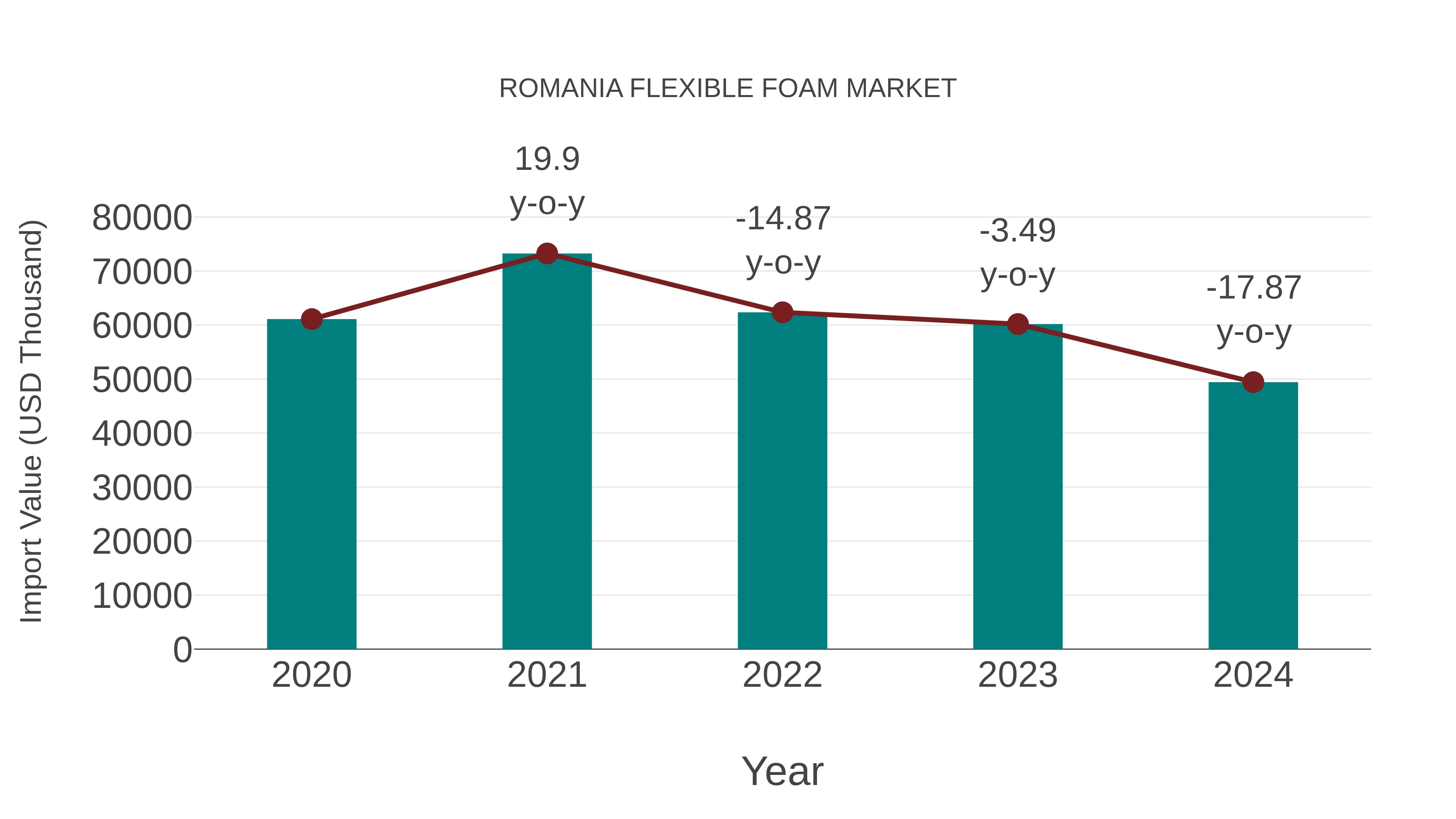
In 2024, Romania`s import trend for the flexible foam market experienced a decline, with a growth rate of -17.87% compared to the previous year. The compound annual growth rate (CAGR) for 2020-2024 stood at -5.16%. This downward momentum could be attributed to shifting demand patterns or changes in trade policies impacting market stability.
Romania Flexible Foam Market Overview
The flexible foam market includes products used in furniture, automotive seating, bedding, and packaging due to their cushioning properties.
Drivers of the market
Rising demand for flexible foam in furniture, bedding, automotive seating, and packaging industries due to comfort, lightweight properties, and insulation capabilities.
Challenges of the market
The flexible foam market in Romania faces challenges related to enhancing foam properties such as comfort, durability, and fire resistance while minimizing environmental impact. Addressing issues such as raw material sourcing, manufacturing efficiency, and recycling capabilities are crucial for market competitiveness. Additionally, compliance with stringent regulations on volatile organic compounds (VOCs) and consumer preferences for sustainable products influence market trends. Innovation in foam technology and adaptation to diverse end-user applications are also key drivers of market growth.
Government Policy of the market
Government policies in the Romania flexible foam market prioritize construction standards, furniture manufacturing, and industrial applications. Policies support use of flexible foams in insulation, upholstery, and packaging solutions. Regulatory frameworks address foam material safety, fire resistance standards, and recycling initiatives to promote sustainable foam production, enhance product performance, and ensure compliance with building codes and environmental regulations in residential, commercial, and automotive sectors.
Key Highlights of the Report:
- Romania Flexible Foam Market Outlook
- Market Size of Romania Flexible Foam Market, 2025
- Forecast of Romania Flexible Foam Market, 2032
- Historical Data and Forecast of Romania Flexible Foam Revenues & Volume for the Period 2022-2032F
- Romania Flexible Foam Market Trend Evolution
- Romania Flexible Foam Market Drivers and Challenges
- Romania Flexible Foam Price Trends
- Romania Flexible Foam Porter's Five Forces
- Romania Flexible Foam Industry Life Cycle
- Historical Data and Forecast of Romania Flexible Foam Market Revenues & Volume By Type for the Period 2022-2032F
- Historical Data and Forecast of Romania Flexible Foam Market Revenues & Volume By Polyurethane for the Period 2022-2032F
- Historical Data and Forecast of Romania Flexible Foam Market Revenues & Volume By Polyethylene for the Period 2022-2032F
- Historical Data and Forecast of Romania Flexible Foam Market Revenues & Volume By Polypropylene for the Period 2022-2032F
- Historical Data and Forecast of Romania Flexible Foam Market Revenues & Volume By Application for the Period 2022-2032F
- Historical Data and Forecast of Romania Flexible Foam Market Revenues & Volume By Furniture & Bedding for the Period 2022-2032F
- Historical Data and Forecast of Romania Flexible Foam Market Revenues & Volume By Transportation for the Period 2022-2032F
- Historical Data and Forecast of Romania Flexible Foam Market Revenues & Volume By Packaging for the Period 2022-2032F
- Romania Flexible Foam Import Export Trade Statistics
- Market Opportunity Assessment By Type
- Market Opportunity Assessment By Application
- Romania Flexible Foam Top Companies Market Share
- Romania Flexible Foam Competitive Benchmarking By Technical and Operational Parameters
- Romania Flexible Foam Company Profiles
- Romania Flexible Foam Key Strategic Recommendations






































