Romania Food & Grocery Retail Market Size, Share & Growth Rate
The Romania Food & Grocery Retail Market was estimated at USD 911 Million in 2025 and is projected to reach USD 1703 Million by 2032, growing at a CAGR of 9.3% from 2026 to 2032. This upward trajectory is driven by rising disposable incomes, increasing urbanization, and a shift in consumer preferences towards convenience and higher-quality products. As consumers become more health-conscious, demand for organic and specialty foods is also accelerating the market's growth.
Romania Food & Grocery Retail Market Year-wise Growth Rate and Key Drivers
This graph highlights how the Romania Food & Grocery Retail Market has steadily grown over the years, supported by major growth factors.
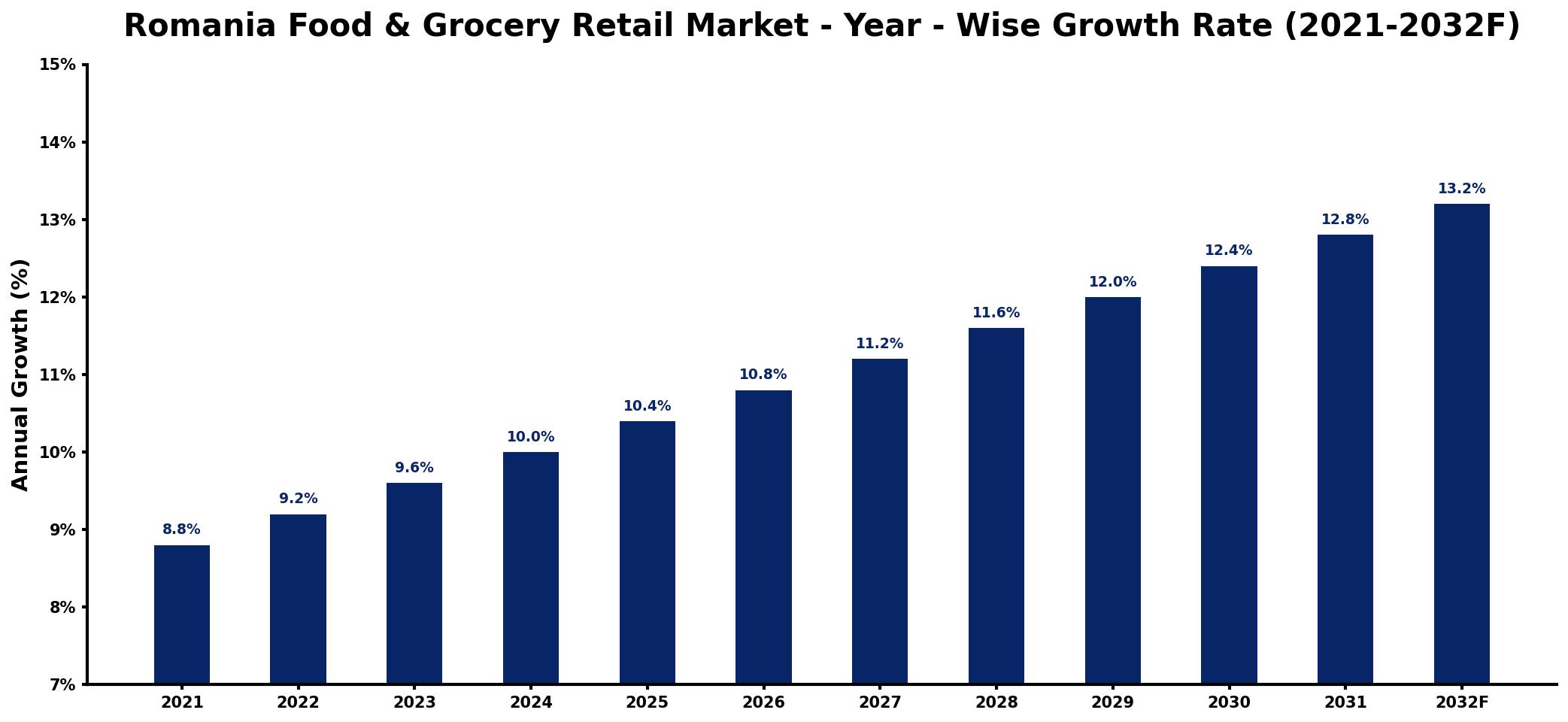
The table below presents the year‑wise growth rates along with the key drivers influencing the market
| Year | Growth Rate | Major Drivers |
| 2021 | 8.8% | Rising consumer purchasing power |
| 2022 | 9.2% | Expansion of online shopping platforms |
| 2023 | 9.6% | Increased health consciousness among consumers |
| 2024 | 10.0% | Growth in convenience store formats |
| 2025 | 10.4% | Higher demand for organic products |
| 2026 | 10.8% | Investment in sustainable packaging solutions |
| 2027 | 11.2% | Emergence of delivery service options |
| 2028 | 11.6% | Technological advancements in logistics |
| 2029 | 12.0% | Diversification of product offerings |
| 2030 | 12.4% | Strengthening local supply chains |
| 2031 | 12.8% | Growing popularity of meal kits |
| 2032 | 13.2% | Rising trends in plant-based diets |
Note: Market size estimations and growth projections presented in this report are based on 6Wresearch's proprietary forecasting methodology, utilizing the latest available industry data, government publications, and primary research inputs.
Romania Food & Grocery Retail Market Synopsis
The Romanian food and grocery retail landscape has recently seen robust momentum, characterized by a competitive environment fueled by both traditional and modern retail formats. However, as consumer behaviors continue to evolve, the market is poised to transition towards even greater convenience and quality in product offerings.
Looking ahead, the market is likely to shift towards enhanced digital experiences, including increased e-commerce adoption, and a rising interest in sustainable and healthy food options. The emphasis on private labels also underscores a growing consumer desire for value without compromising on quality.
- The market is characterized by a diverse mix of retail formats catering to various consumer needs.
- There is a growing shift towards e-commerce, particularly among urban consumers seeking convenience.
- Health-conscious and organic products are increasingly in demand, reflecting changing consumer preferences.
- Private label brands are gaining traction as retailers prioritize value-for-money offerings.
- Investment opportunities exist in expanding supermarket chains and developing innovative delivery services.
Despite the positive outlook, the Romania Food & Grocery Retail Market is not without its constraints. Intense competition from both local and international players creates pricing pressures, leading to margin challenges for many retailers. Additionally, shifting consumer preferences towards healthier and organic products necessitate constant adaptation by businesses. Logistical hurdles and infrastructure limitations in certain areas also hinder operational efficiency, complicating supply chain dynamics. Together, these factors compel retailers to innovate continually and enhance customer engagement to maintain market relevance.
Current trends in the Romania Food & Grocery Retail Market reflect a growing consumer inclination towards organic and health-conscious products. The rise of online shopping platforms is reshaping the retail landscape, offering consumers unprecedented convenience and accessibility. Specialty foods are also gaining popularity as consumers seek unique offerings. Additionally, sustainability is becoming a significant factor influencing purchasing decisions, leading retailers to adopt eco-friendly practices in their operations.
The evolving consumer landscape presents numerous investment opportunities within the Romania Food & Grocery Retail Market. There is substantial potential for expanding existing supermarket chains and establishing innovative food delivery services tailored to modern lifestyles. The demand for specialty and health-focused food stores also remains robust, catering to niche markets. Furthermore, modernizing retail operations through technology integration and sustainable practices can significantly enhance competitiveness and profitability.
The Romanian government has been active in regulating the food and grocery retail sector, implementing quality standards and food safety regulations to protect consumers. Support for local producers and retailers is evident through financial incentives and campaigns promoting domestic products. Additionally, initiatives aimed at fostering healthy eating habits and reducing food waste reflect the governments commitment to creating a sustainable and competitive market environment.
Looking forward to 2026-2032, the Romania Food & Grocery Retail Market is set for steady growth, driven by increasing disposable incomes and a heightened focus on convenience. E-commerce will continue to play a pivotal role, with more consumers gravitating towards online platforms for grocery shopping. The trend towards sustainability and health will further influence retailer strategies, positioning them to align closely with changing consumer demands and expectations.
Recent developments in the Romania Food & Grocery Retail Market indicate a growing emphasis on digital transformation. Retailers are increasingly investing in online platforms and technologies to enhance the customer shopping experience. Simultaneously, there is a noticeable rise in collaborations between retailers and local suppliers to meet the demand for fresh and organic products. Sustainability initiatives are also gaining traction, with businesses adopting greener practices to appeal to environmentally conscious consumers.
- 10 Years of Market Numbers
- Historical Data Starting from 2022 to 2025
- Base Year: 2025
- Forecast Data until 2032
- Key Performance Indicators Impacting the Market
- Major Upcoming Developments and Projects
Key Highlights of the Report:
- Romania Food & Grocery Retail Market Outlook
- Market Size of Romania Food & Grocery Retail Market, 2025
- Forecast of Romania Food & Grocery Retail Market, 2032
- Historical Data and Forecast of Romania Food & Grocery Retail Revenues & Volume for the Period 2022-2032F
- Romania Food & Grocery Retail Market Trend Evolution
- Romania Food & Grocery Retail Market Drivers and Challenges
- Romania Food & Grocery Retail Price Trends
- Romania Food & Grocery Retail Porter's Five Forces
- Romania Food & Grocery Retail Industry Life Cycle
- Historical Data and Forecast of Romania Food & Grocery Retail Market Revenues & Volume By Product for the Period 2022-2032F
- Historical Data and Forecast of Romania Food & Grocery Retail Market Revenues & Volume By Fresh Food for the Period 2022-2032F
- Historical Data and Forecast of Romania Food & Grocery Retail Market Revenues & Volume By Frozen Food for the Period 2022-2032F
- Historical Data and Forecast of Romania Food & Grocery Retail Market Revenues & Volume By Food Cupboard for the Period 2022-2032F
- Historical Data and Forecast of Romania Food & Grocery Retail Market Revenues & Volume By Beverages for the Period 2022-2032F
- Historical Data and Forecast of Romania Food & Grocery Retail Market Revenues & Volume By Cleaning & Household for the Period 2022-2032F
- Historical Data and Forecast of Romania Food & Grocery Retail Market Revenues & Volume By Others for the Period 2022-2032F
- Historical Data and Forecast of Romania Food & Grocery Retail Market Revenues & Volume By Distribution Channel for the Period 2022-2032F
- Historical Data and Forecast of Romania Food & Grocery Retail Market Revenues & Volume By Supermarkets & Hypermarkets for the Period 2022-2032F
- Historical Data and Forecast of Romania Food & Grocery Retail Market Revenues & Volume By Convenience Stores for the Period 2022-2032F
- Historical Data and Forecast of Romania Food & Grocery Retail Market Revenues & Volume By Departmental Stores & Clubs for the Period 2022-2032F
- Historical Data and Forecast of Romania Food & Grocery Retail Market Revenues & Volume By Online for the Period 2022-2032F
- Romania Food & Grocery Retail Import Export Trade Statistics
- Market Opportunity Assessment By Product
- Market Opportunity Assessment By Distribution Channel
- Romania Food & Grocery Retail Top Companies Market Share
- Romania Food & Grocery Retail Competitive Benchmarking By Technical and Operational Parameters
- Romania Food & Grocery Retail Company Profiles
- Romania Food & Grocery Retail Key Strategic Recommendations






































