Romania Food Retail Market Summary
The romania food retail market was estimated at USD 1109 Million in 2025 and is projected to reach USD 2018 Million by 2032, growing at a CAGR of 10.3% from 2026 to 2032.
Romania Food Retail Market Year-wise Growth Rate and Key Drivers
This graph highlights how the Romania Food Retail Market has steadily grown over the past five years, supported by major growth factors.
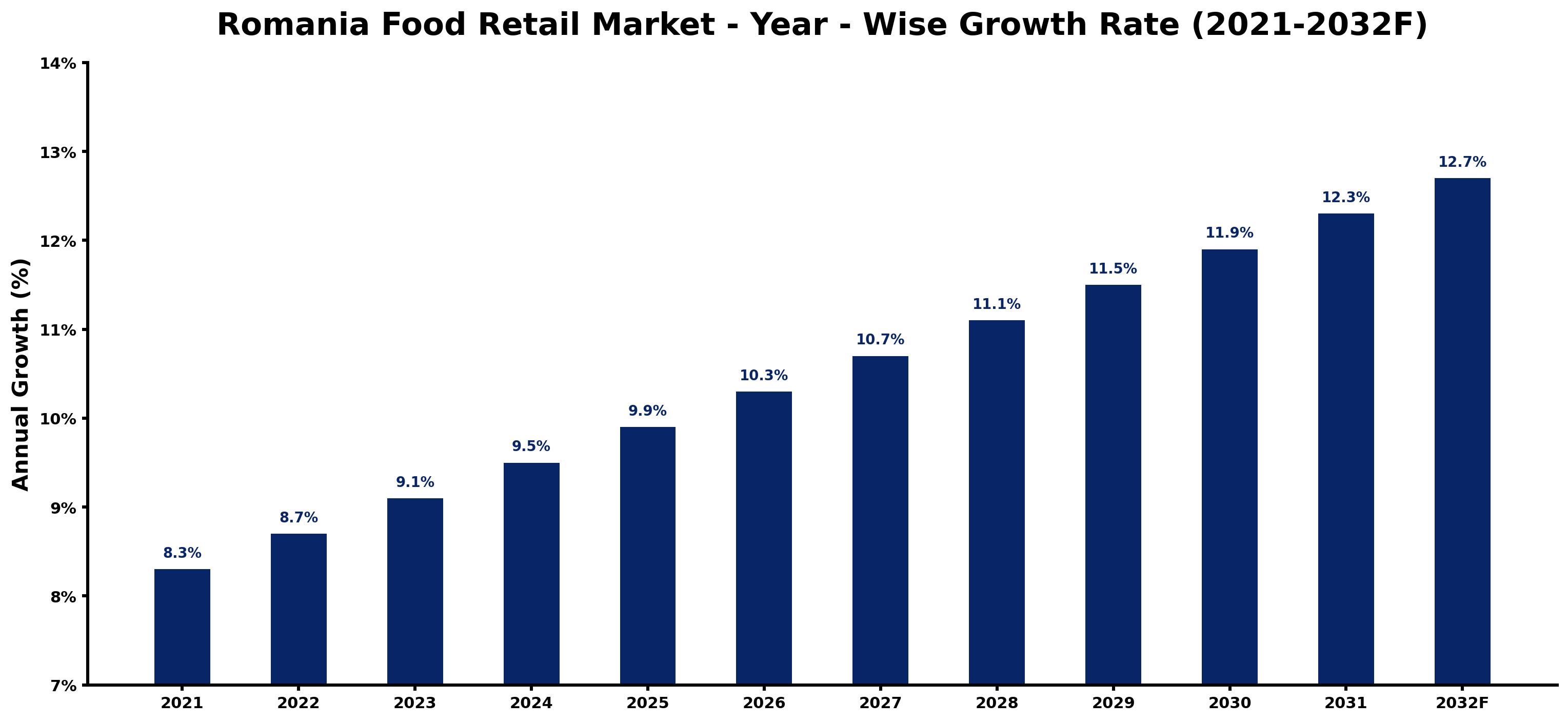
The table below presents the year wise growth rates along with the key drivers influencing the market
| Year | Growth Rate | Major Drivers |
| 2021 | 8.3% | Consumer purchasing habits shifted toward online platforms for grocery shopping. |
| 2022 | 8.7% | Local producers gained prominence, emphasizing fresh and organic food offerings. |
| 2023 | 9.1% | Retailers increasingly adapted to digital payment solutions and contactless shopping experiences. |
| 2024 | 9.5% | Sustainability trends encouraged eco-friendly packaging and waste reduction strategies. |
| 2025 | 9.9% | Urbanization accelerated, driving demand for convenience stores in metropolitan areas. |
| 2026 | 10.3% | Health-conscious choices influenced product assortments, benefiting organic and natural brands. |
| 2027 | 10.7% | Private label products expanded, offering competitive pricing against established brands. |
| 2028 | 11.1% | Collaboration with local farmers strengthened supply chains and enhanced freshness. |
| 2029 | 11.5% | Technological innovations streamlined logistics, enhancing inventory management efficiency. |
| 2030 | 11.9% | Consumer education on nutrition increased, boosting demand for healthier food options. |
| 2031 | 12.3% | Inflationary pressures prompted retailers to explore cost-effective sourcing strategies. |
| 2032 | 12.7% | Digital transformation initiatives led to personalized shopping experiences for consumers. |
Note - Market size estimations and growth projections presented in this report are based on 6Wresearch's advanced forecasting approach, validated with industry datasets as of June 2026.
Romania Food Retail Market Synopsis
The Romania Food Retail Market is projected to reach 10.3% and witness significant growth during the forecast period (2026-2032). This dynamic sector is characterized by an increasing demand for both convenience and quality food products. While traditional grocery retailers maintain a dominant presence, modern retail formats such as supermarkets, hypermarkets, and convenience stores are rapidly gaining traction. The market's evolution is heavily influenced by the shift towards online grocery shopping, spurred by rising internet penetration and changing consumer preferences.
Romania Food Retail Market Growth Drivers
Several key factors are driving the expansion of the Romania Food Retail Market. First, urbanization continues to progress, resulting in a higher concentration of consumers in urban areas where modern retail formats are more accessible. Second, rising disposable incomes are enabling consumers to spend more on diverse and premium food options. Third, there is a notable shift towards health and wellness, prompting increased demand for organic and nutritious food products. Fourth, the convenience factor is critical as consumers lean towards ready-to-eat meals and online shopping alternatives. Lastly, there is a growing interest in sustainability which is encouraging consumers to prefer products that are ethically sourced and support local producers.
Romania Food Retail Market Trends and Opportunities
The Romania Food Retail Market is currently witnessing several prominent trends that present various opportunities for stakeholders. One significant trend is the heightened demand for healthy and organic food products, reflective of consumer health consciousness. Additionally, the convenience of online shopping is revolutionizing how consumers access food products, leading to rapid growth in e-commerce platforms. Furthermore, sustainability and ethical sourcing have become focal points for consumers, who are increasingly interested in supporting local farms and reducing food waste. Another trend is the growing prominence of private label brands, allowing retailers to cater to niche markets and offer competitive pricing. Lastly, innovation in food concepts is gaining traction, prompting retailers to introduce unique product offerings that resonate with evolving consumer preferences.
Romania Food Retail Market Challenges and Restraints
Despite the promising growth trajectory, the Romania Food Retail Market faces several challenges. Intense competition among local and international players places pressure on prices and profit margins, compelling retailers to differentiate their offerings. Additionally, fluctuating consumer preferences can pose a challenge, as economic fluctuations and health trends influence purchasing behaviors. Infrastructure constraints, notably in distribution networks and store placements, can also restrict growth and limit market accessibility. Regulatory changes regarding food safety and compliance also create complexities that retailers must navigate. Adapting to these challenges requires a robust understanding of market dynamics and the ability to innovate consistently.
Romania Food Retail Market Investment Opportunities
The Romania Food Retail Market represents a fertile ground for investment opportunities, appealing to both domestic and international investors. The burgeoning middle-class population and their increasing disposable income are driving demand for convenience food products, as well as organic and specialty items. Investors can also benefit from the growing shift towards online grocery retail platforms, which have gained significant traction following the COVID-19 pandemic. Furthermore, strategic collaborations, including mergers and acquisitions, present avenues for expansion within the market. Partnerships with local producers can facilitate unique product offerings, enhancing consumer appeal. Overall, the landscape is ripe for investors seeking to leverage evolving consumer preferences and economic growth.
Romania Food Retail Market Government Investment and Initiatives
The Romanian government has undertaken various initiatives to regulate and promote the food retail market, fostering a competitive environment. The Competition Law is a cornerstone regulation aimed at ensuring fair competition and preventing monopolistic behaviors among market players. Furthermore, regulations surrounding food labeling and quality standards are critical for consumer protection and transparency throughout the food supply chain. Additionally, government initiatives support local producers, encouraging the consumption of domestic products through various campaigns and incentives. Monitoring of food prices is conducted to combat inflation and ensure affordability for consumers. Collectively, these policies aim to sustain a competitive and responsible food retail market while promoting growth.
Romania Food Retail Market Latest Developments (May 2025 - June 2026)
The period from May 2025 to June 2026 has marked significant developments in the Romania Food Retail Market. A continued emphasis on digital transformation within retail has led to the expansion of online grocery services, catering to an increasingly tech-savvy consumer base. Additionally, there has been a noticeable uptick in the introduction of innovative food products and services, responding to consumer demands for variety and quality. The drive towards sustainability has also seen retailers enhancing their commitments to reduce packaging waste and support local sourcing initiatives. As competition intensifies, strategic partnerships and collaborations have emerged as means for companies to strengthen their market position. Overall, these developments reflect the ongoing evolution of the market amid changing consumer expectations.
Romania Food Retail Market - Key Attractiveness of the Report
- 10 Years of Market Numbers
- Historical Data Starting from 2022 to 2025
- Base Year: 2025
- Forecast Data until 2032
- Key Performance Indicators Impacting the Market
- Major Upcoming Developments and Projects
Key Highlights of the Report:
- Romania Food Retail Market Outlook
- Market Size of Romania Food Retail Market, 2025
- Forecast of Romania Food Retail Market, 2032F
- Historical Data and Forecast of Romania Food Retail Revenues & Volume for the Period 2022-2032F
- Romania Food Retail Market Trend Evolution
- Romania Food Retail Market Drivers and Challenges
- Romania Food Retail Price Trends
- Romania Food Retail Porter's Five Forces
- Romania Food Retail Industry Life Cycle
- Historical Data and Forecast of Romania Food Retail Market Revenues & Volume By Product Types for the Period 2022-2032F
- Historical Data and Forecast of Romania Food Retail Market Revenues & Volume By Unpackaged Food for the Period 2022-2032F
- Historical Data and Forecast of Romania Food Retail Market Revenues & Volume By Packaged Food for the Period 2022-2032F
- Historical Data and Forecast of Romania Food Retail Market Revenues & Volume By Drinks for the Period 2022-2032F
- Historical Data and Forecast of Romania Food Retail Market Revenues & Volume By Household Products for the Period 2022-2032F
- Historical Data and Forecast of Romania Food Retail Market Revenues & Volume By Packaging Types for the Period 2022-2032F
- Historical Data and Forecast of Romania Food Retail Market Revenues & Volume By Boxes for the Period 2022-2032F
- Historical Data and Forecast of Romania Food Retail Market Revenues & Volume By Cans for the Period 2022-2032F
- Historical Data and Forecast of Romania Food Retail Market Revenues & Volume By Cellophane Wrapping for the Period 2022-2032F
- Historical Data and Forecast of Romania Food Retail Market Revenues & Volume By Cylindrical Cardboard for the Period 2022-2032F
- Romania Food Retail Import Export Trade Statistics
- Market Opportunity Assessment By Product Types
- Market Opportunity Assessment By Packaging Types
- Romania Food Retail Top Companies Market Share
- Romania Food Retail Competitive Benchmarking By Technical and Operational Parameters
- Romania Food Retail Company Profiles
- Romania Food Retail Key Strategic Recommendations






































