Romania Formic Acid Market Size (2020-2030)
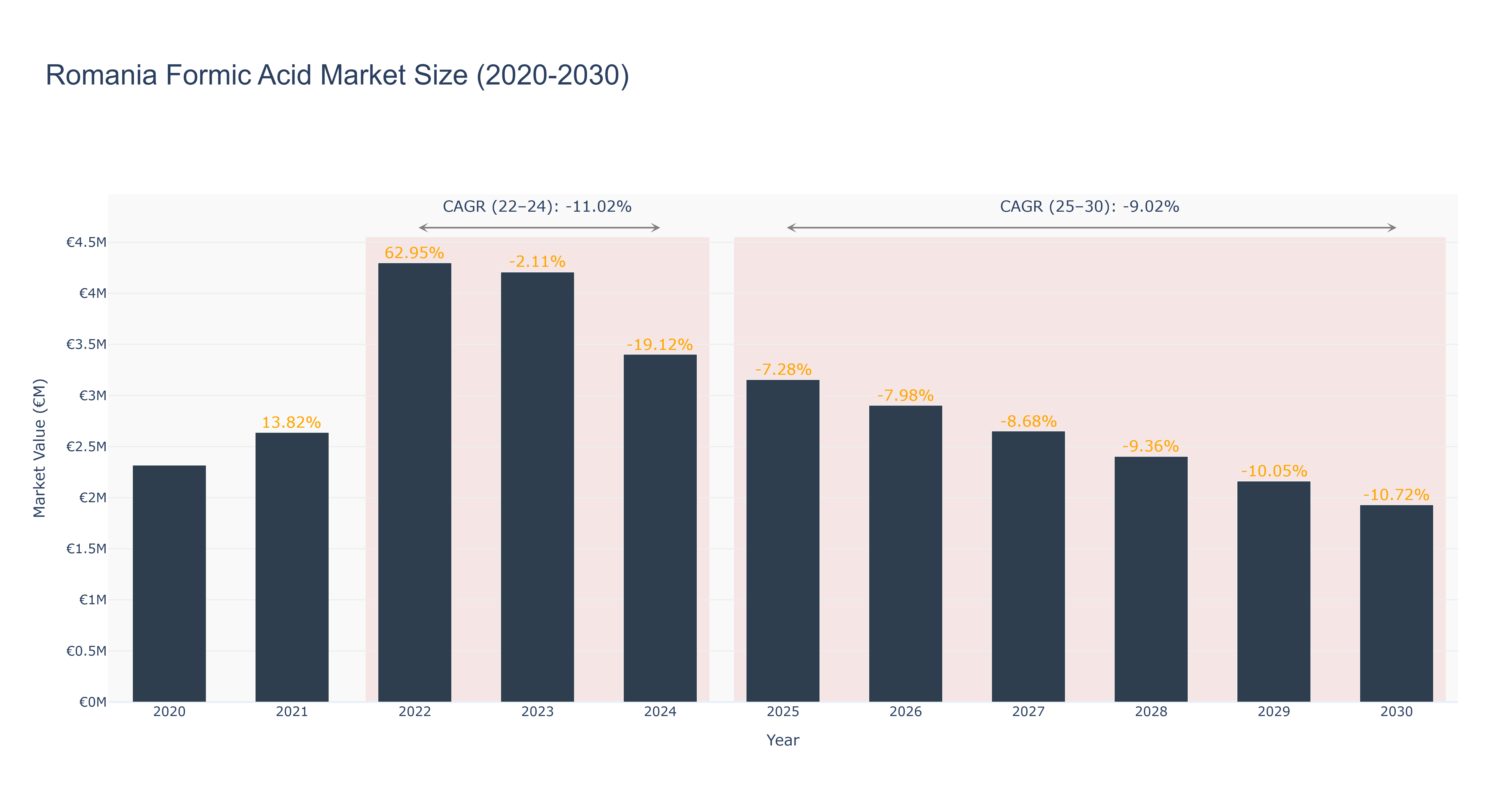
The Romania Formic Acid Market experienced significant fluctuations between 2020 and 2024, peaking at €4.30 million in 2022, representing a remarkable growth of 62.95% from the previous year. However, the market faced a decline in 2023 and 2024, with market sizes of €4.21 million and €3.40 million, respectively, resulting in a negative CAGR of -11.02% for the actual period. Looking ahead to the forecasted years from 2025 to 2030, the market is projected to continue its downward trend, with sizes anticipated to decrease to €1.93 million by 2030, reflecting a CAGR of -9.02%. This decline may be attributed to reduced demand in key applications such as agriculture and textiles, alongside increasing competition from alternative chemicals. Future developments may hinge on innovations in formic acid derivatives and potential regulatory changes that could impact production costs and market dynamics.
Romania Formic Acid Market: Production & Trade Performance (2019-2025)
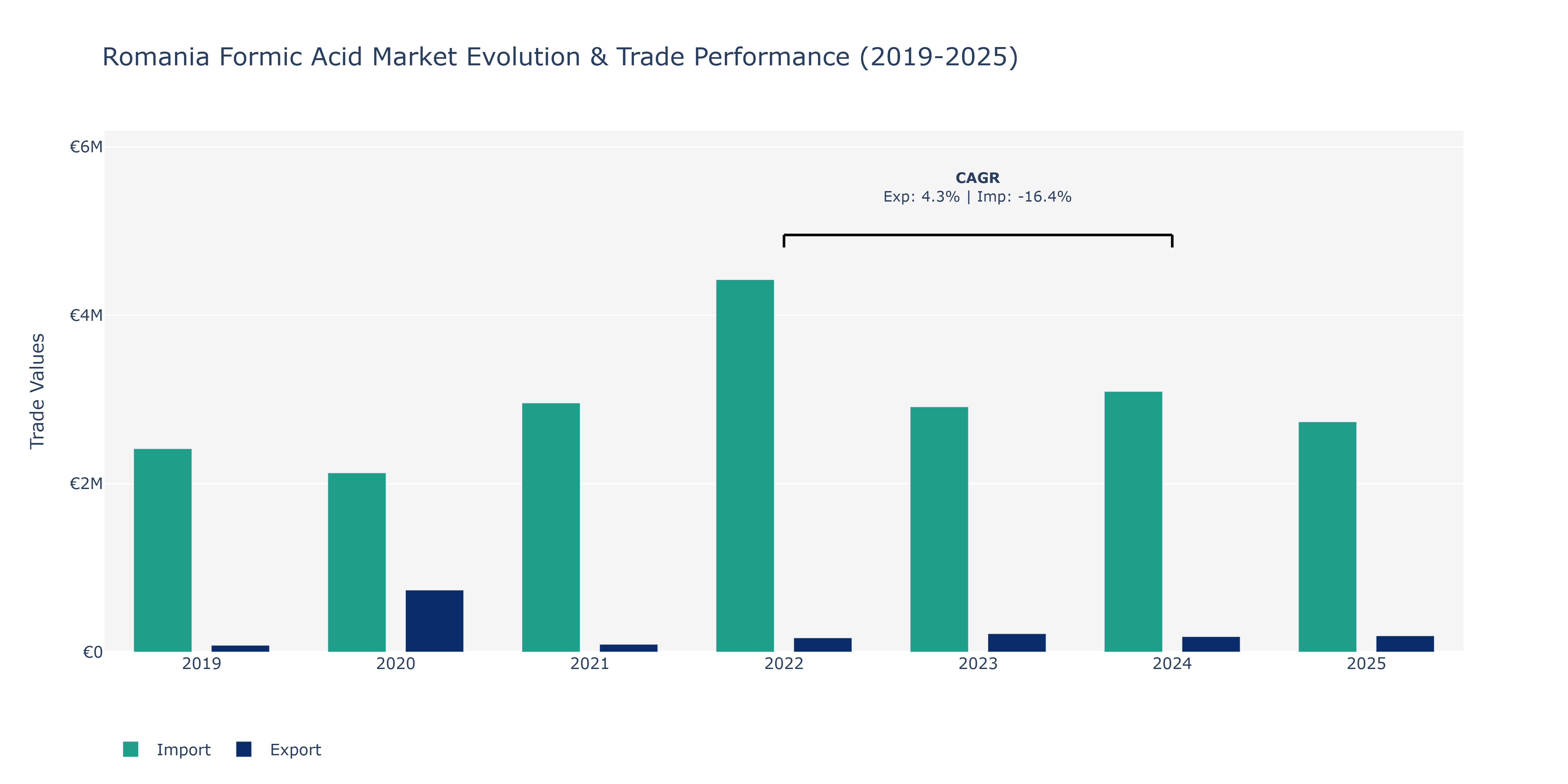
In the Romania Formic Acid Market, exports showed a fluctuating trend over the years, beginning at €80.72 thousand in 2019, reaching a peak of €218.3 thousand in 2023, and then slightly declining to €192.8 thousand in 2025. This growth trajectory indicates periods of both increase and decrease in foreign sales of formic acid. Conversely, imports experienced a steady increase from €2.42 million in 2019 to €4.42 million in 2022, marking a significant peak. However, there was a notable decrease in 2023 to €2.91 million before a slight recovery in 2024 and 2025. These fluctuations could be attributed to various factors such as shifts in global demand, changes in pricing strategies, and evolving trade agreements impacting Romania's position in the formic acid market. Rising environmental concerns and the growing importance of sustainable production methods may have also influenced these trade patterns, leading to adjustments in import and export volumes.
Romania Formic Acid Market Overview
The Romania Formic Acid market is experiencing steady growth due to its diverse applications in various industries such as agriculture, leather production, and chemical manufacturing. The increasing demand for preservatives and antibacterial agents in the food and beverage industry is also driving the market growth. The country`s focus on promoting sustainable agriculture practices is further boosting the demand for formic acid as a key ingredient in animal feed additives. Additionally, the rising awareness about the benefits of formic acid in improving crop yield is expected to fuel market expansion. Key players in the Romania Formic Acid market include BASF SE, Perstorp Holding AB, and Eastman Chemical Company, who are investing in research and development to introduce innovative products and strengthen their market presence.
Romania Formic Acid Market Trends
The Romania Formic Acid Market is experiencing steady growth driven by increasing demand from key industries such as agriculture, food & beverage, and leather processing. A notable trend in the market is the rising awareness about the benefits of formic acid as a preservative and antibacterial agent in animal feed and silage preservation. This has led to a growing adoption of formic acid in the livestock sector to enhance animal health and productivity. Additionally, the automotive and textile industries are also contributing to the market growth by utilizing formic acid in various applications such as dyeing and finishing processes. The market is expected to continue its positive trajectory in the coming years, with manufacturers focusing on expanding their production capacities and developing innovative formulations to cater to diverse end-user requirements.
Romania Formic Acid Market Challenges
In the Romania Formic Acid Market, some key challenges include fluctuating raw material prices, increasing competition from alternative products, and stringent government regulations on chemical usage and safety. Fluctuating raw material prices can impact the overall production cost and pricing strategy of formic acid manufacturers, leading to potential margin pressures. Additionally, the market faces competition from other organic acids and bio-based solutions, which can limit the growth prospects for formic acid. Moreover, government regulations related to environmental sustainability and chemical safety standards can pose compliance challenges for formic acid manufacturers, requiring investments in research and development to meet evolving regulatory requirements. Overall, navigating these challenges requires strategic planning, innovation, and a deep understanding of market dynamics in order to stay competitive and sustain growth in the Romania Formic Acid Market.
Romania Formic Acid Market Investment Opportunities
The Romania Formic Acid Market presents promising investment opportunities due to increasing demand from various end-use industries such as agriculture, leather, and chemicals. The agriculture sector, in particular, is a key driver for formic acid consumption in Romania, as it is used as a preservative and antibacterial agent in animal feed. Additionally, the growing trend towards organic farming and environmentally friendly products is expected to further boost the demand for formic acid in the country. Investors can consider opportunities in formic acid production facilities, distribution networks, or strategic partnerships with key players in the market to capitalize on the expanding market potential in Romania. However, it is important for investors to conduct thorough market research and assess the regulatory environment before making investment decisions in the Romania Formic Acid Market.
Romania Formic Acid Market Government Policy
In Romania, government policies related to the formic acid market primarily focus on environmental regulations and safety standards to ensure the proper handling and disposal of formic acid. The government has implemented strict guidelines for the production, transportation, and use of formic acid to minimize environmental impact and protect public health. Additionally, there are regulations in place to monitor and control the quality of formic acid products in the market to ensure consumer safety. The government also encourages research and development in the formic acid industry to promote innovation and sustainability. Overall, the government policies in Romania aim to support a responsible and sustainable formic acid market that complies with regulatory standards and promotes industry growth.
Romania Formic Acid Market Future Outlook
The future outlook for the Romania Formic Acid Market appears positive with steady growth expected in the coming years. The market is projected to witness an increase in demand driven by various industries such as agriculture, pharmaceuticals, and textiles. Formic acid is utilized in multiple applications including animal feed preservation, leather tanning, and rubber production, which are expected to contribute to market expansion. Additionally, the growing focus on sustainable and eco-friendly solutions is likely to boost the adoption of formic acid as a bio-based alternative in various industries. With increasing investments in research and development for innovative applications, as well as the rising awareness regarding the benefits of formic acid, the market is poised for growth and opportunities in the foreseeable future.
Key Highlights of the Report:
- Romania Formic Acid Market Outlook
- Market Size of Romania Formic Acid Market, 2021
- Forecast of Romania Formic Acid Market, 2027
- Historical Data and Forecast of Romania Formic Acid Revenues & Volume for the Period 2018 - 2027
- Romania Formic Acid Market Trend Evolution
- Romania Formic Acid Market Drivers and Challenges
- Romania Formic Acid Price Trends
- Romania Formic Acid Porter's Five Forces
- Romania Formic Acid Industry Life Cycle
- Historical Data and Forecast of Romania Formic Acid Market Revenues & Volume By Grade Type for the Period 2018 - 2027
- Historical Data and Forecast of Romania Formic Acid Market Revenues & Volume By 0.75 for the Period 2018 - 2027
- Historical Data and Forecast of Romania Formic Acid Market Revenues & Volume By 0.8 for the Period 2018 - 2027
- Historical Data and Forecast of Romania Formic Acid Market Revenues & Volume By 0.85 for the Period 2018 - 2027
- Historical Data and Forecast of Romania Formic Acid Market Revenues & Volume By 0.94 for the Period 2018 - 2027
- Historical Data and Forecast of Romania Formic Acid Market Revenues & Volume By 0.99 for the Period 2018 - 2027
- Historical Data and Forecast of Romania Formic Acid Market Revenues & Volume By Application for the Period 2018 - 2027
- Historical Data and Forecast of Romania Formic Acid Market Revenues & Volume By Animal Feed for the Period 2018 - 2027
- Historical Data and Forecast of Romania Formic Acid Market Revenues & Volume By Leather Tanning for the Period 2018 - 2027
- Historical Data and Forecast of Romania Formic Acid Market Revenues & Volume By Textile Dyeing and Finishing for the Period 2018 - 2027
- Historical Data and Forecast of Romania Formic Acid Market Revenues & Volume By Intermediary in Pharmaceuticals for the Period 2018 - 2027
- Historical Data and Forecast of Romania Formic Acid Market Revenues & Volume By Other Applications for the Period 2018 - 2027
- Romania Formic Acid Import Export Trade Statistics
- Market Opportunity Assessment By Grade Type
- Market Opportunity Assessment By Application
- Romania Formic Acid Top Companies Market Share
- Romania Formic Acid Competitive Benchmarking By Technical and Operational Parameters
- Romania Formic Acid Company Profiles
- Romania Formic Acid Key Strategic Recommendations






































