Romania Fragrance Ingredients Market: Import Trend Analysis
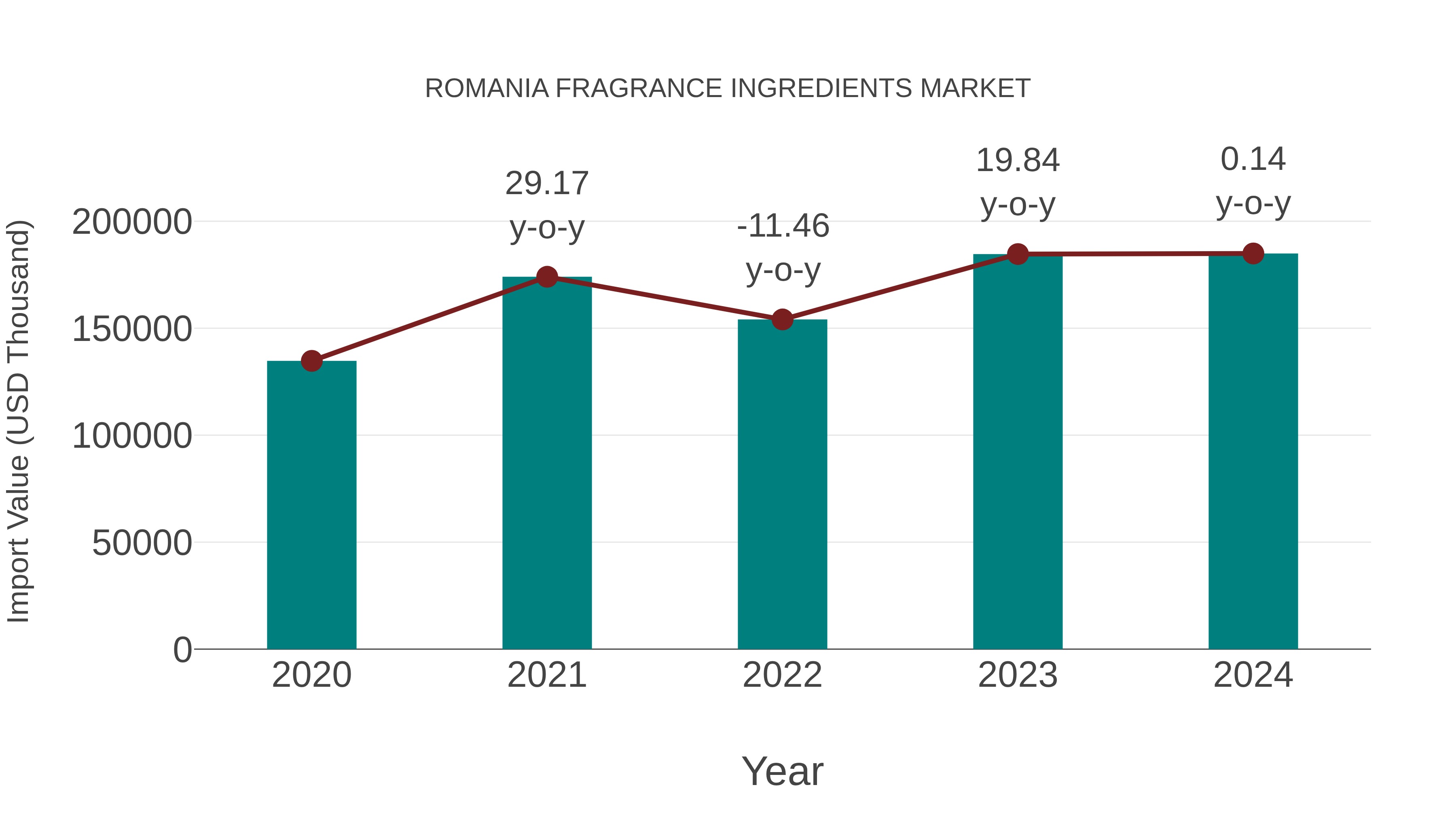
In the Romania fragrance ingredients market, the import trend exhibited a modest growth rate of 0.14% from 2023 to 2024, with a compound annual growth rate (CAGR) of 8.24% from 2020 to 2024. This stable import momentum may be attributed to consistent demand for fragrance ingredients in the market.
Romania Fragrance Ingredients Market Overview
The market for fragrance ingredients includes natural and synthetic compounds used in perfumes, cosmetics, and personal care products.
Drivers of the market
Driven by growing consumer demand for personal care products, cosmetics, and perfumes, coupled with increasing disposable incomes and preferences for natural and exotic fragrances.
Challenges of the market
The fragrance ingredients market in Romania confronts challenges related to ingredient sustainability, regulatory compliance, and consumer preferences for natural fragrances. Addressing issues such as allergen control, ingredient traceability, and synthetic fragrance alternatives are crucial for market competitiveness. Moreover, adapting to trends in clean beauty and transparency in fragrance formulation pose challenges for manufacturers. Innovations in fragrance ingredient extraction, biotechnology-derived fragrances, and eco-friendly sourcing practices will drive market evolution and meet consumer demand for sustainable and safe fragrance products.
Government Policy of the market
In the Romania fragrance ingredients market, government policies focus on cosmetic safety, ingredient transparency, and consumer protection. Policies regulate the use of fragrance ingredients, allergen labeling, and safety assessments to ensure product safety and minimize adverse reactions. Regulatory frameworks address ingredient sourcing, manufacturing practices, and labeling requirements to promote consumer awareness, enhance product safety, and uphold compliance with European Union regulations, fostering trust and market growth in the fragrance industry.
Key Highlights of the Report:
- Romania Fragrance Ingredients Market Outlook
- Market Size of Romania Fragrance Ingredients Market, 2025
- Forecast of Romania Fragrance Ingredients Market, 2032
- Historical Data and Forecast of Romania Fragrance Ingredients Revenues & Volume for the Period 2022-2032F
- Romania Fragrance Ingredients Market Trend Evolution
- Romania Fragrance Ingredients Market Drivers and Challenges
- Romania Fragrance Ingredients Price Trends
- Romania Fragrance Ingredients Porter's Five Forces
- Romania Fragrance Ingredients Industry Life Cycle
- Historical Data and Forecast of Romania Fragrance Ingredients Market Revenues & Volume By Type for the Period 2022-2032F
- Historical Data and Forecast of Romania Fragrance Ingredients Market Revenues & Volume By Essential Oils for the Period 2022-2032F
- Historical Data and Forecast of Romania Fragrance Ingredients Market Revenues & Volume By Aroma Chemicals for the Period 2022-2032F
- Historical Data and Forecast of Romania Fragrance Ingredients Market Revenues & Volume By Application for the Period 2022-2032F
- Historical Data and Forecast of Romania Fragrance Ingredients Market Revenues & Volume By Cosmetics & toiletries for the Period 2022-2032F
- Historical Data and Forecast of Romania Fragrance Ingredients Market Revenues & Volume By Fine fragrances for the Period 2022-2032F
- Historical Data and Forecast of Romania Fragrance Ingredients Market Revenues & Volume By Soaps & detergents for the Period 2022-2032F
- Historical Data and Forecast of Romania Fragrance Ingredients Market Revenues & Volume By Others for the Period 2022-2032F
- Romania Fragrance Ingredients Import Export Trade Statistics
- Market Opportunity Assessment By Type
- Market Opportunity Assessment By Application
- Romania Fragrance Ingredients Top Companies Market Share
- Romania Fragrance Ingredients Competitive Benchmarking By Technical and Operational Parameters
- Romania Fragrance Ingredients Company Profiles
- Romania Fragrance Ingredients Key Strategic Recommendations






































