Romania Hvac Controls Market: Import Trend Analysis
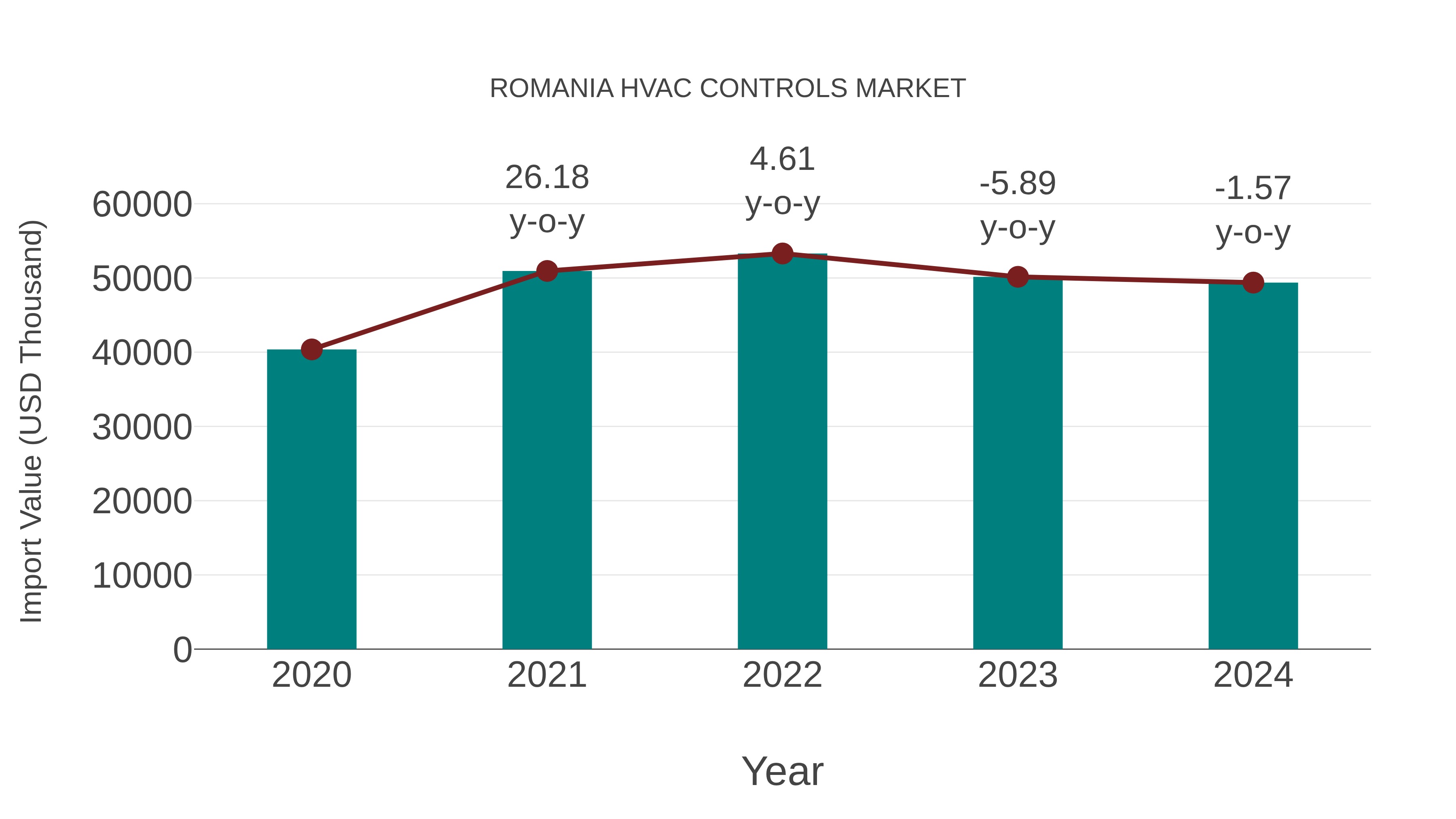
In the Romania HVAC controls market, the import trend experienced a slight decline with a growth rate of -1.57% from 2023 to 2024. However, the compound annual growth rate (CAGR) for the period 2020-2024 stood at 5.16%. This dip in import momentum in 2024 could be attributed to shifting demand patterns or changes in trade policies impacting market stability.
Romania HVAC Controls Market Overview
The Romania HVAC controls market is experiencing steady growth due to increasing construction activities, rising awareness about energy efficiency, and government initiatives promoting sustainable building practices. The market is driven by the demand for smart and connected HVAC systems, which offer enhanced control and energy savings. Key players in the market are focusing on developing innovative products with advanced technologies such as IoT integration and cloud-based solutions. The commercial sector, including office buildings, hotels, and healthcare facilities, is a major end-user of HVAC controls in Romania. As the market continues to evolve, there is a growing trend towards the adoption of building automation systems for efficient control and monitoring of HVAC systems, presenting opportunities for further expansion in the coming years.
Romania HVAC Controls Market Trends and Opportunities
The Romania HVAC controls market is experiencing rapid growth driven by increasing awareness of energy efficiency and sustainability in buildings. Smart technologies such as IoT-enabled devices and connected systems are gaining traction, allowing for remote monitoring and control of HVAC systems. With a growing focus on indoor air quality and comfort, there is a rising demand for advanced HVAC control solutions that offer precise temperature regulation and energy savings. Opportunities exist for market players to develop innovative products tailored to the specific needs of the Romanian market, such as solutions that integrate renewable energy sources and improve overall system efficiency. Moreover, the government`s initiatives to promote green building standards and energy-efficient practices present a favorable regulatory environment for the expansion of the HVAC controls market in Romania.
Romania HVAC Controls Market Challenges
In the Romania HVAC controls market, some of the key challenges faced include the growing complexity of building automation systems, limited awareness and understanding of the benefits of advanced HVAC controls among end-users, and the presence of a large number of small-scale manufacturers leading to fragmented market competition. Additionally, the lack of stringent regulations mandating energy-efficient HVAC controls adoption and the relatively slow pace of technological advancements compared to more developed markets pose obstacles to market growth. Overcoming these challenges will require increased education and training initiatives, stronger government support for energy efficiency programs, and strategic partnerships between industry players to drive innovation and standardization in the Romania HVAC controls market.
Romania HVAC Controls Market Drivers
The drivers fueling the growth of the Romania HVAC controls market include the increasing demand for energy-efficient solutions to reduce operational costs and comply with environmental regulations. The growing construction sector, particularly in commercial and residential buildings, is driving the need for advanced HVAC control systems to enhance indoor air quality and comfort. Technological advancements such as smart thermostats and building automation systems are also contributing to market growth by offering remote monitoring and control capabilities. Additionally, the rising trend towards smart buildings and the integration of IoT technology in HVAC systems are further propelling the demand for advanced control solutions in Romania.
Romania HVAC Controls Market Government Policies
In Romania, government policies related to the HVAC Controls Market primarily focus on energy efficiency and environmental sustainability. The government has implemented regulations and standards to promote the use of energy-efficient HVAC systems and controls in buildings. The Energy Efficiency Law requires buildings to comply with energy performance requirements, driving the demand for advanced HVAC controls that can optimize energy consumption. Additionally, the National Energy Strategy aims to reduce greenhouse gas emissions and increase the share of renewable energy sources in the country`s energy mix, further emphasizing the importance of efficient HVAC controls. These policies create opportunities for manufacturers and suppliers in the Romania HVAC Controls Market to offer innovative solutions that align with the government`s sustainability objectives.
Romania HVAC Controls Market Future Outlook
The future outlook for the Romania HVAC Controls Market appears promising, driven by factors such as increasing construction activities, growing awareness about energy efficiency, and the adoption of smart technologies. With a focus on reducing energy consumption and enhancing building automation, there is a rising demand for advanced HVAC control systems in both residential and commercial sectors. The integration of IoT and cloud-based solutions is expected to further propel market growth, enabling remote monitoring and control of HVAC systems. Additionally, government initiatives promoting sustainable building practices and regulations emphasizing energy conservation are likely to boost the adoption of energy-efficient HVAC controls in Romania. Overall, the market is anticipated to witness steady growth as businesses and consumers prioritize comfort, efficiency, and environmental sustainability in their building operations.
Key Highlights of the Report:
- Romania HVAC Controls Market Outlook
- Market Size of Romania HVAC Controls Market, 2025
- Forecast of Romania HVAC Controls Market, 2032
- Historical Data and Forecast of Romania HVAC Controls Revenues & Volume for the Period 2022 - 2032F
- Romania HVAC Controls Market Trend Evolution
- Romania HVAC Controls Market Drivers and Challenges
- Romania HVAC Controls Price Trends
- Romania HVAC Controls Porter's Five Forces
- Romania HVAC Controls Industry Life Cycle
- Historical Data and Forecast of Romania HVAC Controls Market Revenues & Volume By Component for the Period 2022 - 2032F
- Historical Data and Forecast of Romania HVAC Controls Market Revenues & Volume By Sensors for the Period 2022 - 2032F
- Historical Data and Forecast of Romania HVAC Controls Market Revenues & Volume By Controllers for the Period 2022 - 2032F
- Historical Data and Forecast of Romania HVAC Controls Market Revenues & Volume By Controlled Equipment for the Period 2022 - 2032F
- Historical Data and Forecast of Romania HVAC Controls Market Revenues & Volume By Implementation Type for the Period 2022 - 2032F
- Historical Data and Forecast of Romania HVAC Controls Market Revenues & Volume By New Construction for the Period 2022 - 2032F
- Historical Data and Forecast of Romania HVAC Controls Market Revenues & Volume By Retrofit for the Period 2022 - 2032F
- Historical Data and Forecast of Romania HVAC Controls Market Revenues & Volume By Application for the Period 2022 - 2032F
- Historical Data and Forecast of Romania HVAC Controls Market Revenues & Volume By Residential for the Period 2022 - 2032F
- Historical Data and Forecast of Romania HVAC Controls Market Revenues & Volume By Commercial for the Period 2022 - 2032F
- Historical Data and Forecast of Romania HVAC Controls Market Revenues & Volume By Industrial for the Period 2022 - 2032F
- Romania HVAC Controls Import Export Trade Statistics
- Market Opportunity Assessment By Component
- Market Opportunity Assessment By Implementation Type
- Market Opportunity Assessment By Application
- Romania HVAC Controls Top Companies Market Share
- Romania HVAC Controls Competitive Benchmarking By Technical and Operational Parameters
- Romania HVAC Controls Company Profiles
- Romania HVAC Controls Key Strategic Recommendations






































