Romania Mega Data Center Market Size & Growth Rate (2026-2032)
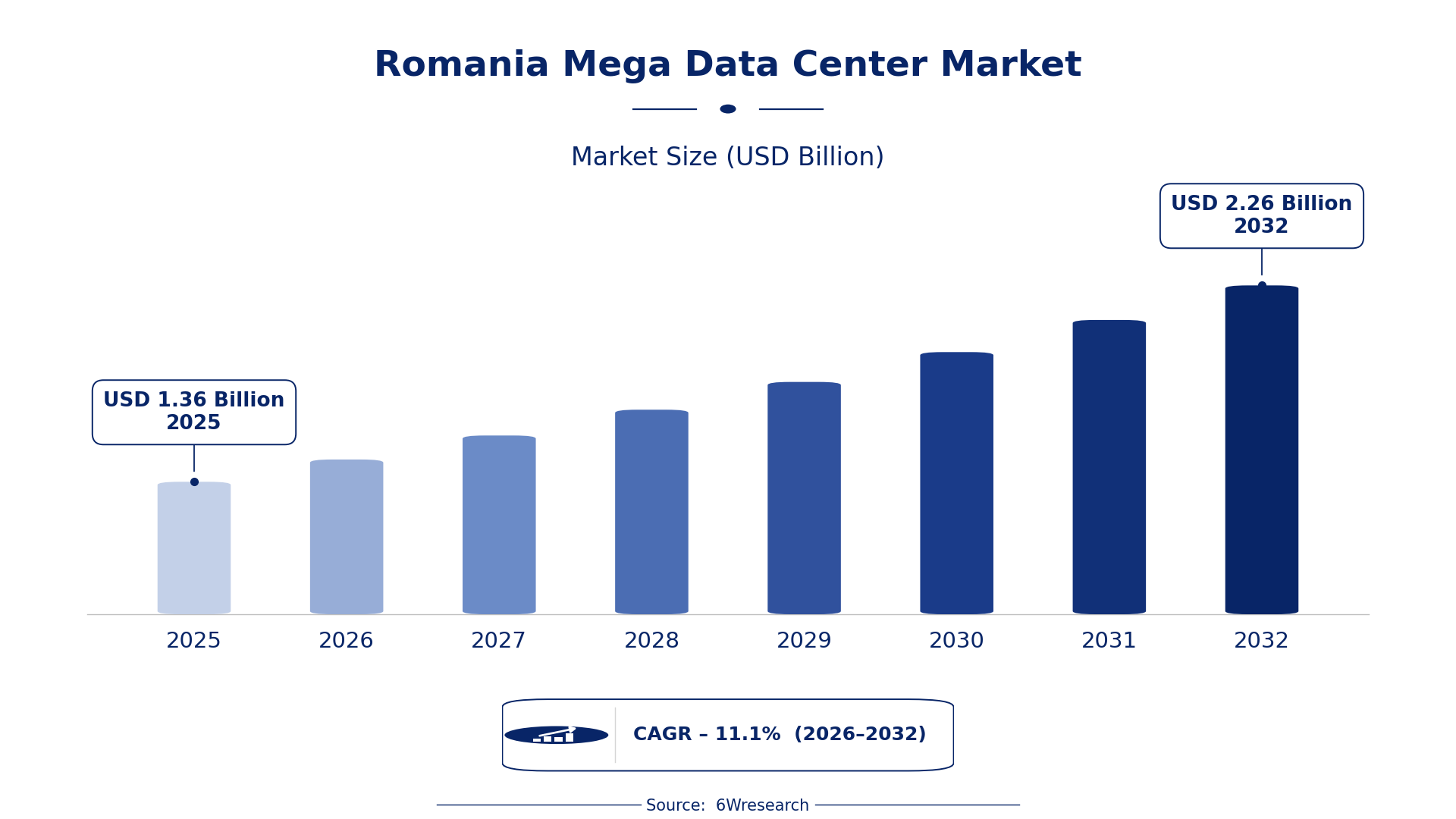
The Romania Mega Data Center Market was estimated at USD 1358 Million in 2025 and is projected to reach USD 2264 Million by 2032, growing at a CAGR of 11.1% from 2026 to 2032.
Romania Mega Data Center Market Synopsis
The surge in cloud computing adoption among Romanian enterprises is driving demand for mega data centers. This trend reflects a broader shift towards digital transformation, with businesses seeking robust infrastructure to support data-heavy applications.
As organizations increasingly turn to big data analytics and artificial intelligence, the need for high-performance computing capabilities becomes paramount. This has positioned Romania as a strategic location for data center development, enhanced by its favorable energy policies.
Romania Mega Data Center Market Year-wise Growth Rate and Key Drivers
This graph illustrates the annual growth rates of the Romania Mega Data Center Market from 2021 to 2032, highlighting a steady upward trajectory and projected expansion over the forecast period.
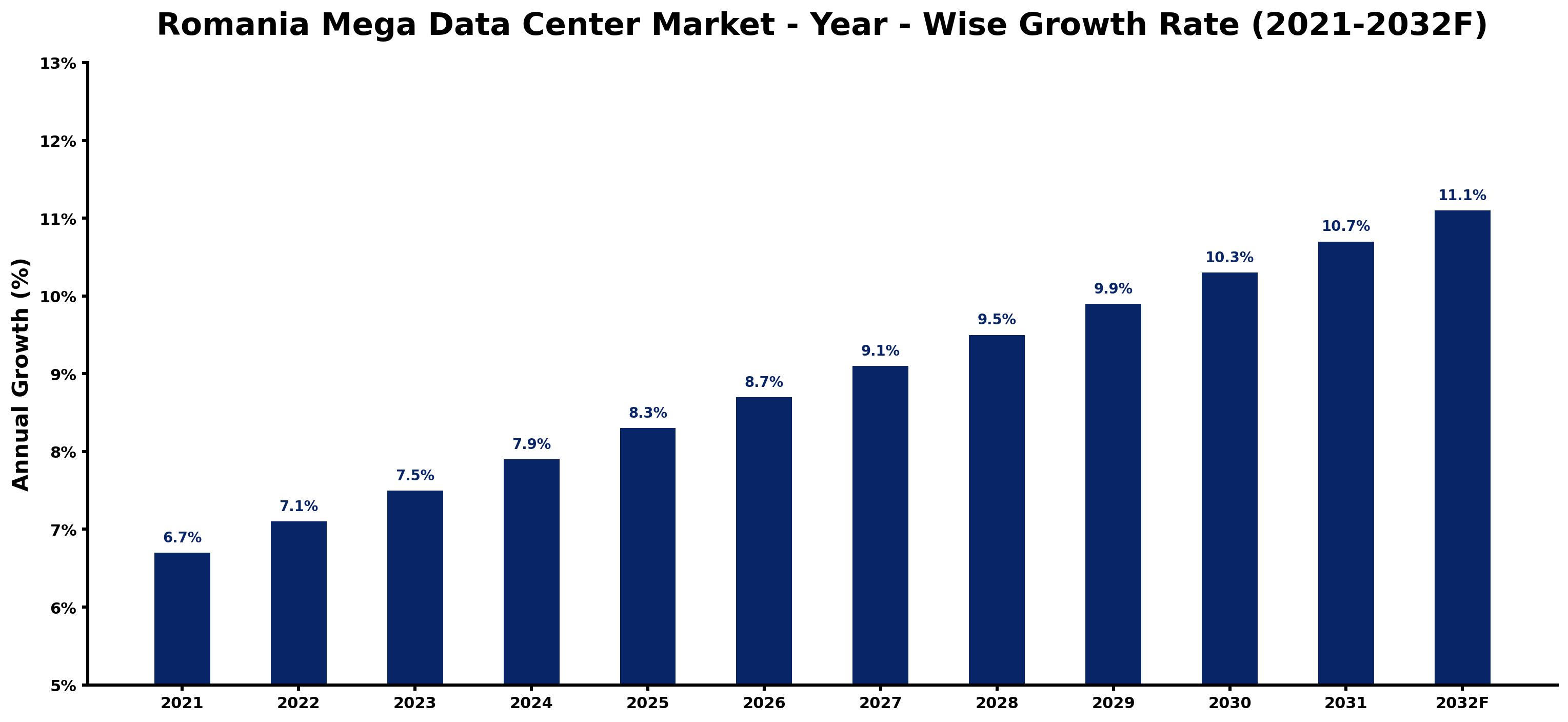
The table below presents the year‑wise growth rates along with the key drivers influencing the market
| Year | Growth Rate | Major Drivers |
| 2021 | 6.7% | Romania's strategic location as a data hub |
| 2022 | 7.1% | Government support for digital infrastructure investments |
| 2023 | 7.5% | Increased energy efficiency regulations for data centers |
| 2024 | 7.9% | Surge in AI adoption driving data processing needs |
| 2025 | 8.3% | Local talent growth in IT and data management |
| 2026 | 8.7% | Emergence of blockchain technology solutions demanding capacity |
| 2027 | 9.1% | Rising cyber security compliance requirements for enterprises |
| 2028 | 9.5% | Focus on sustainable energy solutions for data centers |
| 2029 | 9.9% | Increased foreign investments in local data infrastructure |
| 2030 | 10.3% | Demand for edge computing solutions in urban areas |
| 2031 | 10.7% | Local tech startups fostering innovative data applications |
| 2032 | 11.1% | Enhanced interconnectivity via new regional fiber networks |
Note: Market size estimations and growth projections presented in this report are based on 6Wresearch's proprietary forecasting methodology, utilizing the latest available industry data, government publications, and primary research inputs.
Romania Mega Data Center Market Key Takeaways
Below are some of the specific key takeaways from the market, including:
- Romania's mega data center market is experiencing strong growth driven by digital transformation efforts.
- Data sovereignty regulations are shaping the landscape, emphasizing local data storage and processing.
- Investment in energy-efficient technologies is becoming a critical focus for operators.
- Colocation services are witnessing increased demand as businesses seek scalable solutions.
- The integration of renewable energy sources is enhancing the attractiveness of new data center projects.
Evaluation of Restraints in Romania Mega Data Center Market
Despite the promising growth trajectory, the market faces considerable challenges. Energy efficiency remains a pressing concern; operators must navigate the balance between high computational power and sustainable energy consumption. Regulatory compliance, particularly with stringent data protection laws, adds another layer of complexity. As data security threats continue to evolve, the necessity for ongoing infrastructure investments becomes more apparent. Failure to adequately address these constraints could hinder potential advancements in the sector.
Romania Mega Data Center Market Trends
Key trends shaping the Romania Mega Data Center Market include a noticeable shift towards hyperscale facilities, which can accommodate fluctuating workloads with ease. The rise of 5G technology is also influencing demand, enabling faster data transmission and new applications that require substantial processing power. Additionally, the focus on green data centers is intensifying, as operators strive to minimize their carbon footprint while meeting energy demands.
Romania Mega Data Center Market Opportunities
Significant growth opportunities lie in the continued expansion of cloud services and the burgeoning Internet of Things (IoT) market. As industries such as telecommunications and e-commerce evolve, the demand for reliable, scalable data center solutions will only increase. on top of that, the integration of cutting-edge technologies like artificial intelligence and machine learning presents a unique opportunity for data center operators to enhance their service offerings and improve operational efficiencies.
Government Initiatives in the Romania Mega Data Center Market
Romania's government is actively shaping the mega data center market through a combination of regulatory frameworks and energy efficiency initiatives. The emphasis on data security is paramount, aligning with EU standards to bolster confidence in local data storage solutions. By promoting sustainable practices and reducing energy consumption, these policies not only support market growth but also enhance Romania's attractiveness as a regional data hub.
- A regulatory framework introduced in 2025 mandates compliance with EU data protection laws for all new data centers.
- A national initiative launched in 2026 focuses on enhancing energy efficiency in data center operations.
- Currently, a program is underway to improve the digital infrastructure across major cities, facilitating better connectivity for data centers.
- A planned public-private partnership is expected to promote renewable energy usage in data center facilities by 2027.
Future Insights of the Romania Mega Data Center Market
Looking towards 2026-2032, the Romania Mega Data Center Market is set to evolve significantly. The continued emphasis on digital transformation across various sectors will drive investment in infrastructure and technology. With increasing data generation, the demand for robust and efficient data centers will escalate. on top of that, the integration of AI in data management practices will redefine operational standards, pushing operators to innovate continually. As Romania strengthens its position in the European data center space, stakeholders should remain alert to emerging trends and regulatory shifts that could impact market dynamics.
Romania Mega Data Center Market Latest Developments
Over the past year, the Romania Mega Data Center Market has witnessed a flurry of activity, reflecting the growing interest in data center development. Operators are increasingly focusing on sustainability and energy efficiency, driven by both market demands and regulatory requirements. The current momentum suggests a strong commitment to enhancing Romania’s infrastructure to support its digital economy.
- A major technology vendor announced plans in early 2025 to expand its data center operations in Romania, emphasizing sustainable energy practices.
- In Q1 2025, a regional operator launched a new energy-efficient cooling solution that significantly reduces operational costs.
- A partnership between local firms began in mid-2025 to develop a hyperscale facility aimed at supporting cloud services, currently under construction.
- An initiative expected to begin in late 2026 aims to enhance connectivity between data centers and major urban centers, improving access.
Romania Mega Data Center Market - Key Attractiveness of the Report
- 10 Years of Market Numbers
- Historical Data Starting from 2022 to 2025
- Base Year: 2025
- Forecast Data until 2032
- Key Performance Indicators Impacting the Market
- Major Upcoming Developments and Projects
Key Highlights of the Report:
- Romania Mega Data Center Market Outlook
- Market Size of Romania Mega Data Center Market, 2025
- Forecast of Romania Mega Data Center Market, 2032
- Historical Data and Forecast of Romania Mega Data Center Revenues & Volume for the Period 2022-2032F
- Romania Mega Data Center Market Trend Evolution
- Romania Mega Data Center Market Drivers and Challenges
- Romania Mega Data Center Price Trends
- Romania Mega Data Center Porter's Five Forces
- Romania Mega Data Center Industry Life Cycle
- Historical Data and Forecast of Romania Mega Data Center Market Revenues & Volume By Solutions Infrastructure for the Period 2022-2032F
- Historical Data and Forecast of Romania Mega Data Center Market Revenues & Volume By IT infrastructure solutions for the Period 2022-2032F
- Historical Data and Forecast of Romania Mega Data Center Market Revenues & Volume By Support infrastructure solutions for the Period 2022-2032F
- Historical Data and Forecast of Romania Mega Data Center Market Revenues & Volume By Power solutions for the Period 2022-2032F
- Historical Data and Forecast of Romania Mega Data Center Market Revenues & Volume By Cooling solutions for the Period 2022-2032F
- Historical Data and Forecast of Romania Mega Data Center Market Revenues & Volume By Security solutions for the Period 2022-2032F
- Historical Data and Forecast of Romania Mega Data Center Market Revenues & Volume By Management software for the Period 2022-2032F
- Historical Data and Forecast of Romania Mega Data Center Market Revenues & Volume By Services for the Period 2022-2032F
- Historical Data and Forecast of Romania Mega Data Center Market Revenues & Volume By System integration for the Period 2022-2032F
- Historical Data and Forecast of Romania Mega Data Center Market Revenues & Volume By Monitoring services for the Period 2022-2032F
- Historical Data and Forecast of Romania Mega Data Center Market Revenues & Volume By Professional services for the Period 2022-2032F
- Historical Data and Forecast of Romania Mega Data Center Market Revenues & Volume By Support for the Period 2022-2032F
- Historical Data and Forecast of Romania Mega Data Center Market Revenues & Volume By Power for the Period 2022-2032F
- Historical Data and Forecast of Romania Mega Data Center Market Revenues & Volume By Cooling for the Period 2022-2032F
- Historical Data and Forecast of Romania Mega Data Center Market Revenues & Volume By Security for the Period 2022-2032F
- Historical Data and Forecast of Romania Mega Data Center Market Revenues & Volume By Verticals for the Period 2022-2032F
- Historical Data and Forecast of Romania Mega Data Center Market Revenues & Volume By Banking, Financial Services and Insurance (BFSI) for the Period 2022-2032F
- Historical Data and Forecast of Romania Mega Data Center Market Revenues & Volume By Telecom and IT for the Period 2022-2032F
- Historical Data and Forecast of Romania Mega Data Center Market Revenues & Volume By Media and entertainment for the Period 2022-2032F
- Historical Data and Forecast of Romania Mega Data Center Market Revenues & Volume By Government and public for the Period 2022-2032F
- Historical Data and Forecast of Romania Mega Data Center Market Revenues & Volume By Others for the Period 2022-2032F
- Romania Mega Data Center Import Export Trade Statistics
- Market Opportunity Assessment By Solutions Infrastructure
- Market Opportunity Assessment By Services
- Market Opportunity Assessment By Support
- Market Opportunity Assessment By Verticals
- Romania Mega Data Center Top Companies Market Share
- Romania Mega Data Center Competitive Benchmarking By Technical and Operational Parameters
- Romania Mega Data Center Company Profiles
- Romania Mega Data Center Key Strategic Recommendations






































