Romania Metal Recycling Market Size, Share & Growth Rate
The Romania Metal Recycling Market was estimated at USD 192 Million in 2025 and is projected to reach USD 265 Million by 2032, growing at a CAGR of 4.7% from 2026 to 2032. This growth is largely propelled by heightened environmental awareness among consumers and businesses alike, as well as robust government support for recycling initiatives. Additionally, industries such as automotive and construction are increasingly relying on recycled metals to meet their sustainability goals, further driving demand within this vital sector.
Romania Metal Recycling Market Year-wise Growth Rate and Key Drivers
This graph highlights how the Romania Metal Recycling Market has steadily grown over the years, supported by major growth factors.
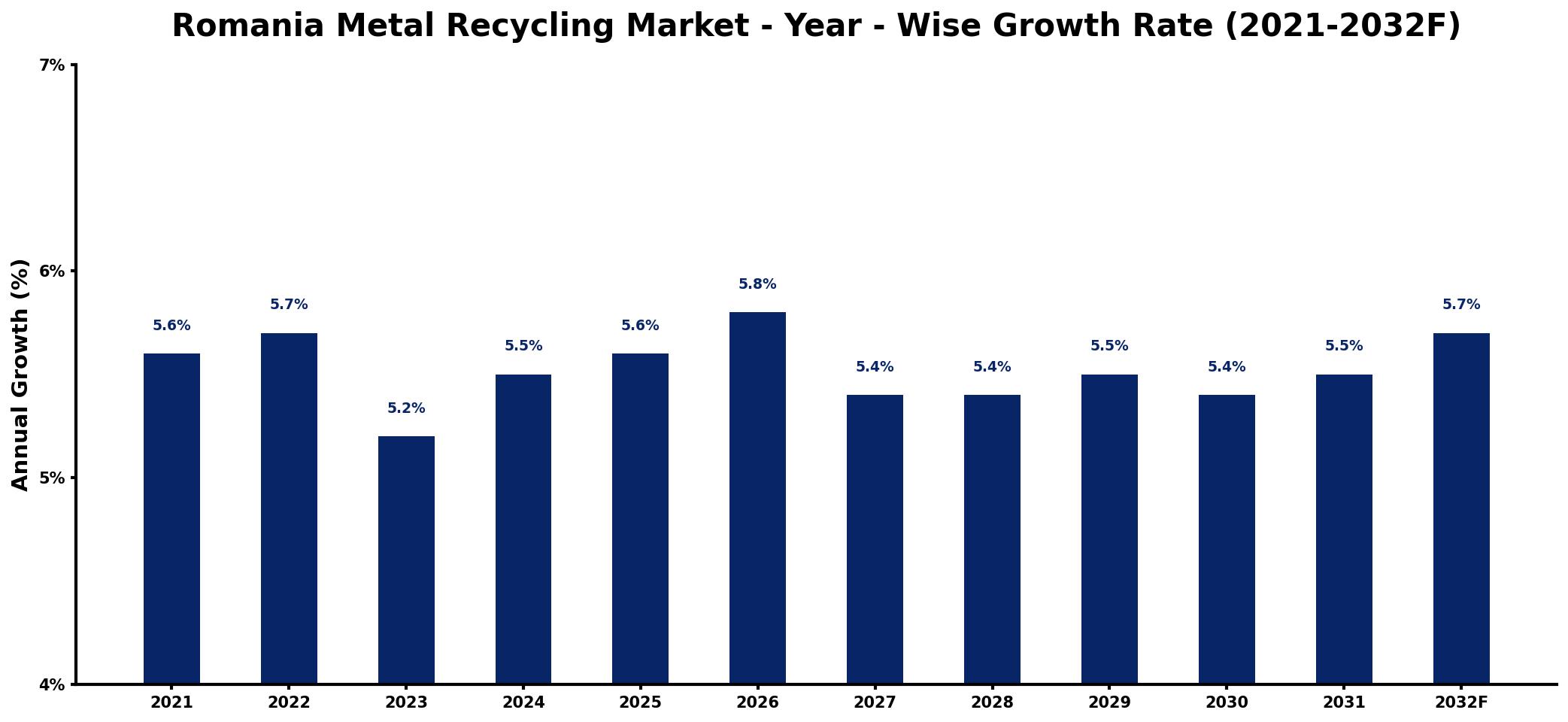
The table below presents the year‑wise growth rates along with the key drivers influencing the market
| Year | Growth Rate | Major Drivers |
| 2021 | 5.6% | Increased industrial production demands |
| 2022 | 5.7% | Rise in construction sector investments |
| 2023 | 5.2% | Growth in automotive sector requirements |
| 2024 | 5.5% | Expansion of renewable energy projects |
| 2025 | 5.6% | Boost in electronics manufacturing needs |
| 2026 | 5.8% | Surge in export opportunities abroad |
| 2027 | 5.4% | Higher consumer electronics demand |
| 2028 | 5.4% | Strengthening infrastructure development initiatives |
| 2029 | 5.5% | Growing urbanization and population growth |
| 2030 | 5.4% | Enhanced government sustainability policies |
| 2031 | 5.5% | Increased focus on circular economy |
| 2032 | 5.7% | Rising global environmental awareness |
Note: Market size estimations and growth projections presented in this report are based on 6Wresearch's proprietary forecasting methodology, utilizing the latest available industry data, government publications, and primary research inputs.
Romania Metal Recycling Market Synopsis
The most significant force currently shaping the Romania Metal Recycling Market is the growing commitment to sustainability. As the country aligns itself with European Union regulations, Romanian industries are becoming more conscious of their environmental footprint and are actively seeking eco-friendly solutions, including the use of recycled metals.
Government initiatives promoting metal recycling are also instrumental in this evolution. Policies designed to increase recycling rates and reduce landfill waste serve not only to enhance operational efficiencies within the sector but also to foster a more circular economy, which is becoming a central tenet of Romanias industrial landscape.
Romania Metal Recycling Market Key Takeaways
- The market is driven by increasing environmental awareness and governmental support for sustainable practices.
- Technological advancements are enhancing efficiency in metal recycling processes.
- Demand from the automotive and construction sectors significantly influences the market landscape.
- Investment opportunities abound, particularly in modern recycling facilities and logistics networks.
- Challenges remain, such as infrastructure limitations and competition from informal waste collection operations.
Evaluation of Restraints in Romania Metal Recycling Market
Despite the promising outlook, the Romania Metal Recycling Market faces several real restraints. One of the primary issues is the limited public awareness and participation in recycling programs, which hampers recycling rates. Additionally, inefficient collection and sorting systems can lead to increased operational costs and lower recovery rates. The market also suffers from a lack of adequate infrastructure, which impedes growth and makes it difficult for companies to scale operations effectively. Fragmentation within the industry, along with regulatory inconsistencies, further complicates the path to establishing a robust recycling ecosystem.
Romania Metal Recycling Market Trends
Current trends in the Romania Metal Recycling Market include significant technological advancements in sorting and separation processes. Innovations such as automated sorting systems and improved recovery techniques are making recycling operations more efficient and environmentally friendly. Furthermore, there is a growing trend toward partnerships between recycling firms and industries in need of sustainable materials, which is catalyzing new business models based on circular economy principles.
Romania Metal Recycling Market Opportunities
The market offers a wealth of investment opportunities, particularly as Romania steps up its commitment to sustainability. Setting up modern recycling facilities equipped with advanced technologies represents a significant avenue for growth. Furthermore, enhancing collection and transportation networks can improve logistics and supply chains, thereby increasing efficiency. Collaborations with local municipalities and industry players also present an avenue for establishing reliable sources of scrap metal, positioning investors favorably within the market.
Government Initiatives in the Romania Metal Recycling Market
The Romanian government has enacted several policies aimed at promoting metal recycling, including the Waste Management Law and the National Waste Management Strategy. These initiatives establish clear recycling targets and provide frameworks for reducing landfill usage. Additionally, the Extended Producer Responsibility (EPR) system mandates that producers are accountable for managing the end-of-life phase of their products, fostering an environment that encourages recycling and resource efficiency. The government is also incentivizing businesses in the sector through financial subsidies aimed at enhancing recycling capabilities.
Future Insights of the Romania Metal Recycling Market
Looking ahead to 2026-2032, the Romania Metal Recycling Market appears set for sustained growth. As environmental issues continue to take precedence, the demand for recycled metals is expected to rise across various sectors. Aligning with EU regulations will open doors for further investments, creating new opportunities in metal recovery technologies. As both businesses and consumers continue to advocate for sustainable practices, the landscape for metal recycling in Romania will likely evolve into a more robust and integrated system.
Romania Metal Recycling Market Latest Developments (2025 - 2026)
Recent developments within the Romania Metal Recycling Market indicate a shift towards more efficient recycling practices. Innovations in technology are becoming increasingly prevalent, allowing for better sorting and processing of scrap metals. Public awareness campaigns are also gaining traction, aimed at encouraging community participation in recycling initiatives. These efforts are being bolstered by favorable government policies that provide financial support and resources for enhancing recycling infrastructure.
Romania Metal Recycling Market - Key Attractiveness of the Report
- 10 Years of Market Numbers
- Historical Data Starting from 2022 to 2025
- Base Year: 2025
- Forecast Data until 2032
- Key Performance Indicators Impacting the Market
- Major Upcoming Developments and Projects
Key Highlights of the Report:
- Romania Metal Recycling Market Outlook
- Market Size of Romania Metal Recycling Market, 2025
- Forecast of Romania Metal Recycling Market, 2032
- Historical Data and Forecast of Romania Metal Recycling Revenues & Volume for the Period 2022-2032F
- Romania Metal Recycling Market Trend Evolution
- Romania Metal Recycling Market Drivers and Challenges
- Romania Metal Recycling Price Trends
- Romania Metal Recycling Porter's Five Forces
- Romania Metal Recycling Industry Life Cycle
- Historical Data and Forecast of Romania Metal Recycling Market Revenues & Volume By Scrap Type for the Period 2022-2032F
- Historical Data and Forecast of Romania Metal Recycling Market Revenues & Volume By Old Scrap for the Period 2022-2032F
- Historical Data and Forecast of Romania Metal Recycling Market Revenues & Volume By New Scrap for the Period 2022-2032F
- Historical Data and Forecast of Romania Metal Recycling Market Revenues & Volume By Type for the Period 2022-2032F
- Historical Data and Forecast of Romania Metal Recycling Market Revenues & Volume By Ferrous for the Period 2022-2032F
- Historical Data and Forecast of Romania Metal Recycling Market Revenues & Volume By Non-Ferrous for the Period 2022-2032F
- Historical Data and Forecast of Romania Metal Recycling Market Revenues & Volume By Equipment for the Period 2022-2032F
- Historical Data and Forecast of Romania Metal Recycling Market Revenues & Volume By Shredders for the Period 2022-2032F
- Historical Data and Forecast of Romania Metal Recycling Market Revenues & Volume By Shears for the Period 2022-2032F
- Historical Data and Forecast of Romania Metal Recycling Market Revenues & Volume By Granulating Machines for the Period 2022-2032F
- Historical Data and Forecast of Romania Metal Recycling Market Revenues & Volume By Briquetting Machines for the Period 2022-2032F
- Historical Data and Forecast of Romania Metal Recycling Market Revenues & Volume By End-use Sector for the Period 2022-2032F
- Historical Data and Forecast of Romania Metal Recycling Market Revenues & Volume By Building & Construction for the Period 2022-2032F
- Historical Data and Forecast of Romania Metal Recycling Market Revenues & Volume By Automotive for the Period 2022-2032F
- Historical Data and Forecast of Romania Metal Recycling Market Revenues & Volume By Equipment Manufacturing for the Period 2022-2032F
- Historical Data and Forecast of Romania Metal Recycling Market Revenues & Volume By Shipbuilding for the Period 2022-2032F
- Historical Data and Forecast of Romania Metal Recycling Market Revenues & Volume By Packaging for the Period 2022-2032F
- Historical Data and Forecast of Romania Metal Recycling Market Revenues & Volume By Consumer Appliances for the Period 2022-2032F
- Historical Data and Forecast of Romania Metal Recycling Market Revenues & Volume By Others for the Period 2022-2032F
- Romania Metal Recycling Import Export Trade Statistics
- Market Opportunity Assessment By Scrap Type
- Market Opportunity Assessment By Type
- Market Opportunity Assessment By Equipment
- Market Opportunity Assessment By End-use Sector
- Romania Metal Recycling Top Companies Market Share
- Romania Metal Recycling Competitive Benchmarking By Technical and Operational Parameters
- Romania Metal Recycling Company Profiles
- Romania Metal Recycling Key Strategic Recommendations






































