Romania Office Chair Market Size Growth Rate
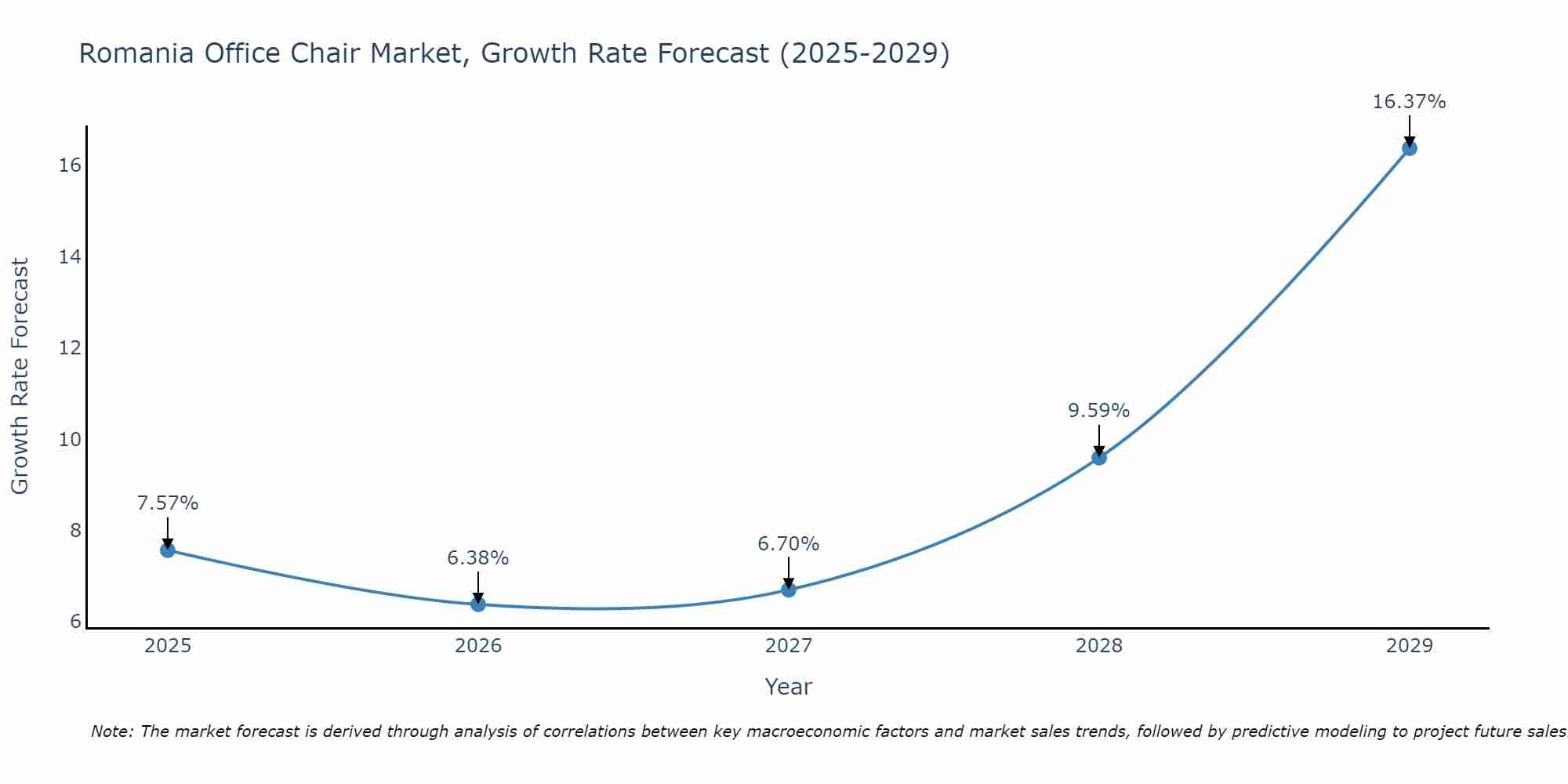
The Romania Office Chair Market is projected to witness mixed growth rate patterns during 2025 to 2029. Commencing at 7.57% in 2025, growth builds up to 16.37% by 2029.
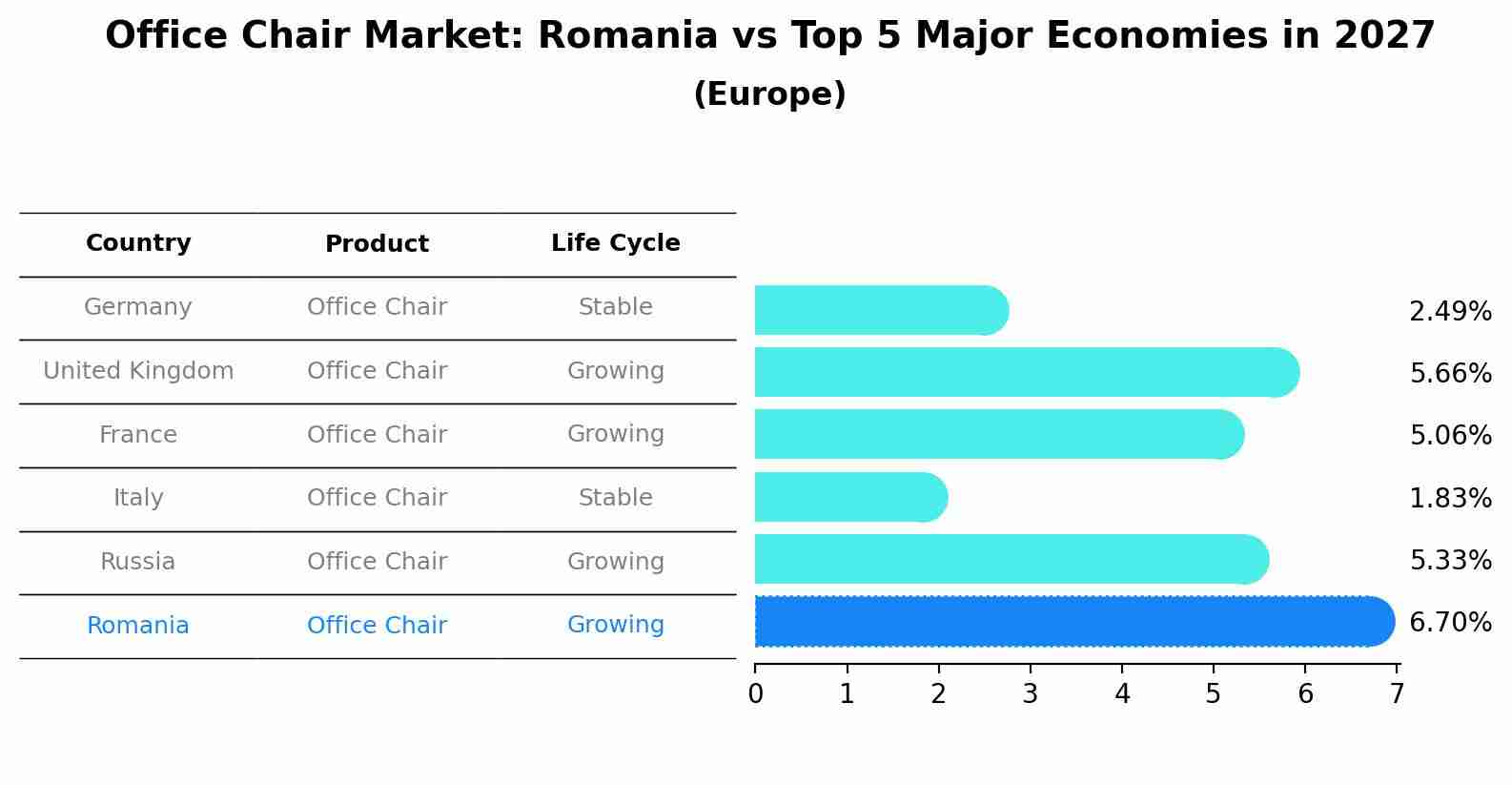
Office Chair Market: Romania vs Top 5 Major Economies in 2027 (Europe)
Romania's Office Chair market is anticipated to experience a growing growth rate of 6.70% by 2027, reflecting trends observed in the largest economy Germany, followed by United Kingdom, France, Italy and Russia.
Romania Office Chair Market Synopsis
The Romania Office Chair Market is experiencing steady growth driven by the increasing number of businesses and the trend towards modern workspaces. Demand for ergonomic chairs is on the rise as companies prioritize employee health and comfort. The market is competitive with both local manufacturers and international brands offering a variety of styles, materials, and price points to cater to different customer preferences. Online retail channels are gaining popularity due to convenience and competitive pricing, although traditional brick-and-mortar stores still play a significant role in the market. Sustainability and eco-friendly materials are becoming important factors influencing purchasing decisions. Overall, the Romania Office Chair Market is expected to continue growing as the business sector expands and the importance of comfortable and functional office furniture is emphasized.
Romania Office Chair Market Trends
The Romania Office Chair Market is currently experiencing a shift towards ergonomic and sustainable design trends. As more companies prioritize employee well-being and comfort in the workplace, there is a growing demand for office chairs that offer proper support and adjustability. Additionally, there is a rising awareness of environmental sustainability, leading to an increased interest in office chairs made from recycled materials or designed for easy disassembly and recycling. Online sales and customization options are also gaining traction in the market, offering consumers a convenient way to purchase office chairs tailored to their preferences. Overall, the Romania Office Chair Market is evolving to meet the demands of modern workplaces that value both comfort and sustainability.
Romania Office Chair Market Challenges
In the Romania office chair market, several challenges are faced by both manufacturers and retailers. One key challenge is the increasing competition from foreign brands, which offer a wider range of products at competitive prices. This makes it challenging for local manufacturers to compete effectively and maintain market share. Additionally, fluctuating raw material prices and supply chain disruptions can impact the production costs and lead to pricing pressures. Another challenge is the changing consumer preferences and demands for ergonomic designs and sustainable materials, requiring manufacturers to continuously innovate and upgrade their product offerings. Finally, economic uncertainties and regulatory changes can also impact consumer spending and overall market demand, making it essential for companies to stay agile and adapt to the evolving market conditions.
Romania Office Chair Market Investment Opportunities
The Romania Office Chair Market presents several investment opportunities for growth and profitability. With the increasing trend towards modern office setups and ergonomic furniture, there is a growing demand for high-quality, comfortable office chairs in the country. Investors can consider entering the market by introducing innovative and customizable office chair designs to cater to the diverse preferences of businesses. Additionally, focusing on sustainability and eco-friendly materials could appeal to the environmentally conscious consumer base. Collaborating with local manufacturers or setting up production facilities in Romania can also provide cost advantages and enable faster delivery to customers. Overall, targeting the growing demand for ergonomic, stylish, and sustainable office chairs in Romania can lead to a successful investment opportunity in the market.
Jordan Agar Market Government Policies
In Romania, government policies related to the office chair market primarily focus on consumer protection, quality standards, and environmental sustainability. The government has implemented regulations to ensure that office chairs meet specific safety and quality requirements, such as ergonomic design standards and durability criteria. Additionally, there are policies in place to promote environmentally friendly practices in the manufacturing and disposal of office chairs, encouraging the use of sustainable materials and recycling initiatives. The government also monitors market competition to prevent monopolies and ensure fair pricing for consumers. Overall, the regulatory framework aims to safeguard consumer interests, promote product quality, and foster sustainability within the Romania office chair market.
Romania Office Chair Market Future Outlook
The Romania Office Chair Market is projected to experience steady growth over the next few years, driven by factors such as the increasing number of businesses and office spaces in the country, rising demand for ergonomic and comfortable office furniture, and the growing focus on employee health and productivity. With the shift towards remote and hybrid work models, there may be a trend towards more versatile and adaptable office chair designs to cater to different working environments. Additionally, as sustainability and eco-friendliness become more important to consumers, the market may see a rise in demand for environmentally-friendly materials and manufacturing processes. Overall, the Romania Office Chair Market is expected to remain resilient and dynamic, offering opportunities for innovation and growth in the coming years.
Key Highlights of the Report:
- Romania Office Chair Market Outlook
- Market Size of Romania Office Chair Market, 2021
- Forecast of Romania Office Chair Market, 2031
- Historical Data and Forecast of Romania Office Chair Revenues & Volume for the Period 2018 - 2031
- Romania Office Chair Market Trend Evolution
- Romania Office Chair Market Drivers and Challenges
- Romania Office Chair Price Trends
- Romania Office Chair Porter's Five Forces
- Romania Office Chair Industry Life Cycle
- Historical Data and Forecast of Romania Office Chair Market Revenues & Volume By Product Type for the Period 2018 - 2031
- Historical Data and Forecast of Romania Office Chair Market Revenues & Volume By Executive Office for the Period 2018 - 2031
- Historical Data and Forecast of Romania Office Chair Market Revenues & Volume By Ergonomic for the Period 2018 - 2031
- Historical Data and Forecast of Romania Office Chair Market Revenues & Volume By Conference for the Period 2018 - 2031
- Historical Data and Forecast of Romania Office Chair Market Revenues & Volume By Material for the Period 2018 - 2031
- Historical Data and Forecast of Romania Office Chair Market Revenues & Volume By Mesh for the Period 2018 - 2031
- Historical Data and Forecast of Romania Office Chair Market Revenues & Volume By Lather for the Period 2018 - 2031
- Historical Data and Forecast of Romania Office Chair Market Revenues & Volume By Plastic for the Period 2018 - 2031
- Historical Data and Forecast of Romania Office Chair Market Revenues & Volume By Fabric for the Period 2018 - 2031
- Historical Data and Forecast of Romania Office Chair Market Revenues & Volume By Sales Channel for the Period 2018 - 2031
- Historical Data and Forecast of Romania Office Chair Market Revenues & Volume By Offline for the Period 2018 - 2031
- Historical Data and Forecast of Romania Office Chair Market Revenues & Volume By Online for the Period 2018 - 2031
- Romania Office Chair Import Export Trade Statistics
- Market Opportunity Assessment By Product Type
- Market Opportunity Assessment By Material
- Market Opportunity Assessment By Sales Channel
- Romania Office Chair Top Companies Market Share
- Romania Office Chair Competitive Benchmarking By Technical and Operational Parameters
- Romania Office Chair Company Profiles
- Romania Office Chair Key Strategic Recommendations






































