Romania Policy Management in Telecom Market Size & Growth Rate (2026-2032)
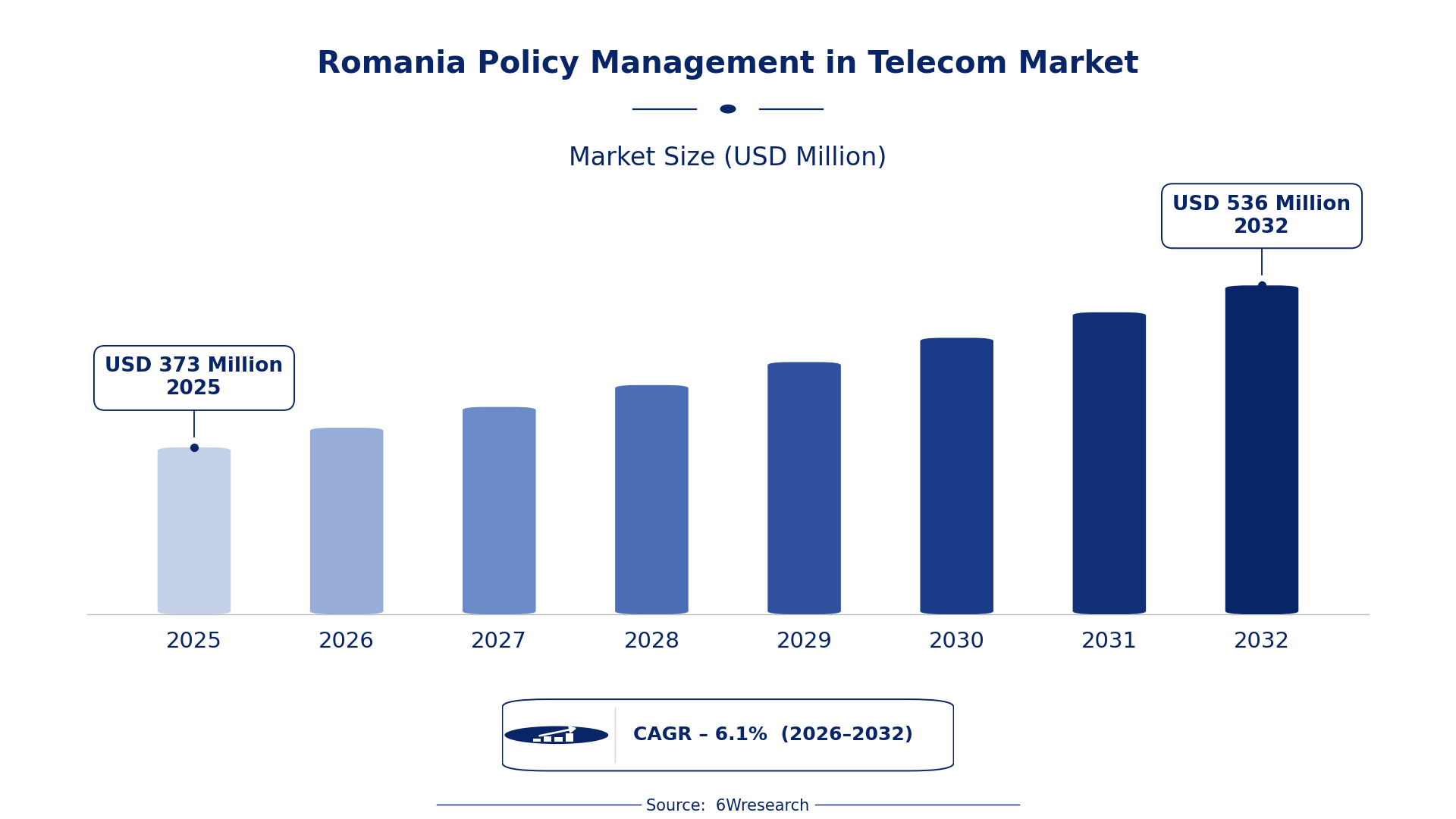
The Romania Policy Management in Telecom Market was estimated at USD 373 Million in 2025 and is projected to reach USD 536 Million by 2032, growing at a CAGR of 6.1% from 2026 to 2032.
Romania Policy Management in Telecom Market Synopsis
The Romanian telecommunications sector is experiencing a shift as operators face mounting pressures for advanced policy management solutions. With an eye toward enhancing customer satisfaction and service quality, telecommunications providers are investing in robust frameworks to efficiently manage network resources and enforce compliance with regulations.
As the transition to 5G networks and the Internet of Things (IoT) gains momentum, the demand for sophisticated policy management tools is escalating. Operators are seeking systems that not only streamline their operations but also comply with evolving governmental policies, thus setting the stage for a more competitive telecom market.
Romania Policy Management in Telecom Market Year-wise Growth Rate and Key Drivers
This graph illustrates the annual growth rates of the Romania Policy Management in Telecom Market from 2021 to 2032, highlighting a steady upward trajectory and projected expansion over the forecast period.
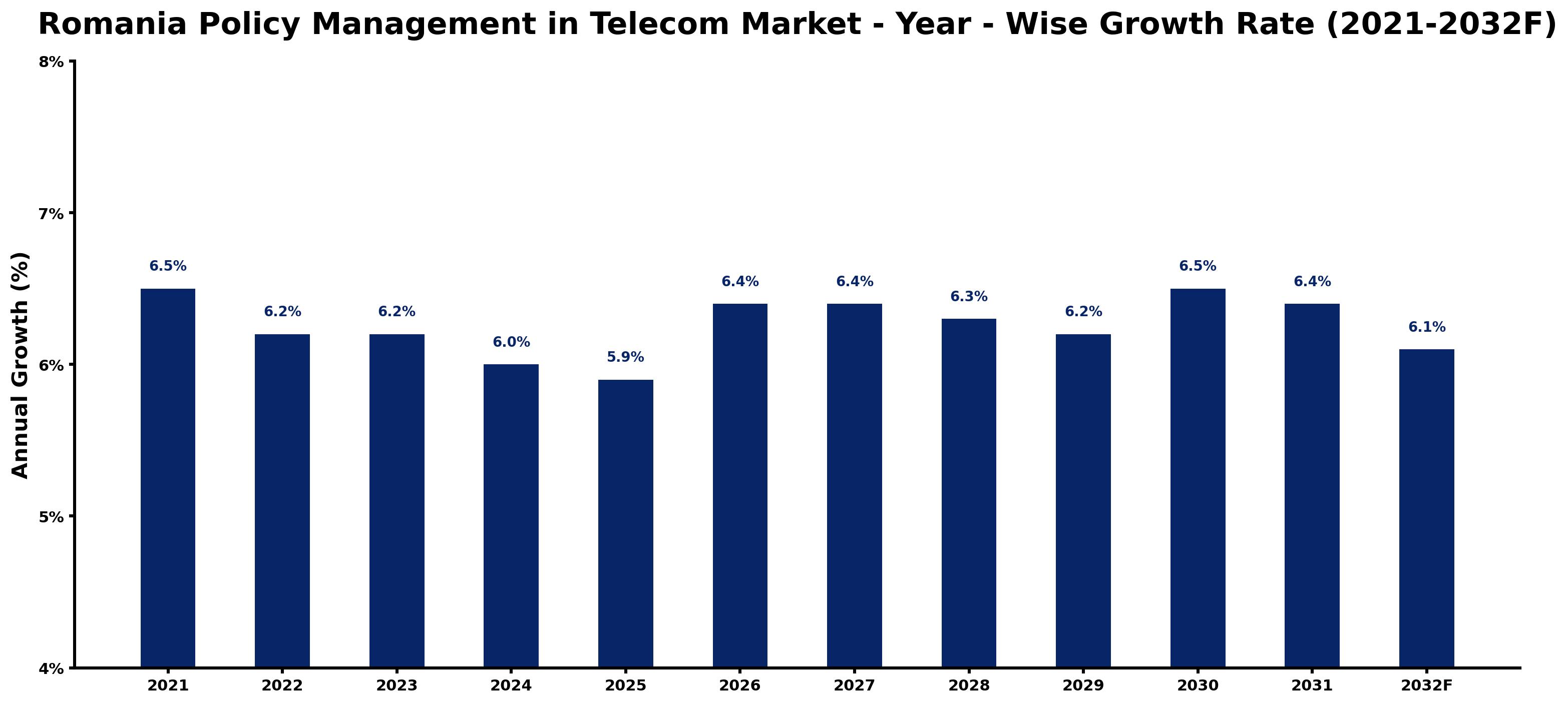
The table below presents the year‑wise growth rates along with the key drivers influencing the market
| Year | Growth Rate | Major Drivers |
| 2021 | 6.5% | Implementation of EU's Digital Decade plans in Romania. |
| 2022 | 6.2% | Launch of 5G networks by major telecom operators. |
| 2023 | 6.2% | Increased funding for rural connectivity projects by ANCOM. |
| 2024 | 6.0% | Government subsidies for broadband expansion in underserved areas. |
| 2025 | 5.9% | Rising smartphone penetration driving data service adoption. |
| 2026 | 6.4% | Broadband policy revisions promoting competition among providers. |
| 2027 | 6.4% | National cybersecurity strategy enhancing telecom service protections. |
| 2028 | 6.3% | Growing IoT applications pushing new telecom regulations. |
| 2029 | 6.2% | Regulatory incentives for green telecom infrastructure investments. |
| 2030 | 6.5% | New mobile payment policies boosting m-commerce services. |
| 2031 | 6.4% | Increased public-private partnerships for telecom infrastructure. |
| 2032 | 6.1% | Focus on enhancing digital literacy driving telecom usage. |
Note: Market size estimations and growth projections presented in this report are based on 6Wresearch's proprietary forecasting methodology, utilizing the latest available industry data, government publications, and primary research inputs.
Romania Policy Management in Telecom Market Key Takeaways
Below are some of the specific key takeaways from the market, including:
- The need for advanced policy control solutions is a primary driver for growth.
- Romania's telecommunications landscape is rapidly adapting to 5G and IoT demands.
- Regulatory compliance remains a crucial challenge for operators.
- Flexible policy frameworks are essential for effective network management.
- Investment opportunities are emerging in technology innovations and partnerships.
Evaluation of Restraints in Romania Policy Management in Telecom Market
While the Romania Policy Management in Telecom Market presents considerable opportunities, several restraints impede its progress. Navigating the complex regulatory environment can be a daunting task for service providers, often leading to delays and increased operational costs. Furthermore, scalability challenges in policy enforcement can hinder the efficient management of network resources, impacting service delivery quality. Operators must develop flexible policy frameworks that can adapt to rapidly changing network architectures to succeed in this competitive landscape.
Romania Policy Management in Telecom Market Trends
The market is witnessing an increasing focus on automation and AI-driven solutions in policy management. This trend facilitates enhanced decision-making capabilities and resource allocation for telecom providers. Additionally, as customer expectations heighten, there is a shift toward personalized services, requiring dynamic policy adjustments to meet individual user needs effectively. The integration of analytics tools is also on the rise, enabling operators to gain insights into network performance and customer behavior.
Romania Policy Management in Telecom Market Opportunities
Investment prospects in the Romanian telecom policy management sector are plentiful. Operators can capitalize on the rising demand for 5G infrastructure by adopting cutting-edge policy management solutions tailored for next-generation networks. Furthermore, public-private partnerships aimed at enhancing digital infrastructure are opening avenues for collaboration and innovation, allowing operators to deliver more robust services while ensuring regulatory compliance.
Government Initiatives in the Romania Policy Management in Telecom Market
Government policy is playing a significant role in shaping the Romania Policy Management in Telecom Market. With a commitment to fostering competitiveness and consumer rights protection, Romanian authorities are implementing various regulatory frameworks that ensure fair competition within the telecommunications sector. These initiatives aim to streamline compliance processes and promote a balanced market environment.
- A regulatory framework introduced in 2025 mandating transparent billing practices to protect consumer rights.
- A national digital infrastructure upgrade programme is currently underway, aimed at enhancing network capabilities across the country.
- A planned public-private initiative expected to expand telecom infrastructure access by 2028, improving service delivery.
- Ongoing assessment and revision of existing telecom policies to align with EU regulations and industry advancements.
Future Insights of the Romania Policy Management in Telecom Market
Looking ahead to 2026-2032, the Romania Policy Management in Telecom Market is set to evolve significantly as operators increasingly embrace advanced technologies. The integration of AI and machine learning into policy management systems is anticipated to streamline operations and improve customer experiences. As the regulatory environment continues to adapt, operators will need to remain agile, aligning their policies with both consumer demands and governmental guidelines to sustain their competitive edge.
Romania Policy Management in Telecom Market Latest Developments
The past year has seen notable advancements in the Romania Policy Management in Telecom Market, as operators and technology providers strive to enhance service quality and compliance measures. The increasing adoption of cloud-based solutions is enabling greater flexibility in policy management, allowing telecom companies to optimize their resource allocation and compliance processes.
- A major technology vendor launched a cloud-based policy management solution in late 2025, aimed at improving efficiency for telecommunications operators.
- An initiative that began in Q2 2025 to integrate AI capabilities into existing policy frameworks is currently underway, focusing on real-time network optimization.
- In early 2025, a leading regional operator completed a service upgrade to enhance network performance, resulting in improved customer satisfaction ratings.
- A rollout expected to begin in late 2026 of a new policy management system designed to support 5G network requirements is currently in the planning stages.
Romania Policy Management in Telecom Market - Key Attractiveness of the Report
- 10 Years of Market Numbers
- Historical Data Starting from 2022 to 2025
- Base Year: 2025
- Forecast Data until 2032
- Key Performance Indicators Impacting the Market
- Major Upcoming Developments and Projects
Key Highlights of the Report:
- Romania Policy Management in Telecom Market Outlook
- Market Size of Romania Policy Management in Telecom Market, 2025
- Forecast of Romania Policy Management in Telecom Market, 2032
- Historical Data and Forecast of Romania Policy Management in Telecom Revenues & Volume for the Period 2022-2032F
- Romania Policy Management in Telecom Market Trend Evolution
- Romania Policy Management in Telecom Market Drivers and Challenges
- Romania Policy Management in Telecom Price Trends
- Romania Policy Management in Telecom Porter's Five Forces
- Romania Policy Management in Telecom Industry Life Cycle
- Historical Data and Forecast of Romania Policy Management in Telecom Market Revenues & Volume By Network for the Period 2022-2032F
- Historical Data and Forecast of Romania Policy Management in Telecom Market Revenues & Volume By Fixed for the Period 2022-2032F
- Historical Data and Forecast of Romania Policy Management in Telecom Market Revenues & Volume By Wireless for the Period 2022-2032F
- Historical Data and Forecast of Romania Policy Management in Telecom Market Revenues & Volume By Component for the Period 2022-2032F
- Historical Data and Forecast of Romania Policy Management in Telecom Market Revenues & Volume By Solutions for the Period 2022-2032F
- Historical Data and Forecast of Romania Policy Management in Telecom Market Revenues & Volume By Services for the Period 2022-2032F
- Historical Data and Forecast of Romania Policy Management in Telecom Market Revenues & Volume By Deployment for the Period 2022-2032F
- Historical Data and Forecast of Romania Policy Management in Telecom Market Revenues & Volume By Cloud for the Period 2022-2032F
- Historical Data and Forecast of Romania Policy Management in Telecom Market Revenues & Volume By On-Premises for the Period 2022-2032F
- Romania Policy Management in Telecom Import Export Trade Statistics
- Market Opportunity Assessment By Network
- Market Opportunity Assessment By Component
- Market Opportunity Assessment By Deployment
- Romania Policy Management in Telecom Top Companies Market Share
- Romania Policy Management in Telecom Competitive Benchmarking By Technical and Operational Parameters
- Romania Policy Management in Telecom Company Profiles
- Romania Policy Management in Telecom Key Strategic Recommendations






































