Romania Radioactive Waste Management Market Size, Share & Growth Rate
The Romania Radioactive Waste Management Market was estimated at USD 1440 Million in 2025 and is projected to reach USD 2075 Million by 2032, growing at a CAGR of 5.4% from 2026 to 2032. This growth trajectory is driven primarily by increasing investments in waste management infrastructure, the necessity to adhere to stringent international safety standards, and advancements in technology related to waste processing and monitoring. The significant output from nuclear facilities, alongside rising healthcare demands, further fuels the need for effective waste management solutions in Romania.
Romania Radioactive Waste Management Market Year-wise Growth Rate and Key Drivers
This graph highlights how the Romania Radioactive Waste Management Market has steadily grown over the years, supported by major growth factors.
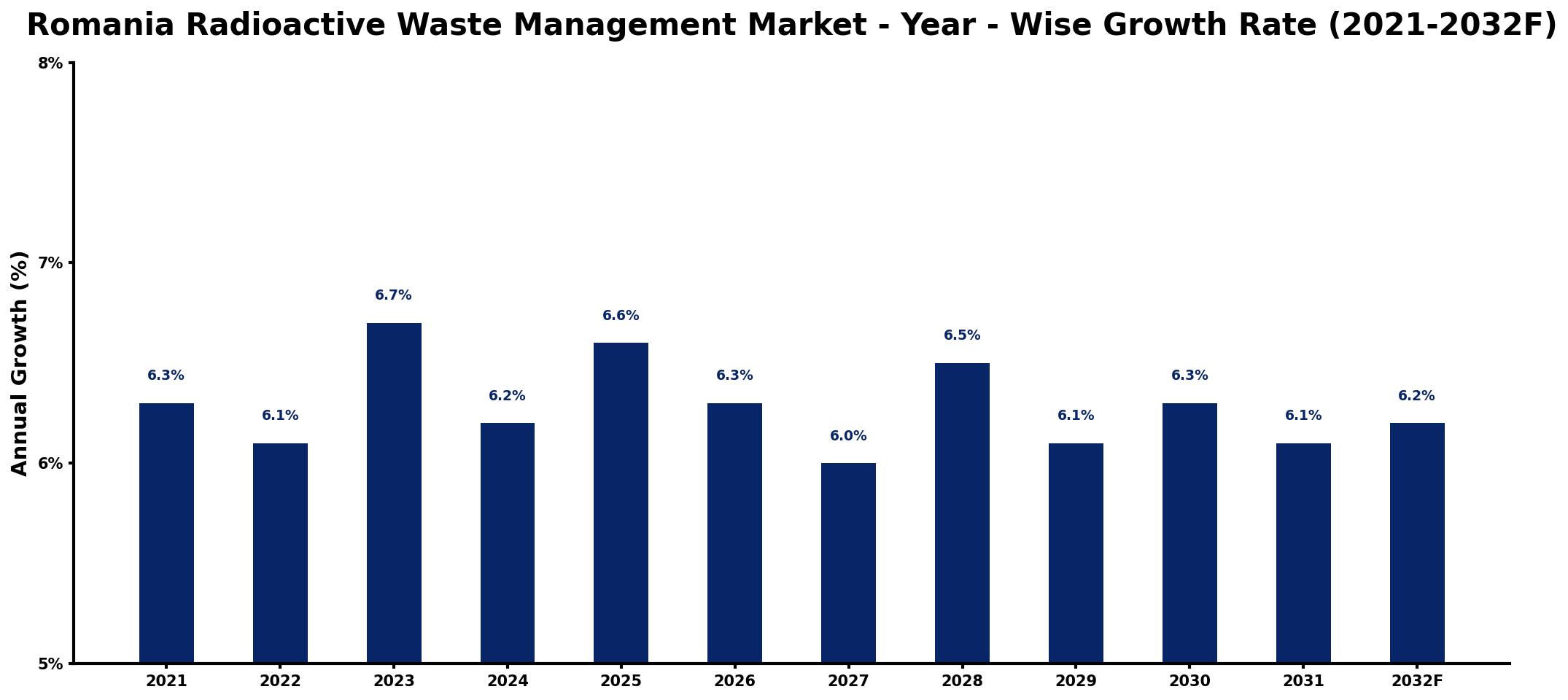
The table below presents the year‑wise growth rates along with the key drivers influencing the market
| Year | Growth Rate | Major Drivers |
| 2021 | 6.3% | Increased investments in infrastructure |
| 2022 | 6.1% | Growing public awareness initiatives |
| 2023 | 6.7% | Expansion of disposal facilities |
| 2024 | 6.2% | Rising demand for clean energy |
| 2025 | 6.6% | increased overall sector activity |
| 2026 | 6.3% | Technological advancements in safety |
| 2027 | 6.0% | Collaborations with international entities |
| 2028 | 6.5% | Enhanced environmental protection policies |
| 2029 | 6.1% | Growth in energy sector partnerships |
| 2030 | 6.3% | Emerging research and innovation |
| 2031 | 6.1% | Rising population and urbanization |
| 2032 | 6.2% | Increased funding for sustainability projects |
Note: Market size estimations and growth projections presented in this report are based on 6Wresearch's proprietary forecasting methodology, utilizing the latest available industry data, government publications, and primary research inputs.
Romania Radioactive Waste Management Market Synopsis
While Romania has made strides in radioactive waste management, the market is poised for dynamic growth as technological innovations and regulatory frameworks evolve. The current focus on enhancing waste disposal capabilities and public safety indicates a transformative phase for the industry.
Looking ahead, the Romanian radioactive waste management market is expected to adapt to both domestic and international pressures, integrating more advanced treatment solutions. Regulatory developments and public awareness will also play key roles in shaping the operational landscape, with a greater emphasis on sustainable practices.
Romania Radioactive Waste Management Market Key Takeaways
- The market is driven by significant investments in infrastructure and compliance with international standards.
- Technological advancements are paving the way for more effective waste processing and containment solutions.
- Government policies are increasingly focusing on environmental protection and nuclear safety.
- Public safety concerns and community engagement remain critical in gaining market acceptance.
- Potential growth in medical and research sectors is anticipated to drive demand for waste management services.
Evaluation of Restraints in Romania Radioactive Waste Management Market
The Romania radioactive waste management market faces notable challenges, primarily due to the intricacies of regulatory compliance and public safety apprehensions. Ensuring the development of safe and sustainable waste disposal and storage solutions necessitates rigorous testing and community outreach. Moreover, the need for transparent communication about risks associated with radioactive materials remains pivotal in building public trust and securing regulatory approval for new facilities.
Romania Radioactive Waste Management Market Trends
Current trends in the Romania radioactive waste management market indicate a shift toward innovative treatment technologies, including advanced containment systems and automation in waste processing. Furthermore, the adoption of digital monitoring solutions is becoming increasingly prevalent, enhancing safety and efficiency. There is also a growing emphasis on sustainable practices, with stakeholders exploring greener methods of waste treatment and disposal.
Romania Radioactive Waste Management Market Opportunities
Significant growth opportunities lie in expanding the infrastructure for waste management services, particularly in underserved regions. Investment in advanced technologies, such as AI and IoT for real-time monitoring, presents avenues for increased operational efficiency. The rise in medical and research activities underscores the potential for tailored waste management solutions, creating a favorable environment for innovation and new partnerships.
Government Initiatives in the Romania Radioactive Waste Management Market
The Romanian government has been proactive in shaping the radioactive waste management landscape through comprehensive policies focused on nuclear safety and environmental standards. This includes establishing protocols for waste handling and disposal, as well as promoting research and development of new management technologies. Public spending initiatives and incentives are also aimed at bolstering infrastructure while ensuring compliance with EU regulations.
Future Insights of the Romania Radioactive Waste Management Market
From 2026 to 2032, the Romanian radioactive waste management market is expected to evolve significantly, guided by regulatory reforms and technological advancements. As the emphasis on environmental protection intensifies, there will be a push towards more sustainable waste management practices. The integration of new technologies will not only enhance processing capabilities but also align with international best practices, ensuring that Romania remains a key player in the region's nuclear safety efforts.
Romania Radioactive Waste Management Market Latest Developments (2025 - 2026)
Recent developments in the Romanian radioactive waste management market highlight a growing commitment to improving safety standards and efficiency. Initiatives focused on enhancing waste processing capabilities and community engagement are being prioritized. The government is expected to release new regulations that will further outline disposal standards and operational protocols, fostering a safer environment for managing radioactive materials.
Romania Radioactive Waste Management Market - Key Attractiveness of the Report
- 10 Years of Market Numbers
- Historical Data Starting from 2022 to 2025
- Base Year: 2025
- Forecast Data until 2032
- Key Performance Indicators Impacting the Market
- Major Upcoming Developments and Projects
Key Highlights of the Report:
- Romania Radioactive Waste Management Market Outlook
- Market Size of Romania Radioactive Waste Management Market, 2025
- Forecast of Romania Radioactive Waste Management Market, 2032
- Historical Data and Forecast of Romania Radioactive Waste Management Revenues & Volume for the Period 2022-2032F
- Romania Radioactive Waste Management Market Trend Evolution
- Romania Radioactive Waste Management Market Drivers and Challenges
- Romania Radioactive Waste Management Price Trends
- Romania Radioactive Waste Management Porter's Five Forces
- Romania Radioactive Waste Management Industry Life Cycle
- Historical Data and Forecast of Romania Radioactive Waste Management Market Revenues & Volume By Type for the Period 2022-2032F
- Historical Data and Forecast of Romania Radioactive Waste Management Market Revenues & Volume By Exempt Waste and Very Low-Level Waste(VLLW) for the Period 2022-2032F
- Historical Data and Forecast of Romania Radioactive Waste Management Market Revenues & Volume By Low-Level Waste(LLW) for the Period 2022-2032F
- Historical Data and Forecast of Romania Radioactive Waste Management Market Revenues & Volume By Intermediate-Level Waste(ILW) for the Period 2022-2032F
- Historical Data and Forecast of Romania Radioactive Waste Management Market Revenues & Volume By High-Level Waste(HLW) for the Period 2022-2032F
- Historical Data and Forecast of Romania Radioactive Waste Management Market Revenues & Volume By Application for the Period 2022-2032F
- Historical Data and Forecast of Romania Radioactive Waste Management Market Revenues & Volume By Industrial for the Period 2022-2032F
- Historical Data and Forecast of Romania Radioactive Waste Management Market Revenues & Volume By Utility for the Period 2022-2032F
- Romania Radioactive Waste Management Import Export Trade Statistics
- Market Opportunity Assessment By Type
- Market Opportunity Assessment By Application
- Romania Radioactive Waste Management Top Companies Market Share
- Romania Radioactive Waste Management Competitive Benchmarking By Technical and Operational Parameters
- Romania Radioactive Waste Management Company Profiles
- Romania Radioactive Waste Management Key Strategic Recommendations






































