Romania Scrap Metal Recycling Market Summary
The romania scrap metal recycling market was estimated at USD 177 Million in 2025 and is projected to reach USD 235 Million by 2032, growing at a CAGR of 4.8% from 2026 to 2032.
Romania Scrap Metal Recycling Market Year-wise Growth Rate and Key Drivers
This graph highlights how the Romania Scrap Metal Recycling Market has steadily grown over the past five years, supported by major growth factors.
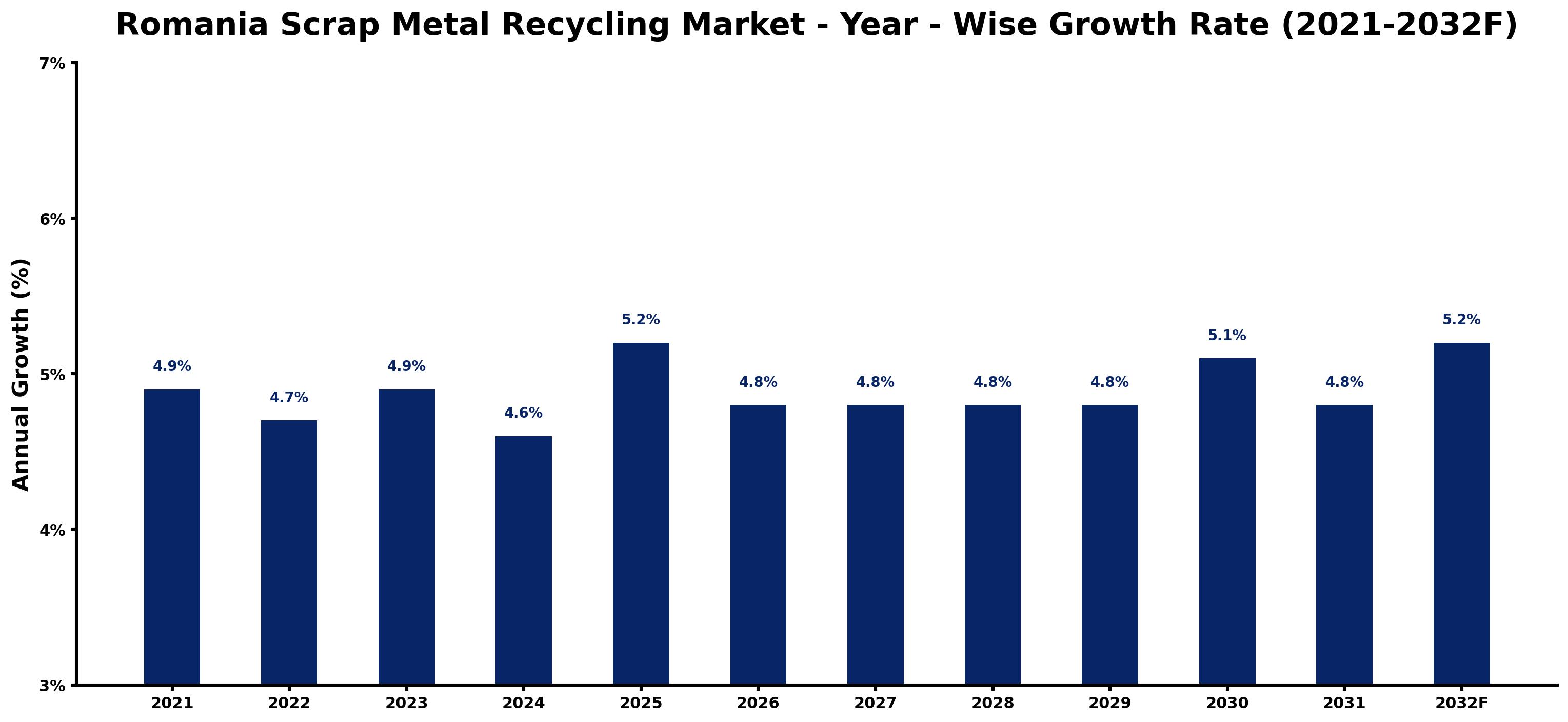
The table below presents the year wise growth rates along with the key drivers influencing the market
| Year | Growth Rate | Major Drivers |
| 2021 | 4.9% | Post-pandemic recovery stimulated operational efficiency in scrap metal processing facilities. |
| 2022 | 4.7% | Increased local industrial output contributed to higher scrap metal collection rates nationwide. |
| 2023 | 4.9% | Innovative recycling technologies enhanced purity levels of processed metals, attracting more clients. |
| 2024 | 4.6% | Urbanization trends drove demand for construction materials, boosting scrap metal utilization. |
| 2025 | 5.2% | Corporate sustainability targets encouraged businesses to source recycled metals over virgin materials. |
| 2026 | 4.8% | Rising global metal prices made recycling operations more economically viable for local players. |
| 2027 | 4.8% | Evolving consumer behavior emphasized eco-friendly products, prompting higher demand for recycled metals. |
| 2028 | 4.8% | Investment in advanced sorting technologies improved operational efficiencies across recycling plants. |
| 2029 | 4.8% | Increased collaboration between municipalities and recyclers streamlined waste collection processes significantly. |
| 2030 | 5.1% | Transition to circular economies highlighted the importance of scrap metal in sustainable development. |
| 2031 | 4.8% | Market education initiatives raised awareness about benefits of recycling among consumers and businesses. |
| 2032 | 5.2% | Establishment of stronger international trade agreements expanded access to global recycling markets. |
Note - Market size estimations and growth projections presented in this report are based on 6Wresearch's advanced forecasting approach, validated with industry datasets as of June 2026.
Romania Scrap Metal Recycling Market Synopsis
The Romania Scrap Metal Recycling Market is projected to reach 4.8% and witness significant growth during the forecast period (2026-2032). This market's expansion is primarily fueled by heightened environmental awareness and stringent government regulations on waste management and recycling initiatives. As industries increasingly recognize the environmental benefits of recycling, the demand for recycled metals in manufacturing and construction sectors further elevates the importance of scrap metal recycling in Romania.
Romania Scrap Metal Recycling Market Growth Drivers
In the Romania Scrap Metal Recycling Market, several key drivers are contributing to its notable expansion:
- The rising consciousness surrounding environmental sustainability motivates both consumers and businesses to adopt recycling practices, promoting a shift towards circular economy principles.
- Efficient waste management practices are becoming essential, leading to increased investments in recycling facilities and technologies capable of processing diverse metal types.
- The economic advantages derived from recycling metals include cost reductions in raw material sourcing, which is particularly attractive to industries reliant on manufacturing processes.
- Government regulations incentivizing the use of recycled materials in production are fostering a favorable market environment for scrap metal recycling.
- The growing construction industry in Romania further amplifies demand for recycled metals due to its focus on sustainable building practices.
Romania Scrap Metal Recycling Market Challenges and Restraints
Despite its growth potential, the Romania Scrap Metal Recycling Market faces several challenges:
- Price volatility in global metal markets can adversely affect the profitability of recycling operations, impacting investment in technology and infrastructure.
- Compliance with an evolving regulatory landscape poses significant hurdles for recycling facilities, necessitating continuous updates to operational procedures to meet legal standards.
- Infrastructure gaps in recycling facilities, particularly in rural areas, limit access to recycling services, hindering the overall growth of the market.
- The need for advanced sorting technologies and more effective material recovery processes is critical for enhancing recycling rates, yet investment in such innovations can be limited.
- Public awareness and engagement in recycling programs can vary, affecting the volume of scrap metal collected for recycling.
Romania Scrap Metal Recycling Market Government Investment and Initiatives
The Romanian government plays a pivotal role in shaping the landscape of the scrap metal recycling market through various initiatives and regulations:
- Environmental regulations aimed at promoting sustainable waste management practices have led to increased public investment in recycling facilities and recycling technologies.
- Government policies focusing on the circular economy encourage industries to integrate recycled materials, thus stimulating demand for scrap metal recycling services.
- Public funding and subsidies are being allocated to enhance infrastructure for recycling operations, addressing existing gaps and boosting processing capabilities.
- Educational campaigns aimed at raising awareness about recycling benefits and practices are being conducted to enhance public participation in metal recycling programs.
- Regulatory frameworks that include material recovery targets set ambitious goals for the recycling industry, mandating adherence that can lead to increased investments.
Romania Scrap Metal Recycling Market Latest Developments (May 2025 - June 2026)
The Romanian scrap metal recycling sector has undergone notable developments between May 2025 and June 2026, reflecting shifting industry dynamics:
- Significant advancements in sorting technologies have emerged, enabling facilities to increase efficiency and reduce contamination rates in recycled metal streams.
- A growing trend toward the adoption of circular economy practices is becoming evident, as various sectors begin to implement sustainable sourcing strategies reliant on recycled materials.
- Engagement between government bodies and industry leaders has intensified, leading to collaborative initiatives aimed at enhancing recycling rates and addressing infrastructure challenges.
- The implementation of stricter waste management regulations is driving increased compliance costs for facilities but is also raising the standard for operational efficiency.
- A rise in public and private partnerships is expected as stakeholders aim to streamline operations and improve the overall ecosystem of the recycling market.
Romania Scrap Metal Recycling Market - Key Attractiveness of the Report
- 10 Years of Market Numbers
- Historical Data Starting from 2022 to 2025
- Base Year: 2025
- Forecast Data until 2032
- Key Performance Indicators Impacting the Market
- Major Upcoming Developments and Projects
Key Highlights of the Report:
- Romania Scrap Metal Recycling Market Outlook
- Market Size of Romania Scrap Metal Recycling Market, 2025
- Forecast of Romania Scrap Metal Recycling Market, 2032
- Historical Data and Forecast of Romania Scrap Metal Recycling Revenues & Volume for the Period 2022-2032F
- Romania Scrap Metal Recycling Market Trend Evolution
- Romania Scrap Metal Recycling Market Drivers and Challenges
- Romania Scrap Metal Recycling Price Trends
- Romania Scrap Metal Recycling Porter's Five Forces
- Romania Scrap Metal Recycling Industry Life Cycle
- Historical Data and Forecast of Romania Scrap Metal Recycling Market Revenues & Volume By Type for the Period 2022-2032F
- Historical Data and Forecast of Romania Scrap Metal Recycling Market Revenues & Volume By Iron for the Period 2022-2032F
- Historical Data and Forecast of Romania Scrap Metal Recycling Market Revenues & Volume By Copper for the Period 2022-2032F
- Historical Data and Forecast of Romania Scrap Metal Recycling Market Revenues & Volume By Aluminum for the Period 2022-2032F
- Historical Data and Forecast of Romania Scrap Metal Recycling Market Revenues & Volume By Lead for the Period 2022-2032F
- Historical Data and Forecast of Romania Scrap Metal Recycling Market Revenues & Volume By Applications for the Period 2022-2032F
- Historical Data and Forecast of Romania Scrap Metal Recycling Market Revenues & Volume By Residential & Commercial for the Period 2022-2032F
- Historical Data and Forecast of Romania Scrap Metal Recycling Market Revenues & Volume By Industrial for the Period 2022-2032F
- Romania Scrap Metal Recycling Import Export Trade Statistics
- Market Opportunity Assessment By Type
- Market Opportunity Assessment By Applications
- Romania Scrap Metal Recycling Top Companies Market Share
- Romania Scrap Metal Recycling Competitive Benchmarking By Technical and Operational Parameters
- Romania Scrap Metal Recycling Company Profiles
- Romania Scrap Metal Recycling Key Strategic Recommendations






































