Romania Smart Airport Market Size, Share & Growth Rate
The Romania Smart Airport Market was estimated at USD 664 Million in 2025 and is projected to reach USD 1138 Million by 2032, growing at a CAGR of 8.0% from 2026 to 2032. This growth trajectory is primarily driven by the increasing adoption of advanced technologies designed to streamline airport operations and enhance passenger experiences. Furthermore, as Romania positions itself as a strategic regional hub for air travel, the demand for innovative smart airport solutions is expected to rise significantly, fueled by ongoing investments in infrastructure upgrades and modernization efforts.
Romania Smart Airport Market Year-wise Growth Rate and Key Drivers
This graph highlights how the Romania Smart Airport Market has steadily grown over the years, supported by major growth factors.
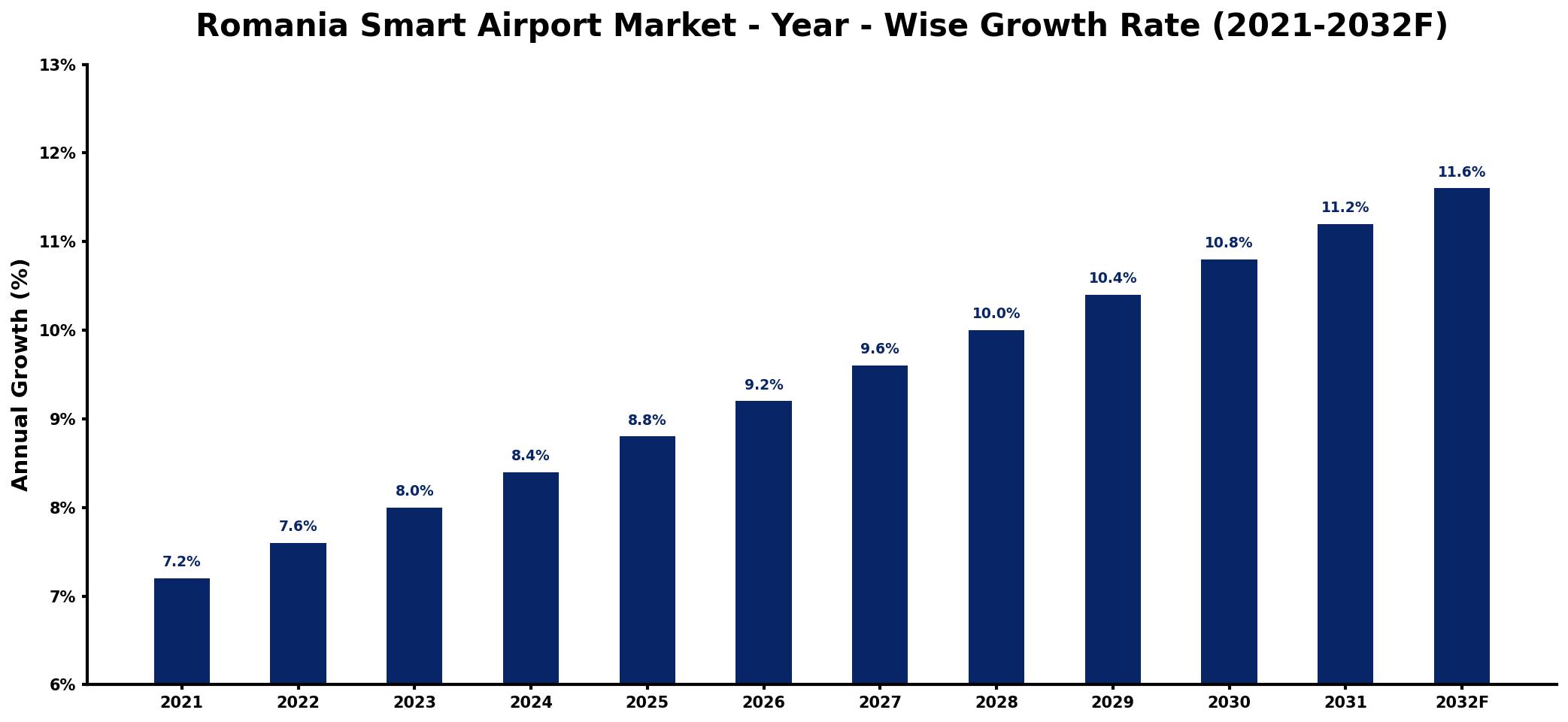
The table below presents the year‑wise growth rates along with the key drivers influencing the market
| Year | Growth Rate | Major Drivers |
| 2021 | 7.2% | Increased passenger traffic demand |
| 2022 | 7.6% | Expansion of digital technologies |
| 2023 | 8.0% | Growing investment in infrastructure |
| 2024 | 8.4% | Rise in tourism activities |
| 2025 | 8.8% | Enhanced security requirements implementation |
| 2026 | 9.2% | Integration of IoT solutions |
| 2027 | 9.6% | Development of urban connectivity |
| 2028 | 10.0% | Focus on sustainability initiatives |
| 2029 | 10.4% | Emergence of new service providers |
| 2030 | 10.8% | Advancements in data analytics |
| 2031 | 11.2% | improved raw material availability |
| 2032 | 11.6% | Adoption of innovative mobility solutions |
Note: Market size estimations and growth projections presented in this report are based on 6Wresearch's proprietary forecasting methodology, utilizing the latest available industry data, government publications, and primary research inputs.
Romania Smart Airport Market Synopsis
Romania's Smart Airport Market is gaining momentum as airports across the country embark on modernization initiatives to handle increasing passenger traffic. The integration of cutting-edge technologies such as biometric identification and automated check-in systems is enhancing operational efficiency, thereby improving the overall travel experience.
Additionally, the emphasis on sustainability and eco-friendly practices in airport operations is shaping the market landscape. With strategic governmental support for modernizing airport infrastructure, the momentum in the Romania Smart Airport Market reflects the countrys commitment to evolving alongside the demands of contemporary air travel.
Romania Smart Airport Market Key Takeaways
- The market is driven by the increasing implementation of advanced technologies aimed at improving airport operations.
- Enhanced passenger experience through smart solutions such as biometrics and automated systems is a critical focus.
- Sustainability initiatives are influencing investment in green technologies and practices in airport management.
- Strategic location of Romania as an air travel hub is boosting the demand for smart airport solutions.
- Government policies are actively supporting the development of modern airport infrastructure and technology.
Evaluation of Restraints in Romania Smart Airport Market
Despite the promising growth of the Romania Smart Airport Market, several constraints are evident. The significant investment required to upgrade existing infrastructure into smart capabilities presents a major barrier for some airports. Additionally, integrating multiple systems—including passenger processing, baggage handling, and security—into a cohesive smart airport framework can be both complex and financially burdensome. Data security and privacy concerns, especially with the deployment of technologies such as IoT and AI, further complicate the landscape, necessitating robust regulatory compliance and cybersecurity measures. Finally, the demand for skilled personnel to manage and maintain these technologies is a pressing issue, potentially limiting the pace of smart airport development in the region.
Romania Smart Airport Market Trends
Several key trends are shaping the Romania Smart Airport Market. The growing utilization of artificial intelligence to analyze passenger data for improving security and streamlining operations is gaining traction. Biometric identification systems are being adopted widely to enhance security measures while expediting the check-in process. Furthermore, the Internet of Things (IoT) is becoming increasingly central in facilitating seamless communication between various airport systems, thereby optimizing resource management. Additionally, an increasing focus on sustainable practices is leading to a rise in the implementation of energy-efficient systems and waste management solutions, aligning airport operations with environmental goals.
Romania Smart Airport Market Opportunities
The Romania Smart Airport Market presents a wealth of investment opportunities. With the persistent demand for efficiency and enhanced passenger experiences, technology investments such as IoT integration, automated baggage handling systems, and self-service kiosks are ripe for exploration. Additionally, the shift towards renewable energy solutions offers avenues for reducing carbon footprints while cutting operational costs. Partnering with airport authorities and technology developers to implement these smart solutions can catalyze significant growth and success in this burgeoning market.
Government Initiatives in the Romania Smart Airport Market
The Romanian government has proactively championed the development of smart airports through various initiatives and policies. These efforts include substantial investments aimed at modernizing airport infrastructure, as well as the promotion of advanced technologies, such as biometrics and artificial intelligence, to enhance security and passenger experiences. Moreover, the government is encouraging sustainable practices to minimize environmental impact while fostering collaboration between diverse stakeholders within the aviation sector. This strategic focus aims to streamline regulations and facilitate the growth of the smart airport market, positioning Romania as a competitive player in the European aviation landscape.
Future Insights of the Romania Smart Airport Market
Looking ahead to the period between 2026 and 2032, the Romania Smart Airport Market is expected to experience robust growth. The continued advancement of smart technologies will play a pivotal role in optimizing airport operations, improving security measures, and enhancing resource utilization. As Romania strives to modernize its airports and establish itself as a key player in the European aviation market, the demand for smart airport solutions is anticipated to grow significantly. With increasing air traffic and ongoing governmental support for aviation infrastructure development, the smart airport market in Romania is well-positioned for a dynamic and prosperous future.
Romania Smart Airport Market Latest Developments (2025 - 2026)
In recent months, several airports in Romania have initiated modernization projects focused on smart technology integration. Significant upgrades in passenger flow management and the rollout of biometric identification systems have been key areas of focus. Moreover, discussions surrounding potential collaborations between airport authorities and technology providers are gaining momentum as stakeholders seek to enhance operational efficiency. As these developments unfold, they signal a notable shift towards adopting smart solutions across the Romanian aviation sector.
Romania Smart Airport Market - Key Attractiveness of the Report
- 10 Years of Market Numbers
- Historical Data Starting from 2022 to 2025
- Base Year: 2025
- Forecast Data until 2032
- Key Performance Indicators Impacting the Market
- Major Upcoming Developments and Projects
Key Highlights of the Report:
- Romania Smart Airport Market Outlook
- Market Size of Romania Smart Airport Market, 2025
- Forecast of Romania Smart Airport Market, 2032
- Historical Data and Forecast of Romania Smart Airport Revenues & Volume for the Period 2022-2032F
- Romania Smart Airport Market Trend Evolution
- Romania Smart Airport Market Drivers and Challenges
- Romania Smart Airport Price Trends
- Romania Smart Airport Porter's Five Forces
- Romania Smart Airport Industry Life Cycle
- Historical Data and Forecast of Romania Smart Airport Market Revenues & Volume By System for the Period 2022-2032F
- Historical Data and Forecast of Romania Smart Airport Market Revenues & Volume By Communication and Network Systems for the Period 2022-2032F
- Historical Data and Forecast of Romania Smart Airport Market Revenues & Volume By Endpoint Devices for the Period 2022-2032F
- Historical Data and Forecast of Romania Smart Airport Market Revenues & Volume By Data Storage for the Period 2022-2032F
- Historical Data and Forecast of Romania Smart Airport Market Revenues & Volume By Software and Solutions for the Period 2022-2032F
- Historical Data and Forecast of Romania Smart Airport Market Revenues & Volume By End User for the Period 2022-2032F
- Historical Data and Forecast of Romania Smart Airport Market Revenues & Volume By Implementation for the Period 2022-2032F
- Historical Data and Forecast of Romania Smart Airport Market Revenues & Volume By Upgrades and Services for the Period 2022-2032F
- Historical Data and Forecast of Romania Smart Airport Market Revenues & Volume By Location for the Period 2022-2032F
- Historical Data and Forecast of Romania Smart Airport Market Revenues & Volume By Landside for the Period 2022-2032F
- Historical Data and Forecast of Romania Smart Airport Market Revenues & Volume By Airside for the Period 2022-2032F
- Historical Data and Forecast of Romania Smart Airport Market Revenues & Volume By Terminal Side for the Period 2022-2032F
- Romania Smart Airport Import Export Trade Statistics
- Market Opportunity Assessment By System
- Market Opportunity Assessment By End User
- Market Opportunity Assessment By Location
- Romania Smart Airport Top Companies Market Share
- Romania Smart Airport Competitive Benchmarking By Technical and Operational Parameters
- Romania Smart Airport Company Profiles
- Romania Smart Airport Key Strategic Recommendations






































