Russia App Analytics Market Size & Growth Rate (2026-2032)
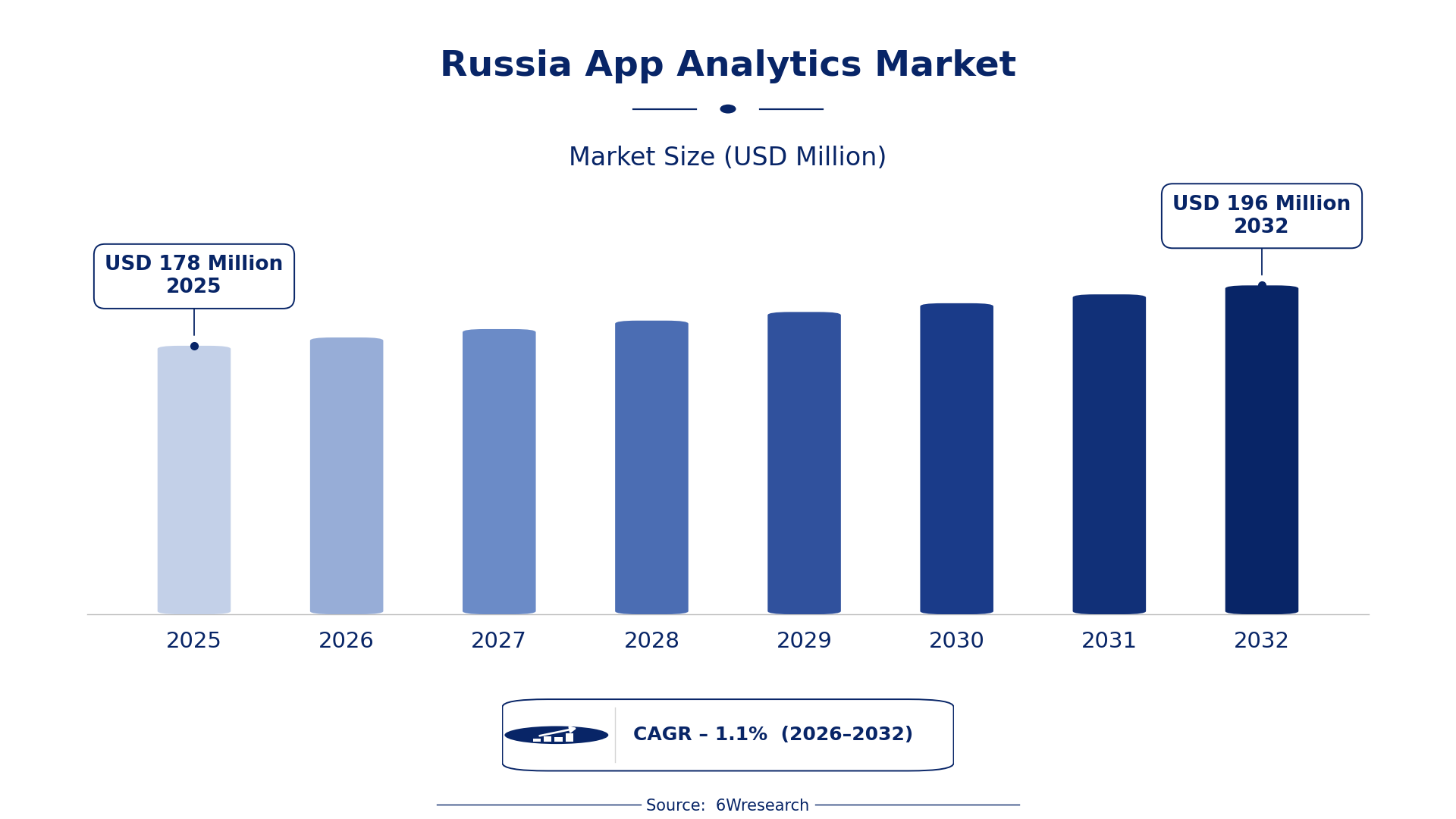
The Russia App Analytics Market was estimated at USD 178 Million in 2025 and is projected to reach USD 196 Million by 2032, growing at a CAGR of 1.1% from 2026 to 2032.
Russia App Analytics Market Synopsis
The increasing adoption of mobile applications is the primary force driving growth in the Russia App Analytics Market. As businesses and developers seek to enhance user engagement and optimize their offerings, the demand for robust analytics tools has surged.
Data privacy and compliance with local regulations are also critical factors influencing the market. Companies are prioritizing solutions that not only offer in-depth analytics but also adhere to stringent data protection laws, which adds complexity to the analytics landscape in Russia.
Russia App Analytics Market Year-wise Growth Rate and Key Drivers
This graph illustrates the annual growth rates of the Russia App Analytics Market from 2021 to 2032, highlighting a steady upward trajectory and projected expansion over the forecast period.
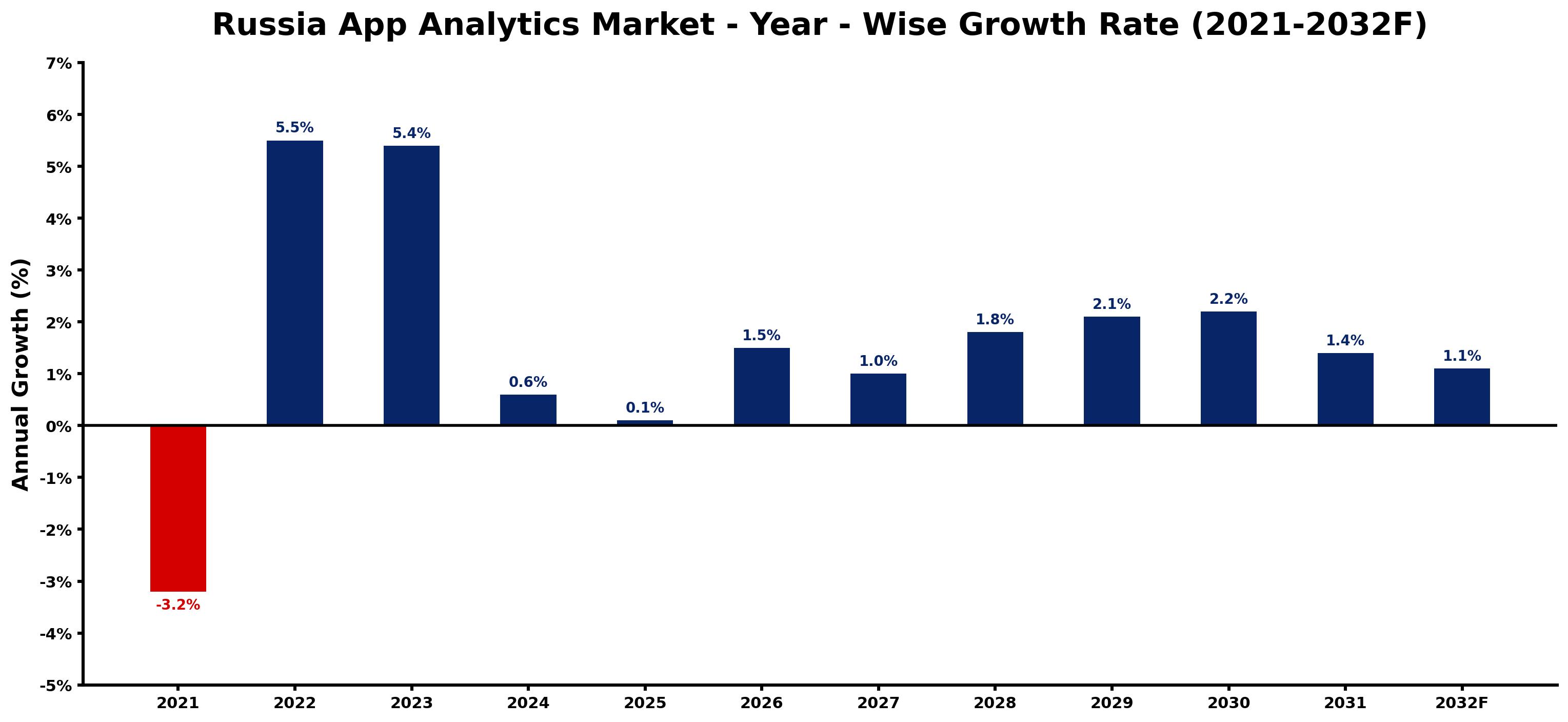
The table below presents the year‑wise growth rates along with the key drivers influencing the market
| Year | Growth Rate | Major Drivers |
| 2021 | -3.2% | Increased restrictions by Roskomnadzor on app usage |
| 2022 | 5.5% | Surge in local app development post-regulatory changes. |
| 2023 | 5.4% | Increased smartphone penetration in urban demographics. |
| 2024 | 0.6% | Growing interest in mobile analytics among retailers. |
| 2025 | 0.1% | Government support for digital economy initiatives. |
| 2026 | 1.5% | Rise of e-commerce apps boosting analytics demand. |
| 2027 | 1.0% | Enhanced focus on cybersecurity in app usage. |
| 2028 | 1.8% | Increased competition among app developers in Russia. |
| 2029 | 2.1% | Expanding user base for gaming apps requiring analytics. |
| 2030 | 2.2% | Adoption of AI tools in app performance optimization. |
| 2031 | 1.4% | Growth in demand for localized content in apps. |
| 2032 | 1.1% | Emergence of new mobile platforms boosting app analytics. |
Note: Market size estimations and growth projections presented in this report are based on 6Wresearch's proprietary forecasting methodology, utilizing the latest available industry data, government publications, and primary research inputs.
Russia App Analytics Market Key Takeaways
Below are some of the specific key takeaways from the market, including:
- The market is witnessing a strong demand for tools that provide insights into user behavior.
- Data privacy concerns are prompting companies to adopt localized analytics solutions.
- The rise of mobile gaming and e-commerce is driving innovation in app analytics capabilities.
- Integration of AI and machine learning technologies is becoming increasingly common.
- Investment opportunities are growing due to the expanding digital economy in Russia.
Evaluation of Restraints in Russia App Analytics Market
The Russia App Analytics Market faces notable restraints that could hinder its growth. One of the most pressing challenges is the stringent regulatory framework surrounding data privacy. Companies must navigate complex laws that require data localization, limiting their operational flexibility. This compliance burden can stifle innovation and deter international players from entering the market.
Additionally, cultural nuances and varying consumer behaviors complicate the data collection process. Understanding the unique preferences of Russian users requires extensive market research and localization efforts. The competitive presence of established local players further intensifies these challenges, as they have a deeper understanding of the market and consumer behavior.
Russia App Analytics Market Trends
Several trends are currently shaping the Russia App Analytics Market. Firstly, businesses are increasingly seeking granular user behavior insights to enhance product performance. This demand is pushing analytics providers to develop more sophisticated tools that offer real-time data and predictive capabilities.
Secondly, the focus on data security is driving the adoption of analytics solutions that comply with local regulations. As privacy laws become more stringent, the integration of AI and machine learning technologies is gaining traction, allowing companies to automate data analysis and enhance user engagement strategies.
Russia App Analytics Market Opportunities
The Russia App Analytics Market is ripe with investment opportunities as the digital economy continues to expand. With the increasing number of smartphone users and a vibrant app ecosystem, there is a pressing need for advanced analytics tools tailored to local requirements. Sectors such as e-commerce, mobile gaming, and financial services are particularly promising, as they demand sophisticated analytics for user engagement and conversion tracking.
Investors can capitalize on companies that focus on developing localized solutions or those that enhance existing analytics platforms with cutting-edge technologies. As businesses increasingly recognize the value of data-driven decision-making, the demand for innovative analytics tools will only grow.
Government Initiatives in the Russia App Analytics Market
The Russian government plays a crucial role in shaping the app analytics market through various policies and initiatives. With a focus on data privacy and security, regulatory requirements such as data localization are impacting how analytics companies operate. Compliance with these regulations is essential for market players to succeed.
- A regulatory framework implemented in 2025 mandates data localization for all personal data of Russian citizens.
- Current efforts are underway to enhance public awareness about data privacy, which affects consumer trust in app analytics.
- A planned initiative aims to promote the adoption of data protection technologies among app developers by 2027.
- Recently completed programs have introduced guidelines for the ethical collection and use of consumer data.
- Ongoing dialogues between government entities and tech stakeholders focus on balancing innovation with regulatory compliance.
Future Insights of the Russia App Analytics Market
Looking ahead to 2026-2032, the Russia App Analytics Market is set for transformative growth. As mobile application usage continues to rise across various sectors, the need for advanced analytics tools will be paramount. Businesses will increasingly rely on data-driven insights to refine their strategies and enhance user experiences.
The integration of real-time analytics and machine learning capabilities will become standard as companies strive for more nuanced understandings of user behavior. This evolution will likely attract new players and foster innovation within the market, making it a dynamic environment for both existing and potential market participants.
Russia App Analytics Market Latest Developments
Recent months have seen notable activity within the Russia App Analytics Market, highlighting a trend towards innovation and compliance. Companies are increasingly focusing on developing solutions that not only meet user needs but also adhere to strict regulatory standards.
- A major technology vendor launched a new analytics platform aimed at enhancing data visualization capabilities in early 2025.
- An initiative that began in mid-2025 is currently underway, focusing on integrating AI tools into existing analytics frameworks to improve efficiency.
- A partnership between local analytics firms was announced in late 2025, aiming to combine resources to create more comprehensive data solutions.
- Upcoming in Q2 2026, a new regulatory compliance program is set to be introduced, designed to assist companies in navigating data privacy laws.
- Completed in late 2025, a pilot program tested innovative user engagement strategies using advanced analytics in mobile apps.
Russia App Analytics Market - Key Attractiveness of the Report
- 10 Years of Market Numbers
- Historical Data Starting from 2022 to 2025
- Base Year: 2025
- Forecast Data until 2032
- Key Performance Indicators Impacting the Market
- Major Upcoming Developments and Projects
Key Highlights of the Report:
- Russia App Analytics Market Outlook
- Market Size of Russia App Analytics Market, 2025
- Forecast of Russia App Analytics Market, 2032
- Historical Data and Forecast of Russia App Analytics Revenues & Volume for the Period 2022-2032F
- Russia App Analytics Market Trend Evolution
- Russia App Analytics Market Drivers and Challenges
- Russia App Analytics Price Trends
- Russia App Analytics Porter's Five Forces
- Russia App Analytics Industry Life Cycle
- Historical Data and Forecast of Russia App Analytics Market Revenues & Volume By Component for the Period 2022-2032F
- Historical Data and Forecast of Russia App Analytics Market Revenues & Volume By Software for the Period 2022-2032F
- Historical Data and Forecast of Russia App Analytics Market Revenues & Volume By Services for the Period 2022-2032F
- Historical Data and Forecast of Russia App Analytics Market Revenues & Volume By Application for the Period 2022-2032F
- Historical Data and Forecast of Russia App Analytics Market Revenues & Volume By Revenue analytics for the Period 2022-2032F
- Historical Data and Forecast of Russia App Analytics Market Revenues & Volume By App performance analytics and operations for the Period 2022-2032F
- Historical Data and Forecast of Russia App Analytics Market Revenues & Volume By User analytics for the Period 2022-2032F
- Historical Data and Forecast of Russia App Analytics Market Revenues & Volume By Ad monitoring and marketing analytics for the Period 2022-2032F
- Historical Data and Forecast of Russia App Analytics Market Revenues & Volume By Type for the Period 2022-2032F
- Historical Data and Forecast of Russia App Analytics Market Revenues & Volume By Mobile app analytics for the Period 2022-2032F
- Historical Data and Forecast of Russia App Analytics Market Revenues & Volume By Web app analytics for the Period 2022-2032F
- Historical Data and Forecast of Russia App Analytics Market Revenues & Volume By Vertical for the Period 2022-2032F
- Historical Data and Forecast of Russia App Analytics Market Revenues & Volume By Banking, Financial Services, and Insurance (BFSI) for the Period 2022-2032F
- Historical Data and Forecast of Russia App Analytics Market Revenues & Volume By Retail for the Period 2022-2032F
- Historical Data and Forecast of Russia App Analytics Market Revenues & Volume By Media and entertainment for the Period 2022-2032F
- Historical Data and Forecast of Russia App Analytics Market Revenues & Volume By Logistics, travel, and transportation for the Period 2022-2032F
- Historical Data and Forecast of Russia App Analytics Market Revenues & Volume By Telecom and IT for the Period 2022-2032F
- Historical Data and Forecast of Russia App Analytics Market Revenues & Volume By Others for the Period 2022-2032F
- Russia App Analytics Import Export Trade Statistics
- Market Opportunity Assessment By Component
- Market Opportunity Assessment By Application
- Market Opportunity Assessment By Type
- Market Opportunity Assessment By Vertical
- Russia App Analytics Top Companies Market Share
- Russia App Analytics Competitive Benchmarking By Technical and Operational Parameters
- Russia App Analytics Company Profiles
- Russia App Analytics Key Strategic Recommendations






































