Russia Application Release Automation Market Size & Growth Rate (2026-2032)
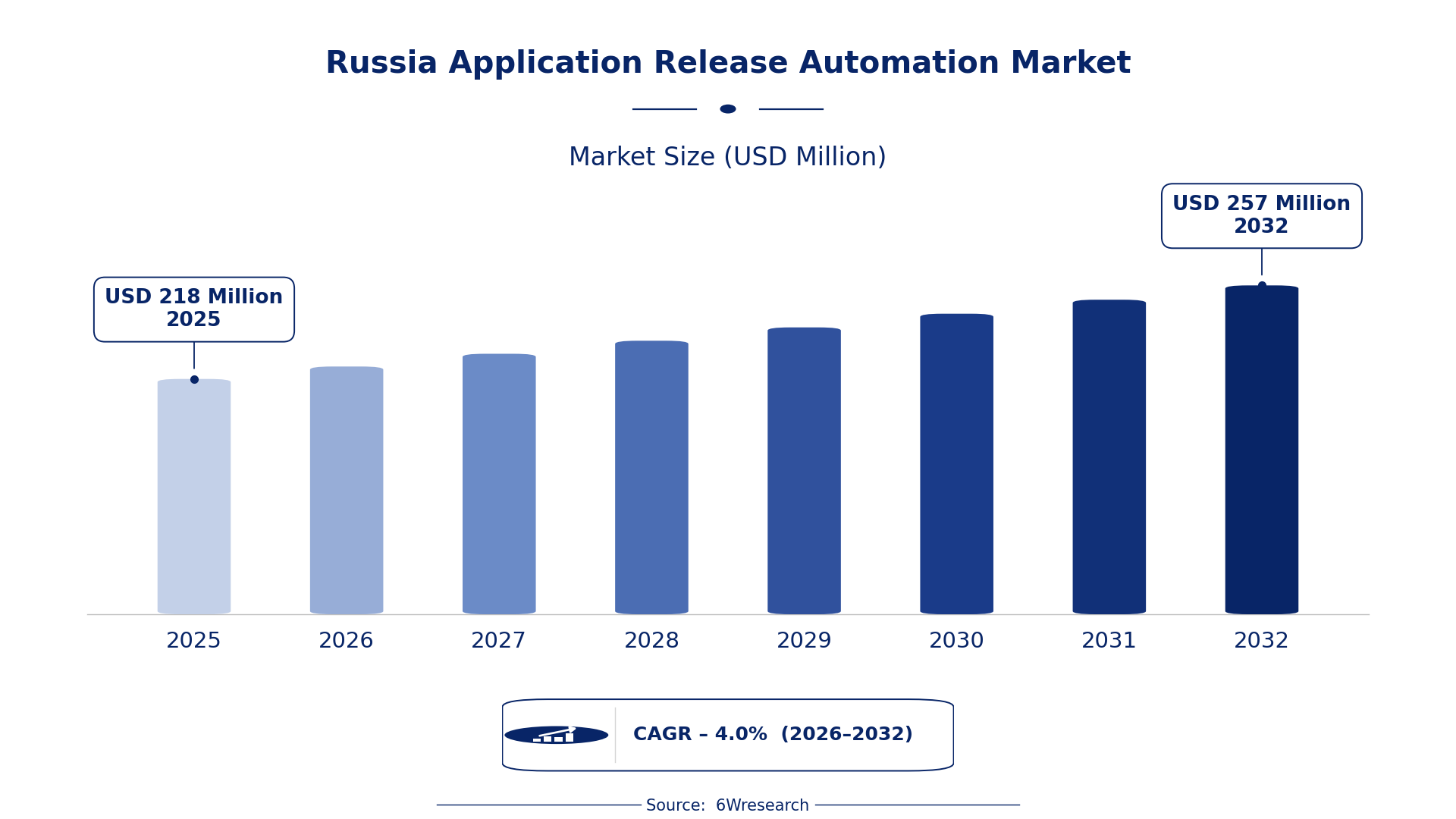
The Russia Application Release Automation Market was estimated at USD 218 Million in 2025 and is projected to reach USD 257 Million by 2032, growing at a CAGR of 4.0% from 2026 to 2032.
Russia Application Release Automation Market Synopsis
The surge in DevOps adoption is the strongest force currently shaping the Russia Application Release Automation Market. Organizations are increasingly realizing the benefits of automating their software development and deployment processes, leading to a greater reliance on application release automation tools.
As digital transformation becomes a priority for many enterprises, the demand for efficient automation solutions is intensifying. Companies are striving to minimize manual errors and enhance collaboration between development and operations teams, solidifying the need for sophisticated application release automation capabilities.
Russia Application Release Automation Market Year-wise Growth Rate and Key Drivers
This graph illustrates the annual growth rates of the Russia Application Release Automation Market from 2021 to 2032, highlighting a steady upward trajectory and projected expansion over the forecast period.
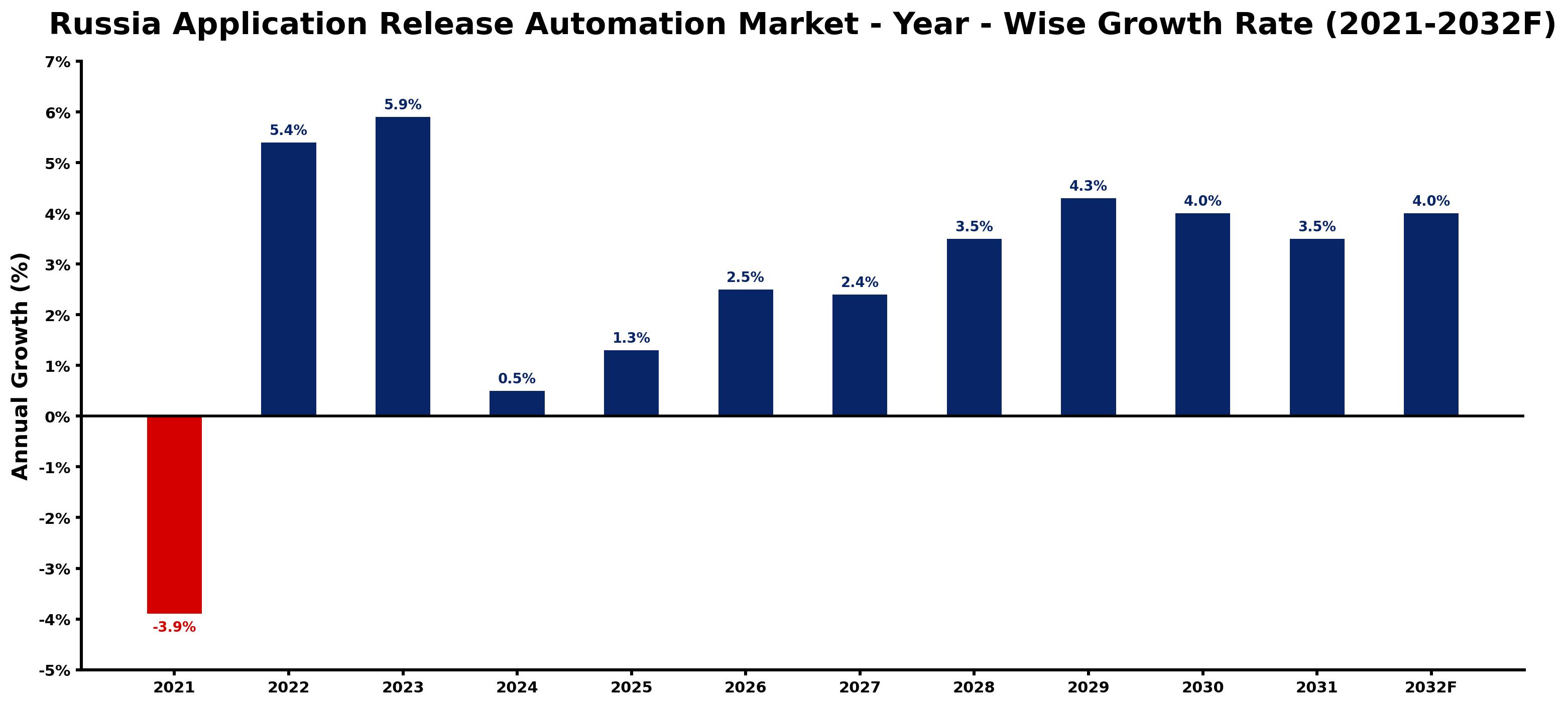
The table below presents the year‑wise growth rates along with the key drivers influencing the market
| Year | Growth Rate | Major Drivers |
| 2021 | -3.9% | EU sanctions limiting software importations in Russia |
| 2022 | 5.4% | Increased demand for digital transformation by enterprises |
| 2023 | 5.9% | Government incentives for tech startups boosting automation solutions |
| 2024 | 0.5% | Growing cybersecurity compliance pressures in financial services sector |
| 2025 | 1.3% | Rising adoption of cloud platforms among Russian businesses |
| 2026 | 2.5% | Investment in local tech talent driving software innovation |
| 2027 | 2.4% | Flourishing e-commerce sector requiring agile deployment processes |
| 2028 | 3.5% | Regulatory push for faster software release cycles in government |
| 2029 | 4.3% | Surge in AI integration into business applications |
| 2030 | 4.0% | Focus on improving user experience in mobile apps |
| 2031 | 3.5% | Enhanced remote work practices driving automation demand |
| 2032 | 4.0% | Continued digitalization efforts across healthcare systems |
Note: Market size estimations and growth projections presented in this report are based on 6Wresearch's proprietary forecasting methodology, utilizing the latest available industry data, government publications, and primary research inputs.
Russia Application Release Automation Market Key Takeaways
Below are some of the specific key takeaways from the market, including:
- The increasing focus on CI/CD pipelines is propelling demand for application release automation tools.
- Cloud-based automation solutions are gaining traction due to their scalability and flexibility.
- Robust security features are now a priority for organizations seeking automation tools.
- Investment opportunities are emerging in consulting services and training programs related to automation.
- Cultural resistance and limited awareness remain hurdles that need addressing for broader adoption.
Evaluation of Restraints in Russia Application Release Automation Market
The Russia Application Release Automation Market faces several restraints that could hinder its growth. Cultural resistance to change within organizations is a significant barrier, often stemming from a lack of understanding or familiarity with automation tools. The complex regulatory environment presents additional challenges, as companies navigate compliance and security concerns. on top of that, a shortage of skilled professionals in application release automation further complicates the landscape, leaving organizations struggling to implement effective solutions. Economic uncertainties and geopolitical factors also contribute to the cautious approach many businesses take towards adopting new technologies.
Russia Application Release Automation Market Trends
The market is witnessing a strong trend toward enhanced automation capabilities, particularly within CI/CD frameworks. As organizations strive for faster release cycles, the shift to cloud-based ARA solutions is becoming more pronounced, enabling greater flexibility and scalability. Additionally, the emphasis on security and compliance is driving demand for tools that offer comprehensive security features, ensuring that automated processes adhere to regulatory requirements. Collaboration between development and operations teams is becoming essential, reinforcing the need for integrated solutions that facilitate seamless workflows.
Russia Application Release Automation Market Opportunities
Numerous investment opportunities exist in the Russia Application Release Automation Market, primarily due to the rising demand for automation solutions. Companies focusing on innovative automation tools and consulting services are well-positioned to capitalize on this trend. The growing emphasis on DevOps practices indicates a need for technologies that enhance collaboration between development and operations teams. on top of that, as businesses prioritize digital transformation initiatives, vendors that offer specialized training and support will find lucrative avenues for growth.
Government Initiatives in the Russia Application Release Automation Market
Government policies are actively shaping the Russia Application Release Automation Market, with a focus on promoting digital innovation and supporting local tech companies. The regulatory framework aims to enhance data security and privacy, which is crucial for the successful implementation of automation solutions. By fostering collaboration between academia and industry, the government is working to build a skilled workforce that can drive technological advancements in the sector.
- A recently completed initiative focused on providing tax incentives for local tech startups, encouraging innovation in automation technologies.
- Current efforts are underway to enhance cybersecurity regulations, ensuring that automation tools comply with data protection standards.
- A planned public-private partnership expected to launch in 2026 aims to improve digital infrastructure and accessibility for automation technologies.
- Ongoing government-funded programs support research and development activities in the IT sector, including automation tools.
- Future initiatives will likely include funding for educational programs aimed at increasing awareness and understanding of automation technologies.
Future Insights of the Russia Application Release Automation Market
Looking ahead to 2026-2032, the Russia Application Release Automation Market is set to expand considerably. The growing demand for faster time-to-market, combined with an increased focus on quality and resource efficiency, will drive the adoption of automation solutions. As more organizations recognize the advantages of application release automation in minimizing errors and fostering collaboration, the market is expected to flourish. Digital transformation initiatives will remain a central theme, prompting continuous investment in advanced automation technologies.
Russia Application Release Automation Market Latest Developments
In the past year, the Russia Application Release Automation Market has seen several notable developments that reflect the growing interest in automation solutions. Companies are actively launching products and enhancing their service offerings to meet the rising demand.
- A major technology vendor introduced an advanced automation tool in early 2025, aimed at streamlining CI/CD processes for local enterprises.
- A partnership between leading regional operators was established in mid-2025 to develop integrated automation solutions for the Russian market.
- Ongoing initiatives are focused on upgrading existing automation platforms to incorporate AI-driven features, enhancing their capabilities.
- A rollout of a training program designed to educate IT professionals about automation tools is expected to begin in Q3 2026.
Russia Application Release Automation Market - Key Attractiveness of the Report
- 10 Years of Market Numbers
- Historical Data Starting from 2022 to 2025
- Base Year: 2025
- Forecast Data until 2032
- Key Performance Indicators Impacting the Market
- Major Upcoming Developments and Projects
There are promising opportunities in companies that offer innovative automation tools, consulting services, and training programs aimed at enhancing organizations’ automation capabilities.
Key Highlights of the Report:
- Russia Application Release Automation Market Outlook
- Market Size of Russia Application Release Automation Market, 2025
- Forecast of Russia Application Release Automation Market, 2032
- Historical Data and Forecast of Russia Application Release Automation Revenues & Volume for the Period 2022-2032F
- Russia Application Release Automation Market Trend Evolution
- Russia Application Release Automation Market Drivers and Challenges
- Russia Application Release Automation Price Trends
- Russia Application Release Automation Porter's Five Forces
- Russia Application Release Automation Industry Life Cycle
- Historical Data and Forecast of Russia Application Release Automation Market Revenues & Volume By Component for the Period 2022-2032F
- Historical Data and Forecast of Russia Application Release Automation Market Revenues & Volume By Tool for the Period 2022-2032F
- Historical Data and Forecast of Russia Application Release Automation Market Revenues & Volume By Services for the Period 2022-2032F
- Historical Data and Forecast of Russia Application Release Automation Market Revenues & Volume By Vertical for the Period 2022-2032F
- Historical Data and Forecast of Russia Application Release Automation Market Revenues & Volume By BFSI for the Period 2022-2032F
- Historical Data and Forecast of Russia Application Release Automation Market Revenues & Volume By ITEs for the Period 2022-2032F
- Historical Data and Forecast of Russia Application Release Automation Market Revenues & Volume By Telecommunications for the Period 2022-2032F
- Historical Data and Forecast of Russia Application Release Automation Market Revenues & Volume By Manufacturing for the Period 2022-2032F
- Historical Data and Forecast of Russia Application Release Automation Market Revenues & Volume By Deployment Type for the Period 2022-2032F
- Historical Data and Forecast of Russia Application Release Automation Market Revenues & Volume By On-Premises for the Period 2022-2032F
- Historical Data and Forecast of Russia Application Release Automation Market Revenues & Volume By Cloud for the Period 2022-2032F
- Historical Data and Forecast of Russia Application Release Automation Market Revenues & Volume By Organization Size for the Period 2022-2032F
- Russia Application Release Automation Import Export Trade Statistics
- Market Opportunity Assessment By Component
- Market Opportunity Assessment By Vertical
- Market Opportunity Assessment By Deployment Type
- Market Opportunity Assessment By Organization Size
- Russia Application Release Automation Top Companies Market Share
- Russia Application Release Automation Competitive Benchmarking By Technical and Operational Parameters
- Russia Application Release Automation Company Profiles
- Russia Application Release Automation Key Strategic Recommendations






































