Russia Artificial Intelligence in Retail Market Size & Growth Rate (2026-2032)
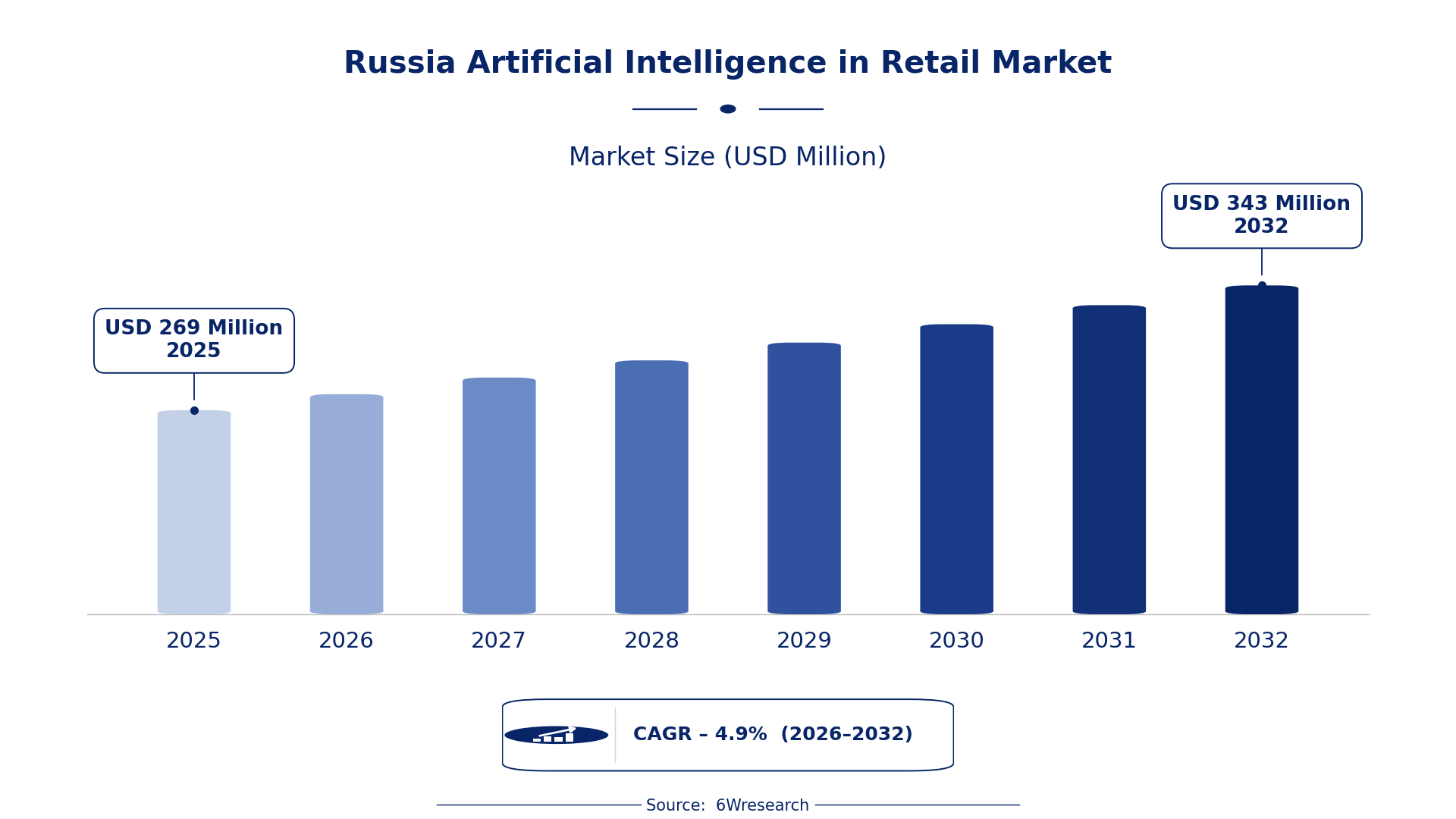
The Russia Artificial Intelligence in Retail Market was estimated at USD 269 Million in 2025 and is projected to reach USD 343 Million by 2032, growing at a CAGR of 4.9% from 2026 to 2032.
Russia Artificial Intelligence in Retail Market Synopsis
The adoption of artificial intelligence in the retail sector in Russia is rapidly gaining momentum. Retailers are harnessing advanced AI technologies to create personalized customer experiences, streamline operations, and enhance overall efficiency. As e-commerce continues to expand, the integration of AI tools has become a critical component for retailers aiming to remain competitive.
Current market dynamics reveal a keen interest in AI-driven analytics, recommendation systems, and customer service chatbots. These innovations are not only transforming shopping experiences but also optimizing inventory management and pricing strategies. Retailers are increasingly investing in these technologies to boost sales and foster customer loyalty.
Russia Artificial Intelligence in Retail Market Year-wise Growth Rate and Key Drivers
This graph illustrates the annual growth rates of the Russia Artificial Intelligence in Retail Market from 2021 to 2032, highlighting a steady upward trajectory and projected expansion over the forecast period.
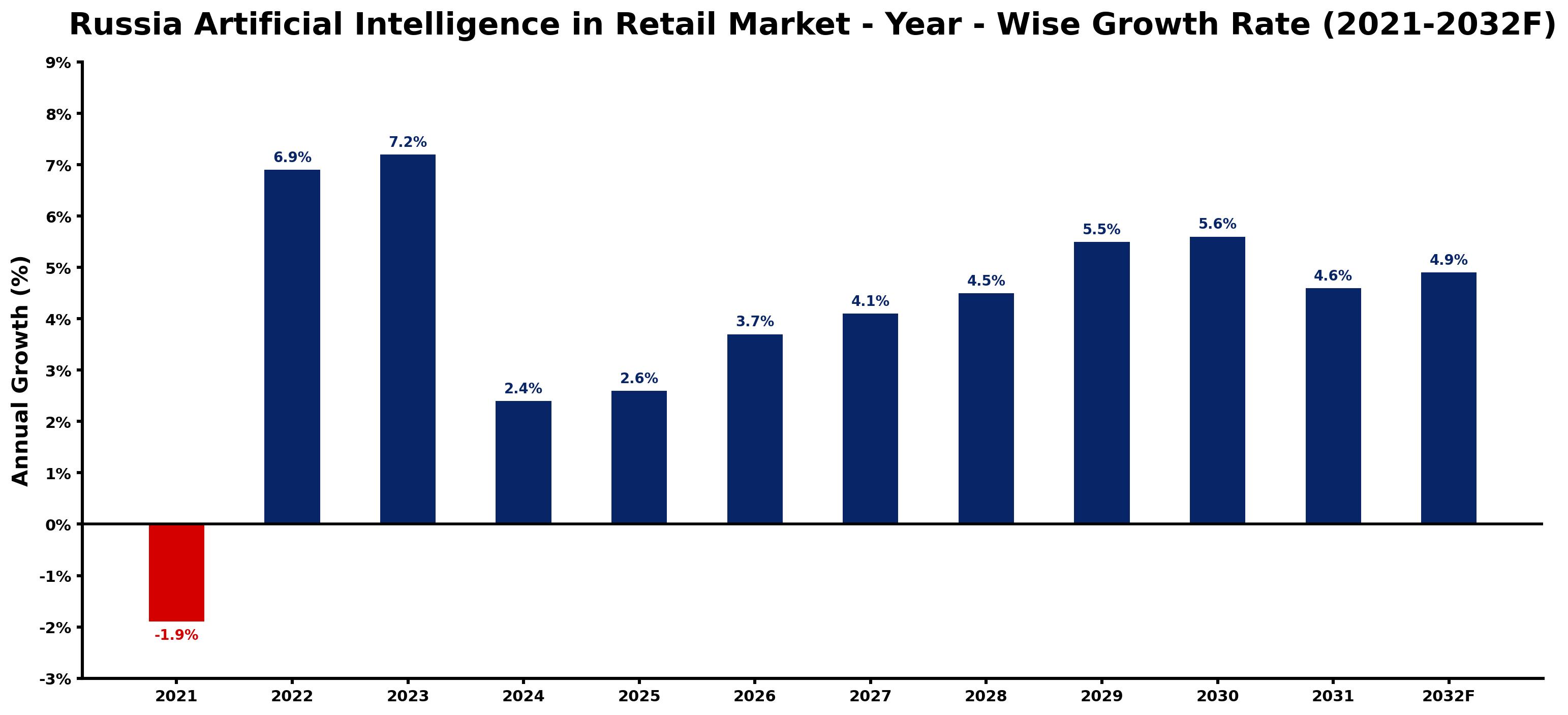
The table below presents the year‑wise growth rates along with the key drivers influencing the market
| Year | Growth Rate | Major Drivers |
| 2021 | -1.9% | Western sanctions limiting technology imports hinder innovation. |
| 2022 | 6.9% | Increased consumer preference for personalized shopping experiences. |
| 2023 | 7.2% | Retail compliance with new e-commerce AI regulations. |
| 2024 | 2.4% | Rise in mobile payment adoption enhancing AI solutions. |
| 2025 | 2.6% | Local partnerships with tech firms boosting AI capabilities. |
| 2026 | 3.7% | Growing availability of AI training data from local retailers. |
| 2027 | 4.1% | Demand for inventory optimization driven by local market needs. |
| 2028 | 4.5% | Surge in loyalty programs leveraging AI analytics. |
| 2029 | 5.5% | Increased integration of AI in supply chain management. |
| 2030 | 5.6% | Investment in AI-driven customer behavior analytics tools. |
| 2031 | 4.6% | Enhancements in cybersecurity attracting AI solutions for retail. |
| 2032 | 4.9% | Government support for AI initiatives in the retail sector. |
Note: Market size estimations and growth projections presented in this report are based on 6Wresearch's proprietary forecasting methodology, utilizing the latest available industry data, government publications, and primary research inputs.
Russia Artificial Intelligence in Retail Market Key Takeaways
Below are some of the specific key takeaways from the market, including:
- The market is witnessing accelerated growth as retailers adopt AI technologies for operational efficiency.
- AI-powered chatbots are becoming standard in customer service, enhancing user engagement.
- Investment in personalized marketing solutions is crucial for retailers looking to improve customer targeting.
- Data privacy concerns are shaping the regulatory environment for AI applications in retail.
- Collaborations between retailers and technology firms are paving the way for innovative AI solutions.
Evaluation of Restraints in Russia Artificial Intelligence in Retail Market
Despite the promising outlook, the Russia Artificial Intelligence in Retail Market faces notable challenges. A critical shortage of skilled professionals who understand both AI technologies and the retail sector complicates the implementation of effective solutions. Additionally, inadequate data infrastructure hinders the training of AI models, affecting the overall performance of these systems. Concerns regarding data privacy and compliance with local regulations further restrict the deployment of AI technologies in retail, making it essential for businesses to tread carefully as they navigate this complex landscape.
Russia Artificial Intelligence in Retail Market Trends
Several key trends are shaping the Russia Artificial Intelligence in Retail Market. The increasing use of AI-powered chatbots for real-time customer support is becoming ubiquitous. Retailers are also capitalizing on personalized product recommendations that leverage consumer behavior data, effectively enhancing shopping experiences. on top of that, AI-driven demand forecasting is gaining traction, allowing businesses to optimize inventory management and reduce operational costs. As digital interactions grow, visual search technologies are emerging as valuable tools for improving product discovery.
Russia Artificial Intelligence in Retail Market Opportunities
Investment opportunities within the Russia Artificial Intelligence in Retail Market are abundant. Retailers are keen on AI-driven personalized marketing and virtual shopping assistants, indicating a strong demand for such technologies. Automated checkout processes present another area ripe for innovation, potentially enhancing customer satisfaction. Collaborations with local AI startups can unlock fresh insights and tailored solutions, making it easier for retailers to adopt cutting-edge technologies and maintain a competitive edge.
Government Initiatives in the Russia Artificial Intelligence in Retail Market
The Russian government is actively promoting the development of AI technologies across various sectors, including retail. With initiatives aimed at fostering innovation and enhancing competitiveness, public policy is crucial for shaping the future of AI in this market. Recent efforts focus on creating a supportive infrastructure while ensuring compliance with data regulations, which is vital for the successful implementation of AI solutions.
- A national digital infrastructure upgrade programme has been rolled out to support AI integration in retail operations.
- Currently, the government is funding research initiatives to develop AI technologies tailored for the retail sector.
- A regulatory framework mandating transparency in data handling was introduced in early 2025 to address privacy concerns.
- Upcoming initiatives include a public-private partnership aimed at advancing AI applications in retail by 2028.
Future Insights of the Russia Artificial Intelligence in Retail Market
Looking ahead, the future of the Russia Artificial Intelligence in Retail Market appears bright. The continuous evolution of AI technologies will enable retailers to refine their operations and customer engagement strategies. As the market for e-commerce expands, AI's role in enhancing online shopping experiences will become increasingly significant. Retailers who strategically adopt these technologies will likely lead the charge in driving innovation and setting new industry standards.
Russia Artificial Intelligence in Retail Market Latest Developments
Recent activity in the Russia Artificial Intelligence in Retail Market indicates a strong push towards innovation and technology integration. Over the past year, retailers have been actively exploring various AI applications to enhance operational efficiencies and improve customer interactions. This trend reflects a broader commitment to leveraging technology for competitive advantage.
- In mid-2025, a major technology vendor launched a new AI-driven analytics platform designed for retail businesses.
- Currently, several retailers are implementing AI-powered inventory management systems to optimize stock levels.
- A collaborative initiative began in early 2025 to develop advanced visual search tools for e-commerce platforms.
- By late 2026, a rollout is expected for a new virtual shopping assistant aimed at enhancing customer engagement.
Russia Artificial Intelligence in Retail Market - Key Attractiveness of the Report
- 10 Years of Market Numbers
- Historical Data Starting from 2022 to 2025
- Base Year: 2025
- Forecast Data until 2032
- Key Performance Indicators Impacting the Market
- Major Upcoming Developments and Projects
Key Highlights of the Report:
- Russia Artificial Intelligence in Retail Market Outlook
- Market Size of Russia Artificial Intelligence in Retail Market, 2025
- Forecast of Russia Artificial Intelligence in Retail Market, 2032
- Historical Data and Forecast of Russia Artificial Intelligence in Retail Revenues & Volume for the Period 2022-2032F
- Russia Artificial Intelligence in Retail Market Trend Evolution
- Russia Artificial Intelligence in Retail Market Drivers and Challenges
- Russia Artificial Intelligence in Retail Price Trends
- Russia Artificial Intelligence in Retail Porter's Five Forces
- Russia Artificial Intelligence in Retail Industry Life Cycle
- Historical Data and Forecast of Russia Artificial Intelligence in Retail Market Revenues & Volume By Type for the Period 2022-2032F
- Historical Data and Forecast of Russia Artificial Intelligence in Retail Market Revenues & Volume By Online for the Period 2022-2032F
- Historical Data and Forecast of Russia Artificial Intelligence in Retail Market Revenues & Volume By Offline for the Period 2022-2032F
- Historical Data and Forecast of Russia Artificial Intelligence in Retail Market Revenues & Volume By Service for the Period 2022-2032F
- Historical Data and Forecast of Russia Artificial Intelligence in Retail Market Revenues & Volume By Professional for the Period 2022-2032F
- Historical Data and Forecast of Russia Artificial Intelligence in Retail Market Revenues & Volume By Managed for the Period 2022-2032F
- Historical Data and Forecast of Russia Artificial Intelligence in Retail Market Revenues & Volume By Technology for the Period 2022-2032F
- Historical Data and Forecast of Russia Artificial Intelligence in Retail Market Revenues & Volume By Machine Learning for the Period 2022-2032F
- Historical Data and Forecast of Russia Artificial Intelligence in Retail Market Revenues & Volume By Deep Learning for the Period 2022-2032F
- Historical Data and Forecast of Russia Artificial Intelligence in Retail Market Revenues & Volume By NLP for the Period 2022-2032F
- Russia Artificial Intelligence in Retail Import Export Trade Statistics
- Market Opportunity Assessment By Type
- Market Opportunity Assessment By Service
- Market Opportunity Assessment By Technology
- Russia Artificial Intelligence in Retail Top Companies Market Share
- Russia Artificial Intelligence in Retail Competitive Benchmarking By Technical and Operational Parameters
- Russia Artificial Intelligence in Retail Company Profiles
- Russia Artificial Intelligence in Retail Key Strategic Recommendations






































