Tunisia Artificial Intelligence in Retail Market Size & Growth Rate (2026-2032)
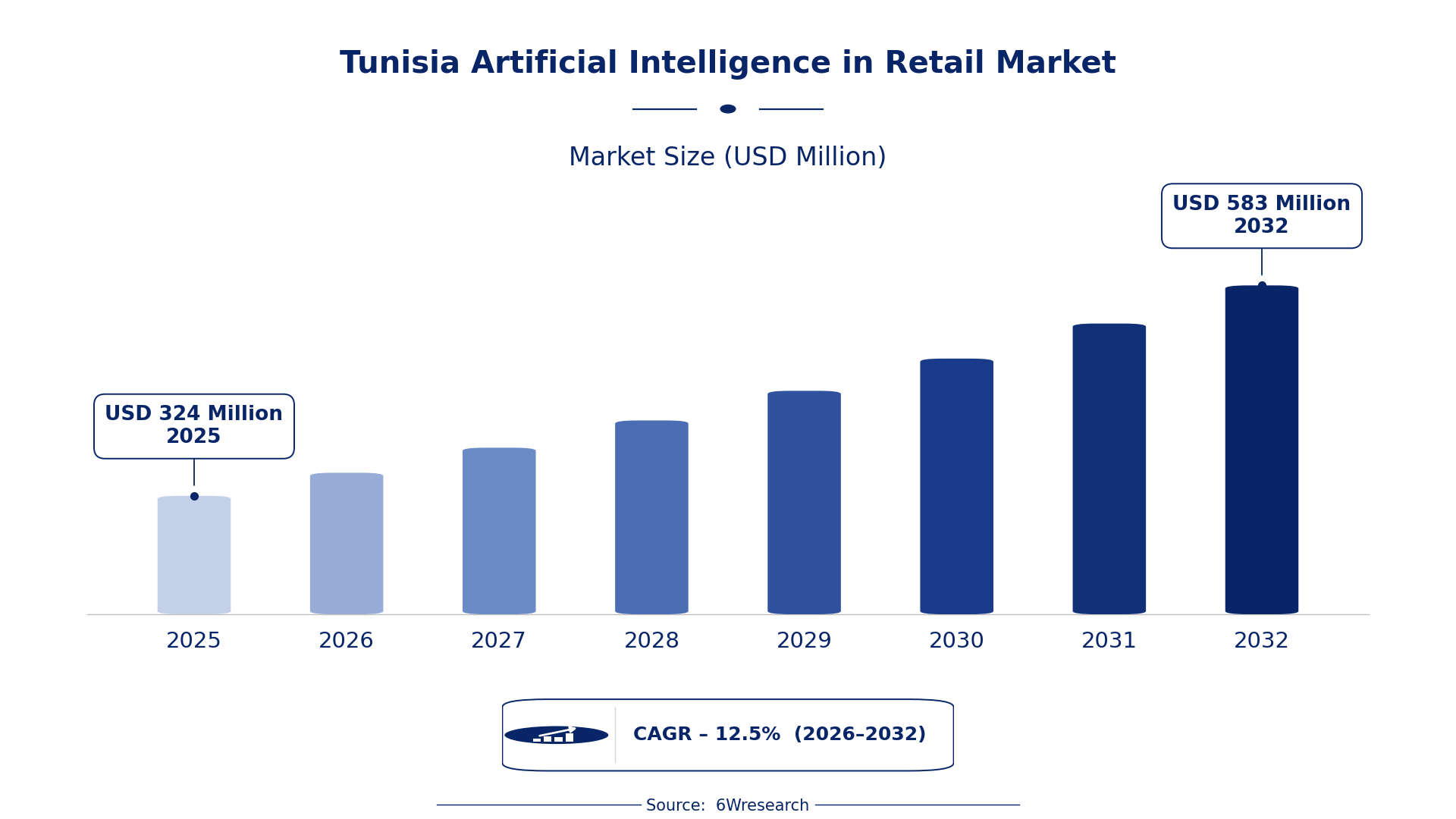
The Tunisia Artificial Intelligence in Retail Market was estimated at USD 324 Million in 2025 and is projected to reach USD 583 Million by 2032, growing at a CAGR of 12.5% from 2026 to 2032.
Tunisia Artificial Intelligence in Retail Market Synopsis
The retail sector in Tunisia is undergoing a significant transformation as businesses increasingly adopt artificial intelligence (AI) technologies to enhance customer engagement and streamline operations. This shift is not just a trend; it represents a fundamental change in how retailers approach consumer interactions and inventory management.
AI applications such as machine learning and natural language processing are becoming essential tools for retailers aiming to deliver personalized shopping experiences. As the market matures, retailers are leveraging data analytics to gain deeper insights into consumer behavior, pushing the boundaries of traditional retail practices.
Tunisia Artificial Intelligence in Retail Market Year-wise Growth Rate and Key Drivers
This graph illustrates the annual growth rates of the Tunisia Artificial Intelligence in Retail Market from 2021 to 2032, highlighting a steady upward trajectory and projected expansion over the forecast period.
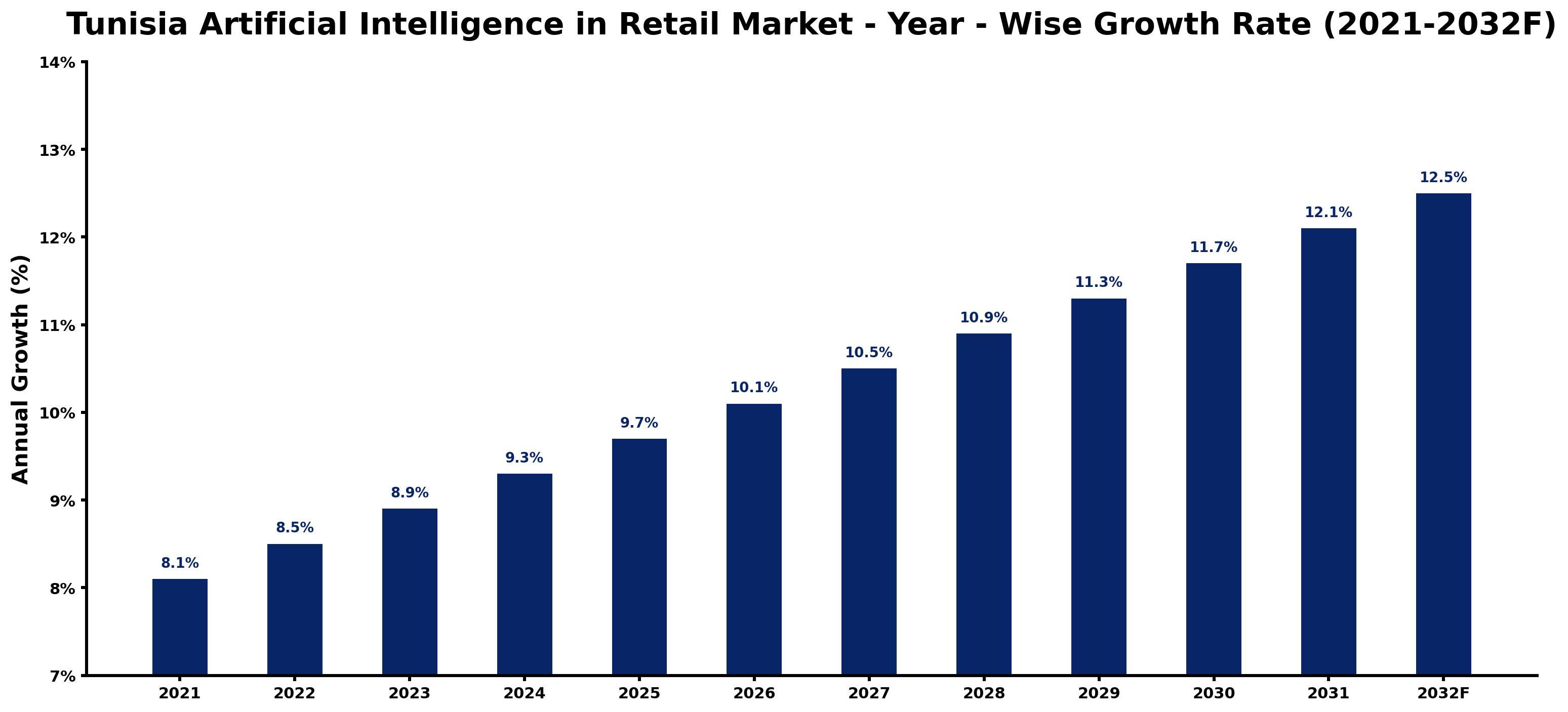
The table below presents the year‑wise growth rates along with the key drivers influencing the market
| Year | Growth Rate | Major Drivers |
| 2021 | 8.1% | Government incentives for AI adoption in retail tech |
| 2022 | 8.5% | Increase in mobile payment solutions enhancing customer experience |
| 2023 | 8.9% | Growth of local startups leveraging AI for e-commerce |
| 2024 | 9.3% | Regulatory support for data privacy boosting consumer trust |
| 2025 | 9.7% | AI-powered chatbots improving customer service efficiency |
| 2026 | 10.1% | Youth demographic increasing online shopping habits |
| 2027 | 10.5% | Partnerships between retailers and tech firms accelerating innovation |
| 2028 | 10.9% | Rise in social media marketing driving online sales |
| 2029 | 11.3% | Investment in AI analytics for consumer behavior insights |
| 2030 | 11.7% | Local universities promoting AI research benefiting retail sector |
| 2031 | 12.1% | Development of smart logistics enhancing delivery services |
| 2032 | 12.5% | Collaborations among retailers for shared AI solutions |
Note: Market size estimations and growth projections presented in this report are based on 6Wresearch's proprietary forecasting methodology, utilizing the latest available industry data, government publications, and primary research inputs.
Tunisia Artificial Intelligence in Retail Market Key Takeaways
Below are some of the specific key takeaways from the market, including:
- The integration of AI technologies is reshaping customer service in retail, with chatbots and virtual assistants at the forefront.
- Retailers are increasingly using AI for demand forecasting and inventory management to optimize stock levels and reduce waste.
- Computer vision technologies are being implemented for enhanced in-store analytics and security measures.
- Investment in AI solutions is projected to grow as retailers look for ways to differentiate themselves in a competitive market.
- The Tunisian government's initiatives are aimed at creating a supportive ecosystem for AI adoption in retail, enhancing overall market potential.
Evaluation of Restraints in Tunisia Artificial Intelligence in Retail Market
Despite the promising growth of the Tunisia Artificial Intelligence in Retail Market, several restraints continue to hinder its full potential. A significant barrier is the shortage of skilled professionals who can effectively bridge the gap between AI technology and retail operations. This skills gap not only limits innovation but also slows down the implementation of advanced AI solutions.
on top of that, many retailers face challenges related to data privacy and security, which have become increasingly important as consumer data becomes central to AI applications. The high costs associated with AI technology implementation can also deter traditional retailers from making necessary investments. Without addressing these constraints, the market may struggle to reach its full potential.
Tunisia Artificial Intelligence in Retail Market Trends
A noticeable trend in the Tunisia Artificial Intelligence in Retail Market is the rise of personalized shopping experiences driven by AI algorithms. Retailers are utilizing sophisticated recommendation engines to tailor product suggestions, creating a more engaging consumer journey.
Another trend is the adoption of AI-driven analytics tools for real-time inventory management, enabling retailers to respond swiftly to changes in consumer demand. The integration of advanced technologies like computer vision also signifies a shift toward enhanced security and operational efficiency within retail environments.
Tunisia Artificial Intelligence in Retail Market Opportunities
The opportunities for investment in the Tunisia Artificial Intelligence in Retail Market are substantial. With the growing need for personalized customer experiences, retailers are increasingly seeking innovative AI solutions. This demand opens up avenues for technology providers specializing in AI applications tailored for retail, particularly those that enhance consumer engagement and operational efficiency.
Investors can also explore the potential of AI startups focusing on cutting-edge retail solutions, which offer the promise of high returns as the market continues to evolve and mature.
Government Initiatives in the Tunisia Artificial Intelligence in Retail Market
The Tunisian government is taking proactive steps to foster the adoption of artificial intelligence in the retail sector. By introducing supportive policies and funding opportunities, the government aims to create a conducive environment for innovation and growth in this area. This commitment is crucial for enhancing the competitiveness of Tunisian retailers on a global scale.
- A recently completed initiative focused on developing a national AI strategy that supports various industries, including retail, by promoting technology adoption.
- A current program is underway to provide funding and resources to startups innovating in the AI sector, enhancing the capabilities of retail businesses.
- Future plans include establishing regulatory frameworks aimed at improving data privacy and security in AI applications, ensuring responsible usage.
- The government is also planning to launch training programs aimed at bridging the skills gap in AI and retail, set to commence in early 2026.
Future Insights of the Tunisia Artificial Intelligence in Retail Market
Looking ahead to the 2026-2032 period, the Tunisia Artificial Intelligence in Retail Market is expected to witness remarkable growth. As more retailers recognize the competitive advantages of AI technologies, the demand for sophisticated solutions is likely to accelerate. This growth will be underpinned by the increasing penetration of e-commerce and the necessity for personalized shopping experiences that cater to a digitally savvy consumer base.
on top of that, advancements in AI capabilities, such as improved machine learning algorithms and natural language processing tools, will continue to drive innovation in retail. The combination of these factors positions the market for substantial expansion in the coming years.
Tunisia Artificial Intelligence in Retail Market Latest Developments
Recent activity in the Tunisia Artificial Intelligence in Retail Market indicates a vibrant and rapidly evolving environment. Retailers are increasingly investing in AI technologies to refine customer interactions and improve operational efficiency. This trend highlights the sector's responsiveness to changing consumer demands and technological advancements.
- In early 2025, a major technology vendor launched a suite of AI tools designed specifically for retail analytics, enhancing the data-driven decision-making capabilities of retailers.
- An ongoing initiative began in mid-2025, focusing on partnerships between local universities and retail companies to foster AI talent development and research.
- A rollout of a customer service chatbot system is planned for Q4 2026, aiming to improve customer engagement and service efficiency across several retail chains.
- Recently, a collaboration was established between a technology integrator and a leading retailer to implement AI-driven inventory management solutions, currently in the deployment phase.
Tunisia Artificial Intelligence in Retail Market - Key Attractiveness of the Report
- 10 Years of Market Numbers
- Historical Data Starting from 2022 to 2025
- Base Year: 2025
- Forecast Data until 2032
- Key Performance Indicators Impacting the Market
- Major Upcoming Developments and Projects
Key Highlights of the Report:
- Tunisia Artificial Intelligence in Retail Market Outlook
- Market Size of Tunisia Artificial Intelligence in Retail Market, 2025
- Forecast of Tunisia Artificial Intelligence in Retail Market, 2032
- Historical Data and Forecast of Tunisia Artificial Intelligence in Retail Revenues & Volume for the Period 2022-2032F
- Tunisia Artificial Intelligence in Retail Market Trend Evolution
- Tunisia Artificial Intelligence in Retail Market Drivers and Challenges
- Tunisia Artificial Intelligence in Retail Price Trends
- Tunisia Artificial Intelligence in Retail Porter's Five Forces
- Tunisia Artificial Intelligence in Retail Industry Life Cycle
- Historical Data and Forecast of Tunisia Artificial Intelligence in Retail Market Revenues & Volume By Type for the Period 2022-2032F
- Historical Data and Forecast of Tunisia Artificial Intelligence in Retail Market Revenues & Volume By Online for the Period 2022-2032F
- Historical Data and Forecast of Tunisia Artificial Intelligence in Retail Market Revenues & Volume By Offline for the Period 2022-2032F
- Historical Data and Forecast of Tunisia Artificial Intelligence in Retail Market Revenues & Volume By Service for the Period 2022-2032F
- Historical Data and Forecast of Tunisia Artificial Intelligence in Retail Market Revenues & Volume By Professional for the Period 2022-2032F
- Historical Data and Forecast of Tunisia Artificial Intelligence in Retail Market Revenues & Volume By Managed for the Period 2022-2032F
- Historical Data and Forecast of Tunisia Artificial Intelligence in Retail Market Revenues & Volume By Technology for the Period 2022-2032F
- Historical Data and Forecast of Tunisia Artificial Intelligence in Retail Market Revenues & Volume By Machine Learning for the Period 2022-2032F
- Historical Data and Forecast of Tunisia Artificial Intelligence in Retail Market Revenues & Volume By Deep Learning for the Period 2022-2032F
- Historical Data and Forecast of Tunisia Artificial Intelligence in Retail Market Revenues & Volume By NLP for the Period 2022-2032F
- Tunisia Artificial Intelligence in Retail Import Export Trade Statistics
- Market Opportunity Assessment By Type
- Market Opportunity Assessment By Service
- Market Opportunity Assessment By Technology
- Tunisia Artificial Intelligence in Retail Top Companies Market Share
- Tunisia Artificial Intelligence in Retail Competitive Benchmarking By Technical and Operational Parameters
- Tunisia Artificial Intelligence in Retail Company Profiles
- Tunisia Artificial Intelligence in Retail Key Strategic Recommendations






































