Russia Automotive Chassis Market Size, Share & Growth Rate
The Russia Automotive Chassis Market was estimated at USD 83 Million in 2025 and is projected to reach USD 90 Million by 2032, growing at a CAGR of 1.2% from 2026 to 2032. This growth trajectory is driven primarily by the increasing production of vehicles, along with a rising consumer demand for advanced safety features in automotive design. Furthermore, the market is benefitting from a shift towards lightweight materials, which enhances fuel efficiency and durability, aligning with global automotive trends.
Russia Automotive Chassis Market Year-wise Growth Rate and Key Drivers
This graph highlights how the Russia Automotive Chassis Market has steadily grown over the years, supported by major growth factors.
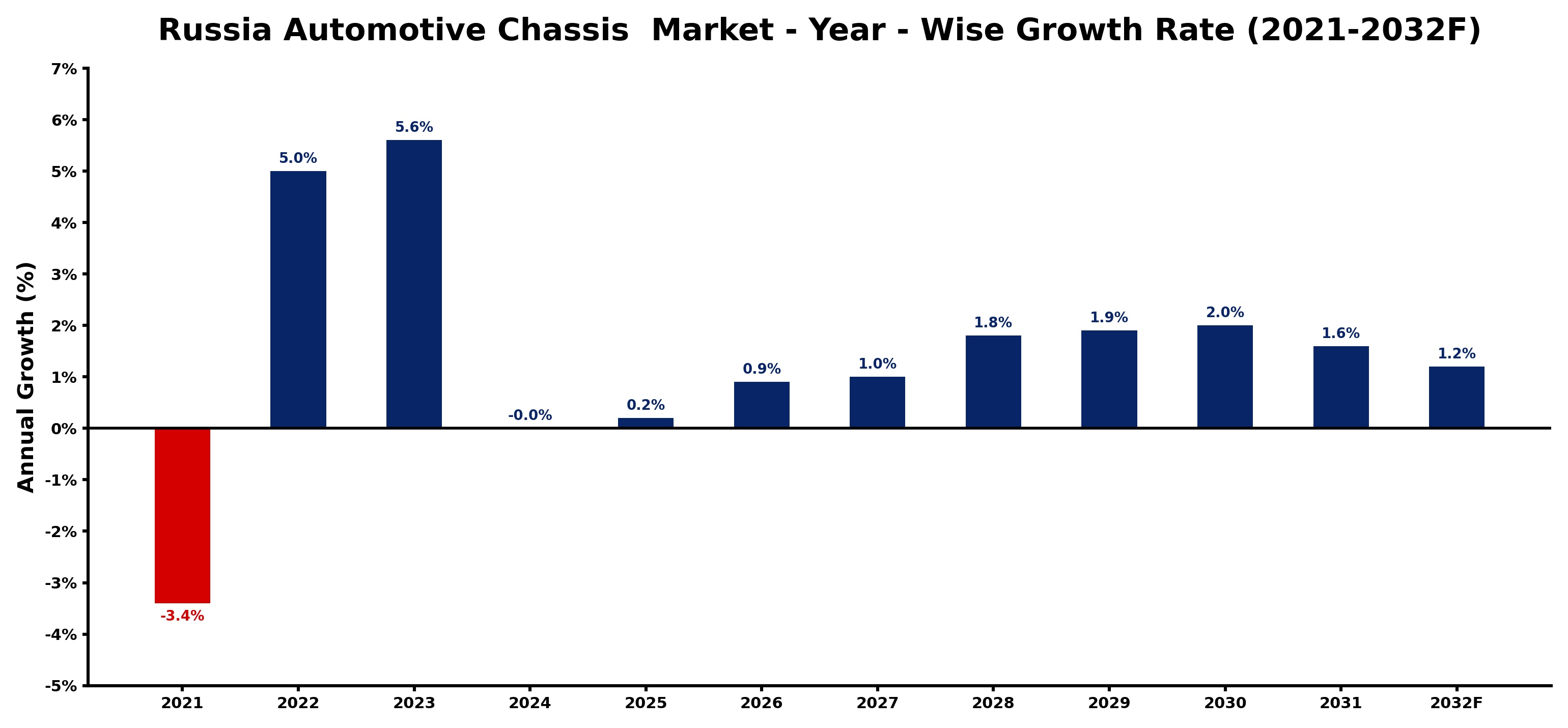
The table below presents the year‑wise growth rates along with the key drivers influencing the market
| Year | Growth Rate | Major Drivers |
| 2021 | -3.4% | Supply chain disruptions hindered production |
| 2022 | 5.0% | Electric vehicle adoption accelerated growth |
| 2023 | 5.6% | Local manufacturing capabilities expanded significantly |
| 2024 | -0.0% | Government incentives supported industry recovery |
| 2025 | 0.2% | Technological advancements enhanced efficiency |
| 2026 | 0.9% | Export opportunities increased market reach |
| 2027 | 1.0% | Sustainability initiatives drove consumer interest |
| 2028 | 1.8% | Partnerships with tech firms flourished |
| 2029 | 1.9% | Investment in R&D fostered innovation |
| 2030 | 2.0% | Industrial activity supported growth |
| 2031 | 1.6% | Aftermarket services gained market traction |
| 2032 | 1.2% | Digital transformation improved operational efficiency |
Note - Market size estimations and growth projections presented in this report are based on 6Wresearch’s advanced forecasting approach, validated with industry datasets as of June 2026.
Russia Automotive Chassis Market Synopsis
The prevailing force shaping the Russia Automotive Chassis Market is the increasing emphasis on vehicle safety and performance. Domestic manufacturers are responding to government regulations and consumer preferences by investing in advanced chassis technologies that promote safety and efficiency. This focus is accelerating innovation and facilitating the transition to modernized automotive structures.
In parallel, the market is witnessing a noticeable pivot towards electric vehicles (EVs). This transition necessitates innovative chassis designs that accommodate unique EV specifications, thereby stimulating demand for specialized chassis components and systems. The combination of these factors is laying a robust foundation for the sustained growth of the market.
Russia Automotive Chassis Market Key Takeaways
- Market growth is driven by a surge in vehicle production and heightened safety regulations.
- Lightweight materials and advanced technologies are becoming essential for improved fuel efficiency.
- The shift towards electric vehicles is necessitating innovations in chassis design.
- Strategic government policies are fostering local production and competitiveness.
- Investment opportunities are expanding due to rising demands in both passenger and commercial vehicle segments.
Evaluation of Restraints in Russia Automotive Chassis Market
The Russia Automotive Chassis Market is grappling with various restraints that are impacting its overall growth potential. Economic instability and geopolitical tensions create an unpredictable environment for both consumers and manufacturers, often resulting in hesitance around spending and investment. Furthermore, fluctuating oil prices can disrupt manufacturing costs and influence the pricing strategies of automotive chassis components. Additionally, the complexity of regulatory compliance adds another layer of challenge, necessitating ongoing adaptations from manufacturers to meet changing standards.
Russia Automotive Chassis Market Trends
A growing trend within the Russia Automotive Chassis Market is the demand for lightweight chassis components, which are integral to improving fuel efficiency and reducing carbon emissions. Automakers are increasingly adopting advanced materials, such as composites and high-strength steels, to enhance performance. The integration of smart chassis systems, offering connectivity and automation features, is also gaining traction, reflecting consumer preferences for modern and technologically advanced vehicles.
In addition, the shift towards electric mobility is pushing manufacturers to explore innovative chassis designs tailored to EV requirements, promoting flexibility and sustainability in production. This transformation is not just a response to market demand; it's a proactive step towards aligning with global automotive trends focused on environmental responsibility.
Russia Automotive Chassis Market Opportunities
The Russia Automotive Chassis Market presents several lucrative investment opportunities for stakeholders. Companies specializing in advanced chassis technologies, particularly those focusing on lightweight materials and integrated electronic systems, are poised for significant growth. Additionally, as the market continues to evolve towards electric vehicles, there is a burgeoning need for firms that manufacture EV chassis components. Establishing partnerships with local manufacturers can also provide strategic benefits, offering pathways for long-term market entry and collaboration.
Government Initiatives in the Russia Automotive Chassis Market
The Russian government is actively implementing policies to bolster the automotive chassis market. Initiatives include offering tax incentives and subsidies to support domestic manufacturers, which aim to stimulate local production and reduce import dependency. Additionally, the government is promoting research and development within the sector, focusing on advancing vehicle safety standards and improving manufacturing capabilities to align with international quality benchmarks.
Future Insights of the Russia Automotive Chassis Market
Looking ahead to 2026-2032, the Russia Automotive Chassis Market is positioned for steady expansion. Key factors such as an increasing demand for both passenger and commercial vehicles, alongside ongoing technological innovations in chassis design, will continue to drive growth. As the middle-class population expands and economic conditions improve, consumer preferences will evolve, placing an even greater emphasis on fuel efficiency, safety, and advanced automotive technologies. However, stakeholders must remain vigilant in navigating potential challenges posed by fluctuating regulatory landscapes and geopolitical uncertainties.
Russia Automotive Chassis Market Latest Developments (May 2025 - June 2026)
Recent developments within the Russia Automotive Chassis Market indicate a marked shift towards the integration of advanced materials and smart technology in chassis design. As manufacturers respond to changing consumer expectations and safety standards, there is an increasing focus on R&D efforts aimed at optimizing chassis performance. Furthermore, collaborative initiatives between government and industry players are underway to accelerate advancements in local manufacturing capabilities and promote innovation in chassis systems.
Russia Automotive Chassis Market - Key Attractiveness of the Report
- 10 Years of Market Numbers
- Historical Data Starting from 2022 to 2025
- Base Year: 2025
- Forecast Data until 2032
- Key Performance Indicators Impacting the Market
- Major Upcoming Developments and Projects
Key Highlights of the Report:
- Russia Automotive Chassis Market Outlook
- Market Size of Russia Automotive Chassis Market, 2025
- Forecast of Russia Automotive Chassis Market, 2032
- Historical Data and Forecast of Russia Automotive Chassis Revenues & Volume for the Period 2022-2032F
- Russia Automotive Chassis Market Trend Evolution
- Russia Automotive Chassis Market Drivers and Challenges
- Russia Automotive Chassis Price Trends
- Russia Automotive Chassis Porter's Five Forces
- Russia Automotive Chassis Industry Life Cycle
- Historical Data and Forecast of Russia Automotive Chassis Market Revenues & Volume By ChassisType for the Period 2022-2032F
- Historical Data and Forecast of Russia Automotive Chassis Market Revenues & Volume By Backbone for the Period 2022-2032F
- Historical Data and Forecast of Russia Automotive Chassis Market Revenues & Volume By Ladder for the Period 2022-2032F
- Historical Data and Forecast of Russia Automotive Chassis Market Revenues & Volume By Monocoque for the Period 2022-2032F
- Historical Data and Forecast of Russia Automotive Chassis Market Revenues & Volume By Modular for the Period 2022-2032F
- Historical Data and Forecast of Russia Automotive Chassis Market Revenues & Volume By Material for the Period 2022-2032F
- Historical Data and Forecast of Russia Automotive Chassis Market Revenues & Volume By Steel for the Period 2022-2032F
- Historical Data and Forecast of Russia Automotive Chassis Market Revenues & Volume By Aluminum Alloy for the Period 2022-2032F
- Historical Data and Forecast of Russia Automotive Chassis Market Revenues & Volume By Carbon Fiber Composite for the Period 2022-2032F
- Historical Data and Forecast of Russia Automotive Chassis Market Revenues & Volume By Electric Vehicle for the Period 2022-2032F
- Historical Data and Forecast of Russia Automotive Chassis Market Revenues & Volume By BEV for the Period 2022-2032F
- Historical Data and Forecast of Russia Automotive Chassis Market Revenues & Volume By PHEV for the Period 2022-2032F
- Historical Data and Forecast of Russia Automotive Chassis Market Revenues & Volume By HEV for the Period 2022-2032F
- Historical Data and Forecast of Russia Automotive Chassis Market Revenues & Volume By Vehicle Type for the Period 2022-2032F
- Historical Data and Forecast of Russia Automotive Chassis Market Revenues & Volume By PC for the Period 2022-2032F
- Historical Data and Forecast of Russia Automotive Chassis Market Revenues & Volume By CV for the Period 2022-2032F
- Russia Automotive Chassis Import Export Trade Statistics
- Market Opportunity Assessment By ChassisType
- Market Opportunity Assessment By Material
- Market Opportunity Assessment By Electric Vehicle
- Market Opportunity Assessment By Vehicle Type
- Russia Automotive Chassis Top Companies Market Share
- Russia Automotive Chassis Competitive Benchmarking By Technical and Operational Parameters
- Russia Automotive Chassis Company Profiles
- Russia Automotive Chassis Key Strategic Recommendations






































