Russia Big Data Market Size & Growth Rate (2026-2032)
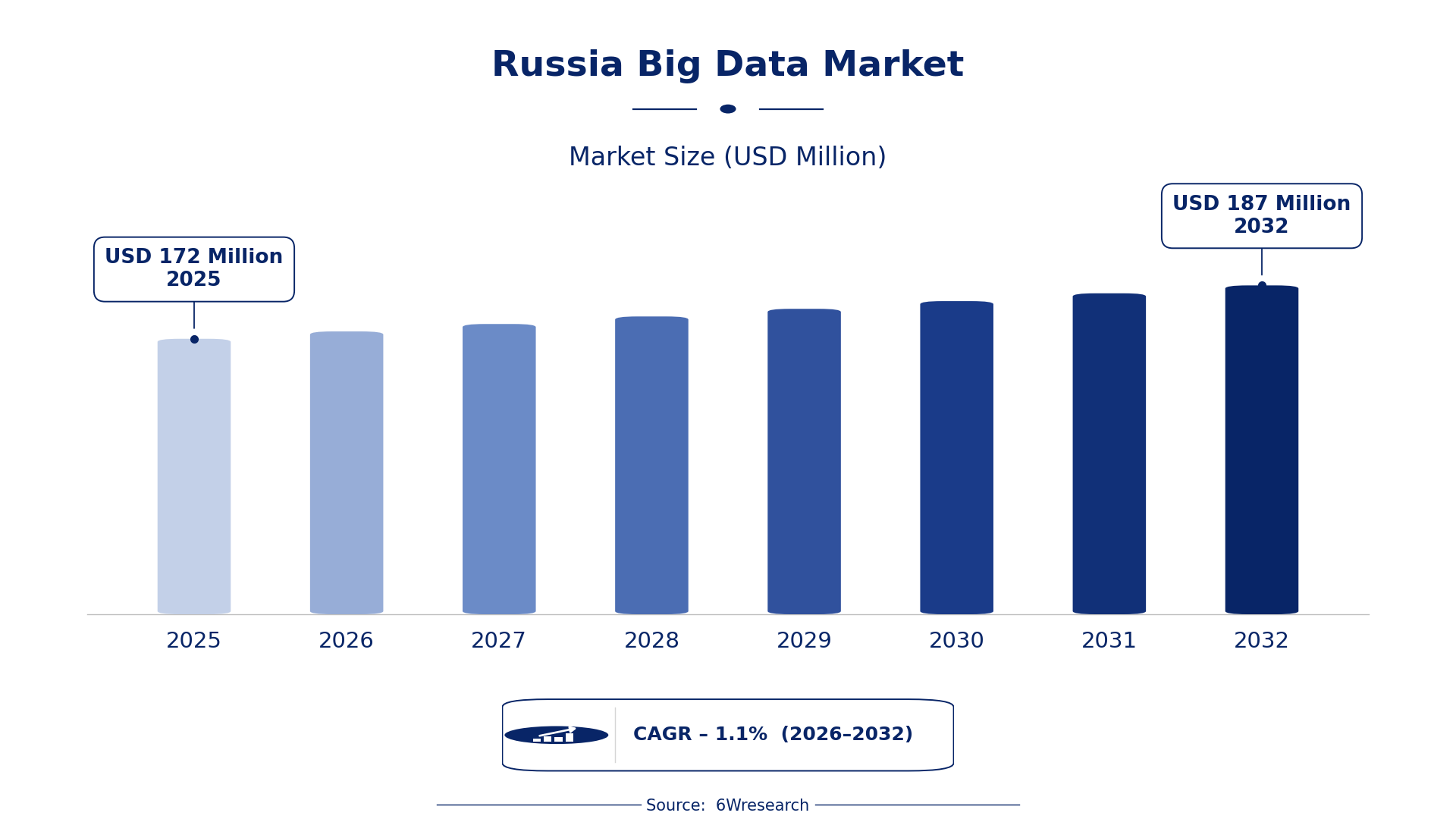
The Russia Big Data Market was estimated at USD 172 Million in 2025 and is projected to reach USD 187 Million by 2032, growing at a CAGR of 1.1% from 2026 to 2032.
Russia Big Data Market Synopsis
The demand for big data solutions in Russia is being driven by sectors such as finance and healthcare, where the need for actionable insights is critical. As organizations grapple with vast amounts of data, the push for advanced analytics and machine learning technologies is becoming increasingly pronounced.
With businesses seeking to enhance their operational efficiency and customer experiences, the adoption of big data analytics is rapidly growing. Companies are investing in data management tools that enable real-time analysis and informed decision-making, reflecting the high stakes involved in data-driven strategies.
Russia Big Data Market Year-wise Growth Rate and Key Drivers
This graph illustrates the annual growth rates of the Russia Big Data Market from 2021 to 2032, highlighting a steady upward trajectory and projected expansion over the forecast period.
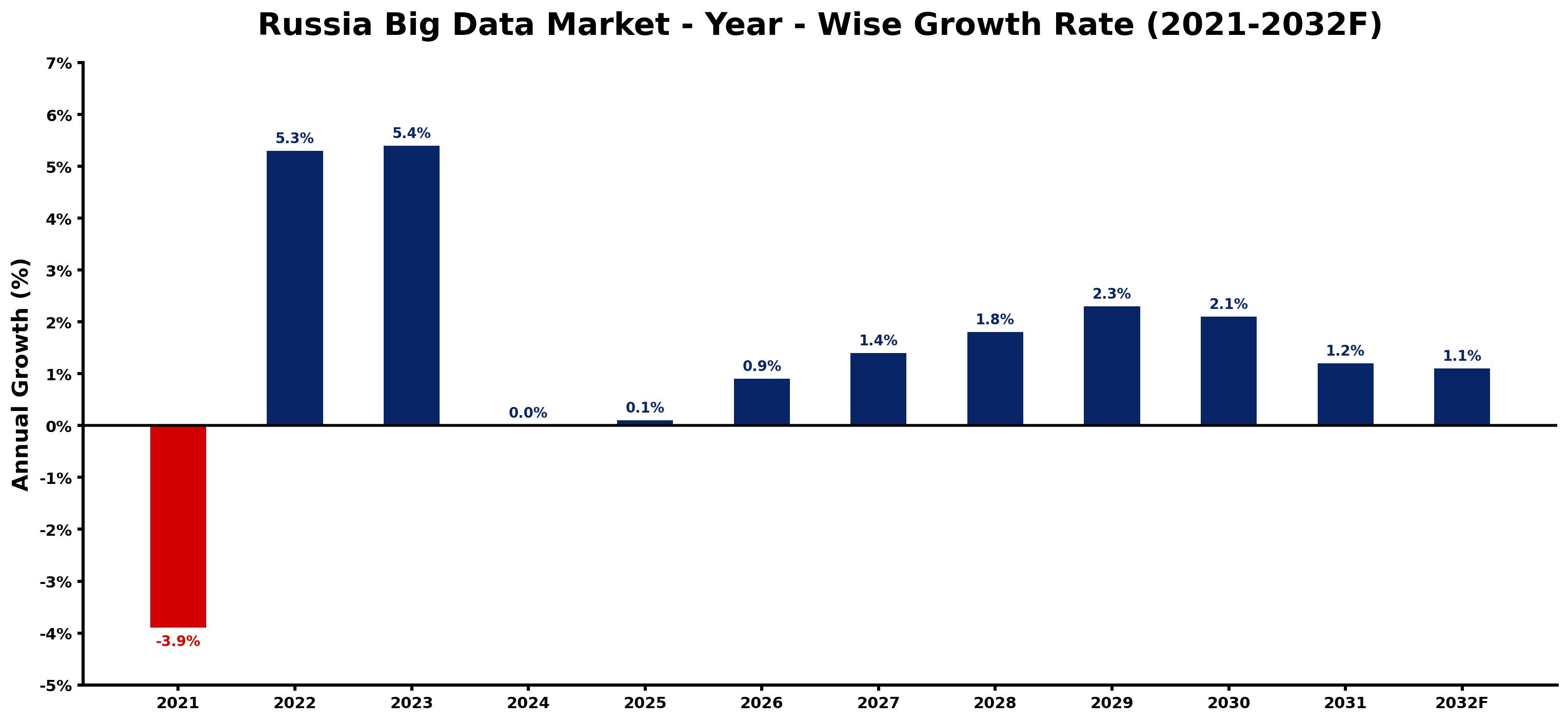
The table below presents the year‑wise growth rates along with the key drivers influencing the market
| Year | Growth Rate | Major Drivers |
| 2021 | -3.9% | Decreased government funding for digital innovation initiatives. |
| 2022 | 5.3% | Increased digital transformation initiatives by the government |
| 2023 | 5.4% | Adoption of data analytics in fintech sectors rising |
| 2024 | 0.0% | Increasing industrial infrastructure investments |
| 2025 | 0.1% | Growth in demand for predictive analytics solutions |
| 2026 | 0.9% | Emerging AI regulations stimulating big data usage |
| 2027 | 1.4% | Local enterprises enhancing data-driven decision making |
| 2028 | 1.8% | Increased investments in cybersecurity supporting data utilization |
| 2029 | 2.3% | Government backing data-driven public services initiatives |
| 2030 | 2.1% | Rising interest in personalized marketing strategies |
| 2031 | 1.2% | Strengthening data protection laws encouraging compliance technologies |
| 2032 | 1.1% | Growing focus on big data in health sector innovation |
Note: Market size estimations and growth projections presented in this report are based on 6Wresearch's proprietary forecasting methodology, utilizing the latest available industry data, government publications, and primary research inputs.
Russia Big Data Market Key Takeaways
Below are some of the specific key takeaways from the market, including:
- Advanced analytics adoption is rising across multiple sectors, notably finance and healthcare.
- Integration of big data with IoT is becoming a common trend, enhancing data collection and analysis capabilities.
- Real-time data analytics is increasingly essential for businesses aiming to stay competitive.
- Data security and privacy regulations are evolving, impacting how organizations manage data.
- Cloud-based big data platforms are gaining traction, facilitating scalability and flexibility for businesses.
Evaluation of Restraints in Russia Big Data Market
Despite the potential for growth, the Russia Big Data market faces considerable challenges. Chief among them is the stringent regulatory environment surrounding data privacy, which necessitates compliance with complex laws that can hinder operational flexibility. Additionally, the market suffers from a shortage of skilled professionals proficient in big data technologies, limiting the ability of organizations to fully exploit data-driven opportunities.
Infrastructure limitations pose another significant barrier, as many companies struggle to integrate legacy systems with modern big data solutions. These challenges, combined with geopolitical uncertainties, create a complicated backdrop for businesses looking to invest in this sector.
Russia Big Data Market Trends
Several trends are shaping the Russia Big Data market, with a notable emphasis on real-time data analytics and the integration of artificial intelligence. Organizations are increasingly recognizing the value of leveraging big data for predictive analytics, enabling them to anticipate customer needs and enhance service delivery.
Another emerging trend is the focus on data security, as companies invest heavily in compliance with privacy regulations and cybersecurity measures. The shift towards cloud-based big data solutions is also notable, as businesses seek to streamline operations while maintaining scalability and cost-effectiveness.
Russia Big Data Market Opportunities
Investment opportunities abound in the Russia Big Data market, particularly in sectors like finance, healthcare, and retail. The increasing digitization of processes and the sheer volume of data generated present lucrative prospects for companies specializing in data analytics and management tools.
Collaborations with local startups and participation in research and development initiatives can also open doors for international players. on top of that, infrastructure development to support big data technologies represents a vital area for investment, laying the groundwork for future advancements.
Government Initiatives in the Russia Big Data Market
Government policy in Russia plays a crucial role in shaping the Big Data market. With a focus on digital transformation and enhancing cybersecurity measures, initiatives are being rolled out to foster a supportive environment for big data innovation. The regulatory framework has been evolving, particularly concerning data localization and protection, which impacts how businesses operate in this domain.
- A data localization law implemented in 2015 mandates that personal data of Russian citizens must be stored domestically.
- The ongoing National Technological Initiative aims to bolster the domestic Big Data industry by advancing key technologies.
- Recent policies have been introduced to enhance cybersecurity measures, addressing the growing concerns around data breaches.
- A planned initiative set to launch in 2026 focuses on upgrading national digital infrastructure to support big data applications across various sectors.
Future Insights of the Russia Big Data Market
Looking ahead to 2026-2032, the Russia Big Data market is expected to experience notable growth driven by increasing data volumes and a heightened demand for sophisticated analytics solutions. The government's commitment to digital transformation, along with advancements in technology infrastructure, will likely create a more conducive environment for big data applications.
As organizations continue to embrace data-driven decision-making, the potential for big data analytics to unlock new opportunities and enhance operational efficiency will become increasingly significant. The interplay of IoT, AI, and cloud technologies will further catalyze this growth trajectory.
Russia Big Data Market Latest Developments
Recent developments in the Russia Big Data market indicate a strong push towards innovation and infrastructure enhancement. The last 12-14 months have seen companies focusing on expanding their capabilities in data analytics and cybersecurity, reflecting the growing importance of data in strategic decision-making.
- A major technology vendor launched a new data analytics platform in early 2025, designed to streamline data processing and enhance user experience.
- Currently ongoing, a national initiative is underway to improve cybersecurity protocols in the financial sector, ensuring data protection against emerging threats.
- An upcoming collaboration between government agencies and private firms is expected to focus on developing AI-driven big data solutions, slated for rollout in 2026.
- A regional operator expanded its data warehousing capabilities in Q3 2025, enhancing its service offerings to local businesses.
Russia Big Data Market - Key Attractiveness of the Report
- 10 Years of Market Numbers
- Historical Data Starting from 2022 to 2025
- Base Year: 2025
- Forecast Data until 2032
- Key Performance Indicators Impacting the Market
- Major Upcoming Developments and Projects
Key Highlights of the Report:
- Russia Big Data Market Outlook
- Market Size of Russia Big Data Market, 2025
- Forecast of Russia Big Data Market, 2032
- Historical Data and Forecast of Russia Big Data Revenues & Volume for the Period 2022-2032F
- Russia Big Data Market Trend Evolution
- Russia Big Data Market Drivers and Challenges
- Russia Big Data Price Trends
- Russia Big Data Porter's Five Forces
- Russia Big Data Industry Life Cycle
- Historical Data and Forecast of Russia Big Data Market Revenues & Volume By Business Function for the Period 2022-2032F
- Historical Data and Forecast of Russia Big Data Market Revenues & Volume By Finance for the Period 2022-2032F
- Historical Data and Forecast of Russia Big Data Market Revenues & Volume By Marketing and Sales for the Period 2022-2032F
- Historical Data and Forecast of Russia Big Data Market Revenues & Volume By Human Resources for the Period 2022-2032F
- Historical Data and Forecast of Russia Big Data Market Revenues & Volume By Operations for the Period 2022-2032F
- Historical Data and Forecast of Russia Big Data Market Revenues & Volume By Industry Vertical for the Period 2022-2032F
- Historical Data and Forecast of Russia Big Data Market Revenues & Volume By BFSI for the Period 2022-2032F
- Historical Data and Forecast of Russia Big Data Market Revenues & Volume By Government and Defense for the Period 2022-2032F
- Historical Data and Forecast of Russia Big Data Market Revenues & Volume By Healthcare and Life Sciences for the Period 2022-2032F
- Historical Data and Forecast of Russia Big Data Market Revenues & Volume By Manufacturing for the Period 2022-2032F
- Historical Data and Forecast of Russia Big Data Market Revenues & Volume By Retail and Consumer Goods for the Period 2022-2032F
- Historical Data and Forecast of Russia Big Data Market Revenues & Volume By Media and Entertainment for the Period 2022-2032F
- Historical Data and Forecast of Russia Big Data Market Revenues & Volume By Telecommunications and IT for the Period 2022-2032F
- Historical Data and Forecast of Russia Big Data Market Revenues & Volume By Transportation and Logistics for the Period 2022-2032F
- Historical Data and Forecast of Russia Big Data Market Revenues & Volume By Component for the Period 2022-2032F
- Historical Data and Forecast of Russia Big Data Market Revenues & Volume By Solutions for the Period 2022-2032F
- Historical Data and Forecast of Russia Big Data Market Revenues & Volume By Big Data Analytics for the Period 2022-2032F
- Historical Data and Forecast of Russia Big Data Market Revenues & Volume By Data Discovery for the Period 2022-2032F
- Historical Data and Forecast of Russia Big Data Market Revenues & Volume By Data Visualization for the Period 2022-2032F
- Historical Data and Forecast of Russia Big Data Market Revenues & Volume By Data Management for the Period 2022-2032F
- Historical Data and Forecast of Russia Big Data Market Revenues & Volume By Services for the Period 2022-2032F
- Historical Data and Forecast of Russia Big Data Market Revenues & Volume By Deployment Mode for the Period 2022-2032F
- Historical Data and Forecast of Russia Big Data Market Revenues & Volume By Cloud for the Period 2022-2032F
- Historical Data and Forecast of Russia Big Data Market Revenues & Volume By Public Cloud for the Period 2022-2032F
- Historical Data and Forecast of Russia Big Data Market Revenues & Volume By Private Cloud for the Period 2022-2032F
- Historical Data and Forecast of Russia Big Data Market Revenues & Volume By Hybrid Cloud for the Period 2022-2032F
- Historical Data and Forecast of Russia Big Data Market Revenues & Volume By On-premises for the Period 2022-2032F
- Historical Data and Forecast of Russia Big Data Market Revenues & Volume By Organization Size for the Period 2022-2032F
- Historical Data and Forecast of Russia Big Data Market Revenues & Volume By Small and Medium-Sized Enterprises for the Period 2022-2032F
- Historical Data and Forecast of Russia Big Data Market Revenues & Volume By Large Enterprises for the Period 2022-2032F
- Russia Big Data Import Export Trade Statistics
- Market Opportunity Assessment By Business Function
- Market Opportunity Assessment By Industry Vertical
- Market Opportunity Assessment By Component
- Market Opportunity Assessment By Deployment Mode
- Market Opportunity Assessment By Organization Size
- Russia Big Data Top Companies Market Share
- Russia Big Data Competitive Benchmarking By Technical and Operational Parameters
- Russia Big Data Company Profiles
- Russia Big Data Key Strategic Recommendations






































