Russia Business Intelligence Market Size & Growth Rate (2026-2032)
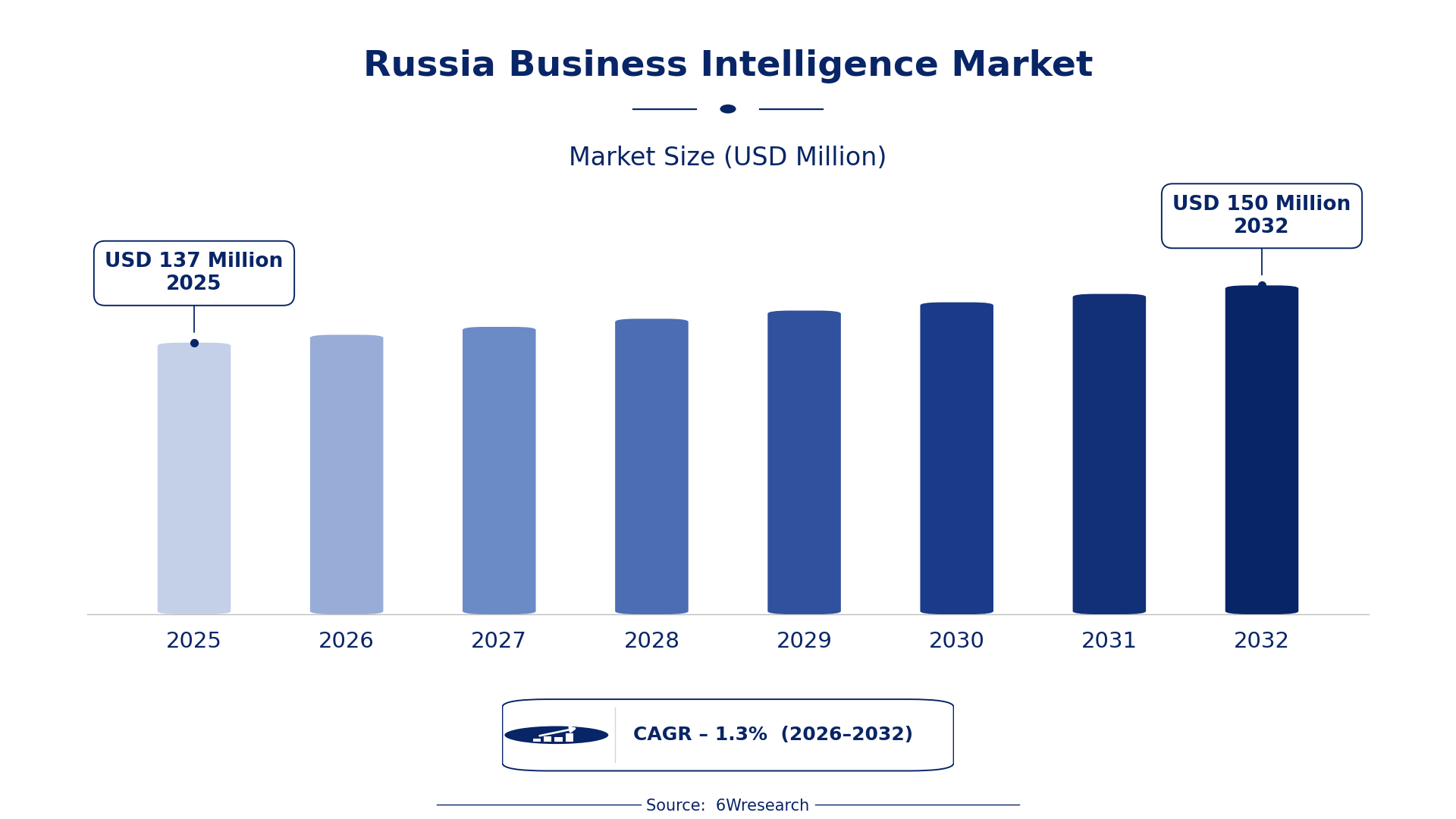
The Russia Business Intelligence Market was estimated at USD 137 Million in 2025 and is projected to reach USD 150 Million by 2032, growing at a CAGR of 1.3% from 2026 to 2032.
Russia Business Intelligence Market Synopsis
The demand for data-driven decision-making tools is the strongest force currently shaping the Russia Business Intelligence Market. As organizations in sectors like finance, healthcare, and retail increasingly rely on data analytics, the need for robust BI solutions has intensified.
This trend is further bolstered by the government's emphasis on digital transformation, which encourages businesses to adopt advanced technologies. As a result, the market is witnessing a surge in cloud-based BI solutions that enable real-time access to analytics and insights.
Russia Business Intelligence Market Year-wise Growth Rate and Key Drivers
This graph illustrates the annual growth rates of the Russia Business Intelligence Market from 2021 to 2032, highlighting a steady upward trajectory and projected expansion over the forecast period.
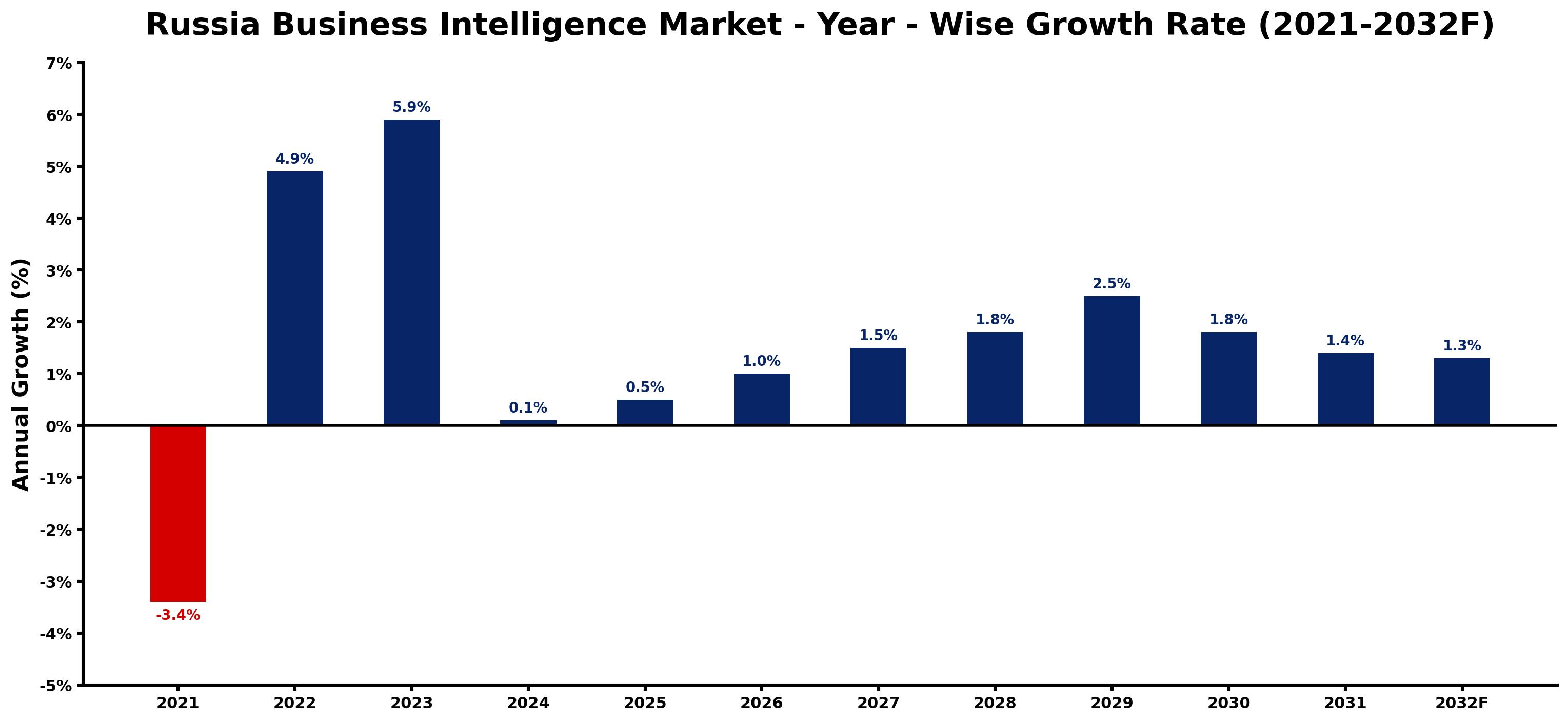
The table below presents the year‑wise growth rates along with the key drivers influencing the market
| Year | Growth Rate | Major Drivers |
| 2021 | -3.4% | Sanctions impacting software license acquisitions and renewals |
| 2022 | 4.9% | Increased adoption of Russian data protection laws enhancing BI usage. |
| 2023 | 5.9% | Rising digital literacy among businesses spurring BI investments. |
| 2024 | 0.1% | Post-pandemic recovery leading to higher data analytics needs. |
| 2025 | 0.5% | Local enterprises seeking to optimize operations through data. |
| 2026 | 1.0% | Focus on supply chain resilience driving intelligence tool adoption. |
| 2027 | 1.5% | Emerging local startups enhancing competition in BI space. |
| 2028 | 1.8% | Increased investment in tech infrastructure supporting BI platforms. |
| 2029 | 2.5% | Growing emphasis on customer experience analytics in industries. |
| 2030 | 1.8% | Regulatory changes fostering innovation in data usage strategies. |
| 2031 | 1.4% | Collaboration between tech firms and industries enhancing BI tools. |
| 2032 | 1.3% | Demand for real-time analytics growing among financial institutions. |
Note: Market size estimations and growth projections presented in this report are based on 6Wresearch's proprietary forecasting methodology, utilizing the latest available industry data, government publications, and primary research inputs.
Russia Business Intelligence Market Key Takeaways
Below are some of the specific key takeaways from the market, including:
- The growing emphasis on machine learning and advanced analytics is redefining how organizations utilize data.
- Cloud-based BI solutions are becoming increasingly popular, allowing for enhanced collaboration and data access.
- Investment in data security measures is critical as companies focus on compliance with privacy regulations.
- Both domestic and international vendors are eyeing opportunities for expansion within the Russian market.
- Government policies are shaping the business intelligence landscape, affecting data storage and usage practices.
Evaluation of Restraints in Russia Business Intelligence Market
Despite its growth potential, the Russia Business Intelligence Market faces several restraints. Navigating a complex political and regulatory environment creates uncertainty for businesses. Economic sanctions and fluctuations in the economy can impact investment decisions and market strategies. Additionally, concerns around data privacy and security make it essential for companies to invest in compliance and protective measures. Language barriers and cultural nuances further complicate the effective gathering and interpretation of business intelligence data.
Russia Business Intelligence Market Trends
A significant trend in the Russia Business Intelligence Market is the increasing adoption of advanced analytics and machine learning technologies. Businesses are looking for deeper insights to make informed decisions quickly, pushing demand for sophisticated BI tools. Real-time data analytics is gaining traction, enabling organizations to respond to market changes promptly. Additionally, a heightened focus on data security and compliance is reshaping how companies approach their data strategies.
Russia Business Intelligence Market Opportunities
The market offers substantial investment opportunities, particularly in advanced BI solutions tailored to local needs. As companies seek to enhance their analytics capabilities, investing in consulting services that help optimize BI tool implementation is also a smart move. With evolving regulations, there is a growing need for BI solutions that comply with local data privacy laws, presenting another avenue for investment. The shift towards data-driven decision-making across industries makes this market ripe for innovation and growth.
Government Initiatives in the Russia Business Intelligence Market
Government policy plays a crucial role in shaping the Russia Business Intelligence Market. With a focus on digital transformation and data localization laws, the regulatory environment is both a challenge and an opportunity for companies. The government's support for advanced technologies aligns with its broader economic goals, making it essential for businesses to stay informed about policy changes.
- A data localization law, enacted in 2025, requires that personal data of Russian citizens be stored within the country.
- Currently underway is a national initiative aimed at improving IT infrastructure to support digital businesses across various sectors.
- Upcoming regulations are expected to be introduced in 2026, mandating stricter compliance measures for data encryption technologies.
- The government is working on a public-private partnership initiative to enhance data privacy standards by 2027.
- In 2025, a regulatory framework was established to promote transparency in data usage across industries.
Future Insights of the Russia Business Intelligence Market
Looking ahead to 2026-2032, the Russia Business Intelligence Market is set to experience notable growth. The rising demand for data analytics in various sectors will drive the adoption of advanced BI solutions. Organizations will increasingly recognize the value of real-time insights, which will become a competitive necessity. With ongoing digital transformation efforts and heightened investments in IT infrastructure, the market is on track for continued expansion. These trends, coupled with government support for technological innovation, will shape the future of business intelligence in Russia.
Russia Business Intelligence Market Latest Developments
In the past year, the Russia Business Intelligence Market has seen a surge in activity as organizations adapt to new data strategies. Companies are increasingly focusing on integrating advanced analytics into their operations, reflecting a broader shift towards data-centric decision-making.
- A major technology vendor announced the rollout of a new analytics platform in early 2025, enhancing data visualization capabilities for users.
- In mid-2025, a leading regional operator launched an initiative to expand cloud-based BI services, which is currently underway.
- A planned partnership between domestic analytics firms and international technology providers is expected to kick off in late 2026, aimed at improving data security measures.
- By Q3 2025, a prominent company is set to introduce a suite of AI-driven BI tools designed specifically for the Russian market.
- An initiative to create a centralized data repository for healthcare analytics was completed in early 2025, allowing for improved data sharing across the sector.
Russia Business Intelligence Market - Key Attractiveness of the Report
- 10 Years of Market Numbers
- Historical Data Starting from 2022 to 2025
- Base Year: 2025
- Forecast Data until 2032
- Key Performance Indicators Impacting the Market
- Major Upcoming Developments and Projects
Key Highlights of the Report:
- Russia Business Intelligence Market Outlook
- Market Size of Russia Business Intelligence Market, 2025
- Forecast of Russia Business Intelligence Market, 2032
- Historical Data and Forecast of Russia Business Intelligence Revenues & Volume for the Period 2022-2032F
- Russia Business Intelligence Market Trend Evolution
- Russia Business Intelligence Market Drivers and Challenges
- Russia Business Intelligence Price Trends
- Russia Business Intelligence Porter's Five Forces
- Russia Business Intelligence Industry Life Cycle
- Historical Data and Forecast of Russia Business Intelligence Market Revenues & Volume By Component for the Period 2022-2032F
- Historical Data and Forecast of Russia Business Intelligence Market Revenues & Volume By Solutions for the Period 2022-2032F
- Historical Data and Forecast of Russia Business Intelligence Market Revenues & Volume By Services for the Period 2022-2032F
- Historical Data and Forecast of Russia Business Intelligence Market Revenues & Volume By Business Function for the Period 2022-2032F
- Historical Data and Forecast of Russia Business Intelligence Market Revenues & Volume By Human Resource for the Period 2022-2032F
- Historical Data and Forecast of Russia Business Intelligence Market Revenues & Volume By Finance for the Period 2022-2032F
- Historical Data and Forecast of Russia Business Intelligence Market Revenues & Volume By Operations for the Period 2022-2032F
- Historical Data and Forecast of Russia Business Intelligence Market Revenues & Volume By Sales and Marketing for the Period 2022-2032F
- Historical Data and Forecast of Russia Business Intelligence Market Revenues & Volume By Deployment Mode for the Period 2022-2032F
- Historical Data and Forecast of Russia Business Intelligence Market Revenues & Volume By On-premises for the Period 2022-2032F
- Historical Data and Forecast of Russia Business Intelligence Market Revenues & Volume By Cloud for the Period 2022-2032F
- Historical Data and Forecast of Russia Business Intelligence Market Revenues & Volume By Organization Size for the Period 2022-2032F
- Historical Data and Forecast of Russia Business Intelligence Market Revenues & Volume By SMEs for the Period 2022-2032F
- Historical Data and Forecast of Russia Business Intelligence Market Revenues & Volume By Large Enterprises for the Period 2022-2032F
- Historical Data and Forecast of Russia Business Intelligence Market Revenues & Volume By Vertical for the Period 2022-2032F
- Historical Data and Forecast of Russia Business Intelligence Market Revenues & Volume By Retail for the Period 2022-2032F
- Historical Data and Forecast of Russia Business Intelligence Market Revenues & Volume By Manufacturing for the Period 2022-2032F
- Historical Data and Forecast of Russia Business Intelligence Market Revenues & Volume By Government and Public Services for the Period 2022-2032F
- Historical Data and Forecast of Russia Business Intelligence Market Revenues & Volume By Media and Entertainment for the Period 2022-2032F
- Historical Data and Forecast of Russia Business Intelligence Market Revenues & Volume By Transportation and Logistics for the Period 2022-2032F
- Historical Data and Forecast of Russia Business Intelligence Market Revenues & Volume By BFSI for the Period 2022-2032F
- Historical Data and Forecast of Russia Business Intelligence Market Revenues & Volume By Telecom and IT for the Period 2022-2032F
- Historical Data and Forecast of Russia Business Intelligence Market Revenues & Volume By Healthcare and Life Sciences for the Period 2022-2032F
- Russia Business Intelligence Import Export Trade Statistics
- Market Opportunity Assessment By Component
- Market Opportunity Assessment By Business Function
- Market Opportunity Assessment By Deployment Mode
- Market Opportunity Assessment By Organization Size
- Market Opportunity Assessment By Vertical
- Russia Business Intelligence Top Companies Market Share
- Russia Business Intelligence Competitive Benchmarking By Technical and Operational Parameters
- Russia Business Intelligence Company Profiles
- Russia Business Intelligence Key Strategic Recommendations






































