Russia Canned Fruits Market Summary
The russia canned fruits market was estimated at USD 239 Million in 2025 and is projected to reach USD 261 Million by 2032, growing at a CAGR of 0.9% from 2026 to 2032.
Russia Canned Fruits Market Year-wise Growth Rate and Key Drivers
This graph highlights how the Russia Canned Fruits Market has steadily grown over the past five years, supported by major growth factors.
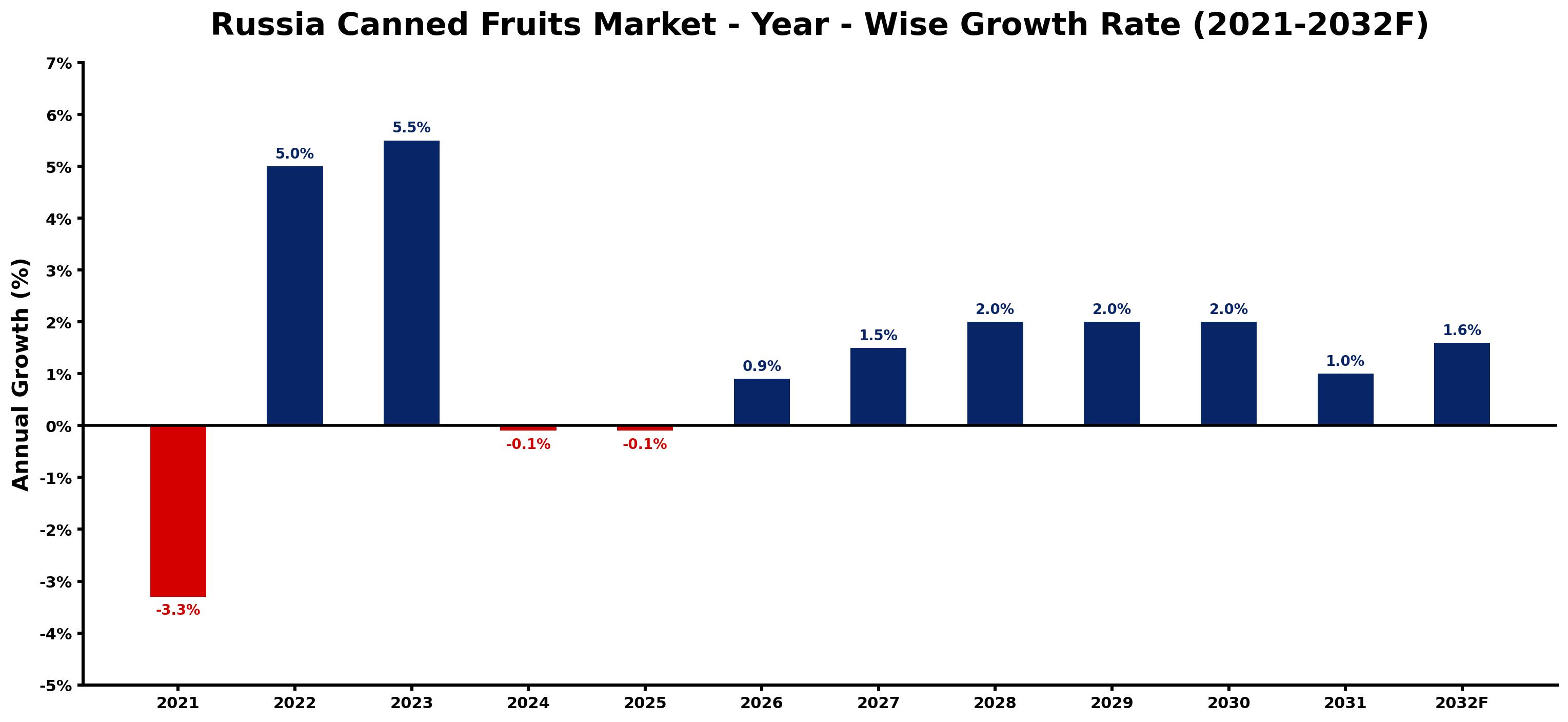
The table below presents the year wise growth rates along with the key drivers influencing the market
| Year | Growth Rate | Major Drivers |
| 2021 | -3.3% | Severe logistics disruptions stemming from geopolitical tensions hampered supply chains and limited product availability. |
| 2022 | 5.0% | Consumer preferences shifted towards convenience, highlighting canned fruits' ready-to-eat appeal. |
| 2023 | 5.5% | Sustainability trends influenced packaging innovations, enhancing product attractiveness for eco-conscious buyers. |
| 2024 | -0.1% | Geopolitical tensions and economic sanctions diminished import availability, stifling market expansion in canned fruits. |
| 2025 | -0.1% | Geopolitical tensions resulted in trade restrictions, significantly disrupting supply chains and limiting product availability. |
| 2026 | 0.9% | Emerging culinary trends prompted interest in gourmet canned fruit varieties and exotic flavors. |
| 2027 | 1.5% | Local sourcing initiatives encouraged sustainable practices in the canned fruits production sector. |
| 2028 | 2.0% | Retailers expanded private label offerings, providing affordable options to price-sensitive consumers. |
| 2029 | 2.0% | Cross-promotion with beverages created innovative product pairings, boosting shelf visibility. |
| 2030 | 2.0% | E-commerce gained traction, making canned fruits readily available to a broader audience. |
| 2031 | 1.0% | Health trends continued to shape the market, favoring low-sugar and organic canned options. |
| 2032 | 1.6% | Technological advancements in preservation techniques improved product quality and shelf life. |
Note - Market size estimations and growth projections presented in this report are based on 6Wresearch's advanced forecasting approach, validated with industry datasets as of June 2026.
Russia Canned Fruits Market Synopsis
The Russia Canned Fruits Market is projected to reach 0.9% and witness significant growth during the forecast period (2026-2032). This anticipated growth is driven by various factors impacting consumer behavior and industry dynamics. The increasing demand for convenience foods, aligned with rising disposable incomes in Russia, is significantly contributing to the market's expansion. Furthermore, heightened health consciousness among consumers has led to a greater preference for fruit-based products, including canned fruits, which are perceived as healthier alternatives to other snacks. The availability of diverse canned fruit options within the country is also fostering consumption, enhancing the overall market landscape.
Russia Canned Fruits Market Growth Drivers
Several critical drivers are influencing the growth trajectory of the Russia Canned Fruits Market. First, the increasing demand for convenience foods is driving consumers towards canned fruits, as they offer quick and easy meal solutions without compromising on nutritional value. Second, as disposable incomes rise, consumers are more willing to spend on higher-quality canned fruit products. Third, the shift towards healthier eating habits is prompting consumers to seek out canned fruits as a source of vitamins and minerals. Fourth, the expansive variety of canned fruit options available is encouraging more frequent purchases and wider consumer acceptance. Finally, the growth of international trade is facilitating greater import and export activities within the canned fruits sector, providing manufacturers with additional avenues for market expansion.
Russia Canned Fruits Market Trends and Opportunities
The Russia Canned Fruits Market is currently experiencing several noteworthy trends that present opportunities for growth. One such trend is the increasing consumer preference for organic and naturally sourced canned fruits, which reflects growing health awareness. Additionally, innovative packaging solutions that enhance product shelf life and convenience are gaining popularity, attracting eco-conscious consumers. The market is also witnessing a surge in demand for fruit-based snacks, often positioned as healthier alternatives to traditional snacks. The rise in e-commerce platforms is enabling consumers to access a broader range of canned fruit products conveniently. Furthermore, the increasing penetration of canned fruits into dietary plans, particularly among fitness enthusiasts and health-conscious individuals, underscores new opportunities for product development and marketing strategies.
Russia Canned Fruits Market Challenges and Restraints
Despite the positive outlook for the Russia Canned Fruits Market, several challenges and restraints could impact its growth. Fluctuations in raw material availability due to climatic changes could hinder production capabilities. Additionally, competition from fresh fruit and alternative snack products may challenge the market share of canned fruits. Consumer perceptions regarding preservatives and additives in canned products could also impede growth, as health-conscious individuals may seek out fresher alternatives. Furthermore, import regulations and tariffs may restrict the influx of international canned fruit products, affecting market dynamics. Lastly, economic instability or fluctuations in disposable income levels could lead to reduced spending on non-essential items, including canned fruits.
Russia Canned Fruits Market Government Investment and Initiatives
The Russian government has recognized the potential of the canned fruits market as part of its broader agricultural development strategy. Investments in modernizing food processing facilities and enhancing product quality standards are being prioritized. There are also initiatives aimed at promoting domestic production of canned fruits through subsidies and financial support for local manufacturers. Incentives for sustainable practices in agriculture are being instituted to boost the quality of raw materials, thereby ensuring that the canned fruits produced meet both local and international standards. Lastly, trade agreements aimed at reducing tariffs on imported raw materials are being explored to facilitate growth in the canned fruits sector, further supporting the market's development.
Russia Canned Fruits Market Latest Developments (May 2025 - June 2026)
From May 2025 to June 2026, the Russia Canned Fruits Market has witnessed several developments indicative of its evolving landscape. Companies in the sector have been increasingly focusing on sustainability practices, incorporating eco-friendly packaging solutions to appeal to environmentally conscious consumers. Additionally, there has been a notable rise in collaboration between domestic producers and international suppliers, enhancing the variety and availability of canned fruit options in the market. A surge in digital marketing initiatives has also been observed, effectively reaching a broader audience and facilitating online sales. Furthermore, consumer interest in health and wellness has prompted manufacturers to invest in product innovation, creating new lines of organic and reduced-sugar canned fruits to cater to changing preferences.
Russia Canned Fruits Market - Key Attractiveness of the Report
- 10 Years of Market Numbers
- Historical Data Starting from 2022 to 2025
- Base Year: 2025
- Forecast Data until 2032
- Key Performance Indicators Impacting the Market
- Major Upcoming Developments and Projects
Key Highlights of the Report:
- Russia Canned Fruits Market Outlook
- Market Size of Russia Canned Fruits Market, 2025
- Forecast of Russia Canned Fruits Market, 2032F
- Historical Data and Forecast of Russia Canned Fruits Revenues & Volume for the Period 2022-2032F
- Russia Canned Fruits Market Trend Evolution
- Russia Canned Fruits Market Drivers and Challenges
- Russia Canned Fruits Price Trends
- Russia Canned Fruits Porter's Five Forces
- Russia Canned Fruits Industry Life Cycle
- Historical Data and Forecast of Russia Canned Fruits Market Revenues & Volume By Fruit Type for the Period 2022-2032F
- Historical Data and Forecast of Russia Canned Fruits Market Revenues & Volume By Peaches for the Period 2022-2032F
- Historical Data and Forecast of Russia Canned Fruits Market Revenues & Volume By Pineapple for the Period 2022-2032F
- Historical Data and Forecast of Russia Canned Fruits Market Revenues & Volume By Mandarin oranges for the Period 2022-2032F
- Historical Data and Forecast of Russia Canned Fruits Market Revenues & Volume By Pears for the Period 2022-2032F
- Historical Data and Forecast of Russia Canned Fruits Market Revenues & Volume By Others for the Period 2022-2032F
- Historical Data and Forecast of Russia Canned Fruits Market Revenues & Volume By Form for the Period 2022-2032F
- Historical Data and Forecast of Russia Canned Fruits Market Revenues & Volume By Whole fruits for the Period 2022-2032F
- Historical Data and Forecast of Russia Canned Fruits Market Revenues & Volume By Cut fruits for the Period 2022-2032F
- Historical Data and Forecast of Russia Canned Fruits Market Revenues & Volume By Distribution Channel for the Period 2022-2032F
- Historical Data and Forecast of Russia Canned Fruits Market Revenues & Volume By Supermarkets/Hypermarkets for the Period 2022-2032F
- Historical Data and Forecast of Russia Canned Fruits Market Revenues & Volume By Convenience Stores for the Period 2022-2032F
- Historical Data and Forecast of Russia Canned Fruits Market Revenues & Volume By Online Retail for the Period 2022-2032F
- Historical Data and Forecast of Russia Canned Fruits Market Revenues & Volume By Other for the Period 2022-2032F
- Russia Canned Fruits Import Export Trade Statistics
- Market Opportunity Assessment By Fruit Type
- Market Opportunity Assessment By Form
- Market Opportunity Assessment By Distribution Channel
- Russia Canned Fruits Top Companies Market Share
- Russia Canned Fruits Competitive Benchmarking By Technical and Operational Parameters
- Russia Canned Fruits Company Profiles
- Russia Canned Fruits Key Strategic Recommendations






































