Russia Cloud Compliance Market Size & Growth Rate (2026-2032)
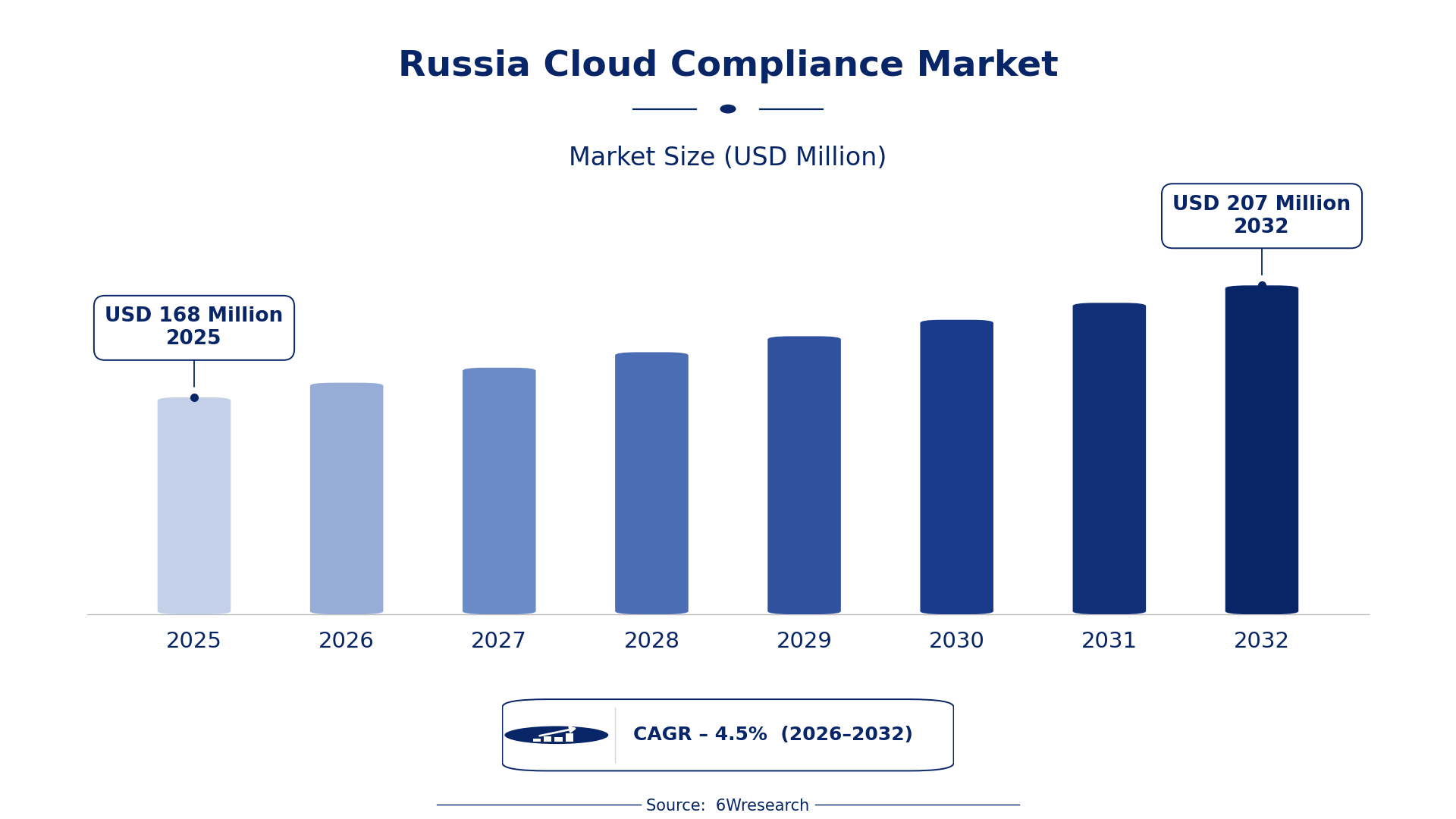
The Russia Cloud Compliance Market was estimated at USD 168 Million in 2025 and is projected to reach USD 207 Million by 2032, growing at a CAGR of 4.5% from 2026 to 2032.
Russia Cloud Compliance Market Synopsis
In recent years, the Russia Cloud Compliance Market has gained momentum, propelled by the increasing adoption of cloud solutions across various sectors. However, as organizations prioritize compliance and data security, the market is on the brink of significant transformation.
The implementation of stringent data localization laws has heightened the need for robust compliance frameworks. As businesses navigate these regulations, the demand for reliable cloud compliance solutions is expected to surge, ultimately reshaping the market's dynamics.
Russia Cloud Compliance Market Year-wise Growth Rate and Key Drivers
This graph illustrates the annual growth rates of the Russia Cloud Compliance Market from 2021 to 2032, highlighting a steady upward trajectory and projected expansion over the forecast period.
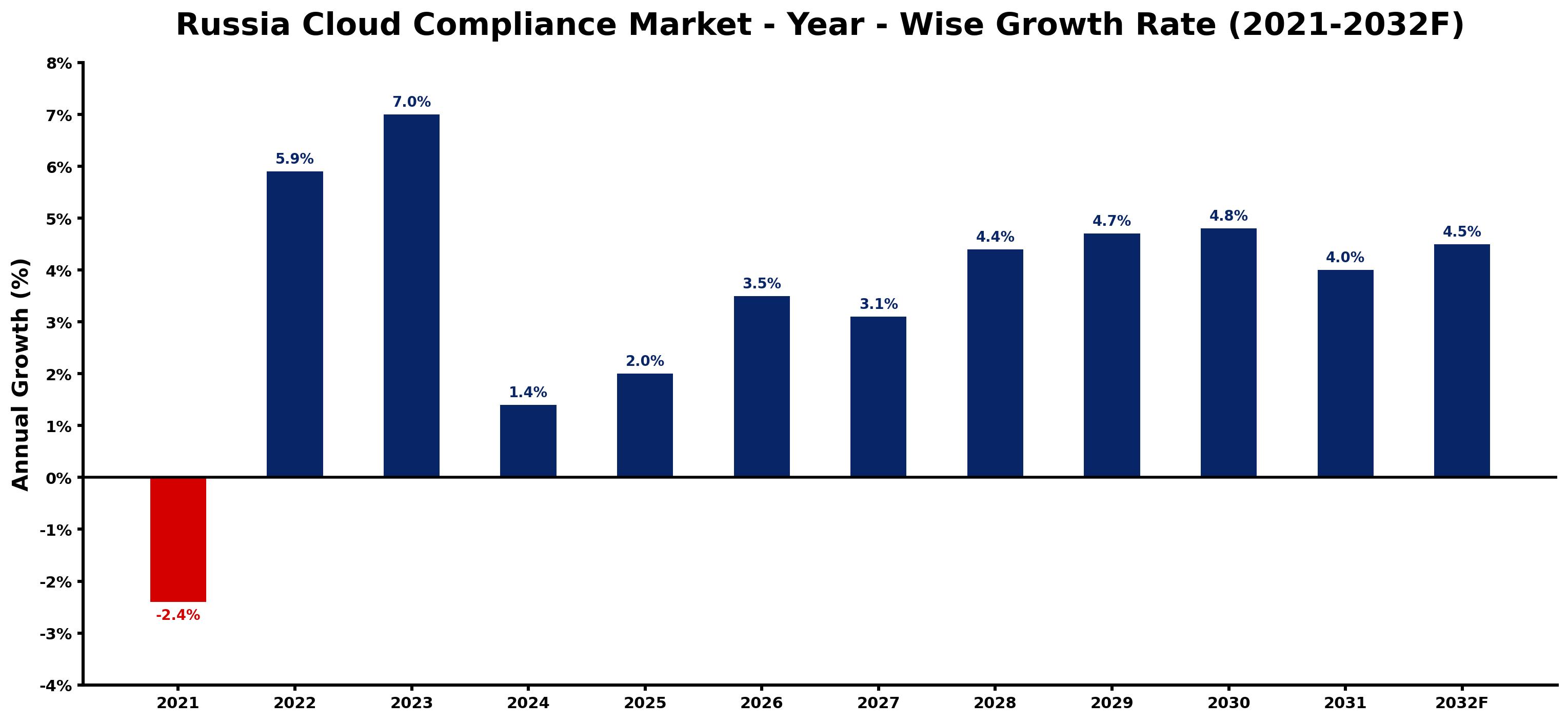
The table below presents the year‑wise growth rates along with the key drivers influencing the market
| Year | Growth Rate | Major Drivers |
| 2021 | -2.4% | Federal Service for Technical and Export Control restrictions imposed |
| 2022 | 5.9% | Russia's personal data localization law enforcement intensifies. |
| 2023 | 7.0% | Increase in government audits for cloud compliance adherence. |
| 2024 | 1.4% | Corporate shift towards hybrid cloud models for data control. |
| 2025 | 2.0% | Growing adoption of cloud solutions in state-owned enterprises. |
| 2026 | 3.5% | Local tech startups enhancing compliance software capabilities. |
| 2027 | 3.1% | National cybersecurity strategy initiatives boost cloud security standards. |
| 2028 | 4.4% | Rise in regulatory demands for transparency in data handling. |
| 2029 | 4.7% | Adoption of international compliance standards accelerates cloud solutions. |
| 2030 | 4.8% | Strengthened collaboration between government and private tech sectors. |
| 2031 | 4.0% | Emergence of cloud compliance training programs for businesses. |
| 2032 | 4.5% | Increased awareness of data sovereignty influences cloud strategy. |
Note: Market size estimations and growth projections presented in this report are based on 6Wresearch's proprietary forecasting methodology, utilizing the latest available industry data, government publications, and primary research inputs.
Russia Cloud Compliance Market Key Takeaways
Below are some of the specific key takeaways from the market, including:
- The shift towards cloud compliance solutions is driven by regulatory requirements and data security needs.
- Data localization laws are influencing cloud service adoption, compelling providers to align with local regulations.
- Companies are investing in advanced compliance technologies, including encryption and access controls.
- The trend towards remote work is increasing the demand for secure cloud-based collaboration tools.
- Investment opportunities are emerging as businesses seek to enhance their compliance capabilities.
Evaluation of Restraints in Russia Cloud Compliance Market
The Russia Cloud Compliance Market faces several restraints that impact its growth trajectory. Regulatory complexities due to stringent data protection laws pose significant challenges for businesses. These laws often mandate that sensitive data be stored within Russia, complicating cross-border cloud service delivery.
on top of that, the absence of standardized compliance frameworks creates confusion for companies striving to meet varied regional regulations. With the rapidly changing landscape of data privacy laws, businesses must continuously adapt to new compliance requirements, which can hinder their operational efficiency.
Russia Cloud Compliance Market Trends
A notable trend in the Russia Cloud Compliance Market is the increasing emphasis on data protection and privacy regulations. The implementation of the Russia data localization law has driven organizations to seek cloud solutions that adhere to these strict requirements, minimizing the risk of penalties.
on top of that, businesses are gravitating towards cloud services that provide transparent data handling practices and robust encryption technologies. As digital transformation accelerates, ensuring compliance with local laws remains a top priority for companies operating in the region.
Russia Cloud Compliance Market Opportunities
Investment opportunities in the Russia Cloud Compliance Market are ripe as more organizations embrace cloud technology. The demand for compliance solutions is on the rise, driven by heightened concerns over data security and privacy.
Investing in companies that specialize in cloud compliance services, such as data encryption, secure storage, and regulatory monitoring, can yield substantial returns. The Russian government's stringent data protection laws further bolster the demand for compliance solutions, creating a fertile ground for innovative providers in this sector.
Government Initiatives in the Russia Cloud Compliance Market
The Russian government has taken a proactive approach to shaping the Cloud Compliance Market through stringent regulations and public policy initiatives. With a focus on data sovereignty and enhanced cybersecurity, these policies are critical for organizations looking to operate within legal parameters while ensuring data protection.
- A regulatory framework implemented in 2023 mandates that personal data of Russian citizens be stored within national borders.
- Current initiatives include a public-private partnership aimed at enhancing cybersecurity measures across cloud services.
- Ongoing discussions focus on developing standardized compliance frameworks to simplify adherence to regional laws.
- A planned government campaign is set to launch in 2026 to promote awareness of data protection compliance best practices among businesses.
Future Insights of the Russia Cloud Compliance Market
Looking ahead to 2026-2032, the Russia Cloud Compliance Market is expected to experience substantial growth as businesses prioritize data security and compliance. The ongoing implementation of strict data protection regulations will compel organizations to seek compliant cloud solutions, driving demand for innovative technologies.
As the digital transformation continues, both domestic and international providers will compete for market share by offering cutting-edge compliance solutions. The evolving regulatory landscape will ensure that compliance remains a central focus, shaping the future of cloud services in Russia.
Russia Cloud Compliance Market Latest Developments
In the past 12-14 months, the Russia Cloud Compliance Market has witnessed a surge in activity as businesses scramble to comply with evolving regulations. Providers are stepping up their offerings to meet the rising demand for secure cloud services that align with legal requirements.
- A major technology vendor announced the rollout of an advanced encryption service in late 2025, enhancing data protection capabilities for clients.
- An initiative that began in early 2025 is currently underway, focusing on developing a regulatory monitoring tool for cloud compliance.
- By mid-2026, a new partnership between a leading cloud provider and a cybersecurity firm is expected to launch, aimed at boosting data security for enterprises.
- A planned expansion of a regional cloud service infrastructure is set to commence in Q4 2026, addressing local compliance needs.
Russia Cloud Compliance Market - Key Attractiveness of the Report
- 10 Years of Market Numbers
- Historical Data Starting from 2022 to 2025
- Base Year: 2025
- Forecast Data until 2032
- Key Performance Indicators Impacting the Market
- Major Upcoming Developments and Projects
Key Highlights of the Report:
- Russia Cloud Compliance Market Outlook
- Market Size of Russia Cloud Compliance Market, 2025
- Forecast of Russia Cloud Compliance Market, 2032
- Historical Data and Forecast of Russia Cloud Compliance Revenues & Volume for the Period 2022-2032F
- Russia Cloud Compliance Market Trend Evolution
- Russia Cloud Compliance Market Drivers and Challenges
- Russia Cloud Compliance Price Trends
- Russia Cloud Compliance Porter's Five Forces
- Russia Cloud Compliance Industry Life Cycle
- Historical Data and Forecast of Russia Cloud Compliance Market Revenues & Volume By Component for the Period 2022-2032F
- Historical Data and Forecast of Russia Cloud Compliance Market Revenues & Volume By Software for the Period 2022-2032F
- Historical Data and Forecast of Russia Cloud Compliance Market Revenues & Volume By Services for the Period 2022-2032F
- Historical Data and Forecast of Russia Cloud Compliance Market Revenues & Volume By Cloud Model for the Period 2022-2032F
- Historical Data and Forecast of Russia Cloud Compliance Market Revenues & Volume By Infrastructure-as-a-Service (IaaS) for the Period 2022-2032F
- Historical Data and Forecast of Russia Cloud Compliance Market Revenues & Volume By Platform-as-a-Service (PaaS) for the Period 2022-2032F
- Historical Data and Forecast of Russia Cloud Compliance Market Revenues & Volume By Software-as-a-Service (SaaS) for the Period 2022-2032F
- Historical Data and Forecast of Russia Cloud Compliance Market Revenues & Volume By Application for the Period 2022-2032F
- Historical Data and Forecast of Russia Cloud Compliance Market Revenues & Volume By Audit and Compliance Management for the Period 2022-2032F
- Historical Data and Forecast of Russia Cloud Compliance Market Revenues & Volume By Threat Detection and Remediation for the Period 2022-2032F
- Historical Data and Forecast of Russia Cloud Compliance Market Revenues & Volume By Activity Monitoring and Analytics for the Period 2022-2032F
- Historical Data and Forecast of Russia Cloud Compliance Market Revenues & Volume By Visibility and Risk Assessment for the Period 2022-2032F
- Historical Data and Forecast of Russia Cloud Compliance Market Revenues & Volume By Other Applications for the Period 2022-2032F
- Historical Data and Forecast of Russia Cloud Compliance Market Revenues & Volume By Organization Size for the Period 2022-2032F
- Historical Data and Forecast of Russia Cloud Compliance Market Revenues & Volume By Large Enterprises for the Period 2022-2032F
- Historical Data and Forecast of Russia Cloud Compliance Market Revenues & Volume By Small and Medium-sized Enterprises (SMEs) for the Period 2022-2032F
- Historical Data and Forecast of Russia Cloud Compliance Market Revenues & Volume By Vertical for the Period 2022-2032F
- Historical Data and Forecast of Russia Cloud Compliance Market Revenues & Volume By Banking, Financial Services, and Insurance (BFSI) for the Period 2022-2032F
- Historical Data and Forecast of Russia Cloud Compliance Market Revenues & Volume By Government for the Period 2022-2032F
- Historical Data and Forecast of Russia Cloud Compliance Market Revenues & Volume By Healthcare for the Period 2022-2032F
- Historical Data and Forecast of Russia Cloud Compliance Market Revenues & Volume By IT and ITeS for the Period 2022-2032F
- Historical Data and Forecast of Russia Cloud Compliance Market Revenues & Volume By Retail and eCommerce for the Period 2022-2032F
- Historical Data and Forecast of Russia Cloud Compliance Market Revenues & Volume By Manufacturing for the Period 2022-2032F
- Russia Cloud Compliance Import Export Trade Statistics
- Market Opportunity Assessment By Component
- Market Opportunity Assessment By Cloud Model
- Market Opportunity Assessment By Application
- Market Opportunity Assessment By Organization Size
- Market Opportunity Assessment By Vertical
- Russia Cloud Compliance Top Companies Market Share
- Russia Cloud Compliance Competitive Benchmarking By Technical and Operational Parameters
- Russia Cloud Compliance Company Profiles
- Russia Cloud Compliance Key Strategic Recommendations






































