Russia Cloud ERP Market Size & Growth Rate (2026-2032)
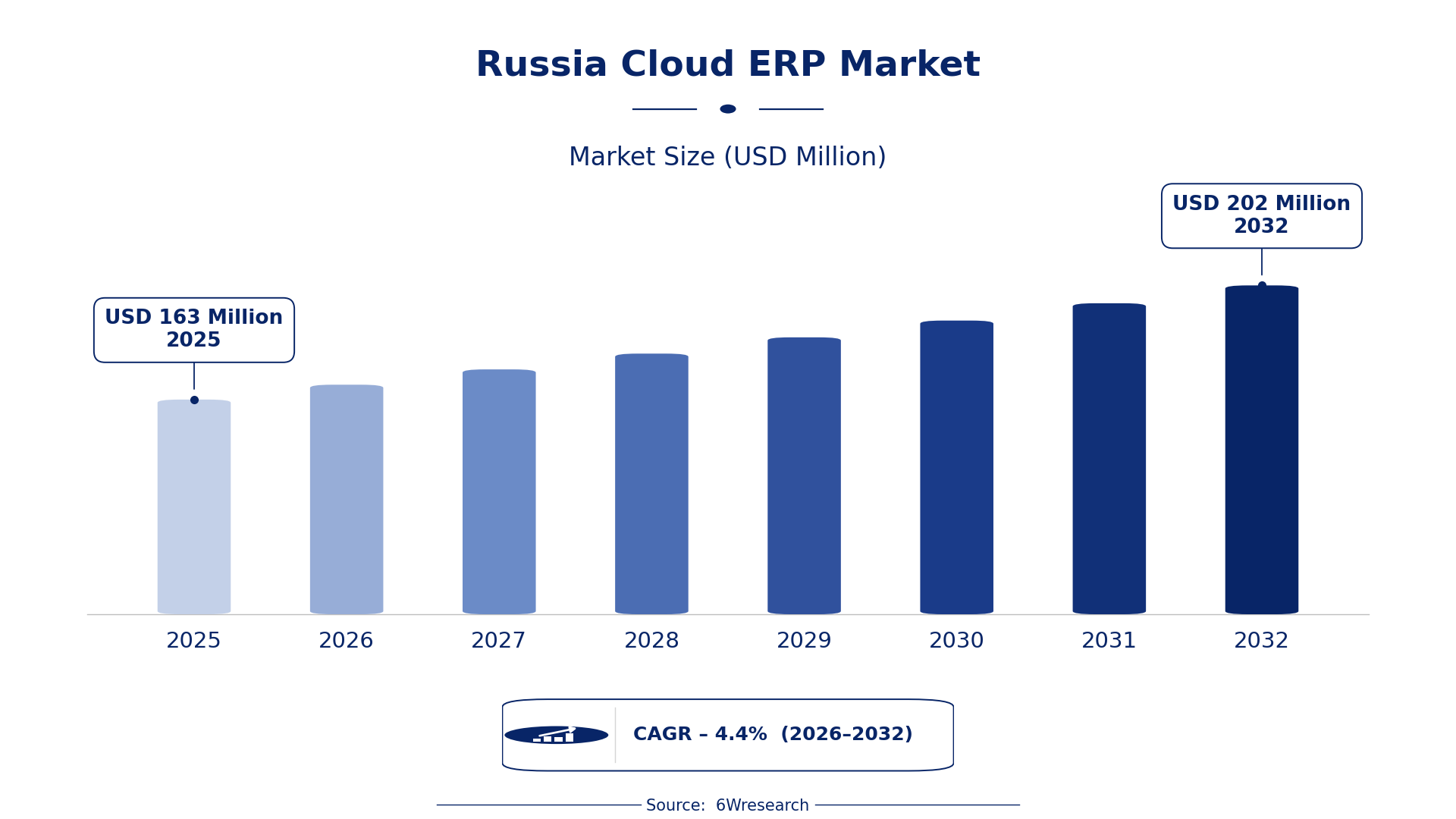
The Russia Cloud ERP Market was estimated at USD 163 Million in 2025 and is projected to reach USD 202 Million by 2032, growing at a CAGR of 4.4% from 2026 to 2032.
Russia Cloud ERP Market Synopsis
The primary force shaping the Russia Cloud ERP market is the rapid digital transformation initiatives across various industries. Businesses are increasingly recognizing the need for efficient, scalable management tools to enhance operational efficiency and decision-making.
With a growing emphasis on integrated cloud solutions, companies are migrating from traditional systems. This shift not only addresses the rising demand for flexibility and real-time data but also aligns with government-backed digitalization strategies aimed at fostering innovation.
Russia Cloud ERP Market Year-wise Growth Rate and Key Drivers
This graph illustrates the annual growth rates of the Russia Cloud ERP Market from 2021 to 2032, highlighting a steady upward trajectory and projected expansion over the forecast period.
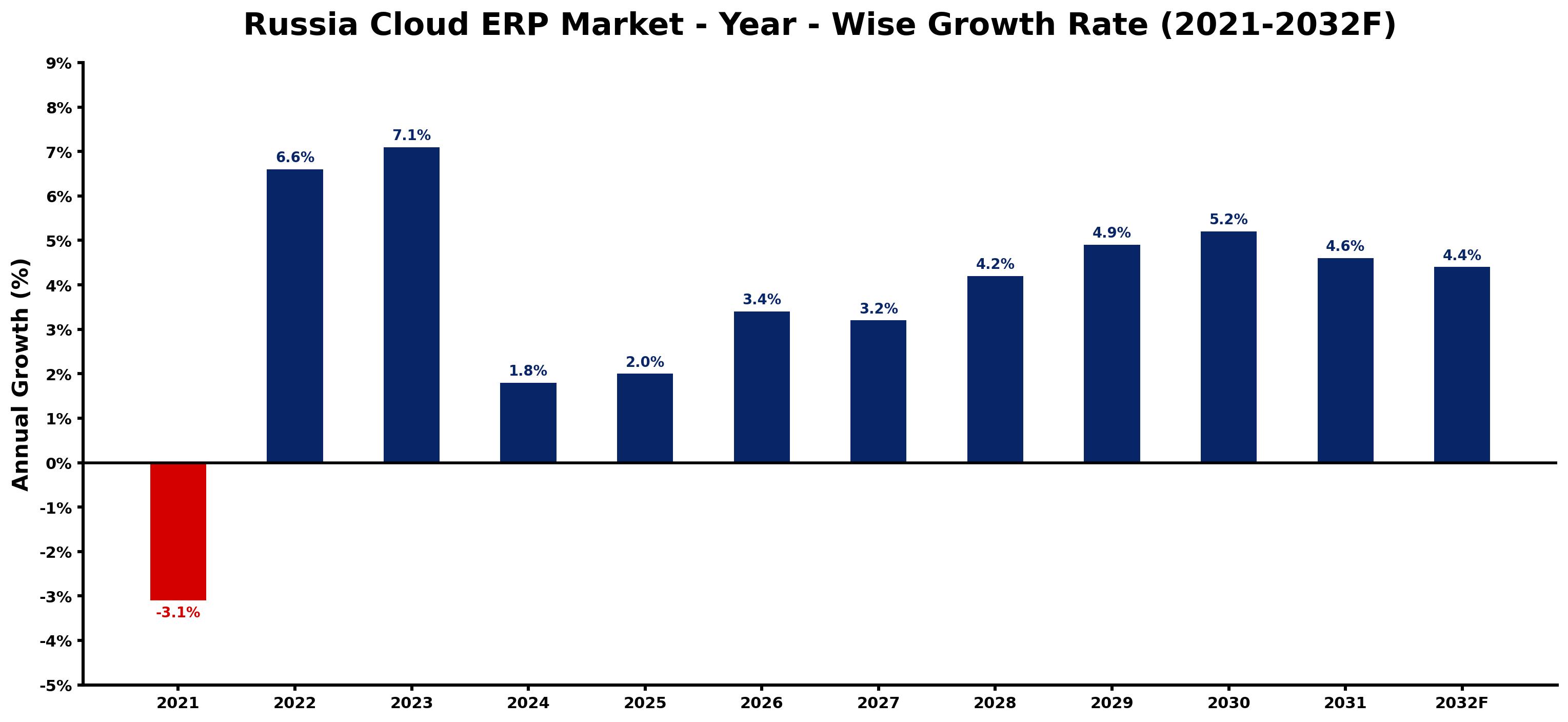
The table below presents the year‑wise growth rates along with the key drivers influencing the market
| Year | Growth Rate | Major Drivers |
| 2021 | -3.1% | Ruble depreciation impacting software licensing costs |
| 2022 | 6.6% | Adoption of digital transformation by Russian businesses |
| 2023 | 7.1% | Increased demand for remote workforce management solutions |
| 2024 | 1.8% | Local tech firms enhancing ERP customization capabilities |
| 2025 | 2.0% | Government support for cloud technology initiatives |
| 2026 | 3.4% | Rise in small-to-medium business cloud adoption |
| 2027 | 3.2% | Regulatory changes favoring cloud data residency |
| 2028 | 4.2% | Emerging AI innovations improving ERP functionalities |
| 2029 | 4.9% | Growing focus on cybersecurity in cloud ERP systems |
| 2030 | 5.2% | Shift towards subscription-based software models in Russia |
| 2031 | 4.6% | Investment in local data centers boosting cloud reliability |
| 2032 | 4.4% | Enhanced mobile access driving ERP usage among users |
Note: Market size estimations and growth projections presented in this report are based on 6Wresearch's proprietary forecasting methodology, utilizing the latest available industry data, government publications, and primary research inputs.
Russia Cloud ERP Market Key Takeaways
Below are some of the specific key takeaways from the market, including:
- The market is transitioning towards integrated platforms that combine ERP with CRM, BI, and HR functionalities.
- Data security and regulatory compliance are major concerns affecting adoption rates among businesses.
- Investment in cloud infrastructure by the government is bolstering market growth and innovation.
- AI and machine learning features are becoming essential components of modern Cloud ERP solutions.
- Industry-specific solutions are gaining traction as businesses seek tailored cloud ERP offerings.
Evaluation of Restraints in Russia Cloud ERP Market
Despite the promising growth trajectory, the Russia Cloud ERP market faces significant hurdles. Data localization laws create complexity for providers and hinder seamless integration. The shortage of skilled IT professionals in cloud ERP implementation further limits growth potential. Additionally, economic sanctions and political instability introduce uncertainty, compelling organizations to proceed cautiously with cloud adoption. Without addressing these challenges, many companies may struggle to realize the full benefits of cloud ERP systems.
Russia Cloud ERP Market Trends
A notable trend in the Russia Cloud ERP market is the rising demand for integrated systems that offer scalability and real-time insights. This shift is driven by businesses seeking to enhance operational efficiency while reducing IT costs. on top of that, the integration of AI and machine learning is transforming ERP functionalities, allowing for predictive analytics and tailored insights that cater to individual business needs.
As more companies transition from on-premise systems to cloud-based solutions, the emphasis on mobile accessibility and user-friendly interfaces continues to grow. This trend reflects a broader push towards digital transformation, where businesses prioritize agility and responsiveness in their operations.
Russia Cloud ERP Market Opportunities
Investment opportunities abound in the Russia Cloud ERP market as organizations strive for digitalization. Companies that offer localized support and industry-specific solutions are well-positioned to capture market share. Additionally, focusing on innovative features, such as mobile capabilities and AI-driven insights, can differentiate providers in this competitive environment. As the demand for cloud ERP solutions escalates, early investments in these areas could yield substantial returns.
Government Initiatives in the Russia Cloud ERP Market
The Russian government's initiatives are pivotal in shaping the Cloud ERP market, emphasizing data security and digital transformation. Recent policies have reinforced data localization requirements, compelling companies to adapt their cloud strategies accordingly. With a focus on enhancing competitiveness through technological advancements, government support plays a crucial role in market dynamics.
- A national digital infrastructure upgrade program launched in early 2023 aims to improve cloud accessibility for businesses across various sectors.
- Currently underway is a review of cybersecurity regulations that will strengthen data protection standards for cloud ERP solutions.
- A planned public-private initiative is set to commence in late 2026, focusing on funding and resources for IT modernization, including cloud ERP systems.
- Recently completed, a framework mandating transparency in data handling was introduced in 2025, impacting all cloud service providers.
Future Insights of the Russia Cloud ERP Market
Looking ahead to 2026-2032, the Russia Cloud ERP market is expected to expand as businesses increasingly prioritize cloud solutions for operational efficiency. The awareness of cost-effectiveness, coupled with the need for scalable systems, will drive adoption rates. Continued technological advancements and the growing acceptance of cloud platforms will provide ample opportunities for providers to innovate and capture market share.
Russia Cloud ERP Market Latest Developments
Recent activity in the Russia Cloud ERP market reflects a strong shift toward innovation and integration. Over the past year, businesses have accelerated their digital transformation journeys, with many seeking out comprehensive cloud solutions. This trend highlights the urgency for companies to adapt to modern demands and enhance operational capabilities.
- A major technology vendor launched a new AI-driven analytics module for its cloud ERP solution in early 2025, aimed at providing businesses with deeper insights.
- An initiative began in mid-2025 focusing on developing user-friendly interfaces for cloud ERP systems to enhance accessibility for non-technical users.
- In Q4 2025, a partnership was established between regional cloud providers to improve data security features across various ERP platforms.
- Upcoming in 2026, a rollout of advanced mobile applications for cloud ERP users is expected to enhance remote accessibility and real-time updates.
Russia Cloud ERP Market - Key Attractiveness of the Report
- 10 Years of Market Numbers
- Historical Data Starting from 2022 to 2025
- Base Year: 2025
- Forecast Data until 2032
- Key Performance Indicators Impacting the Market
- Major Upcoming Developments and Projects
Key Highlights of the Report:
- Russia Cloud ERP Market Outlook
- Market Size of Russia Cloud ERP Market, 2025
- Forecast of Russia Cloud ERP Market, 2032
- Historical Data and Forecast of Russia Cloud ERP Revenues & Volume for the Period 2022-2032F
- Russia Cloud ERP Market Trend Evolution
- Russia Cloud ERP Market Drivers and Challenges
- Russia Cloud ERP Price Trends
- Russia Cloud ERP Porter's Five Forces
- Russia Cloud ERP Industry Life Cycle
- Historical Data and Forecast of Russia Cloud ERP Market Revenues & Volume By Component for the Period 2022-2032F
- Historical Data and Forecast of Russia Cloud ERP Market Revenues & Volume By Solution for the Period 2022-2032F
- Historical Data and Forecast of Russia Cloud ERP Market Revenues & Volume By Services for the Period 2022-2032F
- Historical Data and Forecast of Russia Cloud ERP Market Revenues & Volume By Vertical for the Period 2022-2032F
- Historical Data and Forecast of Russia Cloud ERP Market Revenues & Volume By BFSI for the Period 2022-2032F
- Historical Data and Forecast of Russia Cloud ERP Market Revenues & Volume By Manufacturing for the Period 2022-2032F
- Historical Data and Forecast of Russia Cloud ERP Market Revenues & Volume By IT and Telecom for the Period 2022-2032F
- Historical Data and Forecast of Russia Cloud ERP Market Revenues & Volume By Business Function for the Period 2022-2032F
- Historical Data and Forecast of Russia Cloud ERP Market Revenues & Volume By Accounting and Finance for the Period 2022-2032F
- Historical Data and Forecast of Russia Cloud ERP Market Revenues & Volume By Sales and Marketing for the Period 2022-2032F
- Historical Data and Forecast of Russia Cloud ERP Market Revenues & Volume By Inventory and Order Management for the Period 2022-2032F
- Historical Data and Forecast of Russia Cloud ERP Market Revenues & Volume By Organization Size for the Period 2022-2032F
- Historical Data and Forecast of Russia Cloud ERP Market Revenues & Volume By SMEs for the Period 2022-2032F
- Historical Data and Forecast of Russia Cloud ERP Market Revenues & Volume By Large Enterprises for the Period 2022-2032F
- Russia Cloud ERP Import Export Trade Statistics
- Market Opportunity Assessment By Component
- Market Opportunity Assessment By Vertical
- Market Opportunity Assessment By Business Function
- Market Opportunity Assessment By Organization Size
- Russia Cloud ERP Top Companies Market Share
- Russia Cloud ERP Competitive Benchmarking By Technical and Operational Parameters
- Russia Cloud ERP Company Profiles
- Russia Cloud ERP Key Strategic Recommendations






































