Russia Community Cloud Market Size & Growth Rate (2026-2032)
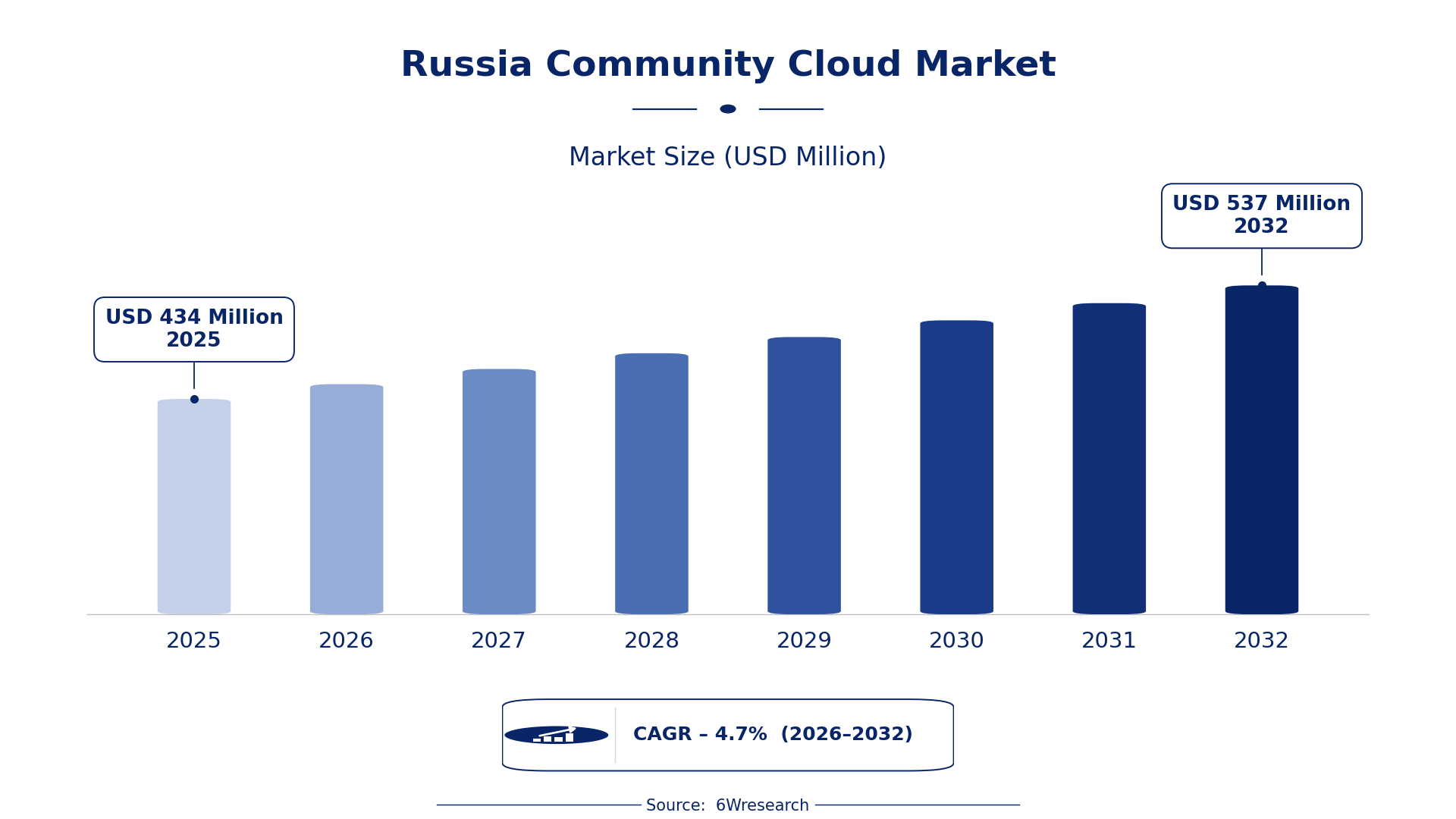
The Russia Community Cloud Market was estimated at USD 434 Million in 2025 and is projected to reach USD 537 Million by 2032, growing at a CAGR of 4.7% from 2026 to 2032.
Russia Community Cloud Market Synopsis
The demand for community cloud solutions in Russia is growing as organizations prioritize data security and compliance with local regulations. This shift is particularly evident in industries such as healthcare and finance, where specialized cloud services are becoming essential to meet stringent regulatory requirements.
With the rapid digitization of various sectors, businesses and government entities are increasingly turning to community cloud infrastructures that allow for shared resources while ensuring data sovereignty. This trend is being fueled by initiatives aimed at enhancing digital capabilities across the region.
Russia Community Cloud Market Year-wise Growth Rate and Key Drivers
This graph illustrates the annual growth rates of the Russia Community Cloud Market from 2021 to 2032, highlighting a steady upward trajectory and projected expansion over the forecast period.
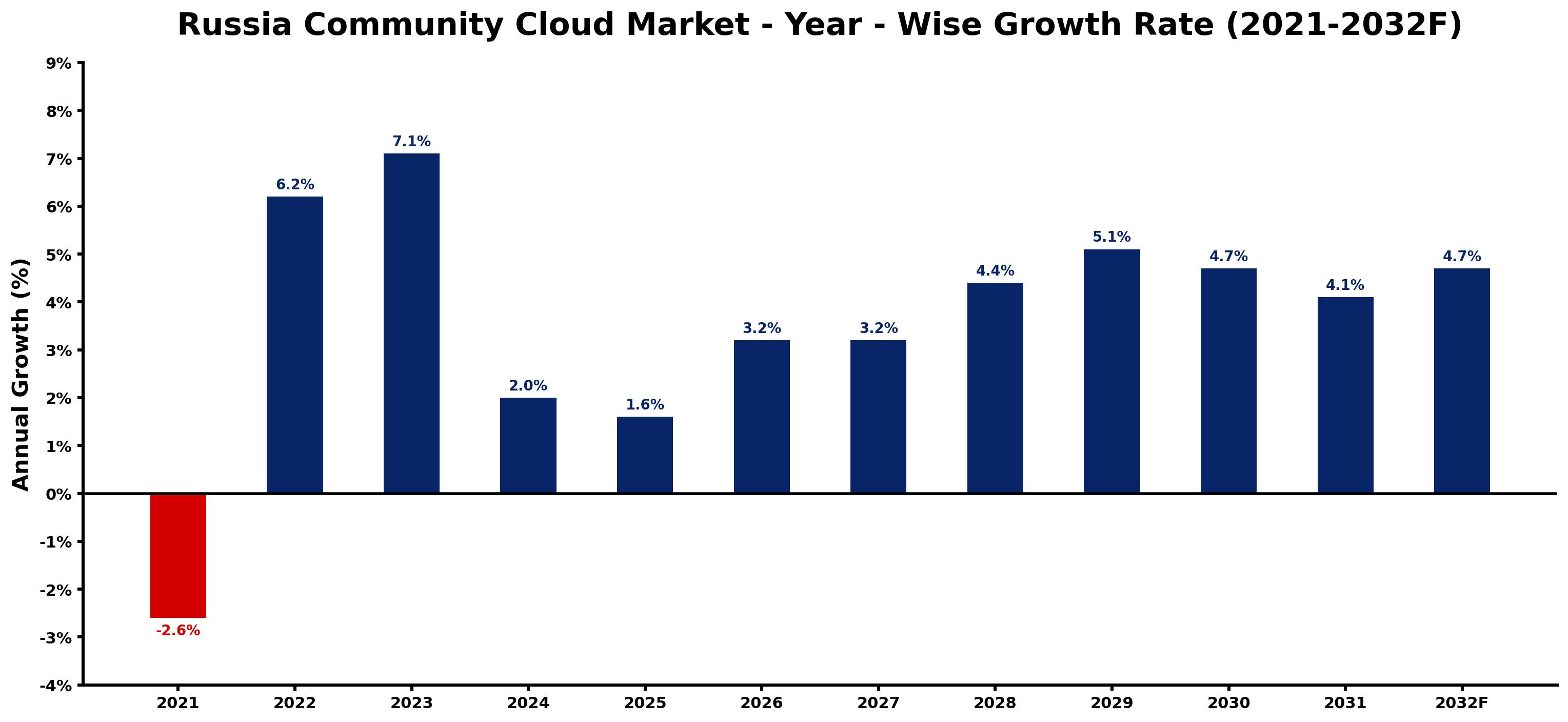
The table below presents the year‑wise growth rates along with the key drivers influencing the market
| Year | Growth Rate | Major Drivers |
| 2021 | -2.6% | Regulatory limitations from Roskomnadzor on data storage. |
| 2022 | 6.2% | Government initiative supporting local cloud service providers |
| 2023 | 7.1% | Increased demand for data sovereignty among businesses |
| 2024 | 2.0% | Migration to cloud for government service efficiency |
| 2025 | 1.6% | Rising interest in hybrid cloud solutions in enterprises |
| 2026 | 3.2% | Growing adoption of digital transformation in SMEs |
| 2027 | 3.2% | Local startups leveraging community cloud for innovation |
| 2028 | 4.4% | Strengthened cybersecurity laws boosting cloud usage |
| 2029 | 5.1% | Enhanced broadband access in rural areas fueling demand |
| 2030 | 4.7% | Corporate shifts towards sustainable IT practices |
| 2031 | 4.1% | Remote work trends driving cloud collaboration tools |
| 2032 | 4.7% | Supportive regulatory environment for tech startups |
Note: Market size estimations and growth projections presented in this report are based on 6Wresearch's proprietary forecasting methodology, utilizing the latest available industry data, government publications, and primary research inputs.
Russia Community Cloud Market Key Takeaways
Below are some of the specific key takeaways from the market, including:
- Growing emphasis on data security and compliance is driving community cloud adoption.
- Healthcare and financial services are leading sectors in the uptake of community cloud solutions.
- Partnerships between cloud providers and local data centers are becoming more common.
- Government policies are both promoting and regulating the community cloud market.
- Demand for cost-effective IT solutions continues to rise, further supporting market growth.
Evaluation of Restraints in Russia Community Cloud Market
The Russia Community Cloud Market is constrained by data localization laws mandating that personal data be stored within the country's borders. This requirement can lead to increased operational costs for cloud service providers, limiting their ability to offer diverse solutions. Additionally, concerns around compliance with stringent data protection regulations add layers of complexity for organizations considering cloud adoption. A lack of awareness regarding the benefits of community cloud models among businesses further hampers market growth.
Russia Community Cloud Market Trends
One notable trend is the increasing adoption of hybrid cloud solutions that combine on-premises infrastructure with community cloud services. This approach allows organizations to maintain sensitive data locally while leveraging the benefits of cloud computing. on top of that, the demand for industry-specific cloud solutions is rising, as sectors like healthcare and finance seek tailored offerings that comply with local regulations.
Innovations in security technologies, such as advanced encryption and AI-driven monitoring, are also shaping the community cloud market. These advancements are designed to address concerns regarding data breaches and compliance failures, thereby enhancing the attractiveness of cloud solutions for organizations in Russia.
Russia Community Cloud Market Opportunities
Opportunities in the Russia Community Cloud Market are abundant, particularly in the formation of strategic partnerships between cloud service providers and local data centers. These collaborations can ensure compliance with data localization requirements while expanding the range of services offered. on top of that, there is potential for developing specialized cloud solutions that cater to the needs of various industries, enhancing data security and regulatory compliance.
As organizations increasingly prioritize digital transformation, investing in community cloud solutions can provide a competitive edge. The emphasis on data privacy and security will likely drive further interest in compliant cloud infrastructures that align with local laws.
Government Initiatives in the Russia Community Cloud Market
The Russian government plays a critical role in shaping the Community Cloud Market through various regulations and initiatives aimed at promoting cloud adoption. By implementing data localization laws, the government is encouraging the establishment of domestic cloud services that meet local compliance standards. Public-sector priorities are increasingly focused on utilizing cloud technologies to enhance operational efficiency and security.
- A national digital infrastructure upgrade programme has recently been launched to bolster cloud capabilities in the public sector.
- Currently underway is an initiative to develop a regulatory framework that ensures data protection while promoting cloud service adoption.
- Upcoming plans include a public-private partnership expected to facilitate the growth of local cloud service providers.
- A regulatory action introduced in 2025 mandates that all personal data of Russian citizens must be stored within the country.
- The government is actively working to improve cloud service efficiency across public sector organizations.
Future Insights of the Russia Community Cloud Market
Looking ahead to 2026-2032, the Russia Community Cloud Market is set for steady growth. As organizations increasingly seek secure and localized solutions, demand for community cloud offerings tailored to specific industries will rise. The government's push for digital transformation and compliance with local regulations will further propel market expansion. Key players are expected to enhance their service portfolios by collaborating with local data centers, ensuring that they meet the evolving needs of Russian businesses and public institutions.
Russia Community Cloud Market Latest Developments
In recent months, the Russia Community Cloud Market has seen various developments reflecting the dynamic nature of the sector. Increased collaboration between cloud service providers and local entities has been observed, aimed at addressing the growing demand for compliant solutions. The focus on data security and regulatory adherence continues to influence market strategies.
- A major technology vendor announced a partnership in early 2025 to launch a cloud service designed specifically for the healthcare sector.
- An initiative focused on enhancing data protection measures began in Q1 2025 and remains ongoing.
- A rollout of new community cloud offerings tailored for the financial services sector is planned for mid-2026.
- A regional operator recently upgraded its infrastructure to improve compliance with local data localization laws, completed by late 2025.
- A public sector cloud initiative is expected to kick off in late 2026, aimed at improving efficiency across government agencies.
Russia Community Cloud Market - Key Attractiveness of the Report
- 10 Years of Market Numbers
- Historical Data Starting from 2022 to 2025
- Base Year: 2025
- Forecast Data until 2032
- Key Performance Indicators Impacting the Market
- Major Upcoming Developments and Projects
Key Highlights of the Report:
- Russia Community Cloud Market Outlook
- Market Size of Russia Community Cloud Market, 2025
- Forecast of Russia Community Cloud Market, 2032
- Historical Data and Forecast of Russia Community Cloud Revenues & Volume for the Period 2022-2032F
- Russia Community Cloud Market Trend Evolution
- Russia Community Cloud Market Drivers and Challenges
- Russia Community Cloud Price Trends
- Russia Community Cloud Porter's Five Forces
- Russia Community Cloud Industry Life Cycle
- Historical Data and Forecast of Russia Community Cloud Market Revenues & Volume By Components for the Period 2022-2032F
- Historical Data and Forecast of Russia Community Cloud Market Revenues & Volume By Server for the Period 2022-2032F
- Historical Data and Forecast of Russia Community Cloud Market Revenues & Volume By Storage Devices for the Period 2022-2032F
- Historical Data and Forecast of Russia Community Cloud Market Revenues & Volume By Network Equipments for the Period 2022-2032F
- Historical Data and Forecast of Russia Community Cloud Market Revenues & Volume By Verticals for the Period 2022-2032F
- Historical Data and Forecast of Russia Community Cloud Market Revenues & Volume By Healthcare for the Period 2022-2032F
- Historical Data and Forecast of Russia Community Cloud Market Revenues & Volume By Finance for the Period 2022-2032F
- Historical Data and Forecast of Russia Community Cloud Market Revenues & Volume By Government for the Period 2022-2032F
- Historical Data and Forecast of Russia Community Cloud Market Revenues & Volume By Transport and Logistics for the Period 2022-2032F
- Historical Data and Forecast of Russia Community Cloud Market Revenues & Volume By Gaming for the Period 2022-2032F
- Historical Data and Forecast of Russia Community Cloud Market Revenues & Volume By Education for the Period 2022-2032F
- Russia Community Cloud Import Export Trade Statistics
- Market Opportunity Assessment By Components
- Market Opportunity Assessment By Verticals
- Russia Community Cloud Top Companies Market Share
- Russia Community Cloud Competitive Benchmarking By Technical and Operational Parameters
- Russia Community Cloud Company Profiles
- Russia Community Cloud Key Strategic Recommendations






































